Forget everything you know about Christmas markets. In Australia, December means 30-degree days, the smell of sunscreen instead of woodsmoke, and Santa arriving by surfboard. The Christmas markets in Australia’s summer are not failed imitations of the European originals — they are a joyful reinvention: twilight night markets under fairy lights and palm trees, carols sung on beaches at sunset, and a festive season that runs on cold seafood, pavlova, and warm ocean breezes instead of mulled wine and frostbite.
This is the southern hemisphere’s great Christmas paradox, and it is wonderful. This guide covers how Christmas markets work in an Australian summer, the best markets and events in Sydney, Melbourne, Brisbane, Adelaide, and Perth, the legendary Carols by Candlelight tradition, how to do a beach Christmas properly, what to pack, and what Australians actually eat on December 25. If you are choosing between hemispheres this December, our best places to spend Christmas guide lays out the snowy alternatives — but nothing cures northern winter fatigue like Christmas in shorts.
What “Christmas Markets in Australia” Actually Means
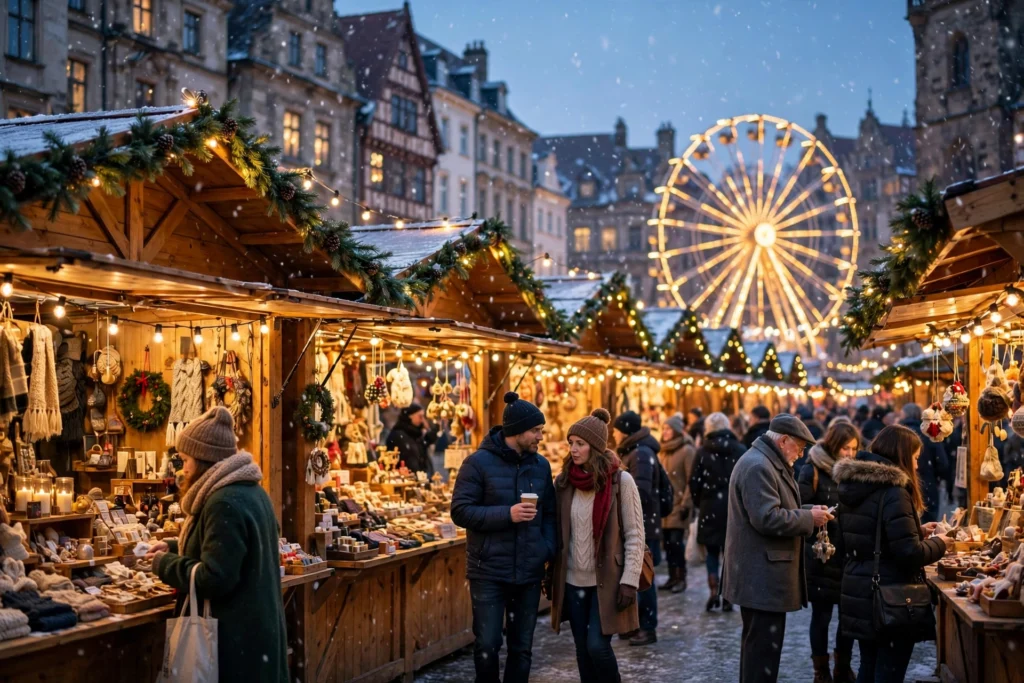
Australian Christmas markets are evening and twilight events, not the all-day winter affairs of Europe. The formula: arrive as the heat of the day fades (markets typically run late afternoon into the night), browse artisan stalls strung with fairy lights, eat from food trucks and hawker-style vendors, and stay for live music or carols as the warm night settles in. The big-city markets run through December, often as special Christmas editions of the regular weekend markets rather than standalone month-long installations.
The other defining feature: Carols. The Carols by Candlelight tradition — thousands of people gathered in parks and on beaches at night, singing Christmas songs by candlelight under the stars — is Australia’s signature Christmas event, and it dwarfs the markets in cultural importance. A proper Australian Christmas trip combines both: markets for shopping and grazing, carols for the soul.
And then there is the Australian Christmas Bush — a native plant that turns brilliant red in December, used as a living Christmas decoration — and the image of Santa ditching his fur coat for board shorts. It sounds like a joke until you are eating prawns on a beach on December 25 and it feels like the most natural thing in the world.
Sydney: Harbour Lights & Summer Night Markets
Sydney does Christmas with its harbor as the backdrop, and the city’s festive season is built for outdoor evenings:
- The Rocks Christmas markets — Sydney’s historic quarter hosts weekend Christmas markets through December, with artisan stalls, buskers, and the sandstone laneways dressed in lights. The most atmospheric market shopping in the city.
- Martin Place Christmas tree — Sydney’s official tree, Australia’s tallest, with the nightly Martin Place lights and projections. The city’s commercial heart goes full festive.
- Carols in the Domain — Australia’s largest free Christmas concert, held in the Domain parklands in mid-December, drawing tens of thousands with picnic blankets. The headline carols event of Sydney’s season.
- Bondi Beach Christmas — the famous beach hosts Christmas Day crowds (backpackers especially) and December surf carnivals. Swimming on Christmas morning is a Sydney rite of passage.
- Darling Harbour & Circular Quay — fireworks, light installations, and harborside dining through the season; the New Year’s Eve fireworks are the global icons, but December’s buildup is lovely.
Sydney’s Christmas weather is the selling point: typically 22–28°C, warm enough for the beach, cool enough in the evenings for the markets to feel festive. Book harbor-view restaurants early — December is peak season.
Melbourne: Laneways, Windows & the Great Carols Night
Melbourne — Australia’s culture capital — does Christmas with characteristic style:
- Christmas Festival at Federation Square — the city’s Christmas hub through December: markets, the giant tree, light shows, and family programming.
- Myer Christmas windows — the department store’s animated Christmas windows on Bourke Street Mall are a Melbourne institution, drawing queues of families. A tradition since the 1950s.
- Queen Victoria Market Christmas nights — the historic market’s summer night market series gets a Christmas edition: street food, bars, live music, and late-night shopping under string lights.
- Vision Australia’s Carols by Candlelight — the big one. Held on Christmas Eve (December 24) at the Sidney Myer Music Bowl, this is Australia’s most famous Christmas event: a star-studded concert supporting children who are blind or have low vision, broadcast live on Channel 9. The 2026 edition is the 89th — a national institution. Gates open from 4:00 PM; tickets sell out, with a rehearsal night on December 23 as backup.
Melbourne’s December weather is the wildcard — “four seasons in one day” is the local saying. Pack for 15°C and 30°C in the same week. The laneway bars and rooftop cinemas make even the cooler evenings delightful.
Brisbane, Adelaide & Perth: The Rest of the Map
- Brisbane — Queensland’s capital is at its best in December: warm, subtropical, and festive. The Christmas in Brisbane program fills King George Square and the city center with markets, the city tree, and light projections on City Hall. South Bank’s parklands host Christmas events with the river as backdrop. Day-trip to the Gold Coast or Sunshine Coast for the full beach-Christmas combo.
- Adelaide — South Australia’s capital punches above its weight: the Adelaide Christmas Pageant (a beloved November parade tradition), Christmas markets in the historic Adelaide Showground and city squares, and the St John Carols by Candlelight at Elder Park on December 12 — gates from 3:00 PM, main concert 8:30 PM, fireworks finale at 10:30 PM. The Barossa and McLaren Vale wine regions add festive cellar-door events.
- Perth — Western Australia’s capital offers the most reliably hot Christmas in the country (often 30°C+). The city’s Christmas Lights Trail winds through the CBD, Elizabeth Quay hosts festive events on the Swan River, and the beaches (Cottesloe, Scarborough) are the real venue. Rottnest Island’s quokkas in Santa hats are a social media inevitability.
- Canberra, Hobart, Darwin — the smaller capitals run charming local markets and carols; Hobart’s waterfront Christmas has a lovely maritime flavor, and Darwin’s tropical Christmas (30°C+, monsoon build-up) is the most extreme version of the summer Christmas.
Carols by Candlelight: Australia’s Great Christmas Tradition
If Europe has the Christmas market, Australia has Carols by Candlelight — and understanding it is key to understanding Australian Christmas. The tradition began in Melbourne in 1938 and has spread to every corner of the country: on a December evening, thousands gather in a park, on a beach, or by a lake, each holding a candle (these days often LED), and sing Christmas carols together under the summer stars.
The flagship is Vision Australia’s Carols by Candlelight at Melbourne’s Sidney Myer Music Bowl on Christmas Eve — 89 years old in 2026, broadcast live nationally, raising vital funds for children who are blind or have low vision. But the local carols are the heart of it: every suburb, town, and region runs its own — Manningham Carols at Ruffey Lake Park (December 11, 2026), St John Carols in Adelaide (December 12), Carols in the Domain in Sydney (mid-December), and hundreds more. Most are free or gold-coin donation, BYO picnic blanket, and open to all.
How to do carols properly: arrive early for a good spot (popular ones fill by late afternoon), bring a picnic (many allow BYO food and non-alcoholic drinks; check the rules), bring the LED candles (sold at the gate or bring your own), and learn the words to at least “O Holy Night” and “Silent Night” — the candlelit mass singalong of the latter, thousands of voices under the stars, is one of the great Christmas moments anywhere in the world. For families, it is unbeatable: free, outdoors, early-evening friendly, and genuinely moving. Our Christmas activities guide has more outdoor festive ideas in the same spirit.
The Beach Christmas Playbook
Christmas Day on an Australian beach is not a novelty — it is a legitimate tradition, especially for the young, the international, and the heat-averse. Here is how to do it right:
- Pick your beach: Bondi (Sydney) for the scene, Manly for the surf, Cottesloe (Perth) for the sunset, Noosa (Queensland) for the beauty. Arrive early — popular beaches fill by mid-morning on December 25.
- The Christmas morning swim: the ritual swim is the centerpiece. The water is warm (22–25°C in Sydney), the mood is euphoric, and the Santa hats in the surf are mandatory.
- Pack a proper esky (cooler): cold prawns, ham, salads, pavlova, cold drinks. The Australian Christmas lunch is served cold and eaten outdoors — see the food section below.
- Sun safety is serious: December UV in Australia is extreme. Shade, SPF 50+, rashies for kids, and a beach tent. Sunburn is the fastest way to ruin the day.
- Respect the rules: most Australian beaches ban alcohol and glass. Check local rules; many Christmas beachgoers do it dry or with cans.
- Evening option: if the full day is too much, do Christmas lunch traditionally and hit the beach for the late-afternoon swim and sunset — the golden hour on December 25 is spectacular.
What Australians Eat on Christmas Day
Australian Christmas food is the summer argument made edible — cold, fresh, and built for heat:
- Cold seafood platters — prawns (the Christmas prawn run is a national event; buy from the fish markets on December 23–24), Moreton Bay bugs, oysters, smoked salmon. Served cold with lemon and aioli.
- Glazed ham — served cold, often with mango or pineapple glaze. The centerpiece of the traditional table.
- Pavlova — the great Australasian debate (Australia vs. New Zealand claims it), but in Australia it is the Christmas dessert: crisp meringue, whipped cream, passionfruit, kiwi, mango, berries.
- Mango and stone fruit — December is peak mango season (Bowen/Kensington Pride). A Christmas without mangoes is barely Christmas.
- The BBQ — Christmas lunch on the barbie: sausages, steaks, marinated chicken. Increasingly common as the main event.
- Trifle and Christmas pudding — the British inheritance survives in chilled form: trifle is huge, and Christmas pudding is served with cold custard or ice cream (hot pudding in 35°C heat is a hard sell).
- Cold drinks — sparkling wine, craft beer, and the great Australian summer wines (Riesling from Clare Valley, rosé from everywhere).
At the markets, the food is summer-festival fare: hawker-style Asian food, gourmet burgers, fresh seafood stalls, gelato and ice cream (essential), tropical fruit cups, and iced everything. The mulled wine of Europe is replaced by the espresso martini and the Aperol spritz — Christmas, Australian style. For hosting your own summer Christmas back home, our Christmas dinner ideas include warm-weather menus.
When to Go & What to Pack
Timing: the Australian festive season runs through December, with the peak from mid-December to Christmas. Note that Australian school holidays start mid-December and run through January — this is the busiest and most expensive domestic travel period of the year. Book flights and accommodation early; prices spike from around December 20. Early December offers the markets and carols with thinner crowds and better prices.
Weather by city (December averages): Sydney 22–28°C, Melbourne 15–28°C (variable), Brisbane 22–30°C, Adelaide 18–30°C, Perth 20–33°C, Darwin 26–33°C (humid). Rain is possible everywhere; Melbourne is the wildcard.
Packing list: summer clothes, swimwear, reef-safe sunscreen (SPF 50+), a hat, sunglasses, a light jacket for Melbourne evenings and air-conditioned venues, comfortable walking shoes for the markets, and a picnic blanket for carols. Leave the winter coat at home — you will not need it. One concession to festivity: Australians do wear Santa hats and tinsel with their shorts, and you should too.
Budget Planner: Australia at Christmas (AUD)
December is Australia’s peak domestic travel season — prices are high, especially from December 20 onward.
| Expense | Typical range |
|---|---|
| Mid-range hotel, Sydney/Melbourne (December) | $200–400/night |
| Carols events | Mostly free; flagship Carols by Candlelight ticketed (~$30–60) |
| Christmas markets | Mostly free entry; food $10–25 per item |
| Christmas prawns (per kg, Dec 23–24) | $30–50 |
| Restaurant Christmas lunch | $100–250 per person |
| Domestic flight (booked early) | $150–350 each way |
Value moves: travel in early December, stay in apartments with kitchens (the Christmas food is better homemade anyway), do the free carols and markets rather than ticketed events, and buy seafood from the fish markets on December 23 rather than restaurants.
Sydney vs. Melbourne: Which Australian Christmas?
The two cities offer genuinely different Decembers. Here is the honest breakdown:
| Sydney | Melbourne | |
|---|---|---|
| Weather | Reliably warm (22–28°C), beach-perfect | Variable (15–30°C), “four seasons in one day” |
| Signature event | Carols in the Domain; harbor Christmas | Carols by Candlelight (Christmas Eve, 89th year) |
| Markets | The Rocks; harborside settings | Queen Vic night markets; Fed Square festival |
| Beach Christmas | The best in the country (Bondi, Manly) | Good (St Kilda), but not the point |
| Culture | Outdoor, harbor-centric, spectacular | Laneways, food scene, arts — deeper |
| New Year’s Eve | The world’s most famous fireworks | Excellent, more local in feel |
| Best for | First-timers, beach lovers, the postcard | Food lovers, culture vultures, repeat visitors |
The ideal trip does both — they are 90 minutes apart by air, with shuttle-frequency flights. Three nights in each covers the highlights, and the contrast (Sydney’s harbor dazzle vs. Melbourne’s laneway depth) is the trip’s real pleasure. If you must choose one: Sydney for the classic Australian Christmas, Melbourne for the richer cultural program.
New Year’s Eve: The Season Finale
An Australian Christmas trip that extends to New Year’s gets a second headline event. Sydney’s New Year’s Eve fireworks — the 9:00 PM family fireworks and the midnight Harbour Bridge display — are among the world’s great spectacles, watched by over a billion people globally. The harbor foreshore fills from midday; the best vantage points (Mrs Macquarie’s Point, Bradley’s Head, the Botanic Gardens) require early arrival or ticketed events that sell out months ahead.
Melbourne’s NYE centers on the City of Melbourne’s midnight fireworks from the city’s rooftops, with family-friendly 9:30 PM displays in the parks. Brisbane, Adelaide, and Perth all run harbor/river fireworks with a more local, less frantic feel — Perth’s Langley Park and Adelaide’s Elder Park events are excellent without Sydney’s crowds.
Practical note: New Year’s Eve accommodation books out across Australia, and many hotels require multi-night minimums over December 30–January 1. If NYE is part of the plan, book it first — before the Christmas arrangements. The week between Christmas and New Year is Australia’s peak beach week; the coastal towns are at their absolute best (and busiest).
Christmas Shopping, Australian Style
Australian Christmas shopping blends the markets with some distinctive local institutions. The twilight and night markets — from Sydney’s Rocks to Melbourne’s Queen Vic nights to the regional town markets — are the best source of artisan gifts: Australian-made ceramics, Indigenous art and textiles (buy from Indigenous-owned stalls and galleries for authentic provenance), native-botanical skincare, and beach-culture design.
For food gifts, the fish markets’ Christmas seafood, native ingredient hampers (macadamias, finger lime marmalade, wattleseed products, Tasmanian honey), and Australian wine (a Barossa Shiraz or Clare Valley Riesling travels well) are the definitive edible souvenirs. The Myer and David Jones Christmas windows and gift floors are institutions in themselves — even if you buy nothing, the windows are worth the pilgrimage.
Timing matters: Australian retailers run their biggest sales on Boxing Day (December 26) — the post-Christmas sales are a national event, with city centers packed from dawn. If your trip extends past Christmas, the Boxing Day sales are worth experiencing once. For gift ideas to pair with Australian finds, browse our Christmas gifts for travelers and stocking stuffers for adults.
Frequently Asked Questions
Are there Christmas markets in Australia?
Yes — every major city runs Christmas markets through December, but they are summer twilight/night markets rather than European-style winter markets. Expect artisan stalls, food vendors, live music, and fairy lights in warm evening weather. The Rocks markets (Sydney), Queen Victoria Market nights (Melbourne), and the city-square markets in Brisbane, Adelaide, and Perth are the highlights.
What is Carols by Candlelight?
Australia’s signature Christmas tradition: thousands gather in parks and on beaches on December evenings to sing carols together by candlelight. The flagship is Vision Australia’s Carols by Candlelight at Melbourne’s Sidney Myer Music Bowl on Christmas Eve (the 89th edition in 2026), broadcast live on Channel 9. Hundreds of free local carols events run across the country through December.
Is it hot on Christmas Day in Australia?
Usually warm to hot: expect 25–35°C in most cities, with Perth and Darwin the hottest. Melbourne is the variable one (15–30°C). Christmas is a summer holiday — beach swims, cold seafood, and outdoor lunches are the norm.
What do Australians eat for Christmas dinner?
Cold seafood (especially prawns), glazed ham served cold, pavlova with summer fruit, mango, trifle, and BBQ. The traditional hot roast has largely given way to cold and outdoor-friendly food. Christmas lunch is the main meal, typically eaten outdoors.
When should I book an Australian Christmas trip?
As early as possible — December is Australia’s peak domestic travel season (school holidays start mid-December). Flights and hotels for December 20–January 5 book out months ahead and prices spike. Early December offers the full festive program with better availability and prices. As a rule of thumb, book international flights 4–6 months out and accommodation 3–4 months out for the Christmas–New Year window.
Can I do a beach Christmas and see the markets too?
Absolutely — that is the ideal Australian Christmas trip. Mornings at the beach, late afternoons at the markets, evenings at carols. Sydney and Perth do this combination best, with world-class beaches minutes from the city-center festivities.
Christmas in Australia will recalibrate your idea of what the holiday can be. No snow, no mulled wine, no winter coats — instead, fairy lights in palm trees, carols under southern stars, mangoes for dessert, and the ocean on December 25. It is not a lesser Christmas. For a week in December, it might just be the better one. And when you are back home next year, shivering through a grey northern December, you will close your eyes and hear ten thousand voices singing “Silent Night” on a warm beach — and start checking flights.