There is a particular vulnerability in writing vows for your husband at a renewal ceremony. The first time, you were making promises to a future you could only imagine. This time, you know exactly who he is — the 6 a.m. alarm snoozer, the dad-joke dispenser, the man who shows love by fixing things rather than saying things. You know what the years cost and what they built. Writing romantic vow renewal vows for your husband means speaking to the real man, not the wedding-day ideal, and telling him — in front of everyone, or just him — what a decade or two of loving him has taught you.
This guide is written for wives preparing renewal vows: original romantic vow examples you can use or adapt, frameworks for finding your own words, guidance on tone (tender without being saccharine, honest without oversharing), and practical advice on delivery. Every example is written fresh — no borrowed lines, no clichés recycled from greeting cards. Whether your husband melts at poetry or squirms at sentimentality, you will find an approach here that lets you say the true thing in your true voice.
What Makes Vows for a Husband Land Differently
Vows written for husbands work best when they acknowledge how most men experience love: through respect, partnership, and being truly seen. That does not mean dumbing down the romance — it means aiming it precisely. The lines that undo a husband are rarely the flowery ones. They are the specific ones: the moment you noticed, the thing he did that nobody else saw, the way he shows up.
Think about what your husband actually values. For many men, the deepest compliment is competence recognized — being told that what he does matters and that you notice. “Thank you for every 5 a.m. airport run, every assembled bookshelf, every time you listened to me vent about work and then quietly fixed the actual problem” will move him more than “you are my knight in shining armor.” The first is about him; the second is about a fantasy.
Humor is also a powerful tool in vows for husbands, used sparingly. One well-placed funny line — about his snoring, his grill obsession, his inability to find anything in the refrigerator — does two things: it gets a laugh that releases the room’s tension, and it proves the vow is about the real him. Just keep the ratio heavily weighted toward sincerity. One joke per vow is plenty; this is a love letter, not a roast.
Finally, consider his comfort with public emotion. Some husbands cry happily through the whole ceremony; others go rigid with discomfort when feelings get too exposed. You know your man. If he is the private type, consider delivering the most intimate lines quietly — voice lowered, eyes locked — so the moment feels like it is for him even with guests present. Or save the rawest paragraph for a letter he reads later, and keep the spoken vows warm but composed. Romance is about making him feel loved, not making him perform being moved.
Romantic Vow Examples for Your Husband
These original examples span tones from tender to quietly funny. Borrow lines, combine them, or use them as launching pads for your own.
“When I married you, I thought I was getting a husband. What I got was a partner, a co-conspirator, a human white-noise machine, and the only person on earth who can make me laugh when I’m furious. You have held my hand through every version of our life — the broke version, the exhausted-new-parent version, the version where we weren’t sure we’d make it. Thank you for never letting go. I vow to keep holding on, tighter every year, for the rest of our story.”
“I want to tell you what I see when I look at you now, after all these years. I see the man who learned to braid hair from YouTube at midnight. I see the man who sat in hospital chairs and parking lots and parent-teacher conferences without complaint. I see someone who shows love the way you do everything — thoroughly, quietly, without needing credit. You are the most dependable miracle I know. I choose you again, the way I’ve chosen you every morning: deliberately, gratefully, completely.”
“They say marriage is 50/50, but we’ve never done math well. Some years you carried 90 and I carried 10. Some years I carried us both. What I know is that you never kept score, never threw it in my face, never made me feel like a burden on the days I was one. That kind of grace is rare, and I married it. My vow is to spend the rest of our years trying to love you the way you’ve loved me: without keeping score.”
“Do you remember our first apartment? The futon, the hand-me-down table, the neighbor’s music through the walls? We were so young we thought love was enough, and the ridiculous thing is — it was. It still is. Everything we’ve built started with two kids who had nothing but each other and somehow that turned out to be everything. I don’t need the big house or the fancy trips. I just need you, in whatever apartment, whatever city, whatever chapter comes next.”
Vows for the Strong, Silent Type
If your husband is a man of few words, your vows can honor that rather than fight it. These examples are shorter, plainer-spoken, and built for men who distrust flowery language — every word earns its place.
“I’m not good at this part — you know that. But here goes. You’re the best decision I ever made. You’ve been steady when I was a mess, patient when I was impossible, and funny exactly when I needed it. I don’t say it enough, so I’m saying it here: thank you. I love you. I’d pick you again every time.”
“You show love by doing. So let me tell you what I’ve noticed: the car always has gas. The bills are always paid. The kids always know you’re in their corner. I notice all of it, even when I don’t say so. You’re the foundation this whole family stands on. I vow to be worthy of that — to notice, to thank, and to love you back just as steadily.”
“We’ve never been the grand-gesture couple, and I wouldn’t trade that. Our love is Tuesday nights and inside jokes and you handing me coffee exactly the way I like it without being asked. It’s not dramatic. It’s better than dramatic — it’s real. Here’s my promise: more Tuesdays. As many as we get.”
The Letter-Style Vow: Intimate and Unhurried
Some of the most moving renewal vows are structured as letters — “Dear [Name]” — because the form gives you permission to be direct and personal in a way ceremonial language sometimes blocks. Here is a complete letter-style vow you can adapt:
“Dear [Name], If I could write to the woman I was on our wedding day, I’d tell her she has no idea what she’s getting. Not the hard parts — everyone warns you about those — but the good parts nobody mentions. The way you’d learn his coffee order and then his bad-day face and then the exact sound of his laugh when something genuinely delights him. I’d tell her that the man she’s marrying will surprise her for decades, mostly by being exactly who he is, consistently, when it counts.
Here’s what I want you to know now: I have paid attention. I know the weight you carry for this family and how rarely anyone thanks you for it. So thank you — for the providing, the protecting, the fixing, the showing up. Thank you for the man you’ve become, which is somehow better than the boy I married.
I can’t promise the future will be easy. But I promise you won’t face it alone. I’ll be beside you — still laughing at your terrible jokes, still stealing the blankets, still choosing you. Always. Love, [Your Name]”
The letter form works beautifully when read aloud at the ceremony, and it doubles as a keepsake — print it on good paper afterward and frame it, or tuck it into a memory book. For more keepsake ideas, our personalized anniversary gifts guide has options that pair perfectly with written vows.
Writing Prompts: Finding Your Own Words
If you want to write from scratch, these prompts will get you there. Answer each in one or two sentences, quickly, without editing — then assemble the answers into vows using the natural arc of past, present, future.
What is the first thing you remember noticing about him? What did your friends and family think when you got together? What is the hardest thing you have been through as a couple, and what did he do during it? What is something he does every day that you have stopped noticing but should not have? When did you last feel overwhelmingly grateful to be married to him, and what triggered it? What has he taught you — about love, about life, about yourself? What do you want the next ten years to feel like, day to day? What is one specific promise you can make that is about action, not feeling?
That last question deserves emphasis. The strongest vows promise behaviors, not emotions. “I promise to always make you happy” is sweet and impossible. “I promise to ask about your day and actually listen to the answer” is humble and achievable — and paradoxically more romantic, because it is real. Go through your draft and convert every feeling-promise into a doing-promise. Your vows will get shorter, truer, and more moving.
Vows by Decade: Calibrating for Your Milestone
The emotional register of your vows should match the chapter you are in. Here is how to calibrate.
| Milestone | Dominant Theme | Tone Guidance | What to Emphasize |
|---|---|---|---|
| 5 years | Foundation | Warm, optimistic, a little playful | What you have learned; the partnership taking shape |
| 10 years | Depth | Honest, grateful, grounded | Specific hard times survived; daily devotion noticed |
| 15–20 years | Partnership | Confident, reflective | The life built together; raising a family; shared achievements |
| 25 years | Legacy | Proud, emotional, expansive | What the marriage created; example for children |
| 30+ years | Devotion | Tender, unhurried, profound | A lifetime of choosing; gratitude for the ordinary miracle |
At every milestone, the rule is the same: speak to the man in front of you, not the idea of a husband. The twenty-five-year vow that mentions his terrible golf swing and his perfect pancakes will outlive the one full of abstract devotion.
Presentation Ideas: Beyond Just Reading Aloud
How you deliver the vows can be as memorable as the words. Consider these presentation options, matched to different comfort levels.
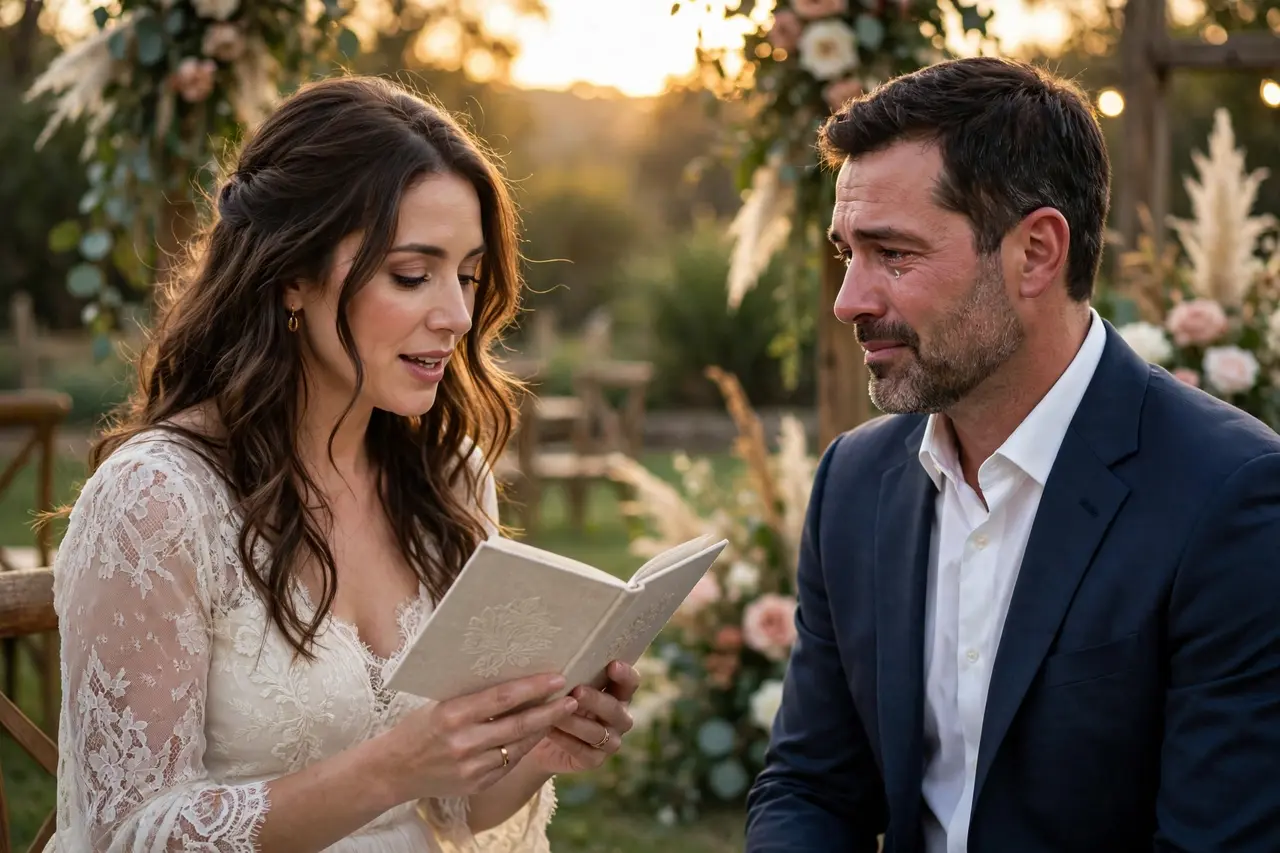
The classic reading — printed vows in a beautiful vow book or folder — remains classic for a reason. It looks intentional in photos, it gives nervous hands something to hold, and a handsome vow book becomes a keepsake. Invest in the presentation: a ten-dollar vow book from a stationery shop elevates the whole moment.
The surprise letter: seal your vows in an envelope and hand it to him at the ceremony to read silently while guests watch, then read a shorter spoken version aloud. He gets the full emotional impact privately; the audience gets the highlight reel. This is ideal for husbands who dislike being the center of emotional attention.
The video vow: record yourself reading the vows in advance — at the place you met, or somewhere meaningful — and play it during the ceremony. This works beautifully for surprise renewals and for speakers who know they will dissolve if they try to read live. It also creates an instant keepsake film.
The keepsake edition: after the ceremony, have your vows professionally printed or calligraphed and framed alongside a photo from the day. Couples consistently name this their favorite post-ceremony purchase. Pair it with a meaningful gift using ideas from our anniversary gifts for him guide, or plan a romantic follow-up with our surprise anniversary ideas for husbands.
The Anatomy of a Husband-Melting Line: A Technique Breakdown
What actually makes a vow line hit a husband right in the chest? It is not poetry — it is technique. Understanding the mechanics lets you write lines that land even if you have never written anything more romantic than a grocery list. Here are the five techniques that do the heavy lifting, with examples of each in action.
Technique one: the specific observation. General compliments slide off; specific observations stick. “You’re a great dad” is nice. “I watched you spend forty-five minutes helping our son with math you hate, and you never once looked at your phone” is devastating. The technique is simple: recall one concrete moment that proves the compliment, and state the moment instead of the compliment. The conclusion draws itself in his mind, which makes it more powerful than if you had stated it.
Technique two: the reframe. Take something ordinary or even mildly annoying about him and reveal it as the thing you love most. His stubbornness becomes his steadfastness. His terrible jokes become the soundtrack of your marriage. His inability to sit still becomes the energy that has dragged your family on a hundred adventures. The reframe works because it tells him he is loved as he actually is, not as an idealized version. Every husband carries a quiet fear that he is merely tolerated; the reframe answers it directly.
Technique three: the witness statement. Tell him what you have seen him do when he thought no one was watching — the kindness to a stranger, the patience with an aging parent, the 2 a.m. worry he thought he hid. “I saw you” is one of the most intimate sentences in any language. It tells him his quiet virtues are not invisible, that the best parts of him have an audience of one who noticed everything.
Technique four: the time collapse. Connect the past and present in a single line: the boy you married and the man he became, held in the same sentence. “You still get the same look when you’re excited about something — I fell in love with that look at twenty-three and I’m still falling for it now.” Time collapse works because it honors both continuity and growth; it says the marriage did not replace the romance, it deepened it.
Technique five: the plain vow. After the beautiful observations, land the promise in the simplest possible language. “I’ll be here.” “I’m not going anywhere.” “You’ve got me.” Husbands distrust ornate promises; plain ones feel like bedrock. The contrast between the lyrical buildup and the plain landing is what makes the landing hit — it sounds like truth because it sounds unadorned.
Combine two or three techniques in a single vow and you have something no greeting card could produce: specific, reframed, witnessed, time-collapsed, and sealed with a plain promise. That is the anatomy. The rest is just your details.
What Not to Say: The Husband-Vow Don’ts
Knowing what to avoid is as important as knowing what to include. These are the traps that sink otherwise good vows for husbands.
Do not backhand-compliment. “I vow to love you despite your flaws” sounds romantic in your head and insulting out loud. If you want to acknowledge imperfection, reframe it as loved-as-is (technique two above) rather than loved-despite. The distinction matters enormously to the person hearing it.
Do not make promises about his behavior. Vows are about what you will do, not what he should do. “I vow that you’ll finally learn to put the seat down” is a joke for the guests at his expense; “I vow to stop keeping score about the seat” is a vow. Keep every promise pointed at yourself.
Do not compare — not to other husbands, not to your father, not to his past self in a way that diminishes who he is now. “You’ve come so far from the boy I married” can sound like the boy was not enough. Prefer “you’ve become even more yourself,” which honors growth without implying deficiency.
Do not overshare intimate struggles. The renewal ceremony is not the venue for “we almost divorced in 2019.” A brief, graceful nod to hard times survived is powerful; specifics about betrayals, separations, or counseling belong in private conversations, not in vows delivered before an audience. Protect the dignity of the story while honoring its truth.
Finally, do not apologize for emotion or for length within reason. “Sorry, I’ll wrap this up” undercuts your own vows mid-delivery. You have earned these two minutes. Take them.
Watch: A Real Vow Renewal Celebration
Sometimes the best preparation is watching a real couple do it. This vow renewal film follows a couple celebrating ten years of marriage, renewing their promises surrounded by love. Notice the genuine emotion, the unscripted moments, and the way the whole room leans in when the vows get personal. Let it inspire you — your vows do not need to be perfect, they need to be his.
Frequently Asked Questions
How long should vows for my husband be?
Two to three minutes spoken (250–350 words) is the sweet spot for most ceremonies. If he dislikes public emotion, lean shorter — ninety seconds of true words beats four minutes that make him squirm. Match your partner’s length roughly; agree on a target in advance so neither vow dwarfs the other.
Should my vows be funny or serious?
Most memorable vows are serious with one or two funny lines, not the reverse. Humor releases tension and proves authenticity, but the emotional core should be sincere. If your relationship’s love language is laughter, you can push the ratio further — just make sure the final line lands on genuine feeling, not a punchline.
What if I am not a good writer?
Good vows are not about writing skill; they are about specificity and honesty. List real memories, real gratitudes, and real promises, then arrange them in past-present-future order. Plain language beats purple prose every time. “Thank you for learning to braid hair from YouTube at midnight” will move him more than any metaphor.
Is it okay to cry while reading my vows?
Yes — it is expected and endearing. Print your vows in large type so tears do not make them unreadable, mark pause points in the text, and have water nearby. If you think you may be unable to finish, give a copy to your officiant or maid of honor as backup. The emotion is the point; the backup plan just lets you surrender to it.
Should I memorize my vows or read them?
Read them. Memorization adds pressure and risks a mid-ceremony blank; reading from a beautiful vow book looks intentional and ensures you say exactly what you meant to say. Glance up at him at the emotional peaks — those moments of eye contact matter more than whether your eyes are on the page the rest of the time.
Can I include our children in vows written for my husband?
Absolutely — thanking him for the father he is often produces the most emotional moment of the ceremony. Keep it to a few lines within your vows rather than a separate section, unless you are doing a dedicated family vow exchange. Speak to what you have witnessed: his patience, his silliness, the way the kids light up when he walks in.
What should I avoid in renewal vows for a husband?
Avoid airing grievances, even wrapped in humor — “I vow to stop nagging you about…” turns the ceremony into a comedy roast of your marriage. Avoid comparing him to other husbands or to your father. Avoid promises you cannot keep. And avoid inside jokes that exclude the audience entirely; one private reference is charming, five is alienating.
When should I start writing?
Start three to four weeks out with the prompts in this guide, produce a draft two weeks out, and finalize one week before. Read the final version aloud three times. Last-minute vows written the night before are almost always either too long or too generic — the good stuff needs time to surface and be shaped.
The Truest Thing You Know
Your husband does not need poetry. He needs to hear, in your voice, that you see him — the real him, the daily him, the man behind the roles — and that after all these years, you would choose him again. Say that truly, specifically, and out loud, and the vows will take care of themselves.
Write them this week. Read them aloud until they sound like you. Then stand in front of him and say the truest thing you know. That is the whole assignment, and it is more than enough. Years from now he will not remember the exact sentences, but he will remember that you stood up, looked him in the eye, and chose him again — deliberately, gratefully, out loud, in front of everyone who matters. And that memory will outlast every gift, every party, every photograph. It will be the story you tell.