
Pricing Psychology: 15 Tactics That Sell More (2026)
Pricing psychology is the science of how customers perceive prices — and it reliably moves revenue without changing your product or costs. The same $50 service presented differently can feel like a bargain or a ripoff; the difference is framing, and framing is free. Small businesses that understand these principles sell more at better margins than competitors with identical offerings but naive pricing.
The tactics below are drawn from behavioral economics research (Kahneman, Tversky, Ariely and decades of follow-ups) and retail practice. Each includes the mechanism, the application, and the ethical boundary — because manipulation backfires: tactics that trick customers into regretted purchases generate refunds, bad reviews, and lost trust. Use psychology to help customers choose confidently, not to deceive them.
Below: 15 tactics organized by mechanism, implementation guide, and the ethics framework.
Why This Matters for Your Business
Price perception drives purchase decisions more than price reality: customers do not evaluate prices in absolute terms — they compare, anchor, and feel their way to decisions using mental shortcuts. Understanding these shortcuts lets you present prices in ways that feel fair and attractive while protecting your margins. It is the highest-leverage pricing work: no cost changes, no product changes, just presentation.
The ethical dimension is the strategic one: tactics used to clarify value and reduce decision friction build trust and loyalty; tactics used to obscure or manipulate destroy it. This guide draws the line clearly — every tactic includes its honest application, because sustainable businesses are built on customers who feel good about paying, not tricked into it.
Step-by-Step Guide
Master charm pricing and price endings
The classics: charm prices ($19.99, $47 — the left-digit effect makes $19.99 feel closer to $19 than $20), prestige pricing (round numbers — $500, $2,000 — for luxury/premium positioning where decimals cheapen), and tiered endings (.99 for value, .95/.97 for deals, round for premium). Application: match endings to positioning — discount lines get charm prices, premium lines get round numbers. Mixed signals (luxury service at $47.99) confuse positioning.
Use anchoring deliberately
The first price seen becomes the reference: show the premium option first (makes mid-tier feel reasonable), display ‘was $X’ genuinely (only real reference prices — fake anchors are deceptive and illegal in many jurisdictions), and bundle-anchor (total value $500, today $299 — itemized value builds the anchor honestly). Anchoring is the most powerful pricing tactic — the initial reference shapes every subsequent judgment. Use real anchors; fabricated ones are fraud.
Deploy the decoy effect (asymmetric dominance)
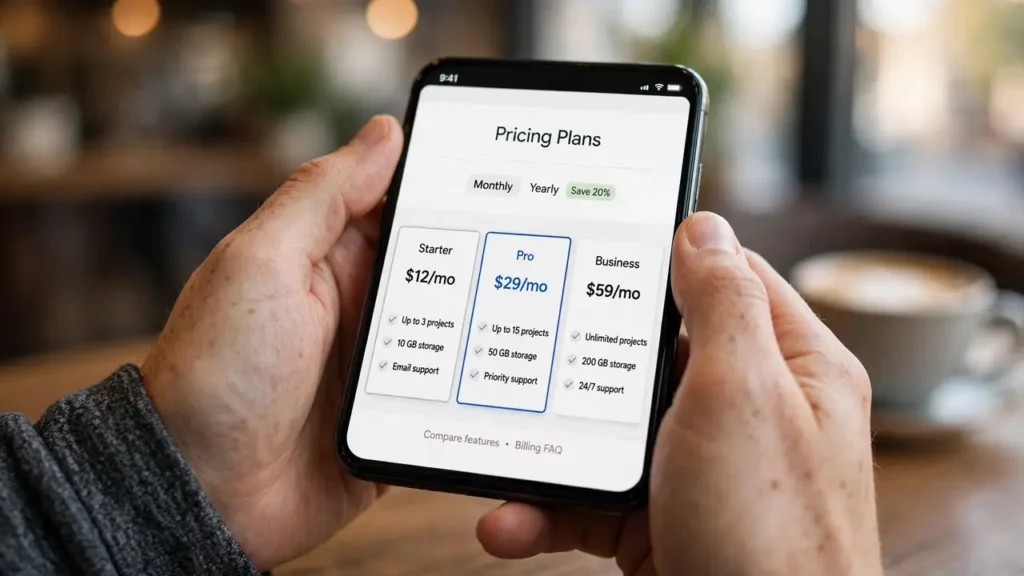
Three-tier pricing where the middle option is engineered to win: small ($29, basic), medium ($49, most features — the target), large ($59, marginally more than medium). The large tier’s proximity makes medium feel like the smart choice — most buyers choose middle. Structure honestly: each tier must be a genuine offering (decoy tiers that exist only to manipulate breed distrust when discovered). Good-better-best is the ethical decoy.
Leverage social proof and scarcity honestly
Social proof (‘2,000+ happy customers,’ ‘most popular’ badges — real data only), scarcity (genuine limited availability — ‘3 spots left this month’ when true; fake countdown timers are manipulation), and urgency (real deadlines — enrollment closes Friday; artificial evergreen urgency erodes trust when discovered). The rule: every scarcity/urgency claim must be TRUE and verifiable. Honest scarcity converts; fabricated scarcity, once exposed, converts customers into ex-customers.
Reframe with partitioning and reframing
Price partitioning: break into components ($29/month vs $348/year — monthly feels smaller; show per-day cost: ‘$1/day’ reframes dramatically). Reframing: compare to alternatives (‘less than your daily coffee’), emphasize gains over payments (‘get X’ not ‘pay Y’), and lead with value before price (establish worth, then reveal cost — the price lands differently after value is clear). Partitioning clarifies; it must never obscure the total (drip pricing — hiding fees until checkout — is deceptive and increasingly illegal).
Test, measure, and stay ethical
A/B test systematically: one variable at a time (price point, ending, anchor, tier structure), measure conversion AND revenue per visitor (higher conversion at lower prices can reduce total revenue), and segment results (new vs returning customers respond differently). The ethics checklist for every tactic: would I be comfortable if customers knew exactly what I was doing? Is the claim true? Does it help them decide or trick them? Tactics passing all three build businesses; tactics failing any one eventually cost more than they earn.
Recommended Tools and Resources
Charm pricing ($X.99) — Free
The left-digit effect: $49.99 feels meaningfully less than $50. Apply to value/discount positioning; avoid for luxury (decimals cheapen premium). The most replicated finding in pricing research — use it where it fits, skip it where it clashes.
Good-better-best tiers — Free
The ethical decoy: three options, middle engineered as the smart choice, each genuinely valuable. Lifts average order value while giving customers comfortable choice. The structure behind most successful service pricing.
Honest anchoring — Free
Real reference prices, premium-first presentation, itemized bundle value. The most powerful perception-shaper — wielded with genuine anchors only. Fake ‘was’ prices are illegal in many places and fatal to trust everywhere.
Per-day reframing — Free
‘$1/day’ transforms $30/month psychologically. Compare-to-coffee framing anchors against trivial spending. Reframing clarifies affordability honestly — as long as the total is never hidden (no drip pricing).
Real social proof — Free
Actual customer counts, genuine ‘most popular’ badges, real testimonials near prices. Proof reduces perceived risk at the decision moment. Fabricated proof is fraud; authentic proof is your best closer.
A/B testing discipline — Free-$50/mo
One variable at a time, revenue-per-visitor as the metric, segmented analysis. The scientific layer separating effective psychology from superstition — test everything, assume nothing, keep what the data validates.
At a Glance: Comparison Table
| Tactic | Mechanism | Use It When | Ethical Line |
|---|---|---|---|
| Charm pricing ($X.99) | Left-digit effect | Value positioning | Fine; skip for luxury |
| Prestige (round numbers) | Quality association | Premium positioning | Fine |
| Anchoring | Reference dependence | Tiered offers | Anchors must be real |
| Decoy / good-better-best | Asymmetric dominance | Multiple tiers | All tiers genuine |
| Social proof | Herd behavior | Near prices | Real data only |
| Scarcity/urgency | Loss aversion | Real limits | Must be true |
| Partitioning ($/day) | Mental accounting | Subscriptions | Never hide totals |
| Free trials/guarantees | Risk reversal | Considered purchases | Honor them fully |
Putting It Into Practice
Start smaller than you think you should. Pick the single step from the guide above that would relieve the most pressure right now, and execute just that one this week. Momentum beats perfection: one completed improvement teaches you more about your business than five half-started initiatives, and each small win funds the confidence for the next one.
Document everything as you go. When you complete each step, write down what you did, what it cost, and what changed — a simple running log in a notebook or document. Six months from now this log becomes your playbook, your training manual for new hires, and your evidence of progress. Owners who document build businesses that run without them; owners who keep it all in their heads build jobs they cannot leave.
Measure one number that reflects Pricing Psychology Tips working well, and check it weekly. It does not need to be sophisticated — revenue collected on time, hours saved, error rates, customer feedback scores. What gets measured gets managed, and a single visible metric will guide dozens of small decisions better than any amount of gut feeling. Review the number every Monday morning and let it set the week’s priorities.
Get a second pair of eyes before you finalize anything important. That might be your accountant, a mentor, a fellow owner, or a paid professional for an hour of review — the cost is trivial compared to the cost of a preventable mistake. Every successful owner has a small circle of advisors they consult before big moves; build yours deliberately, starting with one relationship this month.
The biggest mistake owners make with Pricing Psychology Tips is treating it as a one-time project instead of an ongoing discipline. Block ninety minutes this week to work through the steps above in order, and put a recurring monthly appointment on your calendar to revisit them. Businesses that review Pricing Psychology Tips on a schedule improve steadily; businesses that address it only in emergencies pay the emergency premium every time.
Budgeting and ROI for Pricing Psychology Tips
The DIY-versus-hire decision comes down to three questions: do you have the skill, do you have the time, and what does your hour earn elsewhere? Tasks that are learnable, infrequent, and low-risk are good DIY candidates; tasks that are technical, recurring, or high-consequence usually pay for professional help many times over. Be honest about which category each step falls into rather than defaulting to whichever feels cheaper today.
Build a simple return-on-investment check into your plan: define what success looks like in numbers before you spend the first dollar. That might be hours saved monthly, revenue protected, penalties avoided, or customers gained. Write the target down, measure against it quarterly, and double down on what works while cutting what does not. Owners who track ROI make calmer, better decisions than owners who spend on hope.
Keep a contingency buffer of ten to fifteen percent above your estimated budget for Pricing Psychology Tips. Surprises are not a matter of if but when — a filing fee you missed, a tool that needs the paid tier, a professional who spots something you did not. The buffer turns surprises into footnotes instead of crises, and whatever you do not spend becomes next quarter’s head start.
Budget for Pricing Psychology Tips as an investment with a return, not as an expense to minimize. Add up the realistic costs from the options above — including your own time valued honestly — and compare that against the cost of inaction: the revenue lost, the penalties risked, or the hours wasted by doing nothing. In almost every case the math favors acting deliberately now over reacting expensively later.
Common Mistakes to Avoid
- Fake anchors: ‘Was $200!’ when it never sold at $200 — deceptive, often illegal, and trust-fatal when discovered. Anchors must be real historical prices or genuine comparable values.
- Fabricated scarcity: Evergreen countdown timers resetting on refresh, ‘only 3 left!’ with full warehouses. Customers discover the lie; the discovery costs more than the tactic ever earned.
- Drip pricing: Hiding fees until checkout: the $49 offer that becomes $79 with ‘fees.’ Increasingly illegal, universally resented — disclose the total early, always.
- Manipulation over clarity: Tactics designed to confuse rather than help decide: decoy tiers with no genuine value, dark patterns, pressure tricks. Short-term conversion, long-term brand damage — the math never works.
- Never testing: Applying tactics on faith without measuring: some ‘proven’ tactics fail in specific contexts. A/B discipline separates effective psychology from cargo-cult pricing — test, measure, keep winners.
A Real-World Walkthrough
Maya started with the foundation steps: getting the paperwork right, choosing the right tools, and setting up the accounts and systems the guide recommended. Nothing fancy — just the unglamorous basics, done properly, in the right order. Within three weeks the chaos subsided; within two months she realized she was spending roughly six fewer hours a month on Pricing Psychology Tips than before, and the quality of the outcomes had visibly improved.
The turning point came at her quarterly review, when Maya compared the numbers before and after. The investment — a few hundred dollars in tools and one focused weekend — had returned itself several times over in saved time, avoided penalties, and one retained client who specifically mentioned how professional the process felt. She now reviews the system for thirty minutes each quarter, and Pricing Psychology Tips has gone from a source of dread to a quiet competitive advantage.
Maya’s story is unremarkable, and that is the point. There was no brilliant insight and no expensive consultant — just a good guide, a blocked calendar, and the discipline to follow through. The businesses that pull ahead are rarely the ones with the cleverest strategies; they are the ones that execute the fundamentals consistently while competitors keep postponing them.
Picture a typical owner — let us call her Maya — running a growing service business with twelve employees. For two years she handled Pricing Psychology Tips reactively, squeezing it between client work and wondering why it always felt chaotic. When a preventable mistake cost her a client and a penalty in the same month, she finally blocked two full days to work through a guide like this one step by step.
Expert Tips for Pricing Psychology Tips
- Start a dedicated folder — digital or physical — for everything related to Pricing Psychology Tips. Scattered documents are where deductions get missed, deadlines get blown, and audits get painful. One folder, everything in it, from today forward.
- Take the cheapest credible option first, then upgrade when volume justifies it. Most owners overbuy tools and services for problems they do not yet have at a scale they have not reached.
- Ask vendors and providers for the small-business discount, the annual-billing discount, and the ‘is there anything better you can do’ question. The worst answer is no, and the savings compound across every subscription you carry.
- Write down your process the first time you do it, while the steps are fresh. The second time will be twice as fast, and the document becomes training material the moment you delegate.
- Set phone reminders for every deadline in this guide, with a one-week advance warning. Deadlines missed by a day cost the same as deadlines missed by a month — the reminder is free insurance.
- Join one community of owners dealing with the same topics — a local chamber, an industry group, or even a focused online forum. The collective experience will save you from mistakes you did not know existed.
- Review your bank and card statements line by line once a quarter. You will always find at least one subscription you forgot, one fee you can dispute, and one spending pattern worth changing.
- Teach what you learn to someone on your team, even briefly. Teaching forces clarity, and a team that understands the why makes fewer expensive mistakes than a team just following orders.
- Keep a ‘lessons learned’ note and add one line every time something in this area surprises you. In a year you will have a personalized operations manual no consultant could have written for you.
- Benchmark yourself against one competitor or peer you respect, not against the entire internet. One realistic comparison teaches more than a hundred aspirational ones.
- Automate the repetitive parts before you delegate them. Automation is cheaper than labor and more reliable than memory — delegate only the judgment calls that remain.
- Revisit this guide in ninety days and re-score yourself on each step. Progress you can see motivates the next round of improvements more than any pep talk.
Frequently Asked Questions
What is charm pricing?
Pricing ending in .99 (or 9): $49.99 instead of $50 — the left-digit effect makes prices feel significantly lower. Most effective for value/discount positioning; counterproductive for luxury brands (where round numbers signal premium quality). One of the most replicated findings in pricing research.
Does pricing psychology really work?
Yes — decades of behavioral economics research (and retail practice) confirm that presentation shapes perception: anchoring, charm prices, decoy effects, and social proof measurably shift purchase behavior. Effects are real but modest per tactic; stacked honestly across your pricing, they compound meaningfully.
What is the decoy effect in pricing?
Adding a third option that makes your target option look best: e.g., small $29, medium $49 (target), large $59 — the large tier’s small premium over medium makes medium feel like the smart choice. Ethical version: good-better-best where every tier is genuine. Unethical: phantom tiers designed only to manipulate.
Is pricing psychology manipulative?
It depends on the tactic and honesty: clarifying value, reducing decision friction, and presenting fairly are good business; fabricating anchors, fake scarcity, hidden fees (drip pricing), and tricking customers into regretted purchases are manipulation — generating refunds, bad reviews, and regulatory risk. The test: comfortable if customers knew exactly what you are doing?
Should I use .99 prices or round numbers?
Match to positioning: .99/charm for value, deals, and mass-market (feels like a bargain); round numbers for premium, luxury, and high-trust services (feels like quality). Mixed signals confuse — a luxury consultant at $47.99 undermines the premium story the price should tell.
How do I test pricing changes?
A/B test one variable at a time (price point, ending, tier structure), measure revenue per visitor (not just conversion — cheaper can convert more but earn less), run long enough for significance, and segment by customer type. Change boldly in tests, roll out winners gradually to existing customers with notice.

Your 30-Day Action Plan
Week 1: Foundations
Work through the first two steps of this guide for Pricing Psychology Tips. Gather every document, account, and piece of information the steps require, and set up the basic tools. Do not aim for perfection — aim for a complete first pass so you can see the full picture.
Week 2: Core Implementation
Tackle steps three and four: the operational heart of Pricing Psychology Tips. This is where most of the value lives, so give it your best hours — mornings, before the day’s urgencies consume your attention. Document decisions as you make them.
Week 3: Review and Refine
Complete the remaining steps, then review the whole system end to end for gaps. Ask your accountant, mentor, or a trusted peer to sanity-check what you built — a one-hour review now prevents expensive corrections later.
Week 4: Systematize
Turn everything into a repeatable routine: calendar the recurring tasks, file the documents where they belong, and write the one-page summary of your system. Schedule your 90-day review today, while the details are fresh.
Pricing psychology moves revenue without changing costs: charm prices for value, round numbers for premium, honest anchors, good-better-best tiers, real social proof, genuine scarcity, per-day reframing — each grounded in research, each bounded by ethics. Stack them honestly, test everything, and never cross the line from clarifying value into manufacturing it. Customers who feel good about your prices become customers who return — and that is the only pricing tactic that compounds.
Thirty days from now, Pricing Psychology Tips can be a finished system instead of an open worry. Start week one today — the businesses that act on guides like this one are the businesses still thriving five years from now.
Going Further
Your relationship with professionals compounds like interest. The accountant who knows your business history gives better advice than a stranger hired in a panic; the attorney who set up your structure answers quick questions in minutes. Invest in these relationships during calm periods with brief check-ins, so the trust and context exist when you actually need urgent help.
Customer communication is the invisible thread running through Pricing Psychology Tips. Every process you build should be explainable to a customer in one sentence, because eventually you will need to explain it — during a dispute, a delay, or a change. Businesses that communicate proactively keep customers through problems; businesses that go quiet lose them over smaller issues.
Technology choices should follow the boring rule: pick the established tool with the largest user base in your category unless you have a specific reason not to. Novel tools fail, get acquired, or pivot; boring tools persist, integrate, and have answers on every forum. Your business infrastructure is not the place for early adoption.
Insurance is the unglamorous backstop behind much of Pricing Psychology Tips. Review your coverage annually with an independent agent — not the one who sold it to you — and ask specifically what is NOT covered. The gaps you discover in a calm review are infinitely cheaper than the gaps you discover during a claim.
Training yourself is the highest-ROI investment in Pricing Psychology Tips. One focused book, one good course, or one mentor conversation per quarter compounds into expertise that saves thousands. Block the learning time like a client appointment; the business can survive without you for two hours, but it cannot thrive if you stop improving.
Write your future self a letter about what you decided today and why. In six months, when you are tempted to change course or cannot remember the reasoning, the letter restores context instantly. Decision journals are the cheapest consulting you will ever get — from the person who knows your business best.
The eighty-twenty rule applies ruthlessly to Pricing Psychology Tips: a small number of actions will produce most of the results. Identify them by asking which step, if done excellently, would make the others easier or unnecessary — then do that step first and give it your best energy.
Sleep on big decisions in this area whenever the timeline allows. The choice that looks urgent at 11 PM usually looks clearer at 9 AM, and the cost of a day’s delay is almost always smaller than the cost of a hasty commitment. Urgency is often manufactured; discernment is always valuable.
Build redundancy into anything critical: a backup payment method on file, a second admin on every account, copies of key documents in two places. Redundancy feels wasteful until the day it saves you — and that day always comes eventually.