The Polish Wigilia 12 dishes tradition is one of Europe’s most beautiful Christmas customs: on Christmas Eve (Wigilia, from the Latin vigilia — “vigil”), Polish families sit down to a meatless feast of twelve dishes — twelve for the twelve apostles (or the twelve months of the year) — beginning when the first star appears in the winter sky — the signal that the vigil is over and the feast can begin. No meat, no alcohol to excess, just the humble fruits of the forest, field, river, and orchard — mushrooms, cabbage, beets, fish, poppy seeds, honey, and grain, elevated into ceremony: mushrooms, cabbage, fish, poppy seeds, honey, and grain, each carrying centuries of symbolism.
This complete guide presents all twelve traditional Wigilia dishes in detail — each with its history, symbolism, and cooking notes — so you can cook the full vigil supper or borrow its greatest hits — what they are, what they symbolize, and how to make them — plus the Wigilia rituals (the wafer, the empty plate, the hay under the tablecloth, the first star), regional variations from Silesia to the Tatra highlands, the Christmas Day meat feast that follows the fast, and a practical cooking timeline. See our Christmas traditions in Poland and Christmas dinner ideas for more.
Wigilia: The Vigil Supper and Its Rules
Wigilia (December 24) is Poland’s most important Christmas meal — more significant than Christmas Day itself. The rules are ancient and specific: the supper begins with the first star (pierwsza gwiazdka) — children watch the sky, and the meal starts when it appears. The table is set with a white tablecloth, under which hay (sianko) is placed — recalling the manger. An extra place is set for the unexpected guest (“dla zbłąkanego wędrowca” — for the lost wanderer) — a profound Polish hospitality tradition: no one should be alone on Wigilia.
The meal is strictly meatless (postny) — a legacy of the Catholic fast — though fish is allowed and central. Twelve dishes are served (everyone must taste each one for luck in the coming year), and the supper opens with the breaking of the opłatek (Christmas wafer): family members share pieces, exchanging wishes (życzenia) — the emotional heart of Polish Christmas. Only after the wafer does the eating begin. Midnight Mass (Pasterka) follows the supper — and then the gifts are opened.
The 12 Traditional Wigilia Dishes
Dish 1: Barszcz Czerwony z Uszkami — Beetroot Soup with Mushroom Dumplings
The Wigilia supper opens with barszcz czerwony — the clear ruby-red beetroot soup (not the creamy Ukrainian borscht) — served with uszka (“little ears”): tiny mushroom-filled dumplings (dried porcini/boletus, borowiki, minced with onion). The soup is fermented (from beet kvass, zakwas) for depth, or made fresh with roasted beets, and it must be crystal-clear — strained, never cloudy. The uszka are the labor of love: rolled, filled, and pinched into ears, they float in the barszcz like jewels — a skilled babcia pinches dozens in an hour. Make extra: uszka freeze beautifully, and a Wigilia short on uszka is a quiet tragedy. Symbolism: beets for health, mushrooms for the forest’s bounty.
Dish 2: Zupa Grzybowa — Wild Mushroom Soup
The alternative (or additional) opener: zupa grzybowa — a rich soup of dried wild mushrooms (borowiki, the king bolete, foraged in Polish forests), simmered with vegetables and finished with cream (or kept clear, regionally). Some families serve both soups (counting as one or two dishes, depending on the family accountant). The mushroom is Poland’s forest soul — grzybobranie (mushroom picking) is a national autumn passion, and the dried harvest peaks at Wigilia.
Dish 3: Karp — Christmas Carp
Karp (carp) is the Wigilia fish — Poland’s Christmas Eve centerpiece, as in Bavaria and Czechia. The classic preparations: karp smażony (fried carp steaks, breaded), karp w galarecie (carp in aspic, with hard-boiled eggs and peas — the retro showpiece), karp po żydowsku (“Jewish-style” carp, in a sweet sauce with almonds and raisins — a legacy of Poland’s Jewish culinary heritage), and karp w szarym sosie (in gray sauce with gingerbread). The carp scale in the wallet for luck — dried, carried all year — is observed by the faithful. Buying live carp from tanks (once ubiquitous in December Poland, with families keeping the fish in the bathtub for days — a beloved national anecdote) is fading as pre-filleted carp takes over, but the fish remains the Wigilia centerpiece.
Dish 4: Śledź — Herring
Śledź (herring) — Poland’s other Christmas fish — appears as śledź w oleju (in oil, with onion), śledź w śmietanie (in sour cream), śledź po kaszubsku (Kashubian-style, with prunes), or sałatka śledziowa (herring salad with beets and potatoes). The herring is the Baltic on the Wigilia table — and the sour cream version, with apples and onion, is the crowd-pleaser.
Dish 5: Pierogi z Kapustą i Grzybami — Cabbage and Mushroom Dumplings
Pierogi — Poland’s national dumpling — appear at Wigilia in their Christmas filling: sauerkraut and dried mushrooms (kapusta i grzyby), boiled then pan-fried in butter until golden, served with melted butter (and, for the indulgent, fried onions). The filling — sauerkraut squeezed dry, mushrooms minced fine, seasoned with pepper — is the taste of Polish Christmas for millions. Pierogi ruskie (potato-cheese) are for other days; Wigilia demands kapusta i grzyby.
Dish 6: Kapusta z Grochem — Cabbage with Peas
Kapusta z grochem — sauerkraut braised with yellow peas (and sometimes mushrooms) — is the humble Wigilia dish: peasant food elevated to ritual. The peas are cooked separately, then folded into the buttery sauerkraut; the result is sweet-sour, hearty, and deeply comforting. Symbolism: cabbage for the earth’s bounty, peas for fertility.
Dish 7: Gołąbki Postne — Meatless Cabbage Rolls
Gołąbki (“little pigeons”) — cabbage leaves wrapped around filling — go meatless for Wigilia: rice and mushrooms (or buckwheat/kasza), braised in tomato sauce (or mushroom sauce, regionally). The cabbage must be blanched supple; the rolls tight; the sauce rich. They’re better the next day — make extra for Christmas Day.
Dish 8: Ryba po Grecku — “Greek-Style” Fish
Ryba po grecku — fried fish (cod, pollock, or hake) topped with a braised vegetable medley (carrots, parsnip, celery root, onion, tomato paste) — is the cold fish dish of Wigilia (it’s not Greek at all — the name is a mystery, possibly from Greek Catholic influences). Served room temperature, it’s the make-ahead hero: better after a day’s rest.
Dish 9: Kutia — Wheat Berry Pudding
Kutia — the ancient Wigilia dessert — is cooked wheat berries (pszenica) mixed with poppy seeds, honey, nuts, raisins, and sometimes figs or dates. It’s pre-Christian — a ritual food of the Slavic winter solstice, honoring ancestors — and it tastes like history: chewy, sweet, nutty, profound. Eastern Poland (and Ukraine, Lithuania) holds kutia sacred; western Poland sometimes substitutes kluski z makiem (noodles with poppy seeds).
Dish 10: Makowiec — Poppy Seed Roll
Makowiec — the poppy seed roll — is Poland’s Christmas cake: a yeasted dough rolled around a dense poppy-seed filling (ground poppy seeds, honey, nuts, raisins, candied orange peel), baked and glazed (or dusted). The swirl must be tight; the filling generous. Poppy seeds symbolize prosperity (and, in folk belief, peaceful sleep). Makowiec is also the Easter cake — the year’s cake, really.
Dish 11: Piernik — Polish Gingerbread
Piernik — Poland’s gingerbread — peaks at Christmas: Toruń (the medieval gingerbread capital, Katarzynki) produces the famous heart-shaped cakes, and home bakers make piernik staropolski — the “Old Polish” gingerbread, whose dough matures for weeks (traditionally made in October!), layered with plum jam (powidła) and chocolate-glazed. The matured piernik is dark, spicy, and complex — Poland’s great cake.
Dish 12: Kompot z Suszu — Dried Fruit Compote
Kompot z suszu — the compote of dried fruits (prunes, apricots, apples, pears — smoked prune, suska sechlońska, for depth) simmered with cloves and cinnamon — is the Wigilia drink-dessert: served warm in glasses, eaten with a spoon (fruit and syrup together). It’s digestive (the prunes work), fragrant, and the gentle end to the twelve. Some families add a splash of red wine (unofficially).
The Wigilia Rituals: Opłatek, Hay, and the Empty Plate
Opłatek: The Christmas Wafer
The opłatek — a thin, unleavened wafer (like the Communion host, often embossed with nativity scenes) — is broken and shared before the meal: each person tears a piece from another’s wafer, exchanging wishes (życzenia) — for health, happiness, success. It’s intimate (you must wish everyone individually — in a family of twenty, the opłatek round takes half an hour), emotional (estrangements are mended over opłatek; tears are normal), and uniquely Polish (though Lithuanians and Slovaks share it). Colored opłatek (pink, green) is for animals — Polish tradition holds that animals speak at midnight on Wigilia, and the livestock get their wafer.
Hay Under the Tablecloth
Hay (sianko) under the white tablecloth recalls the manger — and it’s divinatory: after supper, family members pull straws — a long, straight straw means long life; a short or bent one, misfortune. Children love it; adults pretend not to care.
The Empty Plate
The extra place setting — for the unexpected guest, the lost wanderer, the stranger — is Poland’s most moving Christmas tradition: no one should be alone on Wigilia, and the plate stands ready. In practice, it’s often for a late-arriving family member; in spirit, it’s hospitality as sacrament. Some families leave the plate for a deceased loved one — the ancestors at the table.
The First Star
The supper waits for pierwsza gwiazdka — the first star (recalling the Star of Bethlehem). Children are posted at windows; the shout goes up; the family gathers. In December Poland (dark by 3:30 PM), the star comes early — Wigilia supper often starts at 5 or 6 PM.
Regional Wigilia Variations
Eastern Poland: Kutia Country
The east (Lublin, Białystok) holds the most traditional Wigilia: kutia is mandatory, twelve dishes strictly observed, and Ukrainian and Belarusian influences ( pierogi, barszcz) strong. The opłatek ritual is longest here.
Silesia: Moczka and Makówki
Silesia serves moczka — the unique Silesian Wigilia dish: a dark, sweet-sour concoction of gingerbread (piernik!), dried fruit, nuts, and dark beer (yes, beer) — unlike anything else in Polish cuisine. Makówki (poppy-seed-soaked bread or bułki) are the Silesian kutia.
Kashubia and the Coast: Fish Forward
The Baltic coast leans fish: herring in multiple preparations, cod, eel, and śledź po kaszubsku. The sea is on the table.
The Mountains: Oscypek and Kwaśnica
Podhale (the Tatra highlands) adds oscypek (the smoked sheep’s cheese) — grilled with cranberry — and kwaśnica (the highland sauerkraut soup, here in meatless form). Góral Wigilia is hearty even in fast.
Your Wigilia Timeline
October: The Piernik
Make piernik staropolski dough (it matures 4–6 weeks). Yes, October. (Or buy Toruń pierniki — no shame.)
One Week Before
Soak dried mushrooms; ferment beet kvass (zakwas) for barszcz; grind poppy seeds (or buy ground); bake the piernik (if matured) and makowiec.
December 23
Make uszka and pierogi (freeze); braise kapusta z grochem; prepare ryba po grecku (it rests); soak wheat for kutia; make kompot z suszu.
Wigilia Morning
Cook barszcz (strain clear); fry karp; assemble salads; cook kutia; set the table (white cloth, hay underneath, opłatek on a plate, extra place). Post children at windows for the first star.
Christmas Day: The Meat Feast After the Fast
Wigilia’s fast breaks on Christmas Day (Boże Narodzenie) — and the meat returns with a vengeance. The Christmas Day table: roast turkey (indyk — the American bird, fully naturalized), bigos (the hunter’s stew of sauerkraut, fresh cabbage, and multiple meats — Poland’s national dish, better on day three), roast duck or goose, kotlet schabowy (pork cutlets), and white sausage (biała kiełbasa). Bigos — simmered for days, with prunes, mushrooms, and juniper — is the leftover king: it improves with every reheating, and pots of it last into the new year.
Christmas Day is also for sernik (Polish cheesecake — dense, with twaróg), the leftover makowiec, and visiting: godparents, grandparents, neighbors — the opłatek wishes continue. December 26 (St. Stephen’s Day) is for rest and bigos.
Wigilia Drinks: What Poles Pour on Christmas Eve
Wigilia is traditionally temperate — the fast extends to drink — but the table is not dry. Kompot z suszu (the twelfth dish) doubles as the festive drink; herbal teas (herbatka — mint, linden, chamomile) are traditional; and kvass-like fermented drinks appear regionally. Wine (a light red) is increasingly accepted at modern Wigilias — the Church has relaxed the fast, and families follow.
Christmas Day is another matter: vodka (wódka — Żubrówka, Wyborowa) with bigos, wine with dinner, nalewki (homemade fruit liqueurs — wiśniówka, cherry, is the Christmas classic) with dessert. The nalewka — macerated since summer — is the host’s pride: every Polish family has its recipe, and Christmas is its showcase.
Wigilia Around the World: The Polish Diaspora
Ten million Poles live abroad — in Chicago (the largest Polish city outside Poland), London, Toronto, New York — and Wigilia travels with them, fiercely preserved. Chicago’s Polish delis (Andy’s Deli, Kurowski’s) do a roaring December trade in opłatek, white sausage, pierogi, and makowiec; London’s Polish shops stock karp and barszcz concentrate; Toronto’s Roncesvalles is Wigilia central.
Diaspora Wigilia adapts: carp is hard to find (substitute cod or halibut); hay comes from craft stores; the first star is watched through city light pollution. But the opłatek — ordered from Polish parishes or online — is non-negotiable, and the twelve dishes are attempted with heroic dedication. For second-generation Poles, cooking Wigilia is identity: the taste of belonging, twelve dishes at a time.
Pasterka: Midnight Mass After the Supper
Wigilia ends with Pasterka — the midnight Mass (from pasterz, shepherd — the Shepherds’ Mass). After the twelve dishes, families walk (often through snow) to churches packed to the doors; the Mass opens with the Polish carol “Wśród nocnej ciszy” (“In the Still of the Night”). Carols (kolędy) — Poland has hundreds, sung from Christmas through Candlemas (February 2) — are the soundtrack: “Bóg się rodzi,” “Lulajże Jezuniu,” “Dzisiaj w Betlejem.” Gifts (gwiazdka — from the star) are opened after Pasterka, in the small hours — Polish children go to bed late on Wigilia, and love it.
In Pictures: Polish Wigilia — The 12 Dishes
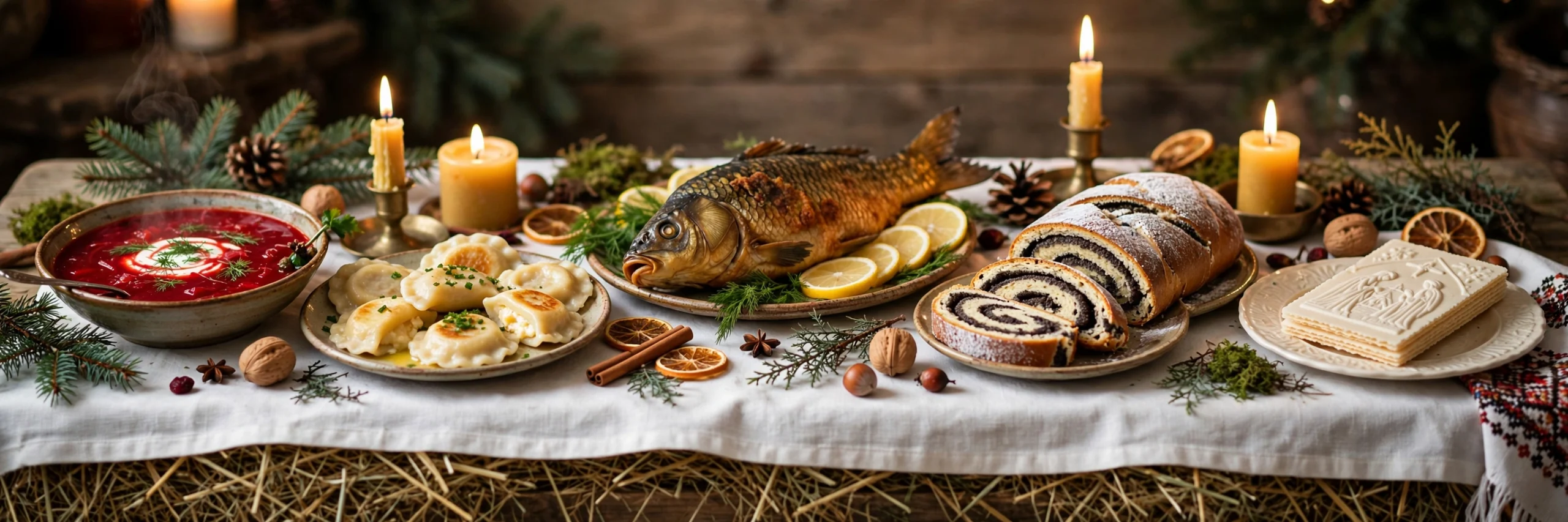
The Wigilia table is Poland’s Christmas masterpiece — twelve meatless dishes, hay under the cloth, and the first star as the starting gun.
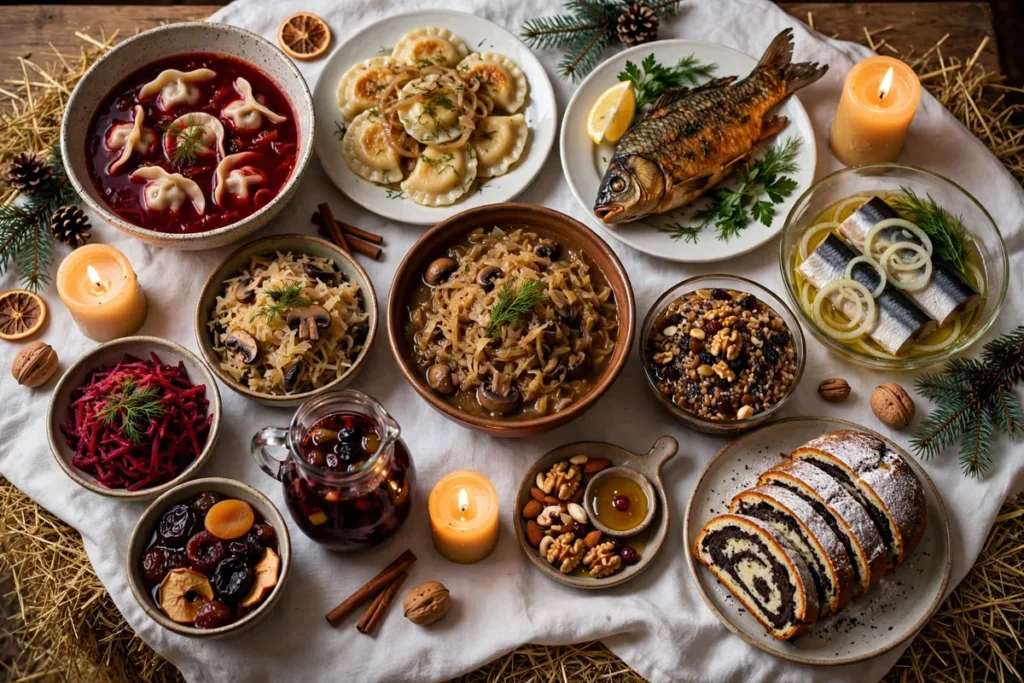
A Polish Wigilia spread: beet borscht with uszka, pierogi, fried carp, herring, kutia and poppy seed cake on a white cloth with candles.
Watch: Polish Wigilia — The 12 Dishes
Polish Foodies explains the custom of twelve dishes for Wigilia — why twelve, and which dishes make the cut.
At a Glance: Polish Wigilia — The 12 Dishes
The classic dishes of the Christmas Eve supper.
| Dish | When | Key detail |
|---|---|---|
| First star | 24 December | The feast only begins when pierwsza gwiazdka — the first star — appears |
| Barszcz z uszkami | 24 December | Red beet borscht with mushroom-filled “little ears” |
| Karp | 24 December | Fried carp — the most traditional of the Wigilia fish |
| Śledzie | 24 December | Herring in oil or cream — the fasting dish par excellence |
| Pierogi | 24 December | With cabbage-mushroom or potato-cheese filling |
| Kutia & makowiec | 24 December | Wheat pudding with poppy seeds and honey; the poppy seed roll |
| Kompot z suszu | 24 December | Dried-fruit compote — the traditional drink of Wigilia |
Frequently Asked Questions
What are the 12 dishes of Polish Wigilia?
The traditional twelve meatless dishes: barszcz with uszka (beetroot soup with mushroom dumplings), wild mushroom soup, carp (fried or in aspic), herring, pierogi with cabbage and mushrooms, cabbage with peas, meatless gołąbki, ryba po grecku (fish with vegetables), kutia (wheat-berry pudding), makowiec (poppy seed roll), piernik (gingerbread), and kompot z suszu (dried-fruit compote). Every guest must taste all twelve for luck.
Why 12 dishes at Wigilia?
Twelve symbolizes the twelve apostles (or the twelve months of the year). The number is traditional, not dogmatic — some families serve 7, 9, or 13 (odd numbers for luck, in some regions) — but twelve is the national standard.
What is opłatek?
The Christmas wafer — a thin unleavened wafer, like the Communion host — broken and shared before the Wigilia supper, with each person exchanging personal wishes (życzenia) with every other. It’s the emotional heart of Polish Christmas: estrangements are mended over opłatek.
Why is there an empty plate at Wigilia?
For the unexpected guest (“dla zbłąkanego wędrowca”) — the lost wanderer. No one should be alone on Christmas Eve; the plate stands ready for a stranger, a late arrival, or (in some families) a deceased loved one.
Can Wigilia be vegetarian or vegan?
Wigilia is already meatless — and largely vegetarian by tradition (fish is the only animal flesh). Vegan Wigilia is very achievable: skip the fish and honey (use sugar in kutia), make pierogi and uszka with oil-based dough, and the twelve translate beautifully.
What is kutia?
Kutia — cooked wheat berries with poppy seeds, honey, nuts, and dried fruit — is the ancient Wigilia dessert, pre-Christian in origin (a Slavic solstice ritual food honoring ancestors). It’s chewy, sweet, and nutty — and mandatory in eastern Poland.
Wesołych Świąt — The Vigil Worth Keeping
The Polish Wigilia 12 dishes are more than a menu — they’re a vigil: twelve humble tastes of the forest, field, river, and orchard, shared beneath the first star of Christmas Eve, with hay under the cloth and a plate for the stranger. Whether you cook all twelve or borrow the barszcz, pierogi, and makowiec for your own table, the Wigilia spirit is reverence — for the food, the family, the stranger who might knock, and the waiting itself. For more great holiday tables from around the world, see our Swedish julbord, our Christmas traditions in Poland, and Christmas movies for the quiet hours after Pasterka. Wesołych Świąt i szczęśliwego Nowego Roku — Merry Christmas and a Happy New Year!