Christmas traditions in Poland are among the most beautiful and deeply ritualized in all of Europe — a Christmas Eve celebration so rich in symbolism that UNESCO-worthy is barely an exaggeration. The heart of the Polish Christmas is Wigilia, the Christmas Eve supper: a meatless feast of twelve dishes shared after the first star appears in the evening sky, beginning with the breaking of the opłatek wafer and the exchange of heartfelt wishes. An empty plate waits at the table for an unexpected traveler. Hay hides beneath the tablecloth in memory of the manger. And at midnight, families walk through the snow to Pasterka, the Shepherds’ Mass. This guide is a practical how-to for understanding — and hosting — a Polish Wigilia, covering every custom, every dish, and every piece of symbolism, so you can celebrate Christmas the Polish way wherever you are.
Understanding Wigilia: Poland’s Christmas Eve Supper
The word Wigilia comes from the Latin vigilia — a vigil, a watchful waiting — and that is exactly what the Polish Christmas Eve is: a night of anticipation. Like much of Europe, Poland celebrates Christmas primarily on December 24, but the Polish Wigilia elevates the evening into something approaching sacred theater. The day itself is a fast day in traditional observance: many Poles eat lightly or not at all until the evening feast, so that the supper arrives with genuine hunger and gratitude.
The supper cannot begin until the first star (pierwsza gwiazdka) appears in the sky — a custom honoring the Star of Bethlehem. In practice, children are dispatched to the windows at dusk to watch for it, and the announcement of the star is the starting gun for the evening. This single rule gives the Polish Christmas Eve its distinctive feeling of hushed expectancy: the whole household waits, ready, for a signal from the heavens.
Wigilia is traditionally meatless — a remnant of the old Catholic fast — which is why the twelve dishes contain no meat (fish, however, is abundant). The number twelve is richly symbolic: the twelve apostles, the twelve months of the year. Every element of the evening carries meaning, and this guide will decode each one. For the culinary deep-dive, our companion guide to the Polish Wigilia 12 dishes covers every dish in detail, with recipes and regional variations.
The 12 Dishes of Wigilia: What They Are
The twelve meatless dishes are the centerpiece of Christmas traditions in Poland, and while the exact lineup varies by region and family, the classic canon includes:
1. Barszcz z uszkami — clear red beetroot soup served with tiny mushroom-filled dumplings (uszka, “little ears”). The soup’s deep ruby color is the visual signature of the Wigilia table.
2. Zupa grzybowa — wild mushroom soup, made from dried porcini and other forest mushrooms gathered in autumn. In some regions this replaces or accompanies the barszcz.
3. Karp — carp, the traditional Wigilia fish, most often served breaded and fried (karp smażony) or in aspic (karp w galarecie). Live carp sold in shops before Christmas is a classic Polish December sight. The scales are sometimes kept in wallets as a good-luck charm for prosperity.
4. Śledź — herring, prepared in multiple ways: in oil, in cream, with onions, or the beloved śledź pod pierzynką (“herring under a blanket”) layered with vegetables and mayonnaise.
5. Pierogi z kapustą i grzybami — dumplings filled with sauerkraut and wild mushrooms, the Wigilia pierogi par excellence.
6. Pierogi ruskie — the famous potato-and-cheese pierogi, appearing on many Wigilia tables alongside the mushroom version.
7. Kapusta z grochem — sauerkraut cooked with yellow peas, a humble, ancient dish.
8. Łazanki z kapustą — flat square noodles with sauerkraut and mushrooms, a comforting pasta dish of the eastern regions.
9. Kutia — a sweet wheat-berry pudding with poppy seeds, honey, nuts, and dried fruit, traditional especially in eastern Poland. Its poppy seeds symbolize abundance.
10. Kompot z suszu — a compote of dried fruits (apples, pears, plums, apricots), served as the traditional Wigilia drink — and, by custom, the meal should include it.
11. Makowiec — poppy seed roll, the coiled, rich pastry that is the king of Polish Christmas baking.
12. Piernik and sernik — gingerbread (piernik, often from the historic city of Toruń) and cheesecake round out the sweet course, with kutia sometimes counted among the twelve instead.
Families are expected to taste at least a little of each dish — it is said to bring good luck and ensure abundance in the coming year. Our full guide to the 12 dishes of Wigilia includes recipes, make-ahead timelines, and regional variations from Silesia to Podhale.
Before the Feast: Christmas Eve Customs
The Wigilia supper is preceded by customs that make Christmas traditions in Poland uniquely moving. The most important is the opłatek: a thin, unleavened wafer, embossed with Nativity scenes, shared at the start of the meal. Each person takes a piece of opłatek and goes around the table, breaking off a piece of everyone else’s wafer while exchanging personal Christmas wishes — for health, happiness, success. It is not a quick toast but a slow, deliberate circuit of the table, often bringing tears. Strangers and distant relatives are included; no one is left out. Colored opłatek is shared with farm animals in rural tradition, a gesture of including all creation in the Christmas peace.
Other pre-supper customs: the empty plate — an extra place is always set at the Wigilia table for an unexpected guest, “the traveler,” honoring the Holy Family’s search for shelter and the Christian duty of hospitality. In modern practice, it symbolizes remembrance of absent loved ones. Hay under the tablecloth — a thin layer of hay recalls the manger of Bethlehem; some families have each person pull a straw, with the longest straw predicting the longest life or greatest luck. No meat, and no arguing — the fast-day spirit extends to behavior: Wigilia is a day of reconciliation, when old quarrels are set aside.
Children, meanwhile, have their own tradition: watching for the first star. The pierwsza gwiazdka vigil gives the evening its structure — dinner waits for heaven’s signal, and the children’s triumphant announcement is the moment the celebration ignites.
How to Set a Traditional Wigilia Table
Setting the Wigilia table is itself a ritual. Here is the traditional arrangement, step by step:
1. The white cloth and the hay. Spread a thin layer of clean hay (or straw) on the table, then cover it with your finest white tablecloth. The hay should peek out slightly at the edges — a visible reminder of the manger.
2. The extra place setting. Set one more place than you have guests — the traveler’s plate. It is never removed, even if no one comes.
3. Candles and the nativity. Candles are lit when the first star appears. Many families place a small nativity scene (szopka) or a Christmas crib as the centerpiece. In Poland, the Christmas tree (choinka) is traditionally decorated on Wigilia morning, often with the whole family participating.
4. The opłatek. Place the opłatek wafers on a special plate — often decorated with a sprig of spruce — at the center of the table, ready for the wish-sharing that opens the meal.
5. The twelve dishes, served in waves. Unlike a buffet, Wigilia dishes are served sequentially: soups first, then fish and pierogi courses, then the sweet finale. The table is cleared and reset between waves in traditional households — a leisurely, hours-long progression.
For decorating your table in a Polish-inspired style, our Christmas decoration ideas include natural, candlelit looks that complement the Wigilia aesthetic beautifully.
Step-by-Step: Hosting Your Own Wigilia
You do not need to be Polish to host a Wigilia — you need only respect for the ritual and a willingness to cook. Here is a practical timeline:
One week before: Order or buy the carp (if using fresh), dried mushrooms, poppy seeds, and dried fruit for kompot. Buy opłatek wafers — Polish delis and online shops stock them in December. Send invitations with the start time listed as “dusk” and explain the first-star tradition to guests.
Two days before: Make the barszcz base, the mushroom soup, and the kompot z suszu (it improves with resting). Bake the makowiec and piernik. Prepare pierogi fillings.
Wigilia morning: Decorate the Christmas tree as a group activity. Assemble and boil pierogi. Fry the carp. Prepare herring dishes. Set the table with hay, the extra plate, candles, and opłatek.
Dusk: Assign a child (or the young at heart) to star-watch. When the first star is spotted, light the candles and gather.
The supper: Begin with the opłatek wish-sharing — go slowly, person to person. Then serve the twelve dishes in waves, encouraging everyone to taste each one. Keep the kompot flowing. No rushing; a proper Wigilia lasts three to four hours.
After supper: Exchange gifts (in Poland, gifts are traditionally brought by Gwiazdor — the Star Man — in many regions, by St. Nicholas in others, or by the Christ Child in the south). Sing kolędy (Polish carols) together — songbooks or printed lyrics help. Then, at midnight, the traditional finale: Pasterka.
Midnight Mass: Pasterka, the Shepherds’ Mass
Pasterka — the “Shepherds’ Mass,” named for the shepherds who first heard the news of Christ’s birth — is the midnight Mass that closes Wigilia. In Poland, attending Pasterka is one of the most widely observed Christmas traditions, drawing even infrequent churchgoers into packed, candlelit churches. The Mass features Polish kolędy sung with full voice, the Nativity story, and an atmosphere of joyful exhaustion after the long evening.
The tradition of midnight Mass on Christmas Eve is ancient in Poland, and in villages the walk to church through the snow — neighbors falling in together along dark lanes — is itself part of the ritual. Even in cities, the sight of crowds streaming toward illuminated churches at midnight is a defining image of the Polish Christmas. Visitors are welcome at Pasterka; arrive early, as churches fill completely.
Polish Christmas Day and St. Stephen’s Day
After the intensity of Wigilia, Christmas Day (Boże Narodzenie, literally “God’s Birth”) is a day of rest and family visiting. The fasting is over — Christmas Day dinner traditionally includes meat, often roast turkey, pork, or bigos (hunter’s stew) in some regions. It is a relaxed, leftover-grazing day, spent with extended family.
December 26 is St. Stephen’s Day (drugi dzień świąt, “the second day of the holidays”), also a public holiday and traditionally a day for visiting friends, caroling from house to house (kolędnicy — groups of carolers, sometimes in costume as the Holy Family, angels, or the Three Kings), and continuing the feasting. In some regions, St. Stephen’s Day blessing of oats recalls the saint’s martyrdom by stoning.
The Christmas season in Poland extends to Epiphany (January 6, Święto Trzech Króli — the Feast of the Three Kings), marked by the charming custom of writing K+M+B (the traditional initials of the Magi: Kaspar, Melchior, Baltazar) in chalk above doorways, blessed in church. The Orszak Trzech Króli (Three Kings’ Parades), with costumed processions through city streets, have grown into major public celebrations in recent years.
Polish Christmas Carols: The Kolędy
Poland’s kolędy are among the richest carol traditions in Europe, and singing them is central to Christmas traditions in Poland. The most beloved include “Bóg się rodzi” (God Is Born) — often called the Polish national Christmas hymn, with words by the 18th-century poet Franciszek Karpiński; “Lulajże, Jezuniu” (Hush, Little Jesus), a tender lullaby; “Wśród nocnej ciszy” (In the Night’s Stillness); and “Dzisiaj w Betlejem” (Today in Bethlehem).
Caroling (kolędowanie) traditionally involves groups visiting homes between Christmas and Epiphany, sometimes with a portable nativity scene (szopka) and star, performing the Nativity story in exchange for treats or donations. The custom survives in villages and has been revived in cities, keeping the musical heart of the Polish Christmas beating.
Christmas Markets and City Traditions: Kraków and Beyond
Poland’s Christmas markets are among Europe’s most atmospheric. Kraków’s market on the Main Square (Rynek Główny) — one of Europe’s largest medieval squares — is the crown jewel: wooden stalls selling oscypek (smoked sheep’s cheese), grilled sausages, mulled wine (grzaniec), amber jewelry, and hand-painted decorations, all beneath the illuminated St. Mary’s Basilica. Kraków also hosts the famous annual szopka competition: the city’s distinctive, fantastical Nativity scenes — towering, glittering architectural fantasies inspired by Kraków’s churches — are paraded to the Main Square on the first Thursday of December and displayed at the Historical Museum. The Kraków szopka tradition is so unique it has been inscribed on UNESCO’s Intangible Cultural Heritage list.
Wrocław’s market, spread across the Market Square with its dwarf figurines, and Gdańsk’s market in the historic Long Market are equally enchanting. Warsaw’s Old Town and the illuminations along the Royal Route offer a more metropolitan Christmas. Markets typically run from late November through late December or early January — check official city sites for 2026 dates.
Polish Christmas Decorations and the Szopka
The Polish Christmas tree (choinka) is traditionally decorated on Wigilia morning — a family event, often with straw ornaments, glass baubles from Poland’s famous ornament workshops (the town of Krosno and others produce world-renowned hand-blown glass ornaments), apples, nuts, and sweets. Tinsel (łańcuchy) and the star or angel on top complete the look.
The szopka (nativity scene) deserves special attention. Beyond Kraków’s architectural fantasies, Polish homes display nativity scenes ranging from simple wooden figures to elaborate multi-tiered constructions. A uniquely Polish addition: the szopka often includes figures of Polish historical heroes and folk characters alongside the Holy Family — a blending of sacred and national identity characteristic of Polish Christmas.
Other traditional decorations include the pająk — a “spider” chandelier of straw, paper, and peas hung from the ceiling, an ancient Slavic good-luck symbol — and podłaźniczka, a decorated spruce branch hung from the ceiling in some regions, predecessor of the Christmas tree. For gift ideas to place beneath your choinka, our best Christmas gifts guide has options for everyone.
Regional Wigilia: How Poland’s Christmas Varies by Region
Christmas traditions in Poland are national, but Wigilia has delicious regional accents. In Silesia (Śląsk), the Wigilia table features siemieniotka (hemp-seed soup) and moczka — a unique Silesian dessert of gingerbread soaked in dark beer with dried fruit and nuts. The Silesian Christmas is also known for its elaborate szopki and the tradition of children “flying” to find the first star.
In the Tatra highlands (Podhale), the Górale (highlanders) celebrate with oscypek (smoked sheep’s cheese), hearty mushroom dishes, and distinctive highlander carols sung in dialect. The mountain Wigilia is the most rustic in Poland — wooden cottages, snow, and traditions barely changed in a century.
In eastern Poland (Podlasie, Lublin region), kutia — the wheat-berry and poppy-seed pudding — is essential, reflecting the region’s Eastern Christian influences. In Pomerania and along the Baltic coast, fish dominates even more than elsewhere, with herring in a dozen preparations. Kashubia has its own carols in the Kashubian language and the tradition of Gwiżdże — masked New Year figures.
These variations are a reminder that “Polish Christmas” is really a family of related Christmases — united by opłatek, the twelve dishes, and Pasterka, but flavored by landscape and history. If you marry into a Polish family, learn their region’s customs: it matters.
Wigilia Abroad: The Polish Diaspora Keeps the Tradition
Some of the most faithful Wigilia celebrations happen far from Poland. The Polish diaspora — some 20 million people of Polish descent worldwide, with huge communities in the United States (especially Chicago, America’s “second Warsaw”), the United Kingdom, Germany, and Canada — keeps Christmas traditions in Poland alive with remarkable devotion. Chicago’s Polish parishes hold Pasterka Masses in Polish; London’s Polish delis sell out of opłatek, makowiec, and carp in December; and Polish Saturday schools teach children the kolędy.
Diaspora Wigilia often becomes more traditional than the homeland version — a common pattern in immigrant communities, where the holiday becomes a vessel for identity. Second- and third-generation Polish-Americans who speak little Polish will still gather for opłatek, still wait for the first star, still set the extra plate. The tradition adapts (frozen pierogi, farmed carp, online opłatek orders) but does not dilute.
If you are invited to a diaspora Wigilia, accept — it is one of the warmest invitations in the Christmas world. Bring a dessert or a bottle, learn to say “Wesołych Świąt” (Merry Christmas), and be prepared for the opłatek wish-sharing to move you. For those building their own Polish-inspired holiday table abroad, our Christmas dinner ideas can help bridge traditions.
In Pictures: Christmas in Poland
Poland’s Christmas belongs to Wigilia — the candlelit Christmas Eve supper of 12 meatless dishes, opened with the sharing of the opłatek wafer.
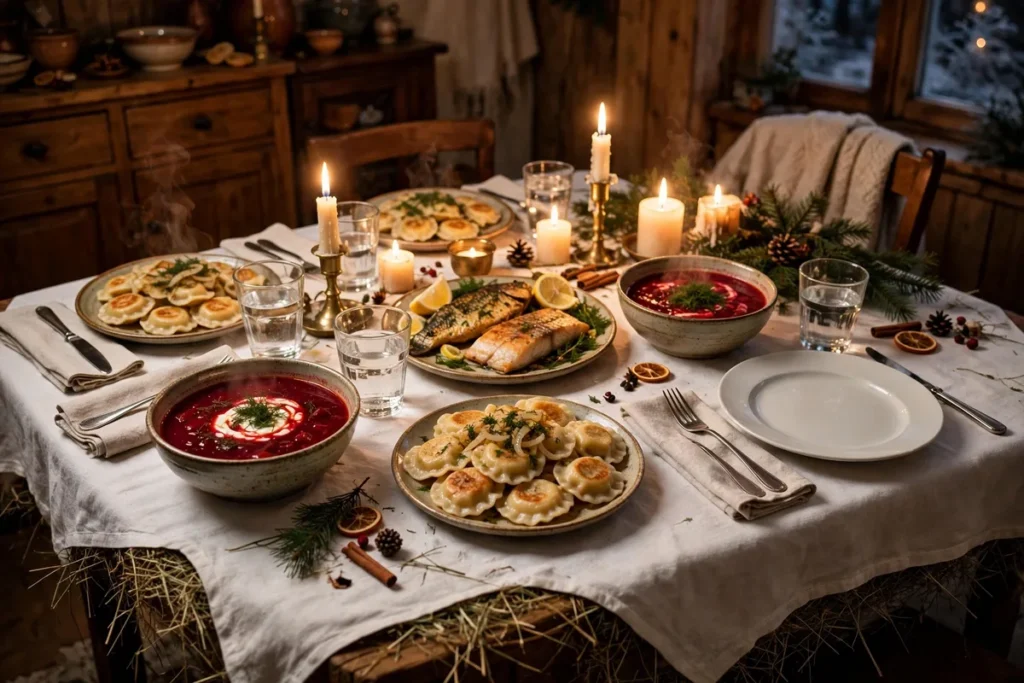
A traditional Polish Wigilia table: white cloth with hay beneath, lit candles, beet soup with dumplings, pierogi, and an empty place set for a guest.
Watch: Christmas in Poland
DW Food explains why Poland celebrates Christmas Eve with 12 dishes — the Wigilia menu, the traditions around it, and the symbolism behind the feast.
At a Glance: Christmas in Poland
The sacred evening of Wigilia.
| Tradition | Date | Key detail |
|---|---|---|
| First star | 24 December | The supper only begins when the first star (pierwsza gwiazdka) appears — recalling the Star of Bethlehem |
| Opłatek | 24 December | Before eating, everyone breaks the Christmas wafer and exchanges wishes of peace and happiness |
| Twelve dishes | 24 December | A meatless feast of 12 dishes for the apostles — barszcz with uszka, pierogi, carp, kutia, makowiec |
| Hay & empty place | 24 December | Hay under the tablecloth recalls the manger; an empty seat waits for an unexpected guest |
| Kolędy | 24 December | After supper the family sings kolędy, Poland’s beloved carols, before opening presents |
| Pasterka | 24–25 December | Midnight mass — the Shepherds’ Mass — closes Christmas Eve in churches across Poland |
| Christmas & St Stephen’s Day | 25–26 December | Two days of visiting and feasting, with Christmas dinner on the 25th and St Stephen’s on the 26th |
Frequently Asked Questions
What is Wigilia?
Wigilia is the Polish Christmas Eve supper — a meatless feast of twelve symbolic dishes shared after the first star appears in the evening sky. It begins with the sharing of the opłatek wafer and the exchange of Christmas wishes, includes an empty place setting for an unexpected traveler, and traditionally ends with midnight Mass (Pasterka).
Why twelve dishes at Wigilia?
The twelve dishes symbolize the twelve apostles (and, in folk interpretation, the twelve months of the year). The traditional dishes are meatless — honoring the old Christmas Eve fast — and include barszcz with uszka, carp, herring, pierogi, mushroom dishes, kutia, dried-fruit kompot, makowiec (poppy seed roll), and gingerbread. Guests should taste each dish for good luck.
What is opłatek?
Opłatek is a thin unleavened wafer, embossed with Nativity imagery, shared at the start of Wigilia. Each person breaks off a piece of everyone else’s wafer while exchanging personal Christmas wishes. It is the emotional centerpiece of the Polish Christmas Eve — a ritual of forgiveness, love, and connection.
Do Poles celebrate Christmas on December 24 or 25?
The main celebration is December 24 (Wigilia), with the festive supper, gift-giving, and midnight Mass. December 25 (Boże Narodzenie) is a quieter day of rest and family visiting, and December 26 (St. Stephen’s Day) is another public holiday for visiting and caroling.
What is Pasterka?
Pasterka (“Shepherds’ Mass”) is the traditional Polish midnight Mass on Christmas Eve, named for the shepherds of the Nativity story. It is one of the most widely attended church services of the year in Poland, featuring Polish kolędy (carols) sung by full congregations.
What are Kraków szopki?
Kraków szopki are the city’s distinctive, fantastical Nativity scenes — towering, glittering constructions inspired by Kraków’s historic church architecture. An annual competition held on the first Thursday of December draws master craftsmen, and the tradition is inscribed on UNESCO’s Intangible Cultural Heritage list.
Christmas traditions in Poland offer one of the world’s most complete Christmas experiences: a fast broken by a twelve-dish feast, wishes exchanged wafer by wafer, an empty chair kept for the stranger, and a midnight walk through the snow to welcome Christmas morning. Whether you host your own Wigilia or simply borrow its spirit of deliberate, symbolic togetherness, the Polish Christmas has a way of making the holiday feel profound. Wesołych Świąt!