In the Philippines, Christmas begins in September — the famous “Ber months” — and by December the entire archipelago glows. But no light shines brighter, or more distinctively Filipino, than the parol: the star-shaped Christmas lantern that hangs in windows, streets, and plazas across the nation. And once a year, in the city of San Fernando, the parol becomes something monumental: gigantic, kaleidoscopic lanterns, some twenty feet across and studded with thousands of bulbs, competing in a festival of light visible for miles. The story of the parol, the Philippines’ giant lantern festival, and the simbang gabi dawn Masses is the story of the world’s longest Christmas season — and one of its most radiant.
The Parol: A Star for Every Home
The parol is a star-shaped lantern, traditionally made from bamboo sticks covered in colored papel de japon (Japanese paper) or, in finer versions, capiz shells — the translucent oyster shells used in Filipino windows. Its five-pointed star form represents the Star of Bethlehem, and its light symbolizes the triumph of light over darkness, hope over despair. During the Christmas season, parols hang everywhere: in homes, offices, schools, shopping malls, and across streets, often illuminated from within.
The parol’s origins are devotional. In the Spanish colonial era, villagers carried small paper lanterns to light their way to the pre-dawn simbang gabi Masses, and to decorate the church and the processional route. Over generations, the humble processional lantern evolved into an art form, with craftsmen competing to make ever more elaborate designs. Today, parol-making is a proud craft tradition, with workshops producing everything from simple bamboo-and-paper stars to capiz-shell chandeliers that sell as premium Christmas décor.
For Filipinos, the parol is more than decoration — it is identity. Overseas Filipino workers hang parols in apartments from Dubai to Toronto as a declaration of home. The star’s light is the visual shorthand for Paskong Pinoy — the Filipino Christmas — and no Filipino Christmas, anywhere in the world, feels complete without one.
The Giant Lantern Festival: Ligligan Parul
Once a year, the parol goes gigantic. The Giant Lantern Festival — Ligligan Parul in the Kapampangan language — is held in San Fernando City, Pampanga, about 70 kilometers north of Manila, on the Saturday before Christmas Eve. It is the culmination of the region’s lantern-making tradition and one of the great light festivals of Asia.
What the giant lanterns are
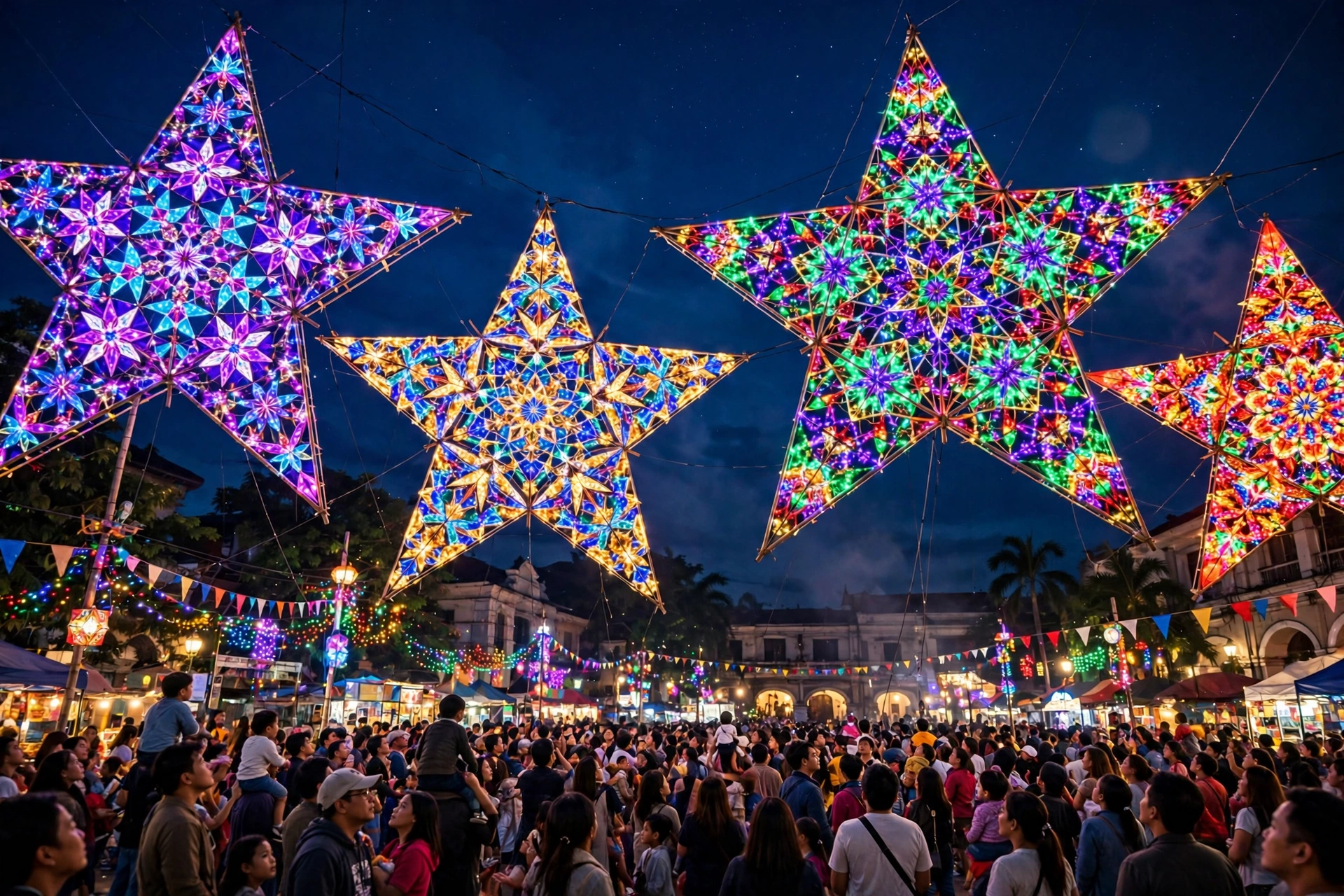
Competing lanterns are enormous — typically around 20 feet (6 meters) in diameter — built on steel frames and covered in thousands of individual light bulbs, now increasingly LEDs. But the true artistry is not the size; it is the rotor mechanism: the lanterns’ lights are choreographed to pulse, chase, and bloom in intricate kaleidoscopic patterns, synchronized to music. Watching a giant parol perform is like watching a mandala made of light breathe and dance.
The competition
Barangays (villages) of San Fernando each field a lantern, built by local craftsmen over months of painstaking work — wiring tens of thousands of bulbs, programming the light sequences, and constructing the frame. On festival night, the lanterns are presented one by one in a darkened venue, each performing its synchronized light-and-music routine before judges and a roaring crowd. The competition is fierce, the hometown pride is intense, and the winning barangay earns a year’s worth of bragging rights.
A tradition with deep roots
The festival’s origins are humble: it began in the early 20th century as a simple procession of small lanterns, and grew as rival villages tried to outdo each other with bigger, brighter creations. The first formal competition is generally dated to the 1930s. What started as devotional craft became civic art — and San Fernando earned its official title: the Christmas Capital of the Philippines.
Seeing it in person
The festival draws huge crowds, including international tourists. If you go, arrive early — the venue fills up — and expect a late night: the lanterns perform after dark, and the atmosphere is pure fiesta, with food stalls, music, and an infectious communal joy. The lanterns remain on display in the days around the festival, and San Fernando’s lantern-makers’ workshops are worth visiting year-round.
Simbang Gabi: Nine Dawn Masses
The parol’s original purpose — lighting the way to church — points to the season’s devotional heart: Simbang Gabi (“Night Mass”), the nine-day series of dawn Masses held from December 16th to the 24th. Filipino Catholics rise before sunrise — Masses typically begin around 4 or 5 AM — and walk through the dark streets, parol-light glowing, to churches packed with the faithful.
Completing all nine Masses is a cherished devotion; folk belief holds that a wish made after completing the novena will be granted. But Simbang Gabi is as social as it is spiritual. After Mass, the streets outside the church fill with vendors selling bibingka (rice cakes baked in clay pots lined with banana leaves, topped with salted egg and cheese) and puto bumbong (purple sticky-rice logs steamed in bamboo tubes, served with butter, sugar, and grated coconut). For many Filipinos, the post-Mass breakfast is as beloved as the Mass itself — faith and food, inseparable.
In the evening counterpart, Misa de Gallo, and in the global Filipino diaspora — where dawn Masses are adapted to evening schedules — the novena continues. Simbang Gabi is arguably the most widely practiced Christmas novena in world Catholicism, observed by millions.
The World’s Longest Christmas Season
The Philippines is famous for the longest Christmas season on earth: it begins on September 1st, the first of the “Ber months” (September, October, November, December). By September, malls are playing Christmas carols, parols are appearing in shop windows, and countdowns to Christmas begin on radio stations. To outsiders it seems extravagant; to Filipinos it is simply the rhythm of the year.
The season builds through distinct phases: the Ber-month anticipation, the Simbang Gabi novena, Christmas Eve’s Noche Buena — the midnight feast that is the centerpiece of the Filipino Christmas, with lechon (roast pig), queso de bola (Edam cheese), ham, and bibingka — and then Christmas Day itself, often quieter, for family and rest. The season extends past New Year to the Feast of the Three Kings in early January.
What sustains a four-month Christmas? Partly the tropical climate — without winter’s natural drama, Filipinos manufacture the season through light, music, and food. Partly the culture’s deep sociability — Christmas is the great homecoming, when overseas workers return and families reunite. And partly, simply, joy: the Filipino Christmas is an extended, deliberate, communal celebration of happiness, and the country sees no reason to rush it.
How Parols Are Made: The Craft Behind the Light
A traditional parol begins with bamboo: thin sticks split, shaped, and bound into a five-pointed star frame, often with smaller star or tassel accents. The frame is covered in papel de japon — a translucent, slightly waxy paper — in vivid reds, greens, yellows, and blues, sometimes layered for stained-glass effects. A bulb or LED string inside completes the lantern. The whole thing can be made in an afternoon by a skilled craftsperson — and Filipino schoolchildren learn simplified versions as a standard December classroom project.
Premium parols use capiz shells: hundreds of small translucent shells, each individually attached to the frame, creating a luminous, mother-of-pearl effect when lit. These are the heirloom parols, expensive and durable, hung year after year. In Pampanga’s lantern-making districts, workshops operate nearly year-round, employing artisans whose families have made parols for generations.
The giant competition lanterns are an engineering discipline unto themselves. Builders work with steel frames, tens of thousands of bulbs, and complex electrical systems — the famous rotor mechanisms that sequence the lights into rotating, blooming patterns. Modern entries use computer-programmed LED arrays synchronized to music, but the aesthetic goal is unchanged from the bamboo-and-paper originals: a star, made of light, that moves.
Noche Buena: The Midnight Feast
All the light and devotion of the Filipino Christmas converges on Noche Buena — the Christmas Eve midnight feast, the undisputed centerpiece of the holiday. After the final Simbang Gabi Mass (or after evening Mass on the 24th), families gather around tables groaning with the great dishes of the Filipino Christmas.
The traditional spread is a study in Filipino fiesta cooking: lechon (whole roast pig, crackling-skinned and magnificent) as the centerpiece for those who can manage it; queso de bola — the red-waxed ball of Edam cheese that is as much a Christmas symbol as the parol; Christmas ham (jamón), often sweet-glazed; bibingka and puto bumbong; pancit (noodles for long life); lumpia; fruit salad; and leche flan. It is abundant, joyful, and eaten at midnight — because no Filipino Christmas could possibly wait until morning.
Noche Buena is also the great homecoming meal. The Philippines has one of the world’s largest overseas worker populations, and Christmas is when the balikbayan — the returning ones — come home, suitcases full of gifts (pasalubong). The feast is their welcome; the parol in the window is the beacon that guided them back.
Bringing the Parol Spirit Home
You do not need to be in Pampanga to celebrate with parol light. Here is how to borrow the tradition:
Hang a parol
Parols are widely available online, from simple paper-and-bamboo stars to capiz-shell showpieces. Hang one in a front window, lit each evening through December — it is a beautiful, meaningful alternative (or addition) to a wreath, and a conversation starter about the world’s longest Christmas.
Make one with kids
A simplified parol — popsicle sticks or straws for the frame, tissue paper for the covering, a battery tea light inside — is a perfect December craft project. It teaches geometry, craft, and a little Filipino culture in one sitting. There are excellent video tutorials for kid-friendly parols.
Cook the Simbang Gabi breakfast
You do not need to attend 4 AM Mass to enjoy bibingka: the banana-leaf-baked rice cakes (or simplified oven versions) topped with salted egg and cheese are a wonderful Christmas-morning breakfast. Pair with hot chocolate or salabat (ginger tea) for the full effect.
Extend your season
The boldest Filipino lesson: start earlier. The Ber-months philosophy holds that Christmas joy should not be rationed to a single week. Put the lights up when it makes you happy. The Filipinos have it right — joy, deliberately extended, is a kind of wisdom.
In Pictures: Parol and the Giant Lantern Festival
In the Philippines, Christmas glows through the parol — the star-shaped lantern — crowned each December by the Giant Lantern Festival of San Fernando, Pampanga.
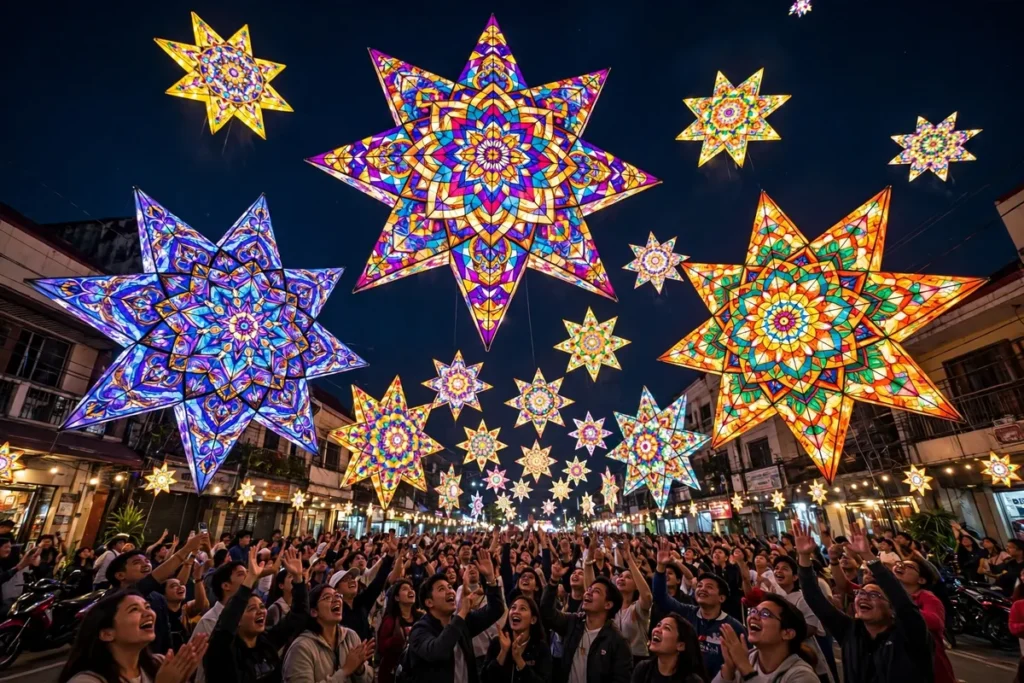
The Giant Lantern Festival in San Fernando: enormous glowing parols with kaleidoscopic light patterns rising above the Christmas crowd.
Watch: Parol and the Giant Lantern Festival
Historian Kirby Araullo traces the real story of the Filipino Christmas lantern — from precolonial roots to the giant lanterns of San Fernando.
At a Glance: Parol and the Giant Lantern Festival
The lantern, the festival, and the city that calls itself the Christmas Capital of the Philippines.
| Element | What it is | Key detail |
|---|---|---|
| Parol | The lantern | The star-shaped Filipino Christmas lantern, symbolizing the Star of Bethlehem; hung in homes and streets each December |
| Ligligan Parul | The festival | The Giant Lantern Festival in San Fernando, Pampanga — a December competition among barangays for the most dazzling lantern |
| 1904 | The origins | The festival began in Bacolor, then Pampanga's capital, rooted in lantern-lit religious processions |
| 1931 | The transformation | The arrival of electricity turned simple candle-lit lanterns into elaborate displays of light and color |
| 20 feet | The scale | Giant parols reach up to 20 feet in diameter, lit by thousands of bulbs choreographed by electric rotors |
| Francisco Estanislao | The innovator | Credited with shaping the modern parol around 1908, inspiring its evolution into an art form |
| Christmas Capital | The title | San Fernando's festival has made it the “Christmas Capital of the Philippines” |
Frequently Asked Questions
What is a parol?
A parol is a traditional Filipino Christmas lantern — a star-shaped frame (originally bamboo) covered in colored paper or capiz shells and lit from within. It symbolizes the Star of Bethlehem and the triumph of light over darkness, and it is the iconic symbol of the Filipino Christmas.
When is the Giant Lantern Festival in the Philippines?
The Giant Lantern Festival (Ligligan Parul) is held in San Fernando City, Pampanga, on the Saturday before Christmas Eve. Barangays compete with enormous lanterns — typically around 20 feet across — featuring tens of thousands of bulbs choreographed into kaleidoscopic light patterns synchronized to music.
What is Simbang Gabi?
Simbang Gabi (“Night Mass”) is a nine-day series of dawn Masses held December 16–24 in the Philippines, typically starting around 4–5 AM. Completing all nine is a cherished devotion, and the post-Mass street food — bibingka and puto bumbong — is a beloved part of the tradition.
Why is the Philippine Christmas so long?
The Filipino Christmas season traditionally begins on September 1st — the start of the “Ber months.” The extended season reflects the culture’s deep love of celebration, the importance of Christmas as a homecoming time for overseas workers, and a joyful refusal to ration festivity. It is widely considered the longest Christmas season in the world.
What is Noche Buena?
Noche Buena is the Filipino Christmas Eve midnight feast — the centerpiece meal of the holiday. Traditional dishes include lechon (roast pig), queso de bola (Edam cheese), sweet ham, bibingka, pancit, and leche flan, shared with family at midnight.
Where can I buy a parol outside the Philippines?
Parols are widely available from online retailers, Filipino specialty shops, and Christmas import stores — from simple paper stars to premium capiz-shell lanterns. Many Filipino communities abroad also hold parol-making workshops in December.
The Philippines’ festival of light deserves a place on every Christmas traveler’s list — see our guide to the best places to spend Christmas for more seasonal journeys. Bring the glow home with Christmas decoration ideas, and for another star-centered tradition, read about the Three Kings Day celebrations that close the season. If the giant lanterns inspire a party, our Christmas party ideas will help you throw one worthy of San Fernando.
Christmas in the Filipino Diaspora: Paskong Pinoy Abroad
With millions of Filipinos living and working overseas — from the Gulf states to Canada, from London to Sydney — the Filipino Christmas has become a global phenomenon. And wherever Filipinos gather in December, the season’s essentials travel with them: the parol in the window, the Simbang Gabi novena (often adapted to evening Masses to accommodate work schedules), the Noche Buena feast, and the Ber-months countdown that starts, defiantly, in September.
Diaspora Christmases are acts of cultural preservation. In cities like Dubai, where public Christmas displays are limited, Filipino communities create their Christmas indoors — in churches, community halls, and apartments glowing with parol light. In Toronto, Vancouver, and Los Angeles, Filipino parishes hold some of the best-attended Simbang Gabi Masses outside the Philippines, followed by the beloved bibingka and puto bumbong breakfasts. In London, the Filipino chaplaincy’s Simbang Gabi draws thousands across the nine days.
The food is the anchor. Overseas Filipinos go to extraordinary lengths to reproduce the Noche Buena table: queso de bola shipped or sourced at premium prices, lechon ordered from specialty roasters, bibingka baked in improvised banana-leaf-lined pans. Filipino grocery stores abroad do their biggest business of the year in December, and the prices — however steep — are paid gladly. Christmas tastes like home, and home is worth it.
There is a poignant dimension to all of this. For the overseas Filipino workers who cannot come home — the nurses, seafarers, domestic workers whose labor sustains both their families and the Philippine economy — Christmas is the hardest season. The community celebrations, the shared Noche Buena tables, the parol light in a faraway window: these are not just festivities but lifelines, ways of being together across distance. The Filipino Christmas, at its best, is an extended exercise in refusing to let distance win.
The Economics of Light: Pampanga’s Lantern Industry
The Giant Lantern Festival is the spectacular tip of a year-round industry. In San Fernando and surrounding Pampanga towns, lantern-making is a serious craft economy: workshops employ artisans — electricians, welders, painters, programmers — who build parols for sale across the Philippines and for export. The industry peaks in the Ber months, when orders flood in from malls, municipalities, corporations, and private buyers.
The craft has evolved dramatically. Where traditional parols used bamboo and paper, modern commercial lanterns use steel frames, capiz shells, fiberglass, and programmable LED systems. The giant competition lanterns are the industry’s R&D lab: techniques pioneered for the festival — new rotor mechanisms, new sequencing methods, new materials — filter down into commercial production. The festival is thus both cultural celebration and trade show, preserving the craft by pushing it forward.
Apprenticeship keeps the tradition alive. Master lantern-makers (paroleros) train younger artisans, and the barangay competition teams function as informal schools — teenagers who wire bulbs for their village’s entry learn skills that become livelihoods. In an age when craft traditions die for lack of practitioners, Pampanga’s lantern industry offers a model: make the craft pay, make it prestigious, and make it spectacular, and the next generation will come.
Planning a Philippine Christmas Trip
For travelers, the Philippines in December is one of the world’s great Christmas destinations — and it rewards planning.
When to go
The season runs September to January, but the sweet spot is mid-December: Simbang Gabi is underway (December 16–24), the Giant Lantern Festival lights up San Fernando (the Saturday before Christmas Eve), and Noche Buena preparations fill the markets. Christmas Day itself is quiet — plan to be somewhere you are welcome, or embrace the restful pause.
San Fernando
Book accommodation early for festival weekend — the city fills up. The festival venue is a dedicated outdoor space; arrive well before dark for a good spot. Combine the trip with visits to lantern-makers’ workshops (many welcome visitors) and Pampanga’s legendary food scene — the province is the culinary capital of the Philippines, and December is its finest hour.
Manila and beyond
Manila’s malls go all-out for Christmas — the Philippines’ famous mall culture reaches its festive peak — and the city’s churches hold beautiful Simbang Gabi Masses. Beyond the capital, every region has its own Christmas customs: the pastores street dramas, regional delicacies, and local festivals. Ask locals; Filipinos love sharing their Christmas and will adopt a curious visitor in minutes.
Practical notes
December weather is warm and relatively dry — pack light, but bring something for cool church interiors and the occasional rain. Book domestic flights early; Christmas is peak travel season as millions head home for the holidays. And bring an appetite: you will be fed, constantly, by people who will not take no for an answer. This is not a suggestion. This is the Filipino Christmas.
What “Ligligan Parul” Means
The festival’s Kapampangan name, Ligligan Parul, translates roughly as “Giant Lantern Festival” — ligligan suggesting greatness or grandeur, parul being the Kapampangan word for lantern (from the Spanish farol). The name itself tells the story: this is the parol tradition, scaled to grandeur. Kapampangan, the language of Pampanga province, is central to the festival’s identity — the competition is a point of fierce provincial pride, and the lanterns are expressions of Kapampangan artistry as much as Filipino Christmas spirit.
That linguistic root — farol to parol — is a small history of the Philippines in a word: Spanish colonial influence, absorbed and transformed into something distinctly Filipino. The giant lanterns of San Fernando are, in the end, the same story told in light: foreign forms, local soul, shining bigger and brighter than anyone expected.
Frequently Asked Questions (Continued)
What does “Ligligan Parul” mean?
Ligligan Parul is Kapampangan for “Giant Lantern Festival” — the traditional name of the San Fernando lantern competition. Parul derives from the Spanish farol (lantern), reflecting the tradition’s colonial-era origins.
How big are the giant lanterns?
Competition lanterns are typically around 20 feet (6 meters) in diameter, built on steel frames and containing tens of thousands of individual bulbs or LEDs, choreographed into synchronized light patterns using rotor mechanisms and computerized controls.