Between the misty coastline and the volcanic peaks, a distinct food culture has taken root — one built on cold-water seafood, foraged mushrooms, orchard fruit, and a farm-to-table ethos the region pioneered decades before it was fashionable. Pacific Northwest Cuisine is the cooking of Seattle, Portland, and the coastal towns between: cedar-plank salmon, Dungeness crab pulled from icy water, oysters from misty bays, marionberries in summer pies, chanterelles in fall risottos, and coffee roasted with near-religious devotion. This guide explores the ingredients, the signature dishes, the seasons, the two great food cities, and how to eat your way through the region like you belong there.
If you believe food should taste like where it comes from, the Pacific Northwest will feel like home.
What Defines Pacific Northwest Cuisine?
Pacific Northwest cuisine is defined less by specific dishes than by a philosophy: ingredients first, seasonality always, and a reverence for the region’s extraordinary natural pantry. The geography explains everything — a cold, nutrient-rich ocean; dense evergreen forests full of mushrooms and berries; volcanic soil that grows remarkable produce; and a climate that produces world-class apples, pears, cherries, and wine grapes.
The cuisine’s modern identity was shaped by chefs who, starting in the 1980s and 90s, rejected the era’s continental conventions and built menus around what the region actually produced. Native American foodways — salmon baked on cedar, camas root, huckleberries — provided deep roots; Asian immigrant communities (particularly Japanese, Chinese, Vietnamese, and Korean) contributed techniques and flavors that fused naturally with the local pantry; and Scandinavian settler traditions added smoking, curing, and pickling. The result is a cuisine that feels simultaneously ancient and cutting-edge: ancient in its ingredients, modern in its expression.
The Star Ingredients
Salmon
The region’s defining protein. Five species of Pacific salmon run the Northwest’s rivers, with king (chinook) the most prized — rich, buttery, and deeply flavored. Traditional preparations include cedar-plank grilling (the Native American technique that perfumes the fish with wood smoke), alder-smoked salmon, and simple preparations that let the fish speak. Salmon season runs roughly May through September, and the first Copper River arrivals are treated as a genuine event.
Dungeness Crab
The sweet, meaty crab of the cold Pacific, harvested in winter. The classic preparation is almost aggressively simple: whole crab, steamed or boiled, cracked at the table with drawn butter and lemon. Crab feeds — communal spreads of whole crab, sourdough, and butter — are a winter ritual. The meat’s natural sweetness needs no improvement, only respect.
Oysters
The Northwest’s cold, clean bays produce oysters with a distinctive cucumber-melon minerality — smaller and more delicate than their East Coast cousins. Varieties like Kumamoto, Kusshi, and Pacific oysters are served raw on the half shell with nothing but a squeeze of lemon or a light mignonette. Oyster farms dot the coasts of Washington and Oregon, and many offer tastings steps from the water.
Mushrooms
Fall in the Northwest means mushrooms: chanterelles, porcini, morels, and matsutake emerge from the damp forests, gathered by foragers who guard their spots like state secrets. Restaurant menus transform overnight — chanterelle risottos, mushroom toast, wild mushroom soups. The foraging culture here is serious and semi-professional; guided foraging walks are a legitimate tourist activity.
Berries
Marionberries (the region’s signature blackberry cultivar), huckleberries (the wild mountain berry worth its weight in gold), raspberries, and blueberries — summer in the Northwest is a berry parade. They appear in pies, jams, sauces for game and salmon, and eaten by the handful at farm stands. Huckleberry anything is worth ordering on sight.
Apples, Pears, and Cherries
Eastern Washington’s orchards produce a huge share of the nation’s tree fruit. The varieties go far beyond supermarket standards — heirloom apples, delicate pears, and dark sweet cherries appear at every farmers market in season, and the region’s ciders (hard and sweet) are world-class.
Hazelnuts
Oregon grows the vast majority of America’s hazelnuts, and they appear throughout the regional kitchen — in pestos, crusts for fish, desserts, and the region’s excellent craft chocolate.
Signature Dishes of the Pacific Northwest
- Cedar-plank salmon: the iconic preparation — salmon grilled on a soaked cedar plank, absorbing smoky wood perfume. Simple, ancient, perfect.
- Dungeness crab feed: whole steamed crab, sourdough bread, drawn butter — winter’s communal feast.
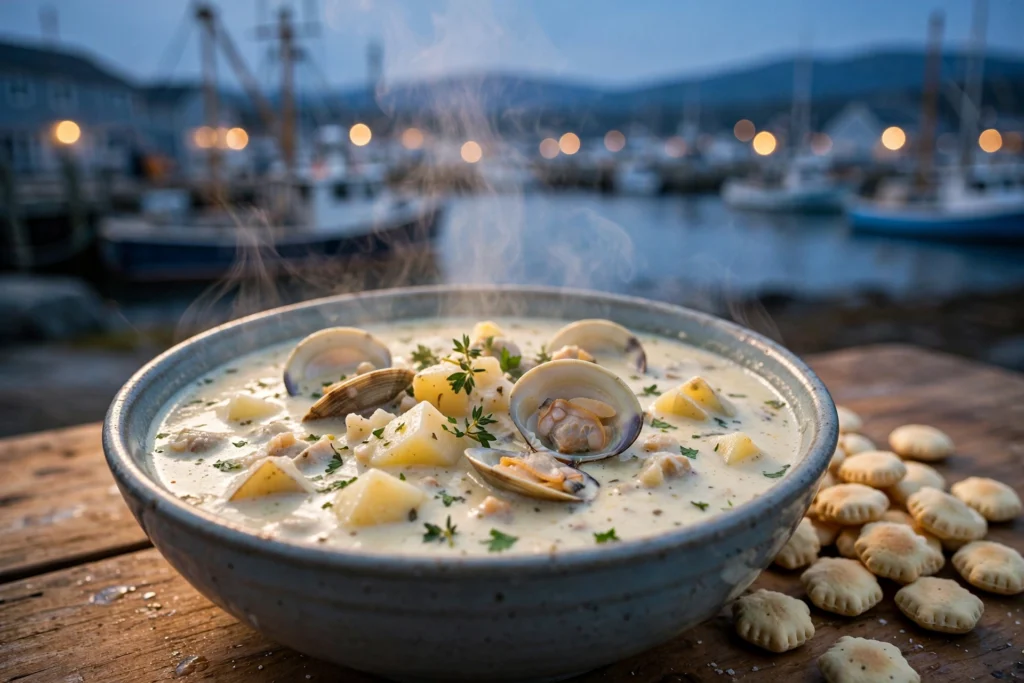
- Clam chowder, Northwest style: often made with razor clams or Manila clams, sometimes with smoked salmon added — the region’s answer to New England’s classic.
- Geoduck: the giant clam, served as sashimi — sweet, crunchy, and startling. A delicacy that divides first-timers and converts most.
- Wild mushroom risotto or pasta: fall’s essential dish, built on foraged chanterelles.
- Marionberry pie: summer’s signature dessert, with the region’s beloved blackberry cultivar.
- Smoked salmon chowder and salmon candy: the preserved-fish traditions, from Indigenous smoking to modern candied preparations.
- Teriyaki: Seattle’s beloved fast food — a legacy of Japanese immigrants, with the city’s own distinct style of char-grilled chicken or beef teriyaki over rice. It is as Seattle as the Space Needle.
Eating Through the Seasons
| Season | What Is at Its Peak | What to Eat |
|---|---|---|
| Spring | Halibut, spot prawns, morels, rhubarb | Spot prawn boils, morel dishes, rhubarb desserts |
| Summer | King salmon, berries, cherries, stone fruit | Cedar-plank salmon, marionberry pie, farm-stand fruit |
| Fall | Chanterelles, apples, pears, hazelnuts | Wild mushroom everything, apple cider, harvest menus |
| Winter | Dungeness crab, oysters, root vegetables | Crab feeds, raw oysters, hearty root-vegetable dishes |
Timing a visit around a season’s peak transforms the experience. Summer salmon season and winter crab season are the two great pilgrimages; fall mushroom season is the insider’s choice.
Seattle vs. Portland: Two Food Cities
| Seattle | Portland | |
|---|---|---|
| Character | Cosmopolitan, tech-money polish, waterfront seafood focus | Quirky, DIY, neighborhood-driven, proudly weird |
| Signature cheap eats | Teriyaki shops on every corner; Pike Place Market grazing | Food cart pods — the city’s defining dining institution |
| Seafood | The great seafood city — salmon, oysters, geoduck at their best | Excellent but less central; the focus tilts farmward |
| Drinking | Craft beer pioneer; serious cocktail scene | Beer capital (more breweries per capita than almost anywhere); natural wine, craft cider |
| Vibe | Polished Pacific Rim metropolis | “Keep Portland Weird” applied to food |
The rivalry is friendly and the correct answer is both. Seattle for the seafood temples and market mornings; Portland for the cart pods and neighborhood adventures. Together they are the two poles of Northwest food culture. For the food-truck and cart culture specifically, our best food trucks in the USA guide covers the mobile-food movement Portland helped pioneer.
Coffee, Beer, and Wine: The Beverage Culture
The Northwest’s beverage culture is as serious as its food. Coffee is a civic religion — Seattle’s roasters set the template for American third-wave coffee, and Portland’s scene is equally deep. The standard is high everywhere: even gas stations pour better coffee than most states’ cafes.
Beer is the other pillar. The region is the birthplace of American craft brewing, with hop fields in the Yakima Valley supplying the nation’s IPAs. Tasting rooms are social centers; the fresh-hop season in fall (beers brewed with just-harvested hops) is a genuine event.
Wine has quietly become world-class: the Columbia Valley and Willamette Valley produce outstanding Cabernet, Syrah, and — especially — Pinot Noir that rivals Burgundy in the eyes of many critics. Tasting-room weekends in wine country are an essential Northwest experience.
Foraging, Markets, and the Local Pantry
The Northwest’s farmers markets are among America’s best — Seattle’s Pike Place and Portland’s Saturday Market are institutions, but every town has its own. What to buy:
- In season, without exception: buy whatever is at peak — the region’s produce culture is built on seasonality, and the difference between in-season and out is dramatic.
- Foraged goods: chanterelles, huckleberries, and fiddleheads appear at markets in season, often sold by the foragers themselves.
- Smoked fish: alder-smoked salmon from market vendors makes an unbeatable souvenir.
- Craft chocolate, cheese, and cider: the region’s artisan producers cluster at markets — taste widely.
Our farmers market food guide has general strategies that apply perfectly to Northwest markets. And for the ocean-harvest celebrations, the seafood festivals guide covers the coastal events worth timing a trip around.
The Indigenous Roots: Native Foodways
Long before restaurants, the Pacific Northwest’s first food culture was perfected by the Indigenous peoples of the Coast Salish, Chinook, and dozens of other nations — a cuisine built on salmon, shellfish, camas root, wapato, huckleberries, and cedar. The techniques remain the region’s foundation: cedar-plank cooking, pit-cooking, smoking and drying salmon for winter, and the reef-net and weir fishing methods that harvested salmon sustainably for millennia.
Contemporary Indigenous chefs are reclaiming and evolving these traditions — tasting menus built on pre-contact ingredients, modern interpretations of pit-cooked feasts, and restaurants that center Native foodways as living cuisine rather than history. Seeking out Indigenous-led dining is one of the most meaningful food experiences the region offers: it connects the farm-to-table philosophy to its original practitioners and reminds you that “eating local” here is a ten-thousand-year-old idea. When you eat cedar-plank salmon, you are eating the oldest recipe in the Northwest.
Asian Influences: The Pacific Rim Kitchen
The Northwest faces the Pacific, and its food looks west as much as it looks local. Japanese immigrants built Seattle’s early fishing and farming industries and left a permanent mark — teriyaki shops, sushi of exceptional quality (the fish comes from the same cold waters), and izakaya culture. Chinese immigrants built the region’s first restaurant Chinatowns; Vietnamese communities brought pho and banh mi that rank among the nation’s best; Korean barbecue, Thai, and Filipino food all thrive.
What makes the Northwest’s Asian food distinctive is the ingredient overlap: local salmon becomes sashimi, Dungeness crab meets salt-and-pepper preparations, foraged mushrooms land in hot pots, and berries appear in Asian-inspired desserts. The fusion is not forced — it is what happens when great local ingredients meet great immigrant cooking traditions. Some of the region’s most exciting restaurants work exactly this seam, and the food cart pods are full of it.
A Perfect Food Weekend in Seattle
- Friday evening: arrive and head straight for teriyaki — the city’s signature fast food — then a craft brewery tasting room.
- Saturday morning: Pike Place Market at opening — graze the produce stalls, watch the fish throwers, eat your way through the market’s food vendors, and buy smoked salmon to take home.
- Saturday lunch: a proper seafood lunch — cedar-plank salmon or a Dungeness crab feed if in season.
- Saturday dinner: the chef’s counter or tasting menu at one of the city’s ingredient-driven restaurants — this is where the Northwest philosophy shows its full range.
- Sunday morning: coffee at a serious roaster (non-negotiable), then dim sum or a bowl of pho in the International District.
- Sunday afternoon: oysters on the half shell at a raw bar before your flight — the briny farewell.
A Perfect Food Weekend in Portland
- Friday evening: start at a food cart pod — order from three different carts and eat at the communal tables. This is Portland’s defining dining experience.
- Saturday morning: the Portland Saturday Market — the nation’s largest weekly open-air arts and crafts market, with excellent food vendors alongside.
- Saturday afternoon: brewery hopping — the city’s density of great breweries is unmatched. Fresh-hop beers in fall are the prize.
- Saturday dinner: a farm-to-table restaurant in one of the walkable neighborhoods — Portland’s chefs were doing nose-to-tail and root-to-stem before it had names.
- Sunday: brunch (Portland takes it seriously), then a wine-country drive to the Willamette Valley for Pinot Noir tasting among the vines.
For the Los Angeles counterpart to these West Coast food weekends, see our Los Angeles food guide.
Wine Country: The Willamette and Columbia Valleys
No discussion of Northwest cuisine is complete without its wines. Oregon’s Willamette Valley, south of Portland, produces Pinot Noir that wine lovers compare to Burgundy — elegant, earthy, and expressive of the valley’s volcanic and marine soils. Across the river, Washington’s Columbia Valley grows powerhouse Cabernet Sauvignon, Syrah, and Merlot in a high-desert climate of long summer days and cool nights.
Wine tasting here is refreshingly unpretentious: small family wineries, walk-in tastings, picnic tables among the vines, and winemakers who pour their own wines. The classic pairing day combines morning tasting with an afternoon farm-stand crawl and dinner at a wine-country restaurant cooking from the surrounding fields. In fall, harvest season brings crush parties and the electric atmosphere of a region making its year in a few frantic weeks. Even if wine is not your primary interest, a day in wine country is one of the Northwest’s great pleasures — the landscape alone justifies the drive.
Sustainable Seafood: Eating Responsibly
The Northwest’s seafood bounty comes with responsibility — wild salmon runs face pressure from habitat loss and climate change, and the region’s food culture is increasingly built around eating from it sustainably. What you can do: choose wild salmon in season from well-managed fisheries, ask questions at fish counters (good mongers love this), try underappreciated species like Pacific rockfish and pink salmon, and support the tribal and small-boat fisheries that harvest traditionally. The region’s chefs lead on this — many menus note the specific fishery and run — and following their lead makes you part of the solution. The ocean feeds the Northwest; eating thoughtfully keeps it that way.
Pacific Northwest Cuisine FAQ
What is Pacific Northwest cuisine known for?
Pacific Northwest cuisine is known for cold-water seafood (salmon, Dungeness crab, oysters), foraged mushrooms and berries, orchard fruit, and a farm-to-table philosophy built on seasonality. Signature dishes include cedar-plank salmon, crab feeds, and wild mushroom preparations.
What is the difference between Seattle and Portland food scenes?
Seattle leans cosmopolitan with a waterfront seafood focus and the iconic teriyaki shop culture. Portland is quirkier and neighborhood-driven, defined by its food cart pods and DIY ethos. Both share the region’s ingredient-first philosophy.
When is salmon season in the Pacific Northwest?
King (chinook) salmon season generally runs from May through September, with the prized Copper River run arriving in mid-May. Summer is peak salmon season and the best time for cedar-plank preparations at their freshest.
What are the must-try foods in the Pacific Northwest?
Prioritize cedar-plank salmon, a Dungeness crab feed (winter), raw oysters on the half shell, wild mushroom dishes in fall, marionberry pie in summer, and Seattle-style teriyaki. Each represents the region’s pantry at its best.
What is Seattle-style teriyaki?
Seattle-style teriyaki is the city’s beloved fast food — char-grilled chicken or beef with a sweet-savory glaze over rice, a legacy of Japanese immigrants. Teriyaki shops are as ubiquitous in Seattle as slice shops in New York.
Is Pacific Northwest cuisine expensive?
Fine dining can be pricey, but the cuisine’s soul is affordable: teriyaki shops, food cart pods, farmers markets, and fish-and-chips counters offer the region’s flavors at everyday prices. The markets in particular are the budget traveler’s best friend.
What is the best time of year to visit for food?
Summer (June–September) offers salmon season, berries, and farmers markets at full abundance with the best weather. Winter brings Dungeness crab season and cozy oyster bars. Fall is the insider’s pick for mushrooms and fresh-hop beers with fewer crowds.