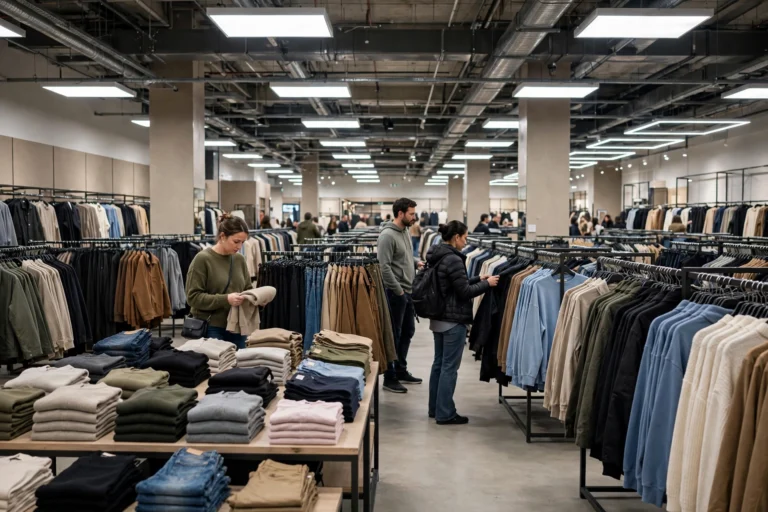
Are outlet stores really cheaper, or is the whole thing clever marketing? It’s the central question in the outlet vs retail debate — one of the most common shopping questions in America, and the honest answer is: it depends on what you’re buying, which store you’re in, and whether you know how to read the price tag. This guide breaks down the real differences between outlet and regular retail stores — pricing, quality, selection, and the “made for outlet” phenomenon — so you can shop with your eyes open.
Outlet shopping generates billions in annual US sales precisely because the value proposition feels obvious: same brands, lower prices. And often, the savings are genuinely excellent. But the outlet business model has evolved into something more complex than “last year’s stuff, cheaper” — and understanding that evolution is worth real money.
The Short Answer: Yes, But Not Always, and Not Equally
Outlet stores are typically cheaper than full-price retail stores for comparable items — usually 25 to 65 percent below original retail prices. However, “comparable” does a lot of heavy lifting in that sentence. Three scenarios cover most of what you’ll encounter:
- Genuine bargains: Past-season retail merchandise, overstock, and clearance items sold at deep discounts. These are the real deals — often 40 to 65 percent off — and the reason outlet shopping has its reputation.
- Fair value: Made-for-outlet merchandise priced moderately below similar retail items. You save money, but less than the signage suggests.
- Illusion deals: Items priced near full retail with inflated “compare at” reference prices. The discount is mostly theater.
Your job as a shopper is telling these apart. Here’s how the two formats actually differ.
Outlet vs Retail: Head-to-Head Comparison
| Factor | Outlet Stores | Regular Retail Stores |
|---|---|---|
| Pricing | Typically 25–65% below original retail; frequent extra-percentage promotions | Full price except during sales; deeper but less frequent markdowns |
| Merchandise mix | Past-season, overstock, clearance + made-for-outlet lines | Current-season collections, full assortments |
| Selection depth | Narrower; sizes and colors sell out and may not restock | Full size runs, restocked regularly |
| Quality | Varies: retail transfers match boutique quality; made-for-outlet may differ in materials/construction | Consistent brand-standard quality |
| New arrivals | Unpredictable; driven by transfers and outlet-season drops | Seasonal, predictable calendar |
| Returns | Often stricter; shorter windows, some final-sale items | Generally more generous policies |
| Shopping experience | Self-service, warehouse feel at many stores | More service, displays, and amenities |
| Price transparency | “Compare at” prices need skepticism | MSRP is the actual recent selling price |
Where Outlet Merchandise Comes From
Retail transfers and overstock
The classic outlet inventory: merchandise that didn’t sell at full-price stores, end-of-season leftovers, and overproduced items. This is typically the best value in the store — genuine retail-quality goods at 40 to 65 percent off. The catch is unpredictability: sizes are broken, colors are random, and when it’s gone, it’s gone.
Made-for-outlet lines
Here’s the part most shoppers don’t know: a large share of outlet inventory is manufactured specifically for outlet stores. These are legitimate, brand-produced items — not counterfeits — but they’re designed to hit lower price points. That can mean simpler construction, less expensive materials, fewer details, or streamlined designs compared to the brand’s retail collection.
Made-for-outlet isn’t a scam; it’s a business model. The issue is purely about value perception. A made-for-outlet jacket “marked down” from an inflated reference price might cost only slightly less than a superior retail version on sale. Judge each item on its own merits: quality, construction, and the actual price — not the strikethrough number.
Outlet-exclusive collaborations and colors
Some brands produce outlet-exclusive colorways or capsule items. These can be fun finds, but they’re priced as outlet merchandise from the start — the “discount” is built into the positioning, not a markdown from a real retail price.
How to Read an Outlet Price Tag
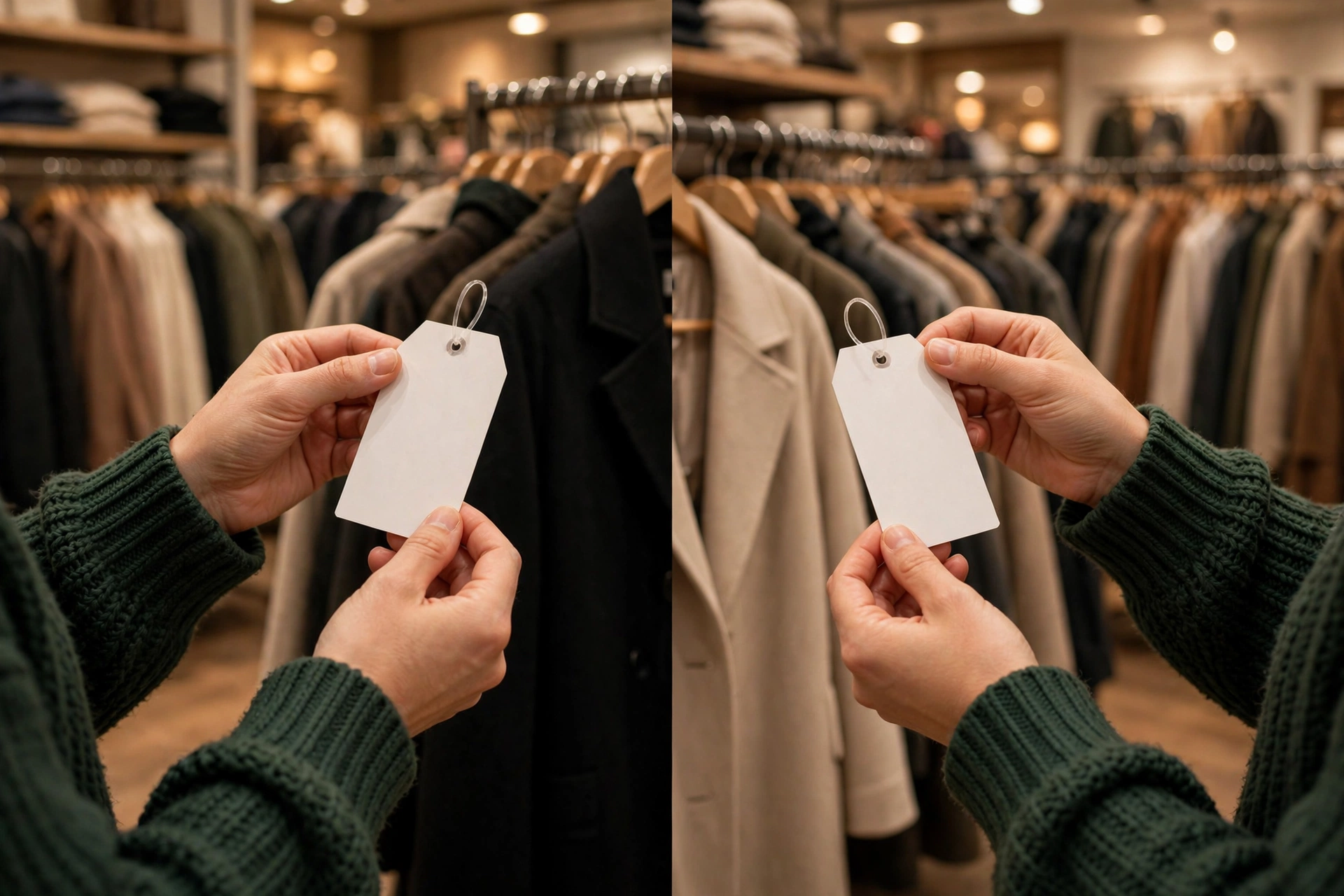
Outlet price tags are designed to make you feel like you’re winning. Decode them:
- “MSRP” or “compare at”: The reference price. For retail transfers, this is usually the genuine original price. For made-for-outlet items, it may be the price of a similar retail item — or a price the item never actually sold at. Treat it as a suggestion, not a fact.
- Outlet price: The everyday selling price at the outlet. This is the real starting point.
- Promotional price: Temporary extra discounts (e.g., “extra 20% off”). This is where stacking gets powerful.
- Clearance/red-line: Final markdowns, often the deepest discounts in the store — and often final sale.
The only number that truly matters is the out-the-door price versus what you’d pay elsewhere right now. A 30-second phone check against the brand’s website or a major retailer tells you whether the “deal” is real.
Quality Differences: What’s Real and What’s Myth
The myth: “outlet stuff is all defective”
False. Retail transfers and overstock are the same quality as what sold at full price — that’s the entire point. Defective or “irregular” items are typically marked as such and represent a small fraction of inventory.
The reality: made-for-outlet can differ
True in many cases, but the differences are often modest: a simpler lining, standard rather than premium hardware, fewer hand-finished details. For everyday items like t-shirts, jeans, and basic accessories, most shoppers will never notice or care. For investment pieces — tailored clothing, leather goods, fine outerwear — the differences matter more, and retail transfers are the better target.
How to check quality in the store
- Feel the fabric weight and check seam finishing — compare against your knowledge of the brand’s retail quality.
- Examine hardware (zippers, buttons, clasps) — this is where cost-cutting shows first.
- Check the label: many brands use distinct markings for outlet lines. Research your favorite brands’ tells before you go.
- Try it on and move around — fit and comfort issues reveal construction shortcuts.
When Outlets Win vs. When Retail Wins
Outlets usually win for…
- Athletic shoes and apparel: Brand outlets (Nike, adidas) consistently undercut retail by 30 to 50 percent on comparable models.
- Premium denim: Last-season washes and fits at steep discounts; denim doesn’t expire.
- Handbags (mid-range designers): Coach, Kate Spade, Michael Kors outlets routinely hit 40 to 60 percent off.
- Kids’ clothing: Kids outgrow everything; outlet pricing plus growth spurts are a natural match.
- Basics and underwear/socks: Low-risk, high-volume categories where outlet pricing shines.
Regular retail (on sale) often wins for…
- Electronics: Outlet electronics “deals” are frequently matched by online retailers. Always comparison-shop.
- Current-season fashion: If you want this season’s exact look, retail is the only option — outlets trail by a season or more.
- Items needing expert fitting: Suits, bras, and technical gear benefit from full-service retail environments.
- Gifts with return flexibility: Generous retail return policies matter when you’re guessing someone’s size.
For the full bargain-hunting spectrum beyond outlets, our thrift store shopping tips and best flea markets and swap meets guides cover the next levels down in price.
The Math: A Realistic Savings Example
Consider a hypothetical shopping list — using typical ranges, not specific prices, since promotions vary:
- Running shoes: Retail typically $120–$180; outlet typically $70–$110. Real savings: roughly 35–45%.
- Designer handbag: Retail typically $300–$500; outlet typically $150–$280. Real savings: roughly 40–50%.
- Premium jeans: Retail typically $130–$200; outlet typically $60–$100. Real savings: roughly 45–55%.
- Winter coat: Retail typically $250–$400; outlet typically $130–$220. Real savings: roughly 40–50%.
These are representative ranges — your mileage varies by brand, season, and promotion stacking. The pattern is consistent: expect genuine savings of roughly a third to a half on comparable goods, with the deepest cuts on clearance.
Five Rules for Outlet vs. Retail Decisions
- Always check the current retail price on your phone. The single habit that prevents every outlet trap.
- Ask whether an item is made for outlet. Associates will usually tell you; it reframes the value instantly.
- Never trust the “compare at” price alone. It’s marketing until verified.
- Factor in return policies. A slightly higher retail price with a 60-day return window can beat a final-sale outlet price for uncertain purchases.
- Consider total cost. Driving an hour each way for a $15 saving is a loss once fuel and time are counted. Make outlet trips count with a real list.
Timing matters too — our what to buy each month guide shows when both outlets and retail stores discount hardest, and best shopping deals 2026 tracks the year’s biggest promotions across formats.
Why the Outlet Format Exists: The Business Model
Outlets aren’t charity — they’re a solution to the fashion industry’s inventory problem. Understanding the business model explains everything about the shopping experience:
- The inventory problem: Brands deliberately overproduce because stockouts cost more than overstock. The excess has to go somewhere — outlets are the controlled channel for it, preferable to flooding third-party discounters and eroding brand image.
- Customer segmentation: Outlets let brands serve price-sensitive shoppers without discounting the full-price boutique experience. The same company captures both the $500-handbag customer and the $200-handbag customer without either feeling cheated — mostly.
- The made-for-outlet margin: Purpose-built outlet lines are engineered for outlet economics: lower production costs, prices that feel discounted, margins that stay healthy. It’s a product line designed around the perception of a deal — which is why verification matters.
- Traffic as marketing: Flagship outlet centers are brand billboards. A shopper who buys a made-for-outlet bag today may buy boutique in five years. Outlets are customer-acquisition channels, not just clearance bins.
None of this is nefarious — it’s rational business. But it means the outlet store’s incentives and yours aren’t perfectly aligned: the store wants you to feel like you got a deal; you want to actually get one. Verification bridges the gap.
Three Products, Three Channels: A Price Walkthrough
How the same shopping mission plays out across channels — using typical ranges:
Running shoes (last season’s model)
- Brand retail store: Full price on current model (typically $130–$180); last season’s model may be gone entirely.
- Brand factory outlet: Last season’s model typically $75–$115 (roughly 35–45% off original). Best channel for this mission.
- Online (brand site sale): Comparable at typically $85–$120 during site-wide promotions — competitive, but you can’t try on.
- Verdict: Outlet wins if your size is in stock; online is the backup.
Designer handbag (accessible luxury)
- Boutique: Current collection, full price (typically $350–$550), best service and return policy.
- Brand outlet: Past-season transfer typically $175–$275 (roughly 40–50% off); made-for-outlet piece typically $150–$250 with thinner real discount.
- Online resale: Pre-owned boutique pieces often match outlet transfer prices — but condition and authenticity verification are on you.
- Verdict: Outlet transfers are the value sweet spot; verify it’s a transfer, not an outlet-line piece at a transfer price.
Premium jeans
- Brand retail: Current washes, typically $130–$200.
- Brand outlet: Last-season washes typically $60–$100 (roughly 45–55% off). Denim doesn’t expire — functionally identical product.
- Department store sale: Typically $90–$130 during promotions — occasionally competitive, rarely better.
- Verdict: Outlet is almost always the best channel for denim. The simplest win in outlet shopping.
The Smart Shopper’s Channel Strategy
Stop thinking “outlet vs. retail” as a loyalty question and start thinking of it as a channel toolkit:
- Outlets for planned brand-specific purchases where past-season is fine (shoes, denim, bags, kids’ clothes).
- Full-price retail for current-season wants, expert fitting, and generous returns — ideally timed to seasonal sales.
- Brand websites for price verification, online-exclusive outlet sections, and Cyber-Monday-style events.
- Off-price stores (TJ Maxx, Marshalls, Nordstrom Rack) for treasure-hunt variety across brands.
- Thrift and resale for the deepest discounts and sustainability — our thrift store guide covers the playbook.
Shoppers who use all five channels — each for what it does best — consistently out-save shoppers loyal to any single one. The outlet vs. retail debate has a winner, and it’s “both, strategically.”
Edge Cases: When the Rules Bend
A few situations where the standard outlet-vs-retail guidance needs nuance:
- Wedding and event outfits: The occasion is date-locked, which kills your ability to wait for transfers or clearance. Retail (or retail on sale) usually wins — the certainty of having the right outfit on the right date outweighs potential outlet savings.
- Hard-to-fit bodies: If you wear uncommon sizes, outlets’ broken size runs work against you. Retail’s full size availability — or online’s extended sizing — is worth the premium.
- Professional wardrobes: Suits, blazers, and workwear benefit from tailoring and consistent quality. A retail suit on seasonal sale (typically 30–40% off) often beats an outlet suit of uncertain construction.
- Collectible sneakers: Limited releases rarely reach outlets in meaningful quantities; when they do, they’re picked over instantly. Retail raffles and reputable resale are the realistic channels.
- One-time needs: A costume, a maternity dress, a single-event outfit — buy the cheapest acceptable option anywhere (thrift, off-price, fast fashion). Channel optimization is wasted on single-use items.
- Gifts for picky recipients: Generous return policies beat lower prices. A gift that can’t be easily exchanged is a liability, not a bargain.
The 60-Second In-Store Decision Framework
For any item you’re considering, run this sequence — it takes about a minute with practice:
- Seconds 0–15: Identify. Is it a retail transfer or made-for-outlet? Check labels, ask if unsure.
- Seconds 15–35: Verify. Phone-check the current retail price of the same or comparable item. Compute the real discount off that number, not the tag’s reference.
- Seconds 35–50: Stack. What coupons, promotions, and loyalty rewards apply? Compute the out-the-door price.
- Seconds 50–60: Decide. Does the final price beat your threshold (or the best alternative channel)? Yes → buy. No → put it back and walk away without regret.
Sixty seconds per item feels slow until you realize it prevents the $80 “deal” that wasn’t one. Speed comes with practice; discipline comes with the list.
Frequently Asked Questions
Are outlet stores really cheaper than retail stores?
Typically yes — outlet vs retail comparisons usually show 25 to 65 percent savings on comparable items. But the gap varies: past-season transfers offer the deepest real discounts, while made-for-outlet lines may be priced only modestly below retail equivalents.
Is outlet clothing lower quality?
Retail-transfer merchandise is identical in quality to what sold at full price. Made-for-outlet lines are brand-authentic but may use simpler materials or construction to hit lower price points. Neither is “fake” — but they’re not always the same product.
What does “compare at” mean on outlet price tags?
It’s a reference price suggesting what the item (or a similar item) sold for elsewhere. For retail transfers it’s usually accurate; for made-for-outlet items it may reference a similar-but-different product. Always verify against current retail prices.
Are outlet deals better than online sales?
Sometimes. Outlets win for try-before-you-buy categories and immediate gratification; online wins for electronics, niche sizes, and price-comparison ease. Smart shoppers check both — many brands’ websites show outlet-exclusive online sections too.
Do outlets have the same return policy as retail stores?
Often not. Outlet return windows tend to be shorter, and clearance items are frequently final sale. Check the policy before buying, especially for gifts or uncertain fits.
Is it worth driving far to an outlet mall?
It depends on the size of your planned purchase. For a single small item, usually not — fuel and time erase the savings. For a planned multi-store trip with a real list, the best outlet centers absolutely justify the drive.