Nowruz — “new day” in Persian — is the ancient New Year celebrated by more than 300 million people across Iran, Central Asia, the Caucasus, and diaspora communities worldwide. Timed to the March equinox (around March 20 each year), it is one of humanity’s oldest continuously observed festivals, with roots reaching back over three thousand years to Zoroastrian Persia. For thirteen days, families gather around the Haft-Sin table, visit elders, picnic in the spring countryside, and welcome the new year not with a countdown but with the exact astronomical moment of the equinox. This guide explores Nowruz’s history, its rituals, the symbolism of the Haft-Sin, and how the festival is celebrated from Tehran to Tajikistan to Toronto.
What makes Nowruz remarkable is its resilience. It survived the fall of empires, the Arab conquest, the Mongol invasions, and the rise and fall of dynasties — absorbing influences from each era while keeping its essential character: a celebration of renewal, nature, and family at the moment winter releases its grip. In 2009, UNESCO inscribed Nowruz on its Representative List of the Intangible Cultural Heritage of Humanity, and the United Nations recognizes March 21 as the International Day of Nowruz. It is, by any measure, a world heritage festival.
When Is Nowruz? The Exact Moment of the New Year
Nowruz begins at tahvil — the precise astronomical instant of the March equinox, when the sun crosses the celestial equator and day and night are nearly equal worldwide. This moment is calculated to the second and announced each year; it usually falls on March 20 (occasionally March 21), and its exact time shifts by time zone. Families gather around the Haft-Sin table in the minutes before tahvil, counting down not to midnight but to the equinox itself, then embrace, exchange greetings (“Nowruz Mobarak” or “Eid-e Shoma Mobarak”), and share a festive meal.
The equinox timing is no accident. Nowruz belongs to a family of spring new years tied to the solar cycle rather than the moon — a different logic from the lunisolar calendars behind Chinese New Year or Thailand’s Songkran. Where lunar new years drift across weeks, Nowruz is pinned to astronomy: the new year begins when nature itself turns the page. That precision is part of the festival’s poetry — millions of people, from Istanbul to Islamabad, marking the same celestial instant in their own local hour.
Three Thousand Years of New Day: The History
Nowruz’s origins lie in ancient Persia and the Zoroastrian tradition, one of the world’s oldest religions, which venerated the forces of light, truth, and the natural order. The festival is associated with the mythical King Jamshid, who in Persian legend established the new year celebration, and it was certainly observed during the Achaemenid Empire (550–330 BCE) — the great Persian empire of Cyrus and Darius. The ruins of Persepolis, the empire’s ceremonial capital, contain reliefs showing gift-bearing delegations from across the empire ascending the staircases, widely interpreted as depictions of New Year tribute ceremonies.
What followed is a story of extraordinary cultural endurance. Nowruz survived Alexander’s conquest, flourished under the Parthians and Sasanians (who made it a central court festival), persisted through the Islamic conquest of Persia in the 7th century — when many pre-Islamic customs were suppressed — and was embraced and elaborated by Persian culture under Islamic rule. The Mongol Ilkhanids, the Safavids, the Qajars: each era added layers. The festival’s survival strategy was its universality — it celebrated spring, family, and renewal, themes no regime found threatening enough to extinguish. Today it is a national holiday in Iran (a thirteen-day public holiday), Afghanistan, Tajikistan, Azerbaijan, Uzbekistan, Turkmenistan, Kyrgyzstan, Kazakhstan, and parts of Turkey, Iraq, Syria, India (among Parsis), and beyond.
The Weeks Before: Khaneh Tekani and Growing the Sabzeh
Nowruz begins long before the equinox — in the cleaning. Khaneh tekani (literally “shaking the house”) is the thorough spring cleaning undertaken in the weeks before the new year: every carpet beaten, every window washed, closets purged, the whole home aired and renewed. It is practical housekeeping elevated to ritual — the physical enactment of the year’s theme. Many families time major purchases (new clothes, fresh linens, sometimes appliances) to the pre-Nowruz weeks, so the new year is entered with new things.
Alongside the cleaning comes the slow cultivation of sabzeh, the sprouted greens for the Haft-Sin table. Wheat berries, barley, or lentils are soaked and spread on a plate or in a shallow dish about two to three weeks before the equinox, kept damp and in indirect light until they grow into a lush green mound — sometimes shaped over a wire frame into decorative forms. Tending the sabzeh is a small daily meditation on growth: you are literally growing the new year on your windowsill. Children are often given charge of a small dish of their own, learning patience as the shoots rise day by day. By tahvil, a well-grown sabzeh is a point of family pride.
The pre-Nowruz weeks also bring the Haji Firuz tradition to the streets: performers with blackened faces and red costumes, tambourines in hand, singing the traditional new-year songs and dancing for coins. The custom’s origins are debated and its imagery is contested in modern Iran, but it remains a vivid street-level herald of the coming festival — like a town crier announcing that the year is about to turn.
The Haft-Sin: Reading the New Year’s Table
The centerpiece of Nowruz is the Haft-Sin (or Haft-Seen) — a table setting of seven items whose Persian names all begin with the letter sin (س), each symbolizing a hope for the new year. Families arrange it with care in the days before the equinox, and it stays up through the thirteen days of celebration:
| Item | Persian | Symbolism |
|---|---|---|
| Sabzeh | سبزه | Sprouted wheat, barley, or lentils — rebirth and growth; grown for weeks before Nowruz |
| Samanu | سمنو | Sweet wheat-germ pudding — affluence, fertility, and the sweetness of life |
| Senjed | سنجد | Dried oleaster fruit — love and wisdom |
| Seer | سیر | Garlic — medicine, health, and protection |
| Seeb | سیب | Apples — beauty and vitality |
| Somaq | سماق | Sumac berries — the color of the sunrise; victory of light |
| Serkeh | سرکه | Vinegar — age, patience, and acceptance |
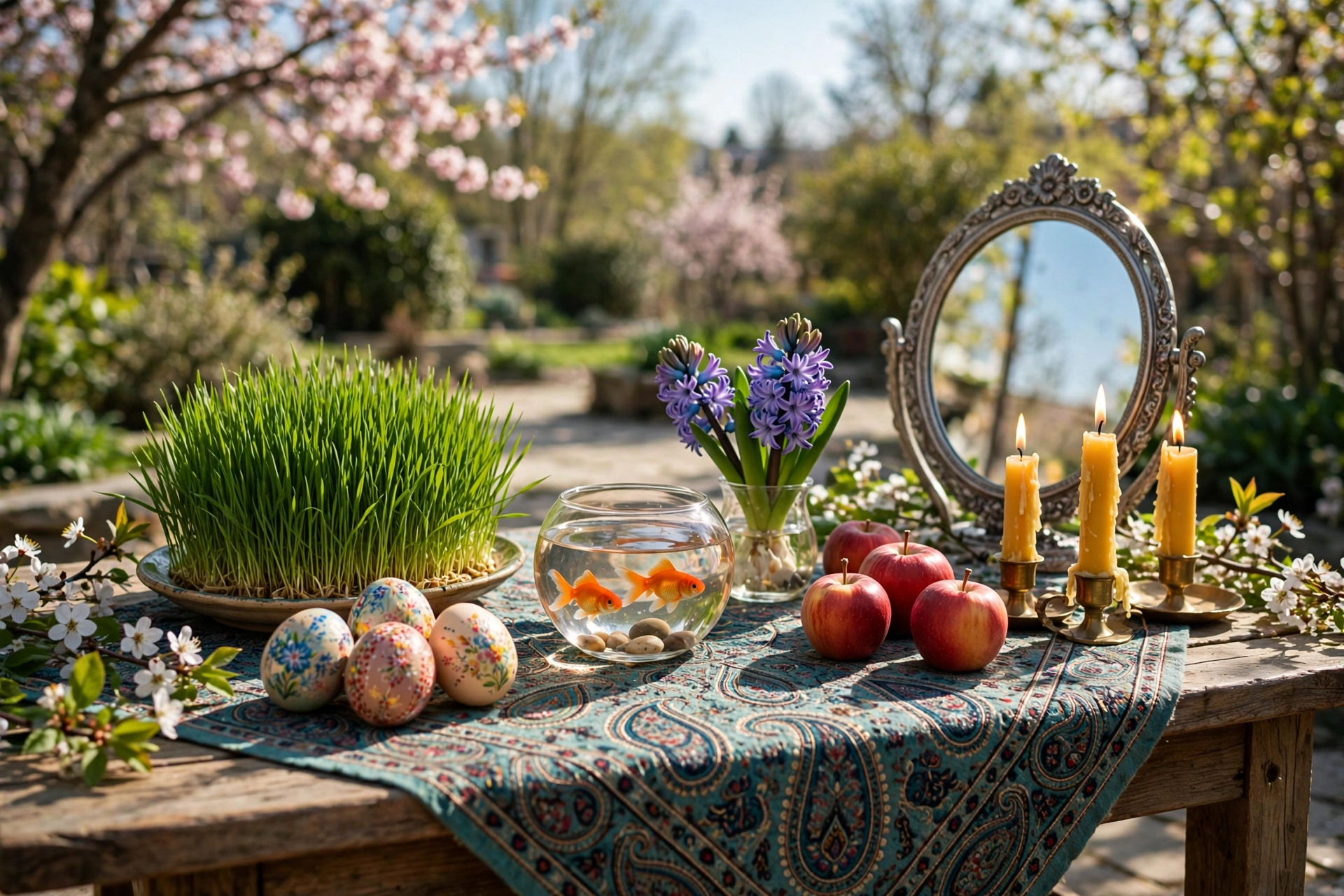
Around the seven S’s gather supporting symbols: a mirror (reflection and honesty), candles (light and happiness, often one per family member), painted eggs (fertility), a bowl with a goldfish (life and movement), hyacinths (spring’s arrival), coins (prosperity), and a book of wisdom — the Quran for Muslim families, the Shahnameh (Persia’s great epic), the Avesta for Zoroastrians, or Hafez’s Divan, whose verses are used for bibliomancy, opening a random page for guidance. In Afghanistan, the table is sometimes a Haft-Mewa — seven dried fruits and nuts — and the festival is called Nawroz with its own distinct customs. The Haft-Sin is less a decoration than a manifesto: this is what we wish for, arranged where we can see it.
The Thirteen Days: From Fire Jumping to Nature Day
Nowruz is not a single day but a thirteen-day season, bracketed by two beloved rituals:
Chaharshanbe Suri: the fire festival (the eve of the last Wednesday before Nowruz)
On the Tuesday evening before the equinox, Iranians build bonfires in streets and courtyards and jump over them chanting “Sorkhi-ye to az man, zardi-ye man az to” — “give me your redness, take away my pallor.” The fire is understood to burn away the past year’s sickness and misfortune and lend its vitality. It is the festival’s wildest night: fireworks, music, crowds in the streets, and a palpable sense of collective release. The custom predates Islam by millennia and remains one of Iran’s most enthusiastically observed traditions.
The first days: visiting and the new year’s table
The days after tahvil are devoted to did-o-bazdid — visiting. Elders are visited first; the young receive eidi (New Year gifts, often crisp banknotes) from their elders. Homes are open, tables are laden with sweets, nuts, and fruit, and the social calendar fills with reciprocal visits. It is a structured, warm choreography of respect: you go to your elders before they come to you.
Sizdah Bedar: Nature Day (the thirteenth day)
On the thirteenth day, tradition holds that staying indoors brings bad luck — so the entire country goes outside. Families picnic in parks, by rivers, and in the mountains; the sabzeh from the Haft-Sin table is taken along and released into flowing water, returning the sprouted greens to nature and symbolically casting away any misfortune the new year might hold. Young people tie knots in grass blades while making wishes for love and marriage. Sizdah Bedar is Nowruz’s joyful exhale: after days of ritual and visiting, the new year ends its opening season with a nationwide picnic.
Nowruz Around the World
- Iran: the fullest expression — thirteen-day national holiday, Chaharshanbe Suri, Haft-Sin, did-o-bazdid, Sizdah Bedar. The weeks before see the great khaneh tekani (literally “shaking the house”) — a thorough spring cleaning that is itself a ritual of renewal.
- Afghanistan: Nawroz centers on Mazar-i-Sharif, where the Gul-i-Surkh (Red Flower) festival marks forty days of celebration and the famous flag-raising (Jahenda Bala) at the Blue Mosque draws huge crowds. Buzkashi (goat polo) tournaments are traditional.
- Tajikistan and Central Asia: Nowruz was suppressed under Soviet rule and revived with independence — in Tajikistan it is now a major national holiday with presidential addresses, concerts, and the traditional sport displays. Sumalak, a sweet wheat porridge cooked communally overnight, is the festival dish.
- Azerbaijan: Novruz features the characters Kosa and Kechal in street performances, bonfires on the four Tuesdays before the holiday (each dedicated to an element: water, fire, earth, wind), and painted eggs.
- Kurdish Newroz (March 21): celebrated with bonfires on mountaintops, traditional dancing (halay), and powerful symbolism of resistance and identity — particularly significant for Kurdish communities across Turkey, Iraq, Syria, and Iran.
- Turkey: Nevruz is observed especially in eastern regions and by Alevi communities.
- Parsis of India: observe Nowruz (often in August by the Shahenshahi calendar, with the vernal equinox also marked) with prayers, festive meals, and community gatherings.
- Diaspora: from Los Angeles (“Tehrangeles”) to Toronto to London, Iranian diaspora communities set Haft-Sin tables in shop windows, hold public celebrations, and keep the thirteen days alive far from home.
Setting Your Own Haft-Sin: A Respectful Beginner’s Guide
You do not need to be Persian to appreciate the Haft-Sin — many non-Iranian households and classrooms set one as a spring ritual of intention. The essentials: grow sabzeh by sprouting wheat berries or lentils on a damp plate about two weeks ahead; gather the seven S items (most are available at Middle Eastern grocers); add a mirror, candles, and something beautiful that represents wisdom to you. Arrange everything symmetrically and keep it through early April. If you are invited to a Nowruz celebration, bring sweets, pastries, or flowers; greet your hosts with “Nowruz Mobarak”; and let them explain their table — every family’s Haft-Sin has its own stories. Approach the tradition the way you would any sacred observance: with curiosity, respect, and an appetite for the sweets.
Spring new years share a common grammar of renewal across cultures. If the idea of a deliberate fresh start resonates, our New Year reset guide translates the same impulse — cleaning, reflection, intention — into a practical modern framework.
Nowruz Foods: What the New Year Tastes Like
Every Nowruz table tells its story in food as well as symbols. The essential dishes:
- Sabzi polo ba mahi: herbed rice with fish — the canonical Nowruz dinner, eaten on the eve of the new year. The rice is green with parsley, cilantro, dill, and fenugreek; the fish (often white fish) represents life and abundance. For many families, this single dish is the taste of Nowruz.
- Ash-e reshteh: a thick noodle soup with beans, lentils, and herbs, topped with kashk (whey) and fried onions. The noodles symbolize the threads of life and good fortune; it is traditional on Chaharshanbe Suri night.
- Kuku sabzi: a vibrant herb frittata, green as spring itself, studded with barberries and walnuts.
- Samanu: the sweet wheat-germ pudding of the Haft-Sin, cooked slowly for hours — in some communities, communally, with women gathering to stir the pot overnight and make wishes.
- Sweets and nuts: baklava, nan-e berenji (rice-flour cookies), qottab, and bowls of pistachios, almonds, and hazelnuts for guests during the visiting days. No guest leaves a Nowruz house without something sweet in hand.
- Sumalak (Central Asia): the communal wheat porridge cooked overnight in huge cauldrons, with singing and storytelling while it simmers — the taste of Nawroz from Dushanbe to Samarkand.
The visiting days run on hospitality: hosts lay out the sweets and nuts, guests are pressed to eat, tea flows continuously. It is a two-week demonstration of the Persian art of taarof — the elaborate ritual politeness of offering and (politely) refusing and offering again.
The Poetry of Nowruz: Hafez and the New Year
No culture has woven poetry into its new year quite like Persia’s. The Divan of Hafez — the 14th-century poet whose verses are close to scripture for many Iranians — sits on the Haft-Sin table, and the practice of faal-e Hafez (bibliomancy with Hafez) peaks at Nowruz: you make a wish or ask a question, open the Divan at random, and read the poem as guidance. Families do it together on New Year’s Eve, half game and half oracle.
The Shahnameh, Ferdowsi’s great epic, supplies the festival’s mythology — the story of Jamshid, who legend credits with founding Nowruz. Reciting or simply displaying the Shahnameh at the new year connects the household to a continuous Persian identity stretching back a millennium. And the poetry of spring itself — Rumi, Saadi, and countless folk songs — provides the season’s soundtrack. A Nowruz without poetry would feel, to many Iranians, like a table without the Haft-Sin: technically complete, spiritually empty.
Greetings, Gifts, and Eidi: The Social Customs
The thirteen days of Nowruz run on visiting, and the visiting runs on ritual politeness. The greeting is “Nowruz Mobarak” (blessed Nowruz) or the fuller “Eid-e Shoma Mobarak” (blessed be your holiday) — said with embraces, often three cheek kisses among family. Elders receive visits first; it would be poor form for a grandparent to call on a grandchild before the reverse has happened.
Eidi — the New Year gift — is the children’s highlight: crisp banknotes, often in new bills, given by elders to the young. The crispness matters; banks in Iran do a brisk business in fresh notes before the holiday. Adults exchange sweets, pastries, flowers, or small gifts, and hosts compete in hospitality — the table must never look empty, the tea must never stop, and guests must be pressed to eat at least twice before their polite refusals are accepted. This is taarof in its festive form: generosity as choreography. If you receive eidi as a guest, accept with both hands and genuine thanks; if you are the elder giving it, the crispness of the bills is noticed and appreciated.
Nowruz by the Numbers
- 3,000+ years of continuous observance, from Achaemenid Persia to today
- 300+ million people celebrate across more than a dozen countries
- 13 days of celebration, from tahvil to Sizdah Bedar
- 7 items on the Haft-Sin table, each beginning with the Persian letter sin
- 2009: the year UNESCO inscribed Nowruz as Intangible Cultural Heritage of Humanity
- March 21: the UN’s International Day of Nowruz
In Pictures: Nowruz: Persian New Year Traditions
At the exact moment of the spring equinox, millions welcome Nowruz — thirteen days of renewal rooted in millennia of tradition. Here's the new year, blooming.

A traditional Nowruz Haft-Seen table: seven symbolic items, painted eggs, a mirror, candles, and hyacinths in spring sunlight.
Watch: Nowruz: Persian New Year Traditions
The history of Nowruz explained in 3 minutes — the Persian New Year's ancient roots and living traditions.
At a Glance: Nowruz: Persian New Year Traditions
The essentials of Nowruz.
| Fact | Detail | Note |
|---|---|---|
| When | Spring equinox, ~March 20/21 | 2026's equinox falls on Friday, March 20 |
| Age | Over 3,000 years | Roots traced to Zoroastrian traditions of ancient Persia |
| Haft-Seen | Seven 'S' items | Sabzeh, samanu, senjed, seer, seeb, serkeh, somāq — each symbolic |
| Chaharshanbe Suri | Fire-jumping eve | Bonfires on the last Tuesday eve before Nowruz |
| Sizdah Bedar | 13th day outdoors | The festival closes with a day in nature |
| Where celebrated | Iran, Central Asia, Caucasus, and beyond | Observed by an estimated 300 million people |
Frequently Asked Questions
When is Nowruz?
Nowruz begins at the exact moment of the March equinox (tahvil) — usually March 20, occasionally March 21 — and the celebrations run for thirteen days, ending with Sizdah Bedar (Nature Day). The equinox moment is calculated astronomically each year and announced in advance.
What does Nowruz mean?
“New day” in Persian (نوروز). It is also spelled Nawroz, Novruz, Newroz, or Nevruz depending on the language and region — all the same festival.
Is Nowruz a religious holiday?
Its roots are Zoroastrian, but today it is primarily a cultural and national celebration observed by Muslims, Zoroastrians, Baha’is, and others alike — and by many secular families as a heritage festival. It is a public holiday in more than a dozen countries regardless of religion.
What are the seven items of the Haft-Sin?
Sabzeh (sprouted greens), samanu (sweet pudding), senjed (dried oleaster fruit), seer (garlic), seeb (apples), somaq (sumac), and serkeh (vinegar) — seven items beginning with the Persian letter sin, symbolizing rebirth, affluence, love, health, beauty, sunrise, and patience.
Why do people jump over fire before Nowruz?
Chaharshanbe Suri, on the last Tuesday evening before the equinox, uses bonfires as purification: jumping over the flames while chanting “give me your redness, take away my pallor” symbolically burns off the old year’s ills and borrows the fire’s vitality. It is an ancient Zoroastrian-era custom of honoring fire as a purifying element.
How is Nowruz different from Chinese New Year?
Nowruz is solar — pinned to the March equinox — while Chinese New Year is lunisolar and falls in January or February. Nowruz centers on nature, the Haft-Sin table, and thirteen days of visiting and picnicking; Chinese New Year centers on family reunion, red envelopes, and fifteen days of feasting. Both, however, share the deep structure of all new years: cleaning the old, honoring elders, and eating your hopes. See our Chinese New Year 2027 guide for the full comparison.
Nowruz has outlasted empires because it celebrates something no empire owns: the return of spring. In a world of manufactured holidays, there is something profoundly grounding about a new year that begins at an astronomical instant — the same moment, measured the same way, for three thousand years. Nowruz mobarak.
Visiting During Nowruz
Experiencing Nowruz in Iran, Tajikistan, or Azerbaijan is unforgettable — and requires planning around the thirteen-day national holiday, when domestic travel peaks, hotels fill, and many businesses close for the first several days. The sweet spot for visitors is the second week: the visiting days are in full swing, Sizdah Bedar offers the great outdoor picnic finale, and the spring weather is at its best. In Tajikistan and Uzbekistan, the sumalak-cooking nights and public concerts are accessible and welcoming to outsiders. Wherever you go, learn the greeting (Nowruz Mobarak), accept every offer of sweets, and let hosts explain their Haft-Sin — the table is the conversation.