In the Philippines, New Year’s Eve is not just a party — it is one of the two great family feasts of the year, rivaled only by Christmas. As midnight approaches on December 31, Filipino families across the archipelago — and in diaspora communities from California to Dubai to Singapore — gather around tables groaning with food for Media Noche, the midnight meal. Children wear polka dots for luck, bowls of round fruits promise prosperity, and at the stroke of twelve, the entire country erupts in noise: fireworks, horns, pots banged with spoons, and children jumping as high as they can. This is the Filipino New Year — loud, abundant, deeply superstitious, and above all, together.
This guide explains the traditions that define New Year in the Philippines: Media Noche, the round-fruit custom, the lucky rituals, and how families at home and abroad keep them alive.
Media Noche: The Midnight Feast
Media Noche — Spanish for “midnight” — is the centerpiece of the Filipino New Year. The feast is served as the clock approaches twelve, and the family eats together as the year turns. The symbolism is direct: a table overflowing with food at the year’s first moment promises abundance for the twelve months ahead. An empty or meager table, by older belief, invites scarcity.
The spread is lavish by design. A typical Media Noche table might include lechon (whole roasted pig) or lechon kawali, pancit (noodles for long life), lumpiang Shanghai, barbecue skewers, hamonado or Christmas ham, queso de bola (edam cheese, a holiday staple), fruit salad, leche flan, and rice — always rice, the foundation of the Filipino table. Families cook for days; the kitchen on December 30 and 31 is a production line of chopping, roasting, and wrapping.
What matters as much as the menu is who is at the table. Media Noche is a homecoming. Overseas Filipino workers time their vacations around it, students return from Manila or Cebu to their home provinces, and extended families — grandparents, aunts, uncles, cousins — crowd into the family home. A Filipino New Year without the full clan feels incomplete, which is why the holiday travel crush in the Philippines rivals any in Asia.
Round Fruits: Twelve Circles of Prosperity
The most visually distinctive Filipino New Year tradition is the display of round fruits. The logic is pure sympathetic magic: coins are round, so round things attract wealth. Families arrange bilog na prutas — round fruits — in bowls and baskets as a centerpiece, and the ideal is twelve different kinds, one for each month of the year.
Which Fruits, and Why
The classic twelve include grapes, oranges, apples, watermelon, melon, pineapple, pomelo, kiat-kiat (small mandarins), lanzones, rambutan, chico, and coconut — though the exact selection depends on what is in season and available at the market. Grapes are nearly mandatory: their clustered roundness reads as multiplied wealth. Watermelons and melons provide the big, impressive centerpieces.
The fruits serve double duty. Before midnight, they are decoration and symbolism; after the feast, they are dessert. Nothing is wasted — the prosperity is meant to be eaten, shared, and enjoyed, which is rather the point. Some families also scatter coins around the fruit bowls or place coins inside the rice container, doubling down on the wealth symbolism.
The Economics of the Fruit Rush
Visit any Filipino market on December 30 or 31 and you will see the tradition in economic action: fruit vendors do some of their best business of the year, prices for round fruits spike, and shoppers hunt for the full set of twelve. It is one of the clearest examples anywhere in the world of a folk belief driving a visible, measurable market pattern. If you are hosting your own Media Noche, buy fruit a day or two early — selection and prices are both better before the last-minute rush.
Polka Dots, Loud Noises, and Lucky Rituals
The Filipino New Year is built on a joyful pile of superstitions, most of them aimed at prosperity, health, and protection from bad luck. Many trace to a blend of indigenous, Spanish-colonial, and Chinese influences — the Philippines’ cultural layers, expressed as party customs.
Wear Something Round: The Polka-Dot Rule
On New Year’s Eve, Filipinos wear polka dots. Shirts, dresses, pajamas — the round pattern echoes the round-fruit logic: circles attract coins, coins attract wealth. Children are dressed head to toe in dots, and adults who would never otherwise wear the pattern dig out their spottiest clothes for the occasion. It is playful, it photographs well, and everyone participates, from toddlers to grandparents.
Make Noise: Scaring Away Evil Spirits
At midnight, the Philippines gets loud — deliberately so. The belief is that loud noise drives away evil spirits and bad luck. Firecrackers and fireworks are the traditional instruments, and despite safety campaigns, the crackle of paputok is the soundtrack of the Filipino New Year. Families also bang pots and pans with ladles, blow torotot (party horns), honk car horns, and shout. The goal is maximum volume at the exact moment of midnight.
In recent years, many communities and local governments have organized centralized fireworks displays as a safer alternative to household firecrackers, and firecracker-related injuries — a serious annual public-health concern — have declined where these alternatives and regulations are enforced. The noise tradition itself, though, shows no sign of fading; it has simply moved partly from private firecrackers to shared celebrations.
Jump for Height, Fill Your Pockets
Children are told to jump as high as they can at midnight — the higher the jump, the taller they will grow in the new year. It is a beloved ritual, and photographs of Filipino kids mid-leap at midnight are a New Year staple. Adults have their own version: fill your pockets with coins (or scatter coins around the house) so the new year finds you with money on your person. Some families also leave all the lights on and open doors and windows at midnight to let good fortune in and bad luck out.
Sticky Rice and Sweet Beginnings
Serving something sticky — like biko (sweet rice cake) or other malagkit desserts — is believed to help good fortune “stick” to the family. Starting the year with something sweet is, as in many cultures, a way of wishing for a sweet year ahead. The Filipino version just takes the metaphor literally, which is part of its charm.
Family Reunions: Why New Year Is a Homecoming
If Christmas in the Philippines is about the extended celebration, New Year is about the reunion itself. The Filipino diaspora — one of the world’s largest, with millions of overseas workers — treats the holidays as the annual return. Airports in Manila, Cebu, and Davao swell in the last two weeks of December; bus terminals overflow; and the phrase “balikbayan” (returning Filipino) is everywhere.
The emotional core of Media Noche is this gathering. The feast matters, the fireworks matter, but what people remember years later is who was at the table — the grandmother who has since passed, the cousin home from abroad, the new baby experiencing their first midnight. Filipino New Year traditions are, at root, technologies of togetherness: rituals designed to get everyone in the same room at the same moment.
For families separated by distance who cannot reunite, video calls during Media Noche have become a tradition of their own. It is common for a phone to be propped up at the feast table so an OFW parent in Riyadh or Singapore can watch their children jump at midnight. The ritual adapts; the togetherness persists.
Regional Variations: Luzon, Visayas, Mindanao
The core traditions — Media Noche, round fruits, noise — are national, but regions add their own flavors.
Luzon
In Manila and surrounding provinces, the celebration is the most cosmopolitan: hotel parties, village (barangay) fireworks, and massive family feasts. Pampanga, the country’s culinary capital, takes Media Noche particularly seriously — Kapampangan families are famous for the scale and quality of their holiday cooking. In the Ilocos region, the feast leans on local specialties like bagnet and pinakbet alongside the national staples.
Visayas
In Cebu and the central islands, the traditions hold with local accents — lechon Cebu, widely considered the country’s finest roast pig, is the undisputed centerpiece of the Visayan Media Noche. Coastal communities add seafood feasts to the table. The Sinulog festival season in Cebu (mid-January) means the New Year flows directly into another major celebration.
Mindanao
In Davao and other Mindanao cities, Media Noche blends with the region’s diverse cultures. Davao’s famous firecracker ban — one of the strictest in the country — has made it a model for safer celebrations, with the noise tradition channeled into community events. Muslim Filipino communities, for whom December 31 has no religious significance, often still join the secular festivities with neighbors and friends.
How to Host a Filipino-Style Media Noche
You do not need to be Filipino to borrow the best New Year traditions in the world. Here is how to host a Media Noche-inspired celebration:
- Plan the feast: Cook more than you think you need — abundance is the point. Include noodles (for long life), a roast centerpiece, something sticky and sweet, and rice. Our practical New Year’s Eve at home plan can help you organize the evening.
- Assemble twelve round fruits: Arrange them in a large bowl as your table centerpiece. Grapes, oranges, apples, and watermelon are easy to find anywhere.
- Dress the part: Ask guests to wear polka dots. It breaks the ice instantly and makes for great photos.
- Prepare the noise: Stock up on party horns, pots and pans for banging, and (where legal and safe) sparklers or fireworks. Check local regulations first.
- Fill pockets with coins: Give each guest a few coins to keep in their pocket at midnight — a small, memorable party favor.
- Jump at midnight: Count down together, then everyone jumps. The kids will love it; the adults will pretend they are doing it for the kids.
- Open the doors: At midnight, open your front door and windows to welcome good fortune in.
- Eat at midnight: Serve the feast as the clock strikes twelve. Toast the year, call the relatives who could not make it, and eat until you cannot move.
Firecracker Safety: A Tradition Evolving
An honest account of the Filipino New Year must address firecrackers. The paputok tradition, while beloved, causes hundreds of injuries every year — mostly to children and young men, mostly from powerful illegal firecrackers. The Department of Health runs an annual injury-watch campaign, and every January 1 brings news tallies.
The trend, encouragingly, is toward safer celebrations: community fireworks displays, regulated firecracker zones, and public information campaigns. Many families have voluntarily switched from private firecrackers to sparklers, horns, and pot-banging — keeping the noise, dropping the risk. If your celebration includes fireworks, follow local laws, keep children at a safe distance, never relight duds, and keep water nearby. The tradition is about joy, not injury.
The Diaspora New Year: Traditions Abroad
Filipino communities abroad recreate Media Noche with remarkable fidelity. In Los Angeles, Toronto, London, Dubai, and Singapore, December 31 means Filipino grocery runs for queso de bola and pancit ingredients, polka-dot outfits ordered online, and video calls home timed to Manila midnight. Some traditions adapt — sparklers replace firecrackers where they are banned, and the feast might be a potluck when no single kitchen can handle it — but the structure survives: the feast, the fruits, the noise, the jumping, the togetherness.
For second-generation Filipino-Americans and others raised abroad, Media Noche is often the tradition that keeps them connected to their heritage — the one night a year when the old superstitions feel not old at all, but alive. If you are part of the diaspora planning your first Media Noche away from home, start with the non-negotiables: the feast, the twelve fruits, and the people. Everything else is garnish.
New Year’s Day: Leftovers, Visits, and the Long Table
If New Year’s Eve in the Philippines belongs to the feast, New Year’s Day belongs to its afterlife. January 1 is a slow, happy day built around leftovers — and Filipino holiday leftovers are a cuisine unto themselves. The lechon is picked clean and reborn as paksiw na lechon; the ham becomes sandwiches; the fruit salad, somehow, tastes better on the second day. Families graze from morning to night, and nobody cooks anything new if they can avoid it.
The day is also for visiting. Godparents (ninong and ninang) receive their godchildren, who come to pay respects — mano, the gesture of pressing an elder’s hand to one’s forehead — and, traditionally, to receive aguinaldo, a small gift of money. Neighbors drop by with plates of food; the exchange of dishes between households is a New Year ritual in itself, a edible form of community. Children compare their midnight jumps and their polka-dot outfits; adults compare how late they stayed up and whose fireworks were loudest.
There is also a charming superstition about the first day: avoid spending money on January 1 if you can, lest you spend all year. Whether anyone actually manages this — with markets reopening and children demanding treats — is another question, but the belief captures the Filipino New Year’s central anxiety and hope: hold on to what you have, invite more of it, and share it generously. The leftovers, the visits, the godchildren’s blessings — it is all one continuous gesture of abundance shared outward.
By January 2, normal life resumes: workers return, schools prepare to reopen, and the Christmas lights — which in the Philippines go up in September — finally begin to come down. But the feeling of Media Noche lingers. Ask any Filipino adult about their childhood New Years and they will not describe the fireworks first. They will describe the table: who sat where, what lola cooked, how the whole family somehow fit in a house built for half as many people. That is the tradition that actually transmits — not the superstitions, but the gathering.
Celebrating New Year in the Philippines: Tips for Visitors
If you are spending New Year’s Eve in the Philippines as a visitor, a few things will help you make the most of it. First, accept every invitation. Filipinos are famously hospitable, and a foreign guest at Media Noche is treated as an honored addition, not an imposition — you will be fed relentlessly and included in every ritual, including the midnight jump. Second, bring something: a dessert, a bottle, or fruit for the table. Contributing to the abundance is the correct etiquette. Third, wear polka dots if you can; your hosts will be delighted.
Practical notes: book domestic travel well ahead, as the holiday rush fills flights, ferries, and buses. In Metro Manila, traffic on December 31 is heavy until the evening, then the streets empty as families gather — plan to be wherever you are celebrating by mid-evening. Fireworks displays at major malls and hotels are the safest way to watch the midnight spectacle. And on January 1, expect a quiet country: most businesses reopen on January 2, so use the day to rest, graze on leftovers with your hosts, and recover.
In Pictures: New Year Traditions in the Philippines
Filipinos welcome the new year with round fruits, polka dots, and joyful noise — a Media Noche feast built for prosperity.
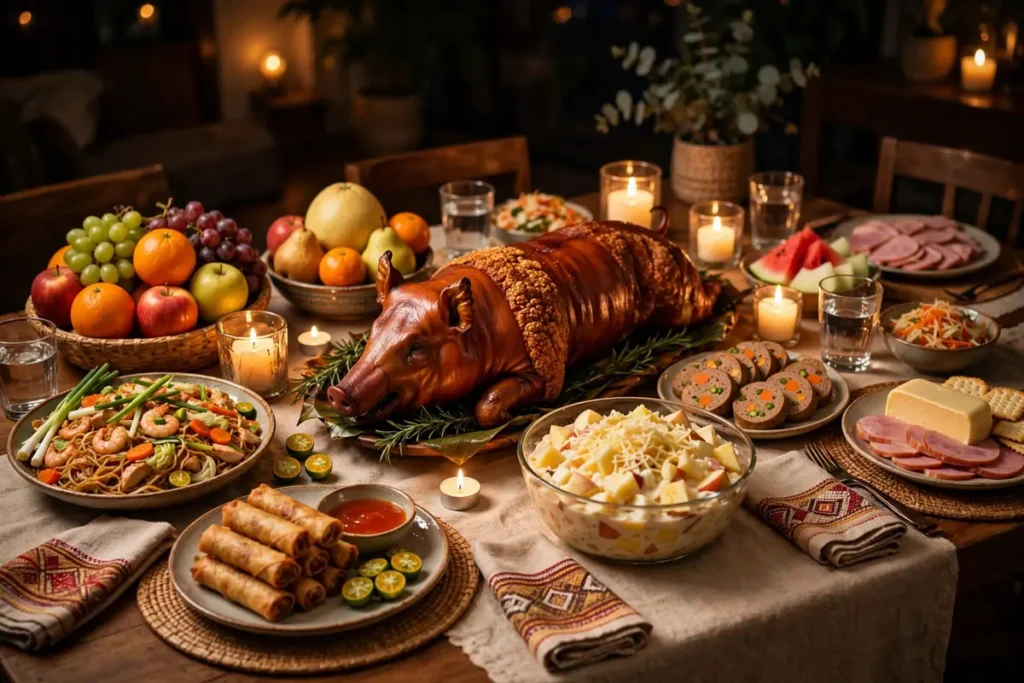
A Media Noche spread of twelve round fruits, the centerpiece of the Filipino New Year’s Eve table.
Watch: New Year Traditions in the Philippines
See how Filipino families prepare Media Noche and ring in the new year with time-honored customs.
At a Glance: New Year Traditions in the Philippines
The Philippines’ luck-filled New Year customs.
| Tradition | Detail | Meaning |
|---|---|---|
| Media Noche | Midnight feast, 31 December | The lavish New Year’s Eve dinner shared by the whole family at midnight |
| Twelve round fruits | On the table | Twelve round fruits — one for each month — symbolize prosperity; grapes, oranges, and melons are popular |
| Polka dots | Worn and displayed | Round shapes echo coins; polka-dot clothing and round accessories are believed to attract wealth |
| Loud noises | At midnight | Firecrackers, horns, and banging pots are thought to drive away evil spirits |
| Jumping at midnight | Midnight | Children (and adults) jump as high as they can at midnight — traditionally believed to help them grow taller in the new year |
| Money in pockets | Midnight | Filling pockets with coins is said to invite financial luck |
Frequently Asked Questions
What is Media Noche?
Media Noche (Spanish for “midnight”) is the Filipino New Year’s Eve feast, served as the clock approaches midnight on December 31. The abundant spread symbolizes prosperity for the coming year, and the meal is shared with family as the year turns. It is one of the two great family feasts of the Filipino year, alongside Noche Buena (Christmas Eve dinner).
Why do Filipinos display round fruits on New Year?
Round fruits symbolize coins, and therefore wealth — the tradition holds that displaying them (ideally twelve kinds, one per month) attracts prosperity. Grapes, oranges, apples, and watermelon are the most common. After their symbolic duty, the fruits are eaten as dessert.
Why do Filipinos wear polka dots on New Year’s Eve?
The round polka-dot pattern echoes the round-fruit symbolism: circles represent coins and attract wealth. It is a playful, widely observed custom — children especially are dressed in dots for the occasion.
What is the jumping tradition at midnight?
Filipino children jump as high as they can at the stroke of midnight, believing the height of the jump determines how much they will grow in the new year. Adults participate too, sometimes while holding coins for added luck.
Are firecrackers legal in the Philippines on New Year?
Firecrackers are regulated: many powerful types are banned, some cities (notably Davao) ban them entirely, and local governments designate specific zones and times. Community fireworks displays are increasingly common as safer alternatives. Always check current local ordinances before buying or lighting anything.
How is the Filipino New Year different from celebrations elsewhere in Asia?
The Filipino New Year is unusually focused on folk prosperity rituals — round fruits, polka dots, coins, noise — layered over a Spanish-colonial feast structure (Media Noche) and celebrated with an intensity of family reunion that rivals Lunar New Year. Compare with New Year traditions in Japan or New Year traditions in Thailand to see how differently the region marks the turning year.
A Final Word
The Filipino New Year is, at its heart, an argument: that prosperity can be invited, that luck can be worn, that noise can protect, and that the people who matter most should be at your table when the clock strikes twelve. Whether or not you believe in the superstitions, the rituals work — not because polka dots attract money, but because they get three generations dressed up and laughing together at midnight. If you take one thing from the Filipino New Year, take that: abundance is not just what is on the table, but who is around it — and that is a tradition worth carrying into every new year, wherever in the world you celebrate. As you plan your own celebration, our New Year reset guide and New Year wishes for 2027 can help you start the year with intention — and maybe, just for luck, wear something with dots.