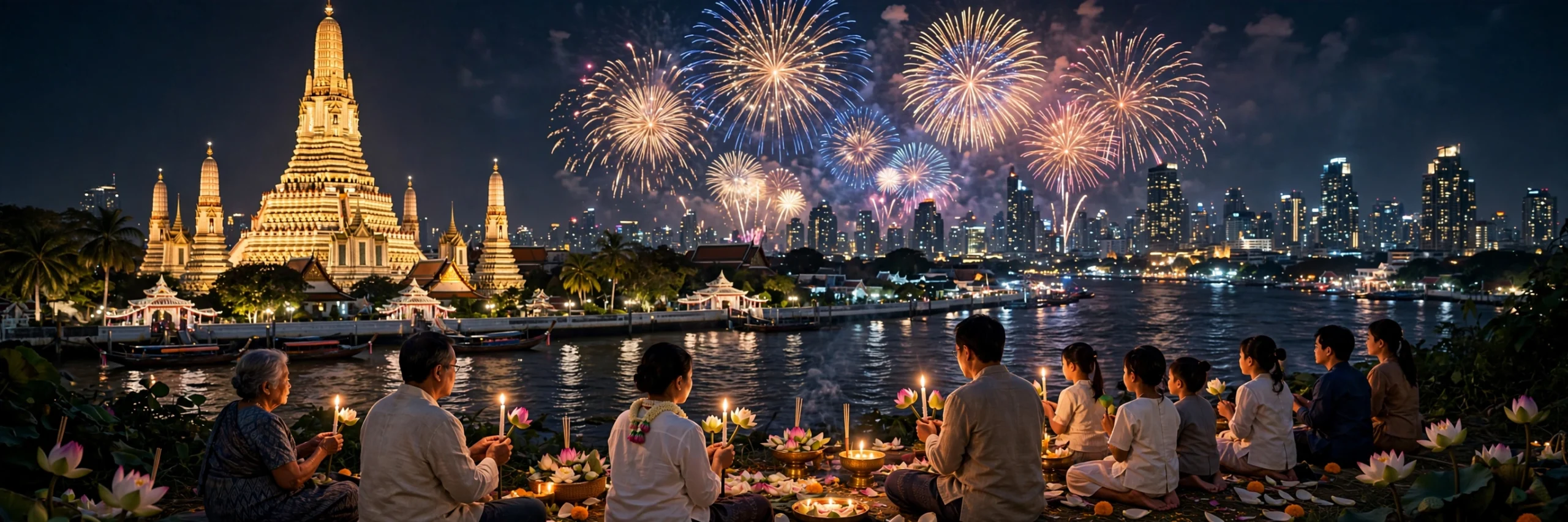
Thailand rings in the New Year with a beautiful contradiction: one of Asia’s wildest countdown parties and one of its most serene spiritual traditions, happening on the same night, sometimes within a few hundred meters of each other. On December 31, Bangkok’s CentralWorld intersection throbs with hundreds of thousands of revelers under the “Times Square of Asia” screens, while across town at Wat Arun, saffron-robed monks lead a candlelit midnight prayer and devotees circle the ancient prang with lotus blossoms and incense.
This is the essential thing to understand about New Year traditions in Thailand: January 1 is celebrated with full modern gusto and deep Buddhist meaning, and the two are not in competition. Locals move easily between the concert stage and the temple courtyard in a single evening. This guide walks you through the whole arc — hour by hour — from morning merit-making to the midnight moment, plus where Bangkok counts down, how to visit temples respectfully, and how January 1 relates to Thailand’s other New Year in April.
First, Let’s Clear Up the Calendar: Songkran vs January 1
Visitors are often surprised to learn that Thailand technically has two New Years. The traditional Thai New Year is Songkran, celebrated April 13–15, famous worldwide for its exuberant water fights. Rooted in ancient astrological tradition — the word derives from the Sanskrit saṅkrānti, the sun’s passage into Aries — Songkran was for centuries the official start of the Thai year, marked by gentle water-pouring rituals, temple visits, and the respectful bathing of Buddha images and elders’ hands.
January 1 entered the picture through royal modernization. King Chulalongkorn (Rama V) adopted the Gregorian calendar for official use in the late 19th century, and in 1941 the government formally moved New Year’s Day from April 1 to January 1. The day is called Wan Khuen Pi Mai (วันขึ้นปีใหม่) — literally “the day of ascending into the new year” — and it is a full national public holiday.
So which one “counts”? Both. Songkran remains the culturally deeper festival — the one tied to family, merit, and the agricultural rhythm of the old year. But January 1 is the New Year Thailand shares with the world, and it is celebrated with genuine enthusiasm: it is the night of the great countdowns, the fireworks over the Chao Phraya, and the temple midnight prayers. Think of Songkran as the soul of the Thai New Year and January 1 as its global coming-out party. If you’re visiting for the December 31 experience, you don’t need to choose — but understanding the distinction will make everything you see richer.
Your New Year’s Eve in Thailand, Hour by Hour
The Thai New Year’s Eve has a natural rhythm that blends the sacred and the celebratory. Here’s how a local might move through December 31 — and how you can, too.
Morning: Merit-Making and the First Temple Visit
The day begins with tam bun (ทำบุญ) — merit-making. The core belief is simple and profound: good deeds performed as the year turns generate merit (bun) that carries into the new year. Many Thais start December 31, or the morning of January 1, by visiting a temple to offer food to monks (tak bat, ตักบาตร — the alms-giving ceremony), release caged birds or fish (a symbolic liberation), and receive blessings.
As a visitor, the most accessible version is the organized New Year’s Day alms-giving. In recent years, Bangkok’s official Amazing Thailand Countdown program has concluded with a New Year’s Day merit-making ceremony at Wat Arun, explicitly inviting tourists to join the alms-giving — a remarkable gesture of cultural openness. Arrive early, dress modestly (covered shoulders and knees), and follow the lead of those around you: place your offering in the monks’ bowls with a slight bow, and accept the blessing with palms together in a wai.
Afternoon: Flower Markets and Final Preparations
By afternoon, the city shifts into preparation mode. Bangkok’s Pak Khlong Talat — the 24-hour flower market near the Chao Phraya — does some of its briskest business of the year, as households buy marigolds, jasmine garlands (phuang malai), and lotus buds for home shrines and temple offerings. Street vendors sell New Year gift baskets, and malls fill with last-minute shoppers.
This is also when savvy countdown-goers stake their positions. The old hands know: for the big free countdowns, arriving three to four hours early isn’t cautious — it’s necessary. Eat a proper meal, hydrate (December nights in Bangkok are pleasantly warm, typically in the 70s–80s°F), and plan your transport now, because central Bangkok’s traffic on New Year’s Eve evening is legendary.
Evening: The Countdown Parties Ignite
As dusk falls, Bangkok’s celebration zones come alive. The two gravitational centers are CentralWorld at the Ratchaprasong intersection and the Chao Phraya riverfront around ICONSIAM — more on both below. Concerts, DJ sets, light shows, and food stalls run for hours, building toward midnight. The atmosphere is jubilant but notably good-natured; Thai New Year crowds are famous for their warmth, and it’s common to see three generations of a family sharing street food while teenagers livestream the stage.
A distinctly Thai touch: many revelers wear something with personal meaning for luck, and vendors do a roaring trade in glow accessories, flower crowns, and novelty headbands. The countdown itself — the final ten seconds shouted in unison by hundreds of thousands of voices — is one of travel’s great communal experiences.
Midnight: Fireworks — and the Temple Alternative
At midnight, the sky erupts. Over the Chao Phraya, eco-friendly fireworks stretch along the river in displays that have run up to 1,400 meters; at CentralWorld, pyrotechnics crown the “Times Square of Asia” screens. Rooftop bars across Sukhumvit and Silom toast with champagne as the city glitters below.
But there is another midnight in Bangkok, quieter and older. At temples like Wat Arun (the Temple of Dawn), the night is given to prayer rather than pyrotechnics. Monks lead suad mon kham pi — “chanting across the year” — carrying sacred verses over the threshold of midnight, and devotees participate in wian tian (เวียนเทียน), a candlelit circumambulation: walking slowly clockwise around the temple’s central prang three times, holding a lit candle, lotus flowers, and incense sticks. The flame-lit procession against the illuminated temple is one of Southeast Asia’s most moving New Year sights — and it is open to respectful visitors.
You don’t have to choose between the two midnights every year. Many Thais do the countdown with friends and the temple visit with family on January 1 morning. The sequence — revelry, then reverence — captures the Thai New Year perfectly.
After Midnight: The City Keeps Going
Bangkok does not sleep after the fireworks. Khao San Road’s backpacker party rages until dawn, clubs in Thonglor and Ekkamai run special New Year’s lineups, and the riverside hotels host gala dinners that stretch into the small hours. Taxis and ride-hailing surge — agree on fares or use the app’s upfront pricing, and expect long waits around the main celebration zones until the crowds thin.
Where Bangkok Counts Down: The Big Venues
CentralWorld — The “Times Square of Asia”
The Ratchaprasong intersection in front of CentralWorld is Bangkok’s definitive countdown ground zero. The mall’s annual countdown show — which has featured top Thai artists and elaborate stage productions — draws the city’s biggest free crowd, with giant screens, live performances, beer gardens, and a midnight fireworks finale. The 2026 edition ran a multi-day program culminating on December 31. Arrive by early evening for a decent spot; the intersection closes to traffic and the crowd easily reaches six figures.
ICONSIAM and the Chao Phraya Riverfront
If CentralWorld is Bangkok’s Times Square, ICONSIAM is its Sydney Harbour — the postcard countdown. The luxury riverside complex stages the Amazing Thailand Countdown on the Chao Phraya, with the river itself as the stage: live performances on riverside stages, and at midnight, Thailand’s longest eco-friendly fireworks display arcing over the water. Recent editions have run multi-night programs (pop, dance, rock, and star nights leading up to the 31st) headlined by major Thai and international artists. Watching from the ICONSIAM River Park is free; watching from a Chao Phraya dinner cruise, with the fireworks reflected in the water, is the splurge version.
Nagaraphirom Park and Wat Arun
For the countdown with the most Thai soul, head to Nagaraphirom Park on the river’s west bank, where the Tourism Authority’s official Amazing Thailand Countdown unfolds with the illuminated Wat Arun as its backdrop. The program blends cultural performances on a floating stage, live music, eco-workshops, Thai cuisine, drone light shows, and a multi-act fireworks display — then concludes on New Year’s Day with the merit-making alms ceremony at Wat Arun itself. It is the only major countdown that explicitly bridges the party and the temple.
Rooftops, River Cruises, and Khao San
Beyond the big three: Bangkok’s legendary rooftop bars (the city has some of the world’s highest open-air perches) sell ticketed New Year’s Eve packages with dinner, DJs, and panoramic fireworks views — book weeks ahead. Chao Phraya dinner cruises offer the most romantic vantage point of all. And Khao San Road remains the free-for-all backpacker street party, all neon and chaos and joy, where midnight arrives in a haze of confetti and stranger-hugs.
Temple Merit-Making: A Visitor’s Guide
Participating in the spiritual side of the Thai New Year is genuinely welcoming to outsiders — but a little etiquette goes a long way. Here’s what to know.
What tam bun involves. Merit-making takes many forms: offering food or necessities to monks, donating to temple funds, releasing animals, listening to sermons, meditating, or simply praying with sincere intention. At New Year, the emphasis is on starting the year with generosity — the merit generated is believed to bless the months ahead.
Tak bat (alms-giving) etiquette. If you join a morning alms-giving: dress modestly (no shorts, no sleeveless tops; a sarong or shawl works), remove shoes where indicated, and place offerings — typically rice, fruit, or packaged food — into the monks’ bowls with both hands or your right hand. Women should take care not to touch monks directly (hand items to a male intermediary or place them in the bowl). Receive the blessing chant with palms pressed together and head slightly bowed.
The midnight chanting. Temples holding suad mon kham pi welcome lay participants for the cross-year chanting session. You don’t need to know the Pali verses — sitting quietly and mindfully through the chanting is participation enough. The wian tian candlelit walk that often follows is profoundly simple: hold your candle, lotus, and incense, walk clockwise three times with the procession, and let the year turn around you.
Which temples? Wat Arun is the signature New Year temple experience in Bangkok, but Wat Pho (the Temple of the Reclining Buddha) and Wat Saket (the Golden Mount) also hold New Year programs. Outside Bangkok, Chiang Mai’s Wat Phra That Doi Suthep and the temples of the old city draw large merit-making crowds.
The parallel with Japan is striking: Thai temples chanting across midnight echo Japan’s Joya no Kane, when temple bells ring 108 times to cleanse the year’s desires — two Buddhist cultures, two midnight rituals, one shared impulse to greet the year with a cleared heart.
Beyond Bangkok: Chiang Mai, Phuket, and the Islands
Bangkok dominates the headlines, but the rest of Thailand celebrates in style. Chiang Mai stages its official Amazing Chiang Mai Countdown at Royal Park Rajapruek, with illumination displays, cultural performances, concerts, and fireworks — a more family-oriented alternative to the capital’s frenzy, set against the northern mountains. The old city’s temples, meanwhile, fill with merit-makers at dawn.
Phuket and the islands do New Year’s Eve in tropical mode: beachfront countdown parties at Patong, resort galas in Krabi and Koh Samui, and fireworks over the Andaman Sea. Many beach clubs run ticketed events with international DJs — the island version of Bangkok’s rooftop scene, with sand between your toes. Note that some islands’ parties skew heavily toward tourists; for a more Thai-flavored island New Year, look to the local temple fairs (ngan wat) that many communities hold around the holiday.
Pattaya hosts one of the country’s biggest fireworks festivals around the New Year period, with pyrotechnic teams firing over Pattaya Bay — worth the short trip from Bangkok if fireworks are your priority.
New Year’s Day the Thai Way
January 1 in Thailand is a public holiday, and the national mood is unhurried. The classic Thai New Year’s Day has three acts. First, the morning temple visit for those who partied on the 31st — tak bat, blessings, and the fresh-start feeling of merit made on day one. Second, the family meal: many families gather for a special lunch, and it’s common to visit elders to offer New Year wishes and receive their blessing in return (the Thai equivalent of the season’s greeting is Sawatdee Pi Mai — “Happy New Year”). Third, rest: the afternoon is for napping off the night before, strolling malls decorated in full festive regalia, or heading to the cinema — a surprisingly popular Thai New Year’s Day tradition.
For visitors, January 1 is an excellent sightseeing day with a caveat: major temples will be busy with worshippers (wonderful atmosphere, but go early), while malls, restaurants, and most attractions operate normally. It’s also worth noting that the days between Christmas and New Year see significant domestic travel, so book intercity transport in advance.
Small Rituals: Calendars, Wishes, and First-Day Luck
Beyond the countdowns and temples, the Thai New Year has a quieter layer of customs that visitors rarely notice — but that reveal how the holiday actually feels from the inside.
The calendar-and-diary tradition. Thailand’s most distinctive New Year gift custom is the giving of calendars and diaries. Companies, banks, and government offices distribute beautifully designed wall calendars and planners as year-end gifts, and receiving your first new diary of the year is a small ritual of fresh beginnings. Bookstores run their biggest planner sales of the year in December, and choosing a diary — its weight, its paper, its promise — is taken almost as seriously as a resolution. If a Thai colleague hands you a calendar in late December, accept it as the warm gesture it is.
Cleaning before, not on, the day. Like many Asian cultures, Thais prefer to do major house-cleaning before the New Year rather than on January 1 itself — the idea being to sweep out the old year’s residue without disturbing the new year’s incoming luck. New clothes for January 1 are common, especially for children visiting elders.
Visiting elders. The days around the New Year are for khaorop — paying respects to senior family members. Younger relatives bring small gifts (fruit baskets are classic), offer New Year wishes, and receive blessings in return. For Thai-Chinese families, red envelopes (ang pao) may appear — though that’s primarily a Lunar New Year custom, the generosity of the season blurs the lines.
First words, first actions. There’s a gentle folk belief that how you spend the first day shapes the year: start it kindly, speak well of others, avoid arguments and debts. It’s less a strict taboo system than a nudge toward mindfulness — begin as you mean to continue. After the noise of the countdown and the stillness of the temple, it’s a fitting final note: the Thai New Year asks only that you cross the threshold with intention.
In Pictures: New Year in Thailand
Thailand celebrates the New Year twice over — the Bangkok countdown on December 31 and the water-blessing festival of Songkran in April.
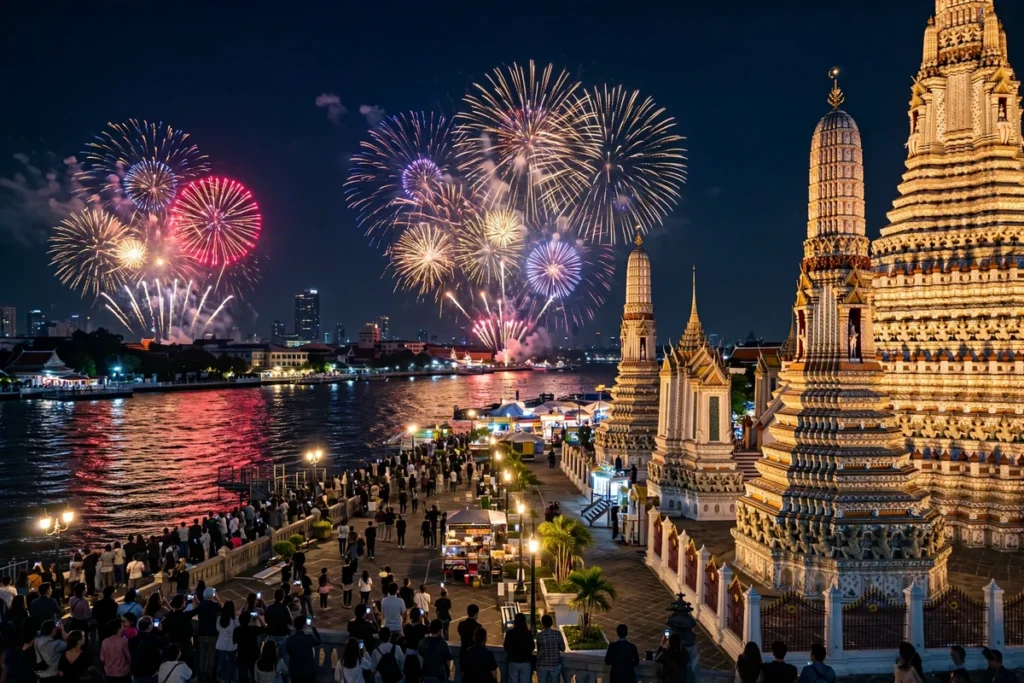
Fireworks burst over the Chao Phraya River by Wat Arun during the Bangkok New Year countdown.
Watch: New Year in Thailand
Watch the 4K fireworks display over the Chao Phraya at Bangkok’s ICONSIAM countdown.
At a Glance: New Year in Thailand
Thailand’s essential New Year facts — the countdown, the water and the temples.
| Fact | Detail |
|---|---|
| Bangkok countdown | The ICONSIAM countdown on the Chao Phraya River is the country’s flagship December 31 celebration |
| Songkran | The traditional Thai New Year, April 13–15 — a three-day water festival of blessings |
| Water blessings | Gently pouring water over elders’ hands asks for their blessing; the street water fights grew from this ritual |
| Temple merit-making | Visiting temples to make merit (tam bun) and offer food to monks is central to the New Year |
| Sand stupas | Building small sand stupas at temples is a traditional Songkran custom in many regions |
Frequently Asked Questions
When is Thai New Year — January or April?
Both. January 1 (Wan Khuen Pi Mai) is the official New Year’s Day and a national public holiday, celebrated with countdowns, fireworks, and temple merit-making. Songkran (April 13–15) is the traditional Thai New Year, famous for water celebrations and deeper cultural rituals. They coexist: January 1 is Thailand’s global New Year, Songkran its ancestral one.
Where is the best countdown in Bangkok?
The three signature experiences are CentralWorld at Ratchaprasong (the biggest free street countdown, the “Times Square of Asia”), ICONSIAM on the Chao Phraya (the most spectacular riverfront fireworks), and Nagaraphirom Park with Wat Arun as backdrop (the most culturally rich, ending with New Year’s Day alms-giving). For luxury, book a rooftop bar or river dinner cruise; for chaos, head to Khao San Road.
What is merit-making (tam bun)?
Tam bun (ทำบุญ) means “making merit” — performing good deeds to generate spiritual merit for the new year. At New Year it typically involves offering food to monks (tak bat), donating to temples, releasing caged animals, listening to sermons, or meditating. Many Thais consider starting the year with merit-making essential to a fortunate year ahead, and visitors are welcome to participate respectfully.
Can tourists join the temple ceremonies?
Yes. Thai temples are generally welcoming to respectful visitors at New Year ceremonies, and the official New Year’s Day alms-giving at Wat Arun has explicitly invited tourists in recent years. Dress modestly (covered shoulders and knees), remove shoes where required, follow the lead of worshippers, and avoid touching monks if you are a woman. The midnight wian tian candlelit procession is open to all who join quietly and reverently.
What should I wear and bring to a Bangkok countdown?
Dress for warm weather (evenings are typically in the 70s–80s°F) but bring a light layer for river breezes. Wear comfortable shoes — you’ll stand for hours. Bring water, a portable charger, and cash for street food. Arrive 3–4 hours early for prime spots at CentralWorld or ICONSIAM, and plan your return transport in advance: ride-hailing surges and waits are extreme right after midnight.
Is it better to spend New Year’s Eve in Bangkok or at the beach?
It depends on your style. Bangkok offers the country’s biggest countdowns, the temple-midnight experience, and unbeatable energy. The islands (Phuket, Koh Samui, Krabi) offer beach parties, resort galas, and fireworks over the sea in a tropical setting. Many travelers split the difference: countdown in Bangkok, then recover on an island for the first days of January.
Thailand’s January New Year is ultimately a study in balance — the volume turned all the way up at CentralWorld and all the way down at Wat Arun, sometimes within the same evening, often within the same person. Do the countdown with the crowds, then greet the dawn with the monks: that two-part rhythm is the most Thai way imaginable to begin again. For a fresh-start framework to carry that feeling into January, see our New Year reset guide, and for the right words to send home, our 100 New Year wishes, messages and captions for 2027 — or keep it simple and local with a heartfelt Sawatdee Pi Mai.