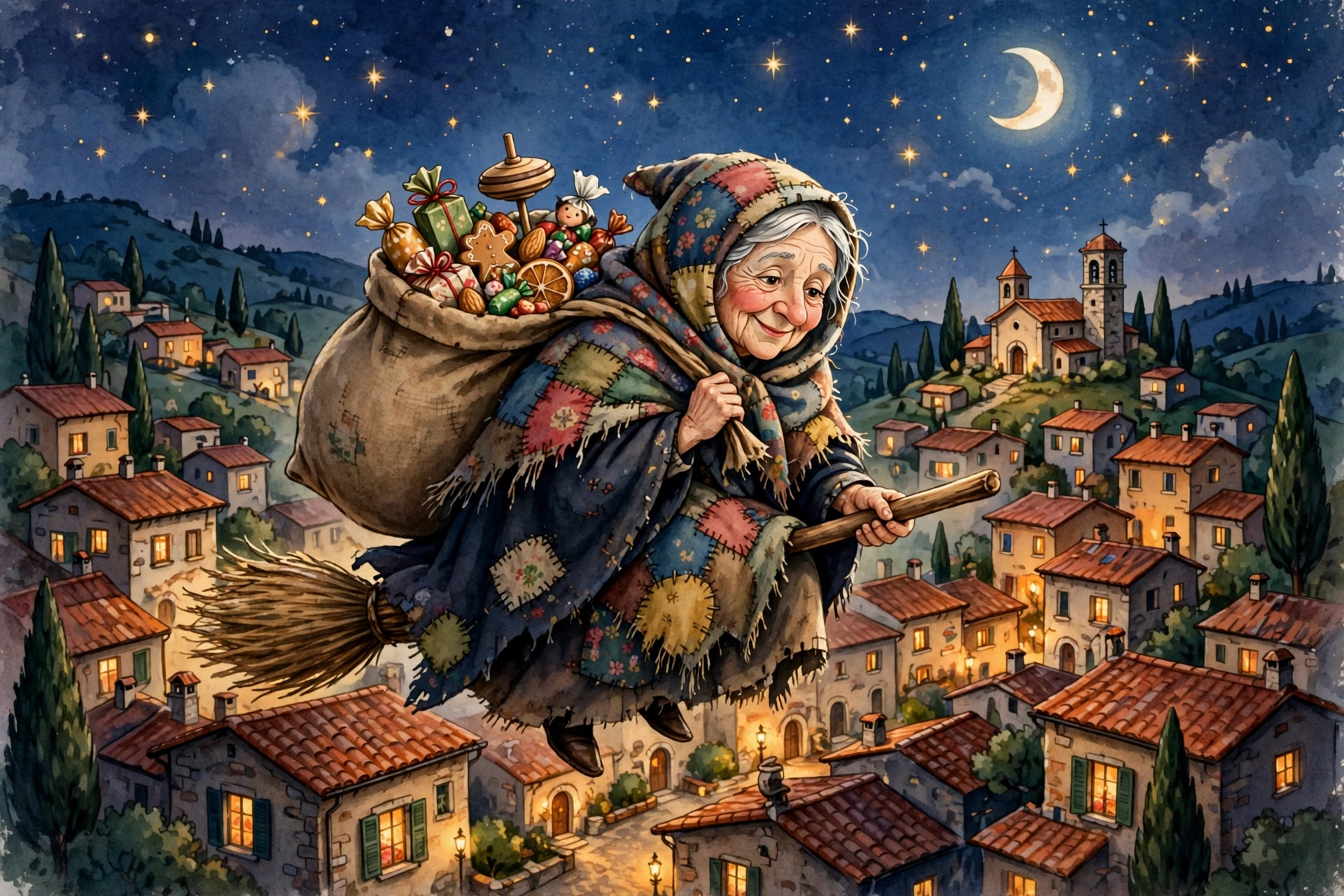
On the night of January 5th, while children in most of the world have long since unwrapped their Christmas presents, Italian children hang up their stockings one more time. They are waiting for a visitor who arrives not by sleigh but by broomstick: an old woman with a crooked nose, a patched shawl, and a sack full of sweets. Her name is La Befana, and she is one of the most beloved figures in Italian folklore. The story of La Befana, the Italian Christmas witch, stretches back centuries — a tale of the Epiphany, the Three Kings, and a missed invitation that turned an ordinary old woman into Italy’s most famous gift-bringer.
Who Is La Befana?
La Befana is traditionally depicted as an old woman — sometimes a kindly grandmother figure, sometimes a classic storybook witch with a wart on her nose — who flies through the night sky on a broomstick on Epiphany Eve (the night of January 5th) and fills children’s stockings with gifts. Good children find candy, dried fruit, and small toys; naughty children find carbone — lumps of “coal” that are actually black sugar candy, a joke that softens the scolding.
Unlike Santa Claus, La Befana enters through the chimney and is never seen — children know she has visited only by the filled stocking in the morning. Tradition holds that families leave out a small glass of wine and a plate of food for her, a gesture of hospitality for a long night’s work. And in a detail that generations of Italian children find hilarious, she is said to sweep the floor before she leaves — a tidy witch, using her broom for its original purpose on her way out.
The name itself is a linguistic clue to her identity: “Befana” is a corruption of Epifania, the Italian word for Epiphany. She is, literally, the personification of the feast — the spirit of January 6th in human (if slightly witchy) form.
The Legend: The Witch Who Missed the Kings
The most famous Befana legend ties her directly to the Nativity story. As the tale goes, the Three Wise Men — the Magi — were traveling to Bethlehem to honor the newborn Jesus when they stopped at the hut of an old woman to ask directions. They invited her to join them. She declined, saying she had too much housework to do. Later, regretting her refusal, she set out after them with a sack of gifts for the child — but she could not find them, and she has been searching ever since.
So on Epiphany Eve, La Befana flies from house to house, leaving gifts for every child she finds — because any one of them might be the Christ child she is still seeking. It is a story of extraordinary emotional richness: a missed chance, a lifetime of atonement, and a love that expresses itself in endless generosity to strangers’ children. No wonder it has endured.
Scholars of folklore note that the Befana legend likely overlays older traditions. January 6th sits at the end of the Twelve Days of Christmas, a period long associated in European folk belief with the roaming of spirits and witches. Some historians connect La Befana to ancient Roman rites — the winter festivals in which an old woman figure represented the passing year — and to the pagan goddess Strenua. The church never fully displaced these midwinter figures; instead, as with so many Christmas traditions, the old and the new braided together into something uniquely local.
Epiphany Eve: How Italy Celebrates La Befana
Epiphany (l’Epifania) on January 6th is a public holiday in Italy, and the Befana season has its own distinct customs that extend the Christmas period a full twelve days past December 25th.
The stocking ritual
On the evening of January 5th, children hang stockings — often oversized, decorated ones sold specifically for the occasion — by the fireplace or at the foot of the bed. In the morning, the stockings are full: chocolates, candy, mandarins, walnuts, small toys, and, for the cheeky, the black sugar carbone. Parents take the same delight in filling Befana stockings that they took in playing Santa two weeks earlier; for many families, the Befana stocking is the more relaxed, more playful of the two rituals.
Urbania: the capital of La Befana
The town of Urbania, in the Marche region, claims the title of Italy’s Befana capital and hosts the country’s most famous Befana festival — the Festa Nazionale della Befana — typically held over several days around Epiphany. Thousands of visitors descend on the medieval town for parades, markets, concerts, and appearances by hundreds of costumed Befanas. The festival is a full-throated celebration of the witch: Befana-themed sweets, Befana souvenirs, and a general atmosphere of joyful, slightly subversive festivity.
Regional variations
Like all Italian traditions, the Befana wears local costumes. In some regions she arrives as a stern old woman; in others as a smiling grandmother. Some towns stage Befana processions or burn a Befana effigy to symbolize the end of the holidays. In Venice, the traditional Regata delle Befane sees rowers dressed as the witch racing along the Grand Canal — a spectacle as only Venice could stage it. Wherever she appears, the constants are the broomstick, the sack, and the sweets.
La Befana vs. Santa Claus: Italy’s Two Gift-Bringers
Modern Italy celebrates both figures, and the division of labor is charming. Babbo Natale (Father Christmas, the Italian Santa) handles December 25th — the big presents, the family Christmas. La Befana handles January 6th — the stocking, the sweets, the epilogue. Italian children thus get two rounds of gift-bringing, spaced twelve days apart, each with its own mythology and mood.
The coexistence is relatively recent. Babbo Natale is largely a 20th-century import, arriving with American commercial culture; La Befana is the indigenous tradition, centuries older. For much of Italy’s history, the Befana was the only gift-bringer, and older Italians remember Epiphany as the true gift day of their childhoods. The witch held her ground against the global Santa — a quiet victory for local folklore over international branding.
The two figures also embody different emotional registers. Santa is distant, industrial, North-Pole magic. La Befana is intimate and human: an old woman who made a mistake and spends eternity making up for it, who sweeps your floor and drinks your wine. Italian children’s literature is full of Befana stories that play on this warmth — she is the rare witch who is loved rather than feared.
The Befana in Italian Culture and Sayings
La Befana is woven deep into the Italian language. The saying “L’Epifania, tutte le feste porta via” — “Epiphany carries all the holidays away” — marks January 6th as the definitive end of the Christmas season; decorations come down and ordinary life resumes. Calling someone a befana is a teasing insult implying a witchy old woman — affectionate or not, depending on tone.
She appears constantly in children’s books, cartoons, films, and advertising. Every January, Italian television runs Befana specials; bakeries sell Befana-shaped sweets; markets overflow with stockings and carbone candy. The nursery rhyme “La Befana vien di notte / con le scarpe tutte rotte” (“The Befana comes at night / with her shoes all broken”) is among the first verses Italian children learn — a lullaby about a witch, sung with love.
There is even a literary tradition of Befana poetry and stories for adults, playing on her symbolism: the old year sweeping itself out, the crone as wisdom figure, the night visitor who rewards the deserving. In a culture that venerates grandmothers, the idea of the ultimate grandmother — flying through the winter night with gifts for every child — was never going to lose its audience.
Befana Sweets and Treats: What Goes in the Stocking
The Befana stocking has its own confectionery canon. Beyond the standard chocolates and candies, look for these Italian Epiphany specialties:
- Carbone dolce: the famous black “coal” — actually sugar candy, made by caramelizing sugar and aerating it into rough black lumps. It looks convincingly like coal and tastes like sweet crunch. No Befana stocking is complete without at least one piece.
- Cioccolato and torrone: chocolate coins and nougat, the universal Italian holiday sweets, appear in Befana stockings as they do at Christmas.
- Frutta secca: dried figs, dates, walnuts, and hazelnuts — the traditional, old-fashioned filling, recalling the days when fresh fruit in January was a luxury.
- Mandarini: mandarins and clementines, their winter-season brightness a natural fit for the stocking.
- Befana cookies: in many regions, bakeries sell witch- or broom-shaped biscuits specifically for Epiphany, often decorated with icing.
Parents assembling Befana stockings tend toward the playful: the stocking is smaller than a Christmas haul, sweeter, and funnier. The carbone is the punchline every child expects and pretends to dread.
Visiting Italy for La Befana: A Traveler’s Guide
Epiphany is one of the loveliest times to visit Italy. The Christmas crowds have thinned, the decorations are still up, and the Befana festivities give early January a festive charge most destinations lack.
Urbania’s Befana festival
The Festa Nazionale della Befana in Urbania (Marche) is the headline event — several days of Befana-themed festivities around January 6th, drawing families from across Italy. Book accommodation early; the town is small and the festival is popular. Expect parades, markets, street food, and an unforgettable density of witches on broomsticks.
Rome and the Vatican
Epiphany Mass at the Vatican is a major event, and Rome’s streets and piazzas host Befana markets — notably the historic Epiphany market in Piazza Navona, where stalls sell stockings, sweets, toys, and Befana paraphernalia. It is one of Rome’s most atmospheric seasonal markets.
Venice’s witch regatta
The Regata delle Befane on the Grand Canal — rowers in witch costume racing traditional boats — is pure Venetian spectacle and worth planning around if you are in the city for Epiphany.
Practical notes
January 6th is a public holiday in Italy: expect closures, festive crowds at major events, and book restaurants ahead. The weather is winter-crisp — perfect for hot chocolate between Befana sightings. And remember the saying: after Epiphany, tutte le feste porta via — the holidays are carried away. See the decorations while you can.
Why La Befana Endures
In an era of globalized, identical Christmases, La Befana is a reminder of what local tradition does best: it gives a holiday a face, a story, and a soul that no marketing department could invent. She is not sleek or efficient. She is an old woman on a broomstick who once said no to the most important invitation in history and has spent the centuries since trying to make it right — one stocking, one child, one Epiphany Eve at a time.
Italian children love her not despite her witchiness but because of it. She is proof that you can be imperfect, late, and a little bit frightening — and still be the bearer of joy. That is a better moral than most holiday myths manage, and it is why, every January 5th, the stockings go up one more time.
In Pictures: La Befana, the Italian Christmas Witch
On the night of January 5th, Italian children hang their stockings one last time — waiting for La Befana, the broomstick-riding witch who fills them with sweets or “coal” on Epiphany Eve.

La Befana over a moonlit Italian village on Epiphany Eve: the old witch on her broomstick, stockings hanging by the fireplace below.
Watch: La Befana, the Italian Christmas Witch
Sergio Perla tells the enchanting legend of La Befana — from the Three Wise Men to the festivals of Urbania and Venice's Regata delle Befane — Italy's most magical holiday folklore.
At a Glance: La Befana, the Italian Christmas Witch
The legend, the night, and the celebrations of Italy's beloved Christmas witch.
| Element | What it is | Key detail |
|---|---|---|
| Epiphany Eve | Night of 5 January | La Befana visits; the Epiphany on 6 January is a national holiday in Italy and the official end of the Christmas season |
| The legend | The story | The Wise Men stopped at her shack for directions; she declined to join them, regretted it, and now searches for the Christ child every year |
| The stockings | The custom | Children hang stockings on January 5: candy and toys for the good, carbone — black sugar “coal” — for the naughty |
| The name | The word | “Befana” is believed to derive from “Epifania” — the Italian word for Epiphany |
| Piazza Navona, Rome | The market | Rome's famous Epiphany market fills the piazza with Befana dolls, sweets, and toys |
| Urbania | The festival | The town of Urbania hosts Italy's official national festival of La Befana |
| Regata delle Befane | The boat race | In Venice, athletes dressed as Befana race on the Grand Canal every January 6 |
| The sweeping | The detail | Tradition says she sweeps the floor before leaving — and families leave her a glass of wine and a plate of food |
Frequently Asked Questions
Who is La Befana?
La Befana is Italy’s traditional Epiphany gift-bringer — an old woman (often depicted as a kindly witch) who flies on a broomstick on the night of January 5th and fills children’s stockings with candy and toys, or black sugar “coal” (carbone) for the naughty. Her name derives from Epifania, the Italian word for Epiphany.
When does La Befana come?
La Befana visits on Epiphany Eve — the night of January 5th — leaving gifts to be found on the morning of January 6th, the Feast of the Epiphany. Epiphany is a public holiday in Italy and marks the traditional end of the Christmas season.
What is the legend of La Befana?
The most famous legend says the Three Wise Men invited an old woman to join their journey to Bethlehem; she declined, then regretted it and set out after them with gifts — but never found them. She continues searching, leaving gifts for all children on Epiphany Eve in case one of them is the Christ child.
What do children leave out for La Befana?
Traditionally, families leave a small glass of wine and a plate of food for La Befana, and children hang stockings by the fireplace. Legend says she sweeps the floor before leaving — using her broom for its original purpose.
Where is the biggest Befana celebration?
Urbania, in Italy’s Marche region, hosts the Festa Nazionale della Befana — the national Befana festival — with several days of parades, markets, and events around Epiphany. Rome’s Piazza Navona Epiphany market and Venice’s Regata delle Befane (witch regatta) are also famous.
Do Italians celebrate Santa Claus too?
Yes — modern Italy celebrates both. Babbo Natale (the Italian Santa) brings gifts on December 25th, while La Befana brings stocking gifts on January 6th. La Befana is the older, indigenous tradition; Babbo Natale is largely a 20th-century arrival.
Italy’s Epiphany witch is one half of the January 6th story — the other half is the feast she is named for. Read about Three Kings Day and Epiphany traditions around the world, and explore more of Italy’s holiday table with our Feast of the Seven Fishes explained. For the full Italian Christmas season, see our Christmas dinner ideas from around the globe.
La Befana in Books, Film, and Popular Culture
La Befana’s afterlife in Italian popular culture is as rich as her folklore. She stars in countless children’s books — from classic illustrated storybooks retelling the Three Kings legend to modern picture books that give her new adventures. Italian children’s television has featured Befana specials for generations; the witch’s annual appearance is as fixed in the broadcast calendar as the Epiphany itself.
Cinema has taken its turn as well. The 2018 Italian family film La Befana vien di notte (The Legend of the Christmas Witch) reimagined her as a secret superheroine — by day a mild-mannered schoolteacher, by night the broomstick-riding gift-bringer — and became a holiday hit, spawning a sequel. The film’s success speaks to the character’s flexibility: La Befana can be a figure of folklore, a comic heroine, or a feminist icon, depending on who is telling the story.
Adult culture has embraced her too. Italian poets and novelists have used La Befana as a symbol — of the old year, of overlooked women, of the persistence of folk wisdom against modernity. Her image appears in advertising every January, on everything from chocolate to cleaning products (the broom is irresistible to copywriters). She is, in short, a national mascot with a broomstick: recognizable, adaptable, and deeply loved.
The nursery rhyme deserves its own appreciation. “La Befana vien di notte / con le scarpe tutte rotte / con le toppe alla sottana: / Viva, viva la Befana!” — “The Befana comes at night / with her shoes all broken / with patches on her skirt: / Hurrah, hurrah for the Befana!” — is sung by Italian children with genuine affection. It is a love song to a shabby old woman, and it captures everything about her appeal: she is not glamorous, she is not powerful, she is patched and broken-shoed and she comes in the night with gifts. Children understand her perfectly.
Befana Baking: Traditional Epiphany Sweets to Make at Home
The Epiphany season has its own baking traditions, and making them is the tastiest way to honor La Befana. Here are the classics:
Carbone dolce (sweet coal)
The iconic Befana candy — black, lumpy, convincingly coal-like, and delicious. It is made by whipping egg whites with sugar into a meringue, then pouring in hot caramelized sugar, which aerates into a rough, porous black mass. Broken into lumps, it looks exactly like coal and tastes like crunchy caramel. Making it at home requires care with hot sugar, but the result is the definitive Befana stocking stuffer — the joke every Italian child expects.
Befanini (Tuscan Epiphany cookies)
In Tuscany, the befanini are the traditional Epiphany biscuits: buttery, lemon- or anise-scented cookies cut into festive shapes — stars, hearts, witches, brooms — and decorated with colored sprinkles. Families bake them in the days before Epiphany, and children decorate them with the seriousness of artists. They are simple, delicious, and deeply tied to the holiday: the taste of January 6th in cookie form.
Cavallucci and panforte (Sienese tradition)
In Siena and its surroundings, the Christmas-Epiphany sweet canon includes cavallucci (chewy spiced cookies with walnuts and candied fruit) and panforte (the dense, ancient spiced fruit-and-nut cake). These keep for weeks, making them ideal for the long season from Christmas to Epiphany — bake once, eat through La Befana’s visit.
Focaccia della Befana (Piedmont)
In parts of Piedmont, a special sweet focaccia is baked for Epiphany — a soft, rich bread, sometimes hiding a bean or coin for the lucky finder, in the tradition of the French galette des rois. Whoever finds the token is crowned king or queen of the feast: a fitting end to the twelve days.
La Befana and the End of Christmas: The Ritual of Taking Down
“L’Epifania, tutte le feste porta via” — Epiphany carries all the holidays away. In Italy, January 6th is not just La Befana’s day; it is the day Christmas ends. The tree comes down, the nativity scene (presepe) is packed away, the lights are unstrung. The Befana’s visit is the last magic of the season, and her departure — broom swept, floor clean — is the signal to return to ordinary life.
There is wisdom in this extended ending. Where many cultures collapse Christmas into a single frantic day, Italy stretches the season across twelve days, with two gift-bringers, two feasts, and a witch to close the proceedings. The long goodbye makes the season feel substantial — a true season, not an event. And La Befana, sweeping the floor as she leaves, performs the final domestic ritual: the house is clean, the holidays are over, the year can begin.
Italians describe the post-Epiphany feeling with a particular melancholy — the tristezza of the undecorated house, the quiet after weeks of festivity. But the Befana legend offers consolation: she will be back. She is always searching, always flying, always leaving sweets for the children she finds. The broomstick circles the sky, the stockings will hang again, and next January 5th, the old woman will come down the chimney once more.