

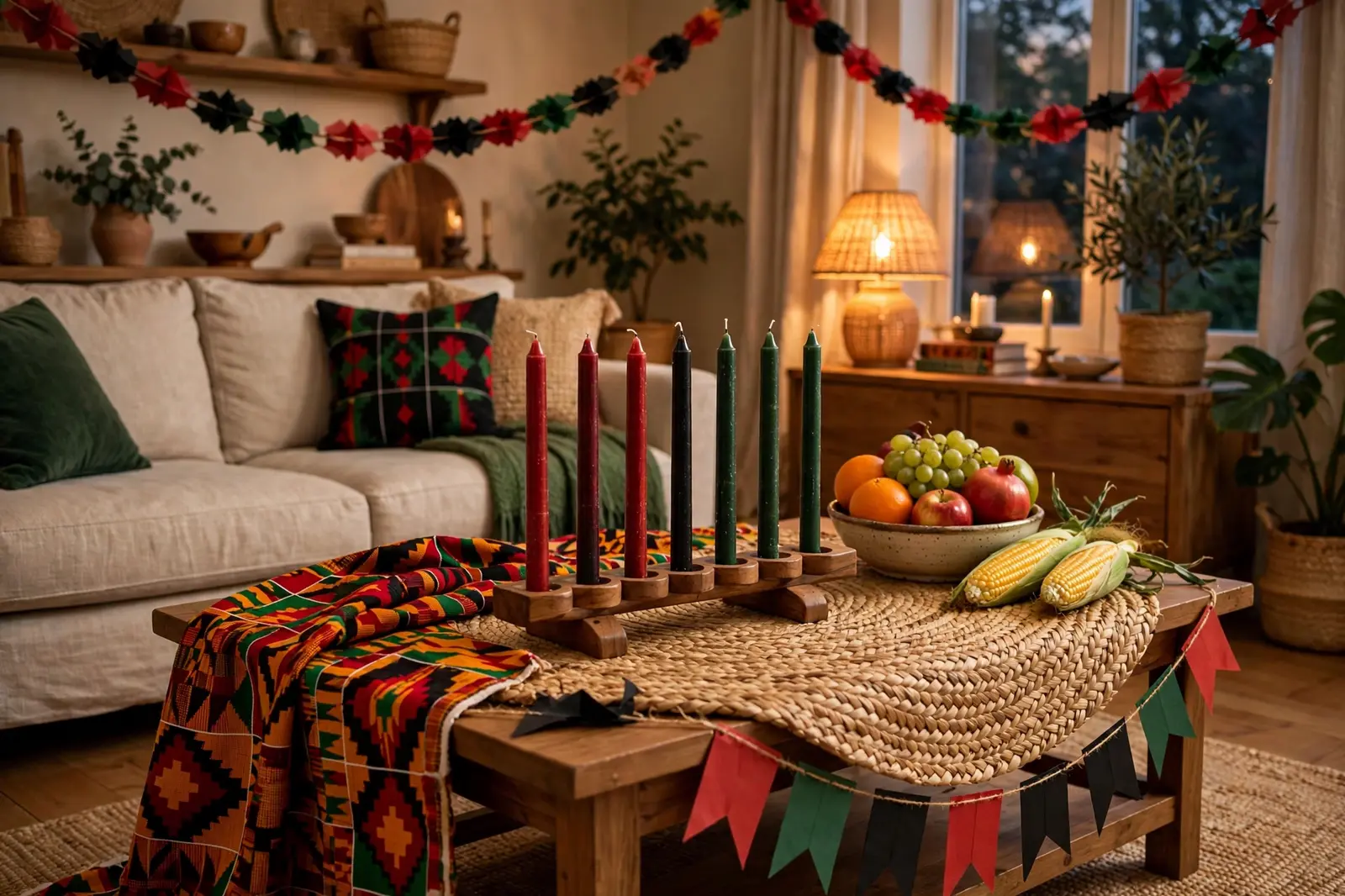
Kwanzaa Decoration Ideas: Red, Black, and Green Themes
Kwanzaa is a celebration of heritage, community, and culture — and nothing sets the tone for the seven-day observance like decorations in the holiday’s signature colors: red, black, and green. These are not just pretty holiday colors. Drawn from the Pan-African flag, each color carries deep meaning: red for the blood and struggle of African people, black for the people themselves, and green for the hope and promise of the future. When you decorate your home in these colors, you are not merely making things festive — you are making a statement about identity, resilience, and aspiration.
Whether this is your first Kwanzaa or your fortieth, decorating your home is one of the most joyful parts of the season. This guide walks you through everything: the symbolism behind the colors, the foundational pieces every Kwanzaa display needs, room-by-room decoration ideas, a seven-day decorating plan, do-it-yourself projects that cost little, tips for sourcing decor on any budget, and how to blend traditional African aesthetics with your own home’s style. By the end, you will have a home that radiates the warmth, pride, and unity Kwanzaa represents.

The Meaning Behind Kwanzaa’s Three Colors
Before you hang a single banner, understanding what red, black, and green stand for will make your decorating choices feel intentional rather than decorative. Kwanzaa was created in 1966 by Dr. Maulana Karenga, a professor of Africana studies, as a way for African Americans to honor their heritage through seven principles called the Nguzo Saba. The colors come from Marcus Garvey’s Pan-African flag, designed in 1920, and they tie Kwanzaa to a century of Black pride and liberation.
Decorating with awareness of this symbolism changes the project from holiday decorating into an act of cultural expression. When guests ask why your tablecloth is green or your candles alternate red and black, you will have a story to tell — and storytelling is at the heart of Kwanzaa itself.
Red: The Struggle and the Blood of the People
Red represents the blood that unites all people of African descent — both the blood shed in the struggle for liberation and the lifeblood that connects the community. In decorating, red brings energy, warmth, and urgency to a room. Use red for candles, ribbons, table runners, and accent fabrics. A deep, rich red reads as celebratory and grounded rather than flashy; think burgundy kente accents rather than bright Christmas red.
Practical ways to bring red into your decor: the three red candles (mishumaa) on the left side of the kinara; a red woven runner beneath the mkeka mat; red fabric draped as a backdrop behind your celebration table; red and black beaded garlands; and red blossoms or dried flowers in arrangements. Red is the color of the first days of the celebration — December 26, 27, and 28 light red candles — so lean into red early in the week.
Black: The People
Black stands for the people — African people everywhere, in all their diversity and dignity. As a decorating color, black is the anchor: it gives the other two colors depth and contrast. The black candle sits in the center of the kinara and is lit first, on the opening night of Kwanzaa, symbolizing unity (Umoja).
Black decor does not have to mean darkness. Think rich textures: black velvet tablecloths that make the candles glow, black-and-white kente strips, dark wood carvings, black wicker baskets holding mazao (crops), and framed photographs of family elders displayed with pride. A black backdrop behind the kinara makes the candlelight dramatically visible and gives your celebration table a gallery-like presence.
Green: The Future, the Land, and Hope
Green symbolizes the fertile land of Africa and the hope for the future — growth, renewal, and prosperity. Green is the color of the last three days of Kwanzaa (the green candles are lit December 30, 31, and January 1), and it brings life and freshness into the decor scheme.
Incorporate green through living plants — a small potted plant or a bowl of greenery on the celebration table doubles as symbolism and freshness — green candles, green fabric, and natural elements like corn husks, gourds, and woven baskets. If you want a modern look, eucalyptus sprigs and monstera leaves in black vases give a Kwanzaa display a contemporary, editorial feel while staying within the palette.
Building Your Kwanzaa Decor Foundation
Every great Kwanzaa display starts with the same foundation: the celebration table, sometimes called the Kwanzaa table or the altar space. This is where the seven symbols of Kwanzaa live, and it anchors the entire home’s decorations. Build this first, then let the rest of the house echo its colors and textures.
Start With the Mkeka (Mat)
The mkeka is a woven mat — traditionally made of straw or cloth — that represents history and tradition, the foundation on which everything else rests. In decorating terms, it is your base layer. Lay the mkeka as the centerpiece of your main table, or use it as a wall hanging behind the display for dramatic effect.
If you do not own a traditional mkeka, you can approximate one: a woven straw placemat, a piece of kente-printed fabric, or a hand-woven runner in earthy tones all work. Some families weave their own mkeka from construction paper in red, black, and green as a craft project — a wonderful way to involve children and save money. Place all other symbols on or around the mkeka so the arrangement reads as one unified display rather than scattered objects.
Layer Fabrics: Kente, Mudcloth, and Ankara
African textiles are the fastest way to make a room feel unmistakably Kwanzaa. Kente cloth — the colorful woven fabric of the Ashanti people of Ghana — is the classic choice, with its bold geometric patterns in red, gold, green, and black. Mudcloth (bogolan) from Mali brings earthy browns and blacks with white geometric designs. Ankara prints offer vibrant, joyful patterns.
Use these fabrics as table runners over a solid black or cream tablecloth, as wall hangings behind the kinara, as throw pillows on the sofa, or draped over a mantel. You do not need authentic hand-woven kente (which can be expensive); printed kente-pattern fabric from a fabric store achieves the visual effect for a fraction of the cost. A six-foot runner of printed kente over a plain table instantly transforms a dining room.
The Kinara as Centerpiece
The kinara — the seven-branched candleholder — is the visual heart of Kwanzaa decor. Place it front and center on the mkeka, where it can be seen from across the room. The candles (mishumaa saba) are arranged with the black candle in the center, three red on the left, and three green on the right.
Kinaras come in every style: hand-carved wood in traditional African designs, sleek modern metal, ceramic, and even sculptural art pieces. If you are buying your first kinara, choose one sturdy enough to hold candles safely and large enough to be a focal point — roughly 12 to 18 inches wide works for most tables. Surround it with greenery, fabric, and the other symbols so it reads as part of a composed scene. And remember the practical side: place the kinara on a heat-safe surface, keep candles away from curtains and fabric drapes, and never leave burning candles unattended.
Mazao: Crops as Natural Decor
Mazao — fruits, vegetables, and nuts representing the harvest and the rewards of collective labor — double as beautiful, natural decoration. A bowl of fresh fruit (oranges, apples, grapes), a basket of corn, nuts in their shells, and colorful gourds arranged around the kinara bring texture and abundance to the display.
Refresh the mazao during the week if fruit starts to soften; the display should look abundant all seven days. Dried corn, decorative gourds, and unshelled nuts last the whole week without maintenance and add an autumnal richness that bridges the December season beautifully.
Room-by-Room Kwanzaa Decoration Ideas
Once your celebration table is set, extend the red, black, and green theme through the rest of the home. The goal is immersion: wherever family and guests gather during the week, they should feel the celebration. You do not need to redecorate the whole house — focus on the rooms where the action happens.
The Entryway: First Impressions
The entryway is where the Kwanzaa spirit greets your guests. A wreath on the front door in red, black, and green — made from ribbon, dried flowers, or even a grapevine base wrapped in kente-pattern fabric — announces the celebration before anyone steps inside. Hang a “Habari Gani?” (What’s the news?) banner near the door, the traditional Kwanzaa greeting, to set the tone.
Inside the entry, place a small console-table vignette: a potted green plant, a black candle in a holder, and a red bowl of nuts or fruit. A doormat layered over a kente-print rug adds color underfoot. If you host a Karamu feast or a gathering, consider a chalkboard or framed sign by the door listing the seven principles (Nguzo Saba) — it doubles as decor and as a conversation starter for guests who are new to Kwanzaa.
The Living Room: The Gathering Space
The living room is where nightly candle-lighting ceremonies happen, so it deserves the most attention after the celebration table. Swap out throw pillows for ones in red, black, and green — or simply drape kente or mudcloth throws over the sofa arms. A garland strung across the mantel or along a bookshelf ties the room together; make one from paper chains in the three colors, wooden beads, or dried orange slices and cinnamon sticks for a natural look.
Arrange family photos — especially of elders and ancestors — on the mantel or a side table, framed or clipped to a string with clothespins. Honoring ancestors is central to Kwanzaa, and a photo display turns your living room into a shrine of family history. Add pillar candles in the three colors (flameless LED candles are safest with children and pets) and a basket of cozy blankets in African prints for the nightly gatherings.
The Dining Room: Feast-Ready
The dining room carries the Karamu feast on December 31, so dress it for abundance. A black tablecloth with a red runner and green napkins is the classic combination. Use chargers or placemats in kente print, and tie napkins with simple red or green ribbon. A centerpiece of fresh fruit, nuts, and greenery runs the length of the table; tuck small LED candles among the fruit for evening glow.
Name cards for the feast can be small folded cards in the three colors with each guest’s name and one of the seven principles printed inside — a thoughtful touch that personalizes the table. If children are at the feast, give them a small craft to take home as a party favor: a paper kinara, a woven bracelet, or a bag of mazao treats. For menu planning inspiration, see our Galentine’s Day celebration ideas with friends — parties, games and menus, which has excellent tips on structuring a festive group dinner.
The Kitchen: Functional Festivity
The kitchen works hard during Kwanzaa week, so keep its decor simple and functional. A kente-print apron hung on a hook, red and green dish towels, a bowl of fresh fruit on the counter, and a small kinara or candle arrangement on a shelf are enough. If you bake for the Karamu feast, display cooling treats on a tiered stand — desserts double as decor when they look this good.
Outdoor and Porch Decor
Do not neglect the outside. A red-black-green wreath on the door, potted plants flanking the steps, and warm string lights (choose warm white or amber for elegance, or red and green for festivity) make the home inviting after dark. Luminaries — paper bags with sand and LED candles — lining the walkway on the night of the Karamu feast create a magical arrival for guests. In warmer climates, extend the celebration to the patio with floor cushions in African prints and a low table for the nightly ceremony under the stars.

The Seven Symbols as Decorative Elements
The seven symbols of Kwanzaa (Nguzo Saba is the principles; the symbols are the objects) are inherently decorative. Understanding each one helps you display them with intention and explain them to guests.
Mazao (Crops)
Representing the harvest and the fruits of collective labor. Display bowls of fresh fruits, vegetables, ears of corn, and nuts. Group them in odd numbers and varying heights for visual interest — a tall basket of corn beside a low bowl of oranges, for instance.
Mkeka (Mat)
Representing tradition and history as the foundation. Use as the base layer of the display, or hang a large one on the wall as a textile art piece. Layered under the kinara, it visually grounds the whole arrangement.
Kinara (Candleholder)
Representing ancestry and the original stalk from which the people grew. The centerpiece — choose one with presence. Wooden hand-carved kinaras with African motifs are traditional; modern sculptural kinaras in black metal suit contemporary homes.
Muhindi (Corn)
Representing children and the future. Place one ear of corn for each child in the family on the mkeka — a touching, personalized element. Decorative dried corn in red, yellow, and blue-black kernels adds color; fresh corn works too and can be cooked for the feast afterward.
Mishumaa Saba (Seven Candles)
Representing the seven principles. Beyond the kinara, echo the candle motif around the house: trios of red, black, and green pillar candles on side tables, floating candles in bowls of water with greenery, and candle-style string lights on the mantel.
Kikombe cha Umoja (Unity Cup)
Representing unity. Display a beautiful goblet or carved wooden cup on the mkeka. It is used ceremonially — everyone drinks from it in turn — so choose one that feels special. A hand-thrown ceramic cup or a carved calabash makes a stunning visual and a meaningful ritual object.
Zawadi (Gifts)
Representing the labor and love of parents and the commitments made and kept. Wrap gifts in red, black, and green paper or fabric, and stack them artfully near the display before they are given on January 1. The wrapped gifts themselves become part of the decor all week — a growing pyramid of presents that builds anticipation.
Seven-Day Decorating Plan
Kwanzaa lasts seven days, from December 26 to January 1, and your decorations can evolve with it. This day-by-day plan keeps the home feeling fresh all week without requiring you to redecorate daily — small nightly additions build toward the grand Karamu feast on the sixth night.
| Day | Principle | Candle Lit | Decor Focus |
|---|---|---|---|
| Dec 26 — Day 1 | Umoja (Unity) | Black (center) | Set the foundation: lay the mkeka, place the kinara, arrange mazao. Keep it simple and symbolic — the display grows from here. |
| Dec 27 — Day 2 | Kujichagulia (Self-Determination) | Red (far left) | Add red accents: red fabric drape behind the kinara, red candles around the room, red flowers in arrangements. |
| Dec 28 — Day 3 | Ujima (Collective Work) | Red (second) | Community craft night: make paper chains, banners, and place cards together. Hang the finished crafts tonight. |
| Dec 29 — Day 4 | Ujamaa (Cooperative Economics) | Red (third) | Support Black-owned businesses: display newly purchased art, books, or crafts. Add the kikombe cha umoja to the table. |
| Dec 30 — Day 5 | Nia (Purpose) | Green (first) | Bring in green: fresh plants, green candles, green table linens. Refresh any wilting mazao. |
| Dec 31 — Day 6 | Kuumba (Creativity) | Green (second) | Karamu feast day: full dining room dressed, luminaries on the walkway, name cards and favors set, maximum abundance. |
| Jan 1 — Day 7 | Imani (Faith) | Green (third) | Zawadi morning: gifts arranged around the kinara. Reflective, warm lighting; a display of the week’s photos and crafts. |
DIY Kwanzaa Decoration Projects
Some of the most meaningful Kwanzaa decorations are the ones you make yourself. These projects are affordable, family-friendly, and rooted in the principle of Kuumba (creativity) — leaving the community more beautiful than you found it.
Paper Chain Garlands
Cut construction paper into strips in red, black, and green, loop them into chains, and drape them across mantels, doorways, and the celebration table. This is the classic children’s craft, but done with care — alternating color patterns, even loops — it looks genuinely festive. Write one of the seven principles on each link for an educational garland.
Kwanzaa Banners
Cut triangles of felt or sturdy paper in the three colors, string them on twine, and spell out “KWANZAA,” “HABARI GANI,” or “NGUZO SABA” with letter stickers or paint. Hang across the living room or above the dining table. Felt banners are reusable year after year — store them flat and they will last a decade.
Centerpiece in a Basket
Fill a low woven basket with a bed of greenery, then arrange dried corn, gourds, nuts, red candles, and a small potted plant. This 20-minute project makes a stunning dining table centerpiece and uses the mazao symbolism beautifully. Swap in fresh fruit closer to the Karamu feast.
Unity Cup Display Stand
If your kikombe cha umoja is small, give it presence: place it on a stack of art books about African history, on a carved wooden box, or on a small pedestal draped with kente fabric. Surround its base with a ring of greenery or beads.
Photo Tribute Wall
Print black-and-white photos of family elders and ancestors, mount them on red, black, and green cardstock, and arrange them in a grid on the living room wall. Add small labels with names and dates. This deeply personal display often becomes the emotional center of the home during Kwanzaa week.
Lighting: Making the Colors Glow
Lighting transforms Kwanzaa decor from daytime pretty to evening magical. The nightly candle-lighting ceremony is the emotional peak of each day, so design your lighting around it.
Candlelight Strategy
Beyond the kinara’s seven candles, distribute candlelight around the ceremony room: clusters of pillar candles in the three colors on side tables, tea lights in red and green glass holders along the mantel, and a bowl of floating candles as a dining table centerpiece. Dim the overhead lights during the ceremony so the candles become the room’s light source — the effect is intimate and reverent.
Flameless Options
With children, pets, or fabric-heavy decor, flameless LED candles are the smart choice. Modern LED candles flicker convincingly and come in red, black, and green. Use real flames for the kinara ceremony itself (with supervision) and LED candles for ambient decor elsewhere. Candle-style string lights in warm white draped along a bookshelf or window frame add glow without any fire risk.
Colored Accent Lighting
A single smart bulb set to deep red or warm amber in a corner lamp can wash a wall in Kwanzaa color. Projected patterns — a simple gobo or even a phone projector app casting geometric African patterns on the ceiling — turn an ordinary room into an event space for the Karamu feast. Keep it tasteful: one colored accent per room is enough.
Where to Source Kwanzaa Decor on Any Budget
Kwanzaa decorating does not require a big budget. The principle of Ujamaa (cooperative economics) actually encourages buying from Black-owned businesses and community artisans when you do spend — your decorating dollars can support the community the holiday celebrates.
Buy: Black-Owned Shops and Artisans
Search for Black-owned home decor shops in your city or online marketplaces for kinaras, mkeka mats, mudcloth, and art. Kwanzaa-specific retailers sell complete celebration sets — kinara, candles, mat, unity cup — which are ideal for first-time celebrants. Buying from artisans means your decor is authentic and your money circulates in the community.
DIY: The Creative Path
Fabric stores, dollar stores, and craft shops cover most DIY needs: construction paper, felt, ribbon, candles, baskets, and greenery. A full set of paper-chain garlands, banners, and table accents can cost under $30. Thrift stores are goldmines for baskets, candleholders, wooden bowls, and fabric you can repurpose.
Borrow and Share
Kwanzaa is communal. Borrow a kinara from a family elder, share fabric and craft supplies with neighbors, or organize a decor swap with friends who celebrate. Community Kwanzaa celebrations at churches, cultural centers, and schools often have decorations you can contribute to rather than duplicating at home. Our roundup of local holiday events, tree lightings, and markets can help you find community celebrations near you.
Tips for Stunning Kwanzaa Decor
Pick two neutrals, then add the trio: A base of black and cream (or natural wood and white) lets red, black, and green pop without overwhelming the room. Too much of all three colors everywhere reads as chaotic; restraint makes each accent count.
Odd numbers and varying heights: Group candles, fruit, and objects in threes and fives at different heights — a tall kinara, a medium basket, a low bowl. This classic design rule makes any display look professionally arranged.
Repeat the palette in every room: Even a single red candle or green plant in the bathroom or hallway ties the whole house together. Repetition is what makes a color scheme feel intentional.
Honor the ancestors visibly: Photos of elders, heirlooms, and objects that belonged to grandparents give Kwanzaa decor a depth no store-bought item can match. Place them where the family gathers for the nightly ceremony.
Safety first with candles: Keep the kinara on a stable, heat-resistant surface away from fabric drapes, paper garlands, and curious hands. Trim candle wicks to a quarter inch, extinguish candles before bed, and keep a small fire extinguisher in the kitchen during the holiday season. For broader cultural context on heritage celebrations, read our guide on what Juneteenth is — history, meaning, and traditions explained.
Plan for the full seven days: Fresh fruit and flowers fade; plan a mid-week refresh on December 29 or 30. Dried elements — corn, gourds, nuts, fabric — carry the display between refreshes.
Budget beautifully: Some of the most striking Kwanzaa displays cost almost nothing: a borrowed kinara, a hand-woven paper mkeka, fruit from the grocery store, and candles from the dollar store. For more inspiration on celebrating richly without overspending, see our celebration ideas on a budget — 40 ways.

Watch: The Seven Principles of Kwanzaa
Decorations tell the visual story, but the principles give it meaning. This community video explores what each of the seven principles means in practice — watch it with family before your first candle-lighting to ground the celebration:
Frequently Asked Questions About Kwanzaa Decorations
What are the traditional Kwanzaa colors and what do they mean?
Red, black, and green — the colors of the Pan-African flag. Red represents the blood and struggle of African people, black represents the people themselves, and green represents the land of Africa and hope for the future. Every Kwanzaa decoration scheme builds on this trio.
Do I need a real kinara, or can I make one?
You can absolutely make one. A wooden board with seven drilled holes for candles, a row of seven small candleholders on a tray, or even a crafted paper kinara for children’s displays all honor the tradition. If you buy one, choose sturdy construction — it holds lit candles for seven nights.
Where should I set up my Kwanzaa display?
Choose the room where the family gathers most — usually the living room or dining room. The display should be at a comfortable height for the nightly candle-lighting ceremony, visible to everyone seated, and on a stable surface away from drafts and foot traffic.
Can I mix Kwanzaa decor with Christmas decorations?
Yes — many families celebrate both, since Kwanzaa is a cultural celebration rather than a religious one. Keep the displays distinct so each tradition reads clearly: Kwanzaa’s red, black, and green in the celebration area, Christmas decor elsewhere. The color overlap (red and green) actually blends beautifully.
How do I decorate for Kwanzaa on a tight budget?
Focus on the essentials: a kinara (borrowed or DIY), seven candles, a mat or fabric base, and fruit from the grocery store. Add paper chains, printed kente-pattern fabric, and greenery from the yard. A meaningful display can cost under $30 — the symbolism matters more than the spending.
When should I put up and take down Kwanzaa decorations?
Set up the celebration table on or just before December 26, the first day of Kwanzaa. Many families build the display gradually through the week, adding elements each night. Take decorations down after January 1; some families keep the kinara displayed year-round as a cultural art piece.
The Bottom Line
Kwanzaa decorations in red, black, and green do something ordinary holiday decor cannot: they tell a story of heritage, struggle, and hope every time you look at them. Start with the foundation — the mkeka, the kinara, the mazao — then layer in fabric, color, and light room by room. Build the display through the seven days so it grows richer each night, involve the whole family in DIY projects, and let the ancestors’ photos watch over the celebration.
The most beautiful Kwanzaa home is not the most expensive one. It is the one where every color was chosen with meaning, every object placed with intention, and every candle lit with the family gathered close. Habari gani — and happy decorating.


