Kwanzaa Symbols Explained: Kinara, Mkeka, Mazao, Kikombe, and More
Every Kwanzaa celebration is built from a vocabulary of symbols — physical objects that carry meaning the way words carry sentences. The kinara holding seven candles, the woven mat beneath it, the unity cup, the harvest fruits, the ears of corn: each one is a compressed lesson in history, values, and identity. To a newcomer, the Kwanzaa display can look like beautiful but mysterious decor. To someone who knows the symbols, it reads like a text — a statement about who a people are, what they have survived, and what they intend to build.
This guide explains every major Kwanzaa symbol in depth: what each object is, what it represents, how it is used during the seven days, where it came from, and the details that are easy to get wrong. Whether you are setting up your first display, teaching children, or simply want to understand what you are looking at when you see a Kwanzaa table, this is your complete reference.

The Seven Core Symbols: An Overview
Kwanzaa tradition recognizes seven primary symbols, each with a Swahili name and a specific role. They are designed to work as an ensemble — the display is the sentence, and each symbol is a word. Here they are, in the order you would encounter them setting up a display from the ground up.
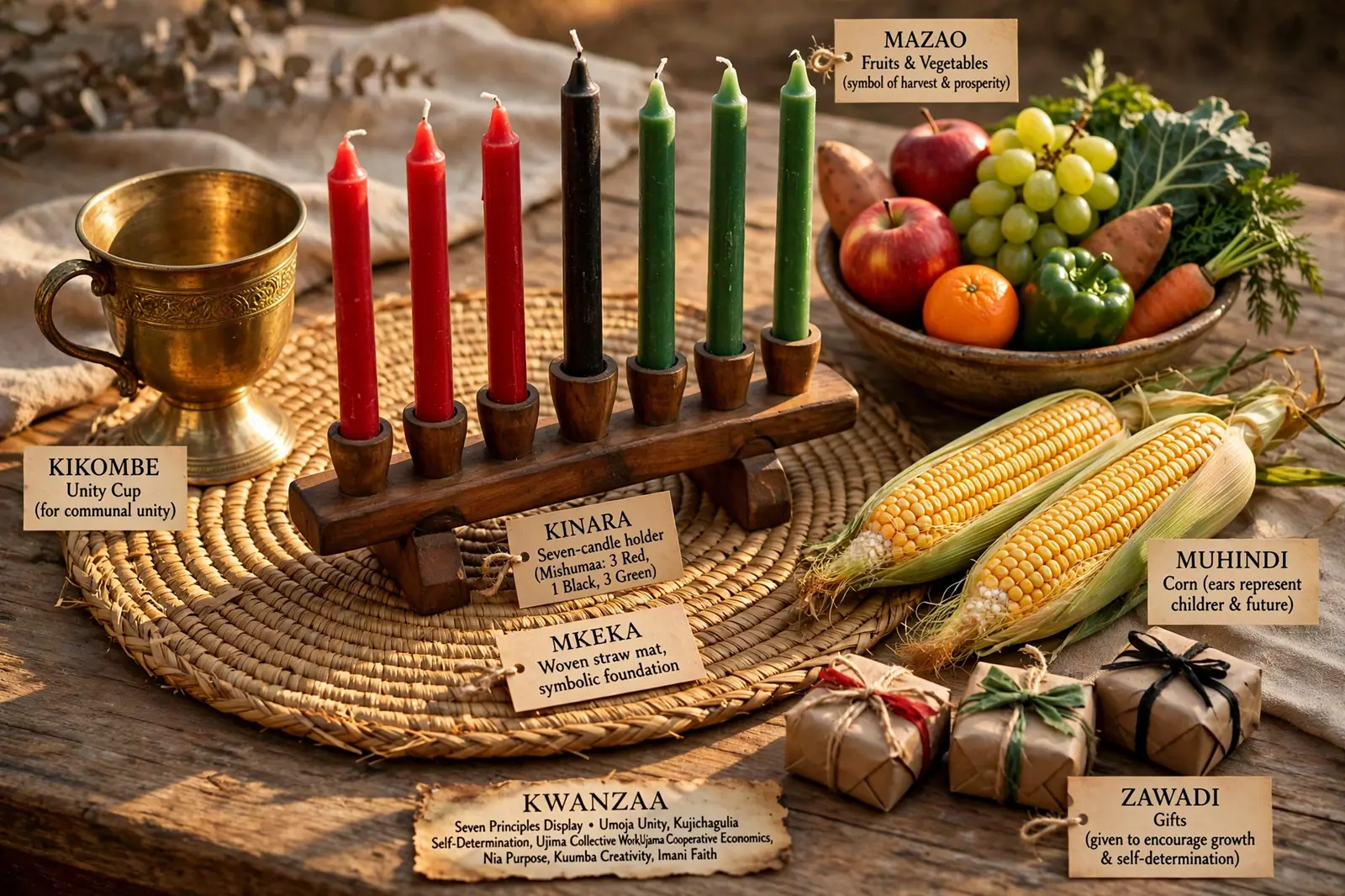
| Symbol (Swahili) | English Meaning | What It Is | What It Represents |
|---|---|---|---|
| Mkeka | Mat | A woven straw mat, traditionally rectangular | The foundation — history, culture, and tradition on which everything rests |
| Kinara | Candleholder | A seven-branched holder, usually wood, for the candles | Ancestral roots and the family/community holding the light |
| Mishumaa Saba | The seven candles | Three red, three green, one black candle | The Nguzo Saba — the Seven Principles, the light of the values |
| Mazao | Crops | Fresh fruits, vegetables, and nuts in a bowl or arrangement | The harvest; the rewards of collective labor |
| Muhindi | Corn | Ears of corn — one for each child in the household | Children and the future; fertility and continuity |
| Kikombe cha Umoja | Unity cup | A special cup, often brass, wood, or ceramic | Unity; used for the ceremonial libation to ancestors |
| Zawadi | Gifts | Wrapped presents placed near the display | The rewards of labor; meaningful, often handmade giving |
Mkeka: The Mat That Holds Everything
The mkeka is always laid first, and that order is the lesson. Traditionally a rectangular mat woven from straw, the mkeka symbolizes the foundation — the historical and cultural ground on which the family, the community, and the celebration itself stand. Everything meaningful in the Kwanzaa display rests on the mkeka, which makes the abstract idea of “foundation” physically visible: remove the mat and the symbols scatter; keep it and they hold together.
Choosing and Placing Your Mkeka
A traditional straw mkeka is ideal and widely available from cultural shops and online artisans, but the symbolism matters more than the material. A woven placemat, a piece of burlap, a strip of kente cloth, or even a black table runner can serve — what matters is that it reads as a distinct foundation layer beneath the other symbols. Size it generously: the kinara, unity cup, corn, and fruit should all sit comfortably on it with breathing room at the edges. Place it centered on your table, mantel, or dedicated surface, and build upward from there. If you are teaching children the symbols, the mkeka is the perfect starting point: “everything we believe stands on what came before us.”
Kinara: The Candleholder
The kinara is the visual heart of Kwanzaa — the object most people picture when they hear the holiday’s name. The word means “candleholder” in Swahili, and the seven branches represent the seven principles, the seven days, and the sevenfold strength of family and community. Traditionally carved from wood, kinaras range from simple, rustic designs to elaborate sculptural pieces; the material matters less than the form, though many families treasure handmade or artisan-carved kinaras as heirlooms.
What the Kinara Represents
Beyond holding candles, the kinara symbolizes ancestral roots — the stalk from which the family and community grow, holding the light of the principles aloft. Some interpretations describe it as the family tree made visible: a single base (shared heritage) branching into seven (the principles that guide daily life). When choosing a kinara, look for sturdiness first — it must hold seven tall candles safely — and then for beauty that speaks to you. A kinara you love becomes a fixture of your December for decades.

Mishumaa Saba: The Seven Candles
The mishumaa saba — “the seven candles” — are where the week’s drama lives. Three red, three green, one black: the Pan-African colors rendered in wax and flame. Each candle corresponds to one of the Nguzo Saba, and the nightly lighting is the central ritual of Kwanzaa.
The Arrangement: Getting It Right
Place the black candle in the center holder. As you face the kinara, the three red candles go on the left and the three green candles go on the right. (Some families mirror this; the essential point is black in the center.) Use tall taper candles that fit the holders securely — standard dinner tapers work, though many families prefer slightly thicker candles for longer burn times. Keep spare candles on hand; nothing disrupts the ceremony like a candle that burns out mid-week.
The Lighting Order: Night by Night
The candles are lit in the order of the principles, from the center outward, alternating colors. On December 26, the black candle is lit for Umoja (unity). December 27 adds the first red candle for Kujichagulia (self-determination). December 28 adds the first green for Ujima (collective work and responsibility). December 29, the second red for Ujamaa (cooperative economics). December 30, the second green for Nia (purpose). December 31, the third red for Kuumba (creativity). January 1, the final green for Imani (faith) — and all seven burn together. The growing row of flames is the week’s most powerful visual metaphor: the light literally increases as the principles accumulate.
Candle Safety
Seven open flames demand respect. Never leave the kinara unattended while candles are lit. Keep the display away from curtains, garlands, paper decorations, and little hands. Place the kinara on a stable, heat-resistant surface — the mkeka is traditional, but a ceramic tile or metal tray underneath adds safety. Trim wicks to about a quarter inch for cleaner burning, and extinguish candles before bed each night rather than letting them burn down. Families with small children or pets should consider high-quality LED tapers for the kinara; the ritual of “lighting” survives intact, and safety is itself an act of Ujima — collective responsibility for the family’s wellbeing.
Mazao: The Crops
The mazao — fruits, vegetables, and nuts — represent the harvest and, by extension, the rewards of collective labor. This is Kwanzaa’s most direct link to the African first-fruits festivals that inspired it: in agrarian societies, the harvest was the year’s proof that work, cooperation, and care produce abundance. On the Kwanzaa table, a generous bowl of produce makes the same argument in miniature.
What to Include
There are no strict rules, but abundance and variety are the point. Classic choices include oranges, apples, grapes, bananas, pomegranates, yams or sweet potatoes, winter squash, and nuts in their shells (walnuts, pecans, almonds). Choose produce with rich color — deep oranges, reds, and greens echo the palette. Arrange the mazao in a wooden or woven bowl, or scatter it artfully across the mkeka around the kinara. Refresh the fruit through the week as needed; slightly imperfect produce is fine, but wilted or spoiled fruit undermines the symbolism of abundance. After the week ends, the fruit can be eaten or cooked — waste contradicts the harvest spirit.
Muhindi: The Corn
The muhindi — ears of corn — represent children, fertility, and the future. Tradition calls for one ear for each child in the household, placed on the mkeka where everyone can see them. The message is unmistakable: the children are the crop that matters most, the harvest the whole celebration is ultimately for.
The Details That Matter
Use whole ears of corn, ideally with the husks partially pulled back for visual texture — dried decorative corn works beautifully and lasts the full week, while fresh corn looks vibrant but may dry out. If there are no children in the household, place a single ear to represent the children of the community; the future belongs to all of us, not just our own households. Some families write each child’s name on a small tag tied to their ear with raffia — a lovely personalization that makes children feel literally represented on the family altar. Like the mazao, the corn connects the display to agricultural roots: in many African traditions, children and crops were spoken of in the same breath, both being the yield of care and cultivation.

Kikombe cha Umoja: The Unity Cup
The kikombe cha umoja — the unity cup — is used in one of Kwanzaa’s most moving rituals: the pouring of libation. Each evening, the eldest or a designated family member pours a small amount of liquid (water, juice, or wine, depending on the family) from the unity cup onto the ground or into a plant, speaking the names of ancestors and honored dead. The libation acknowledges that the family’s present stands on the sacrifices of those who came before — a moment of remembrance woven into celebration.
Choosing Your Unity Cup
The cup should feel special — distinct from everyday drinkware. Brass, carved wood, ceramic, or glass all work; many families use a cup with personal history, which deepens the ritual. It should be large enough to pour from comfortably and stable enough to sit on the mkeka without tipping. Some families pass the cup after the libation so each person can take a sip, literally sharing unity; others keep the cup ceremonial-only. Either practice is fine — what matters is the intention. Keep a small plant or bowl of soil nearby to receive the libation if you are indoors; pouring onto a houseplant works perfectly and gives the ritual a living recipient.
The Libation: How It Works
The person leading pours a small stream while saying something like: “For our ancestors, whose strength brings us here” — then names specific ancestors: grandparents, great-grandparents, historical figures the family admires. Others may call out names as well. The tone is reverent but warm, not mournful; this is thanksgiving, not grief. Children can participate by naming ancestors they have learned about, which turns the ritual into a history lesson. For families exploring the broader heritage traditions Kwanzaa honors, our guide to what Juneteenth commemorates offers another window into how remembrance and celebration intertwine.
Zawadi: The Gifts
Zawadi — gifts — are the seventh symbol, and they come with a philosophy that sets Kwanzaa apart from the December gift-giving frenzy. Traditionally exchanged on January 1, the day of Imani, zawadi are meant to be meaningful rather than expensive: handmade items, books (especially books about heritage and history), educational materials, and gifts that reflect the recipient’s growth and the giver’s care. The emphasis is on the thought, the labor, and the meaning — a direct expression of Kuumba (creativity) and Nia (purpose).
Place wrapped zawadi near the kinara display through the week; they become part of the visual abundance. Wrap them in red, black, and green paper or African-print fabric to fold them into the decor. For children, the tradition strongly favors books and handmade gifts over generic toys — a practice that, year after year, builds a home library and a habit of valuing learning. Many families include a handwritten note with each gift explaining why it was chosen; the note often becomes the most treasured part.
Beyond the Seven: Colors, Greetings, and the Feast
Several other elements, while not counted among the seven symbols, are essential to the Kwanzaa vocabulary.
The Colors: Red, Black, and Green
The Pan-African colors saturate every Kwanzaa display. Black for the people, red for the struggle, green for the future and the land. They appear in the candles, the textiles, the decorations, and the gift wrap — a constant visual reminder of the holiday’s meaning. When decorating, treat the three colors as a language: black grounds, red energizes, green renews.
“Habari Gani?” — The Greeting
The traditional Kwanzaa greeting is “Habari Gani?” — Swahili for “What is the news?” The response is the name of that day’s principle: “Umoja!” on the first day, “Kujichagulia!” on the second, and so on. The call-and-response structure makes everyone a participant; even guests who know nothing about Kwanzaa can join in within seconds. Use it when people arrive, when the candles are lit, and in place of “hello” all week — it is a small ritual that keeps the principles on everyone’s lips.
The Karamu: The Feast
The Karamu feast on December 31 is sometimes called the eighth symbol — not an object but an event. The communal meal, with its African and diaspora dishes, its libation, its music, and its gathering of community, is where all the symbols come alive in practice. If the display is the text of Kwanzaa, the Karamu is the performance. For families who love the ceremonial side of gathering, our look at celebrations around the world shows how communal feasting anchors holidays across cultures.
Setting Up the Full Display: Step by Step
Here is the complete setup sequence, in order: (1) Choose a central, visible location — a table, mantel, or low shelf where the family can gather. (2) Lay the mkeka, centered, as the foundation. (3) Place the kinara in the center of the mkeka. (4) Arrange the mishumaa saba: black in the center, red on the left, green on the right (as you face it). (5) Set the kikombe cha umoja near the kinara. (6) Arrange the mazao — bowl of fruit, vegetables, and nuts — on the mkeka. (7) Place the muhindi — one ear of corn per child. (8) Arrange wrapped zawadi nearby. (9) Add personal touches: ancestor photos, meaningful books, art. (10) Step back and check: candles tallest and centered, everything on the mat, space around it for gathering. The whole setup takes under an hour once you have the pieces — and taking it down on January 2, carefully storing each symbol for next year, is itself a small closing ritual.
The Colors as Symbol: Red, Black, and Green
Though not counted among the seven symbols, the three colors deserve their own explanation because they saturate everything. Red, black, and green are the Pan-African colors, popularized by Marcus Garvey’s Universal Negro Improvement Association in the 1920s and adopted by Kwanzaa’s founder to root the holiday in the broader movement for African dignity and self-determination. Black stands for the people — the foundation of the celebration. Red stands for the struggle: the blood shed and hardships endured in the fight for freedom. Green stands for the future: the land, growth, and hope.
The colors appear most famously in the mishumaa saba — three red candles, three green, one black — but they also govern textiles, decorations, gift wrap, and clothing throughout the week. Understanding the color symbolism helps you “read” any Kwanzaa display at a glance: where black dominates, the emphasis is on people and foundation; where red leads, on struggle and sacrifice remembered; where green leads, on hope and growth. Together they tell the whole story in three strokes — who we are, what we endured, where we are going — which is why getting the palette right matters more in Kwanzaa decor than in almost any other holiday.
Common Symbol Mistakes to Avoid
Wrong Candle Order or Colors
The most frequent error: placing the black candle off-center or mixing up the red-green sides. The standard is black in the middle, red on the left, green on the right as you face the kinara, lit from the center outward alternating red-green. Some families mirror the sides, which is acceptable — but the black candle must hold the center, because Umoja (unity) is the first principle and the heart of the week.
Skipping the Mkeka Foundation
Setting the kinara directly on a bare table without the mat underneath is more than an aesthetic miss — it drops the symbol of foundation from the display. Even a simple cloth runner or woven placemat restores the meaning. The mkeka is the first thing laid down and the last thing picked up; treat it as non-negotiable.
Using the Unity Cup as Ordinary Drinkware
The kikombe cha umoja is ceremonial, not a spare mug. Using it for everyday drinking through the week blurs its meaning. Keep it on the display, use it for the libation, and otherwise let it stand as a symbol. If you want guests to share from it after the libation, that is a recognized tradition — but it should be intentional, not casual.
Forgetting the Children in the Symbolism
The muhindi — one ear of corn per child — is easy to overlook in households focused on the candles, but it carries one of the week’s most important messages: the children are the future the celebration serves. Place the corn visibly, name the children it represents, and involve them in the display. A Kwanzaa table without the corn is a statement missing its conclusion.
Treating Symbols as Mere Decorations
The deepest mistake is aesthetic-only decorating: a beautiful display that no one explains or uses. The symbols are meant to be handled, discussed, and taught — the candles lit nightly, the libation poured, the corn counted, the gifts given with intention. A modest display used with understanding will always mean more than an elaborate one treated as a backdrop. If you take one rule from this guide, take this: use the symbols, don’t just show them.
Watch: My Family Celebrates Kwanzaa
See these symbols in action in a real family’s celebration:
Frequently Asked Questions About Kwanzaa Symbols
What are the seven symbols of Kwanzaa?
The seven symbols are the mkeka (mat), kinara (candleholder), mishumaa saba (seven candles), mazao (crops), muhindi (corn), kikombe cha umoja (unity cup), and zawadi (gifts). Each has a Swahili name and represents a specific value or concept, from foundation and heritage to children, unity, and the rewards of labor.
How do you arrange the candles on the kinara?
Place the black candle in the center, the three red candles on the left, and the three green candles on the right as you face the kinara. Light them in principle order from the center outward: black on Dec 26 (Umoja), then alternating red and green — Dec 27 red (Kujichagulia), Dec 28 green (Ujima), Dec 29 red (Ujamaa), Dec 30 green (Nia), Dec 31 red (Kuumba), Jan 1 green (Imani).
What is the unity cup used for?
The kikombe cha umoja is used for the libation ceremony: each evening, liquid is poured from the cup in honor of ancestors while their names are spoken. Some families then share the cup, each person taking a sip as an act of unity. The cup should feel special and distinct from everyday drinkware.
Why corn, and how many ears do you display?
Corn (muhindi) represents children and the future — the most important “crop” of all. Display one ear for each child in the household. If there are no children at home, a single ear represents the children of the community.
When are Kwanzaa gifts exchanged?
Zawadi are traditionally exchanged on January 1, the final day of Kwanzaa (Imani). They are meant to be meaningful rather than expensive — handmade items, books, and educational gifts are preferred, often accompanied by a handwritten note explaining the gift’s significance.
Do the symbols have to be expensive or authentic?
No. The symbolism matters more than the materials — a handmade kinara, a simple woven placemat as a mkeka, and an ordinary special-feeling cup all serve perfectly. What makes the display authentic is correct arrangement, understood meaning, and sincere use, not cost. For more ideas on meaningful celebrating without overspending, see our budget celebration ideas and local holiday events and markets where artisans sell handmade ceremonial pieces.
The Bottom Line
The symbols of Kwanzaa are a language — and like any language, they reward fluency. The mkeka teaches that everything stands on a foundation. The kinara teaches that heritage holds the light. The seven candles teach that values accumulate, night by night, into illumination. The crops teach that labor bears fruit. The corn teaches that children are the future. The unity cup teaches that we remember those who came before. The gifts teach that giving should mean something.
Set up the display correctly, use it nightly, and teach each symbol as you go — especially to children, who absorb this vocabulary the way they absorb everything: by watching it lived. Photograph the display on the first night and again when all seven candles burn together; the contrast tells the week’s story in a single glance. A Kwanzaa table is never just decoration. It is a curriculum, a memorial, and a promise, arranged on a mat and lit one candle at a time.