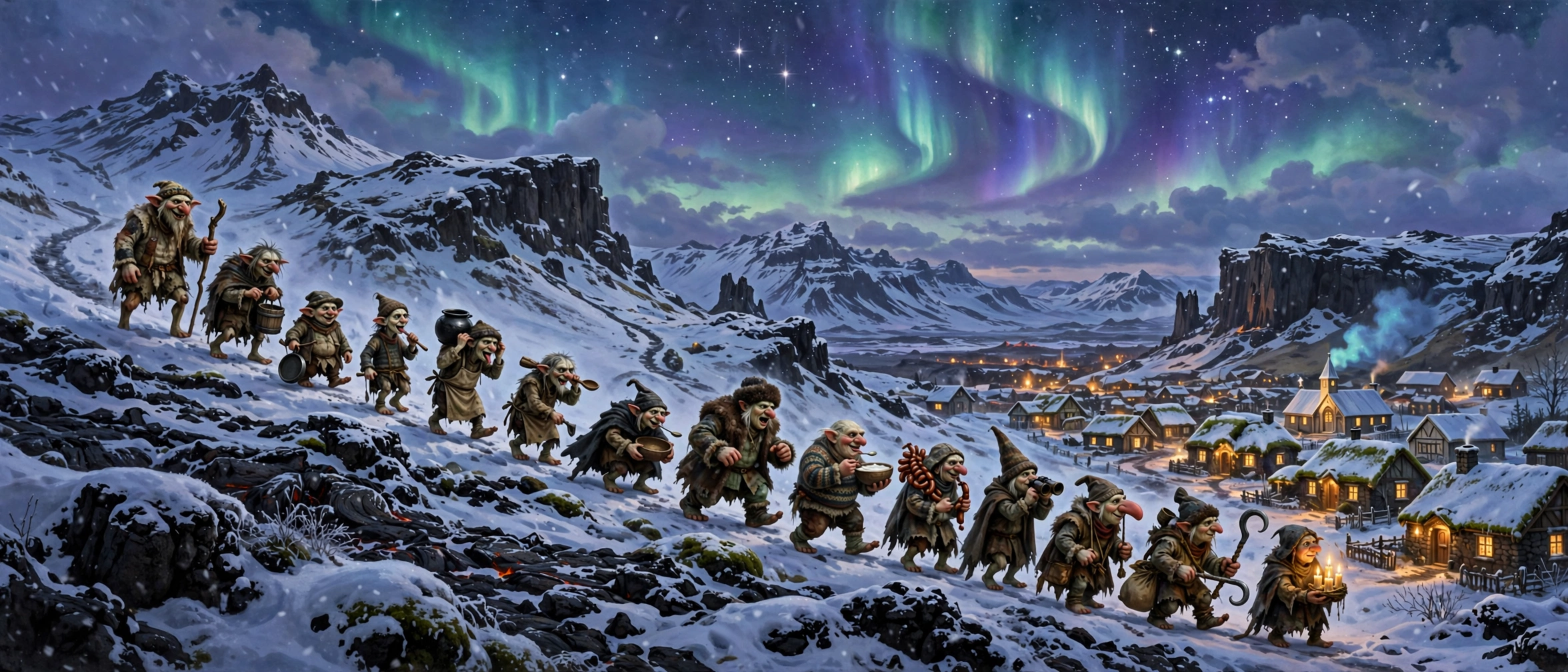
Forget everything you know about Santa Claus. In Iceland, Christmas doesn’t bring one jolly gift-giver — it brings thirteen. The Icelandic Yule Lads (Jólasveinarnir) are a gang of mischievous troll-brothers who descend from the mountains one by one over the thirteen days before Christmas, each with his own personality, his own prank, and his own night to fill children’s shoes with candy — or potatoes, if they’ve been naughty.
And the Yule Lads are only the beginning. Their mother is Grýla, a child-eating ogress of Icelandic folklore; their father is the lazy troll Leppalúði; and their pet is the Yule Cat, a monstrous feline that devours anyone who doesn’t receive new clothes for Christmas. Iceland’s Christmas folklore is gloriously, unapologetically dark — and utterly captivating.
This complete guide introduces all 13 Icelandic Yule Lads in order, tells the stories of Grýla and the Yule Cat, explains the shoe-in-the-window tradition, traces how these monsters became beloved Santas, and shows how Iceland celebrates them today. It’s a journey into one of the world’s strangest Christmas traditions — and a perfect companion to other Nordic December customs like St. Lucia Day in Sweden and Eastern Europe’s Ukrainian Christmas spider legend.
Who Are the Icelandic Yule Lads?
The Icelandic Yule Lads are thirteen brothers, the sons of the ogress Grýla and her third husband, the troll Leppalúði. According to folklore, they live in the mountains with their parents and their giant cat, descending to human settlements in the days before Christmas — one arriving each night from December 12 through December 24. Each lad then stays for thirteen days before departing in the same order, the last one leaving on January 6 (Twelfth Night).
Unlike Santa Claus, the Yule Lads were not originally gift-givers at all. In the old folktales, they were pranksters and petty thieves: they stole food, slammed doors, peered through windows, and generally terrorized farmsteads during the dark Icelandic winter. Children feared them — and their mother far more. Over the 19th and 20th centuries, as Iceland urbanized and Christmas commercialized, the Lads softened into the gift-bringing figures children know today, though they’ve never entirely lost their mischievous edge.
The modern tradition works like this: from December 12 onward, Icelandic children place a shoe in their bedroom window each night. Overnight, the Yule Lad of the day visits — leaving candy, small gifts, or treats for good children, and a potato (traditionally a rotten one) for the naughty. Each Lad’s visit corresponds to his personality: the pranks of folklore have become the charm of the custom. It’s Advent-calendar magic stretched across thirteen nights, with thirteen distinct characters instead of one.
The 13 Yule Lads, in Order of Arrival
Here they are — all thirteen Icelandic Yule Lads, in the order they arrive, with their dates, their names’ meanings, and their signature mischief:
1. Stekkjastaur — Sheep-Cote Clod (December 12)
The first to arrive, Stekkjastaur is stiff-legged from years of mountain dwelling, which makes his walk peculiar — he peg-legs it between his knees, as the old poem says. His particular obsession is sheep: he sneaks into sheep-cotes to suckle milk directly from the ewes. In modern tellings, he’s the clumsy, endearing eldest who kicks off the season, leaving the first treats in children’s shoes on the night of December 12.
2. Giljagaur — Gully Gawk (December 13)
Giljagaur hides in gullies and ravines, waiting for the chance to slip into the cowshed and steal the foam from freshly milked pails. He’s the shy lurker of the family, more comfortable in ditches than doorways. Children who leave their shoes out on December 13 wake to find Giljagaur has been — and hopefully left something sweeter than stolen milk foam.
3. Stúfur — Stubby (December 14)
As his name suggests, Stúfur is remarkably short — and he uses his stature to his advantage, sneaking about kitchens to steal pans and scrape off the delicious crust of leftovers. He’s the Lad most likely to be caught red-handed with his face in your cookware. On his night, check your pans — and your shoes.
4. Þvörusleikir — Spoon-Licker (December 15)
Þvörusleikir is obsessed with þvörur — the long wooden spoons traditionally used in Icelandic cooking. He’s painfully thin (all that spoon-licking provides little nutrition) and will steal spoons outright to lick them at leisure. In the old days, a missing wooden spoon in December was blamed squarely on this Lad.
5. Pottaskefill — Pot-Scraper (December 16)
Where Stúfur steals the pan, Pottaskefill goes for the pot — scraping up every last bit of leftovers. He’s the Lad of second helpings, the patron saint of licked-clean cookware. Icelandic parents once invoked him to encourage children to finish their food: eat up, or Pottaskefill will get the leavings.
6. Askasleikir — Bowl-Licker (December 17)
Askasleikir hides under beds, waiting for someone to set down their askur — the traditional lidded wooden bowl Icelanders ate from — and then snatches it to lick clean. He’s the bedroom lurker of the thirteen, which made him a particularly effective figure for frightening children into good behavior at bedtime.
7. Hurðaskellir — Door-Slammer (December 18)
Everyone’s least favorite houseguest: Hurðaskellir spends his nights slamming doors, preferably when people are trying to sleep. In the thin-walled turf houses of old Iceland, a door-slamming troll in the December dark was genuinely terrifying. Today, he’s the rowdy middle child — the one parents blame for every mysterious nighttime bang.
8. Skyrgámur — Skyr-Gobbler (December 19)
Skyrgámur has a single, all-consuming passion: skyr, the thick, tangy cultured dairy product that is Iceland’s national food. He’ll devour entire tubs of it, leaving empty containers as evidence of his visit. Modern Icelandic kids sometimes leave a spoonful of skyr out for him — a tribute offering to the Lad most likely to raid the refrigerator.
9. Bjúgnakrækir — Sausage-Swiper (December 20)
Bjúgnakrækir hides in the rafters of smokehouses and pantries, reaching down with his namesake hook to snatch smoked sausages (bjúga) hanging overhead. In farming Iceland, where smoked meats were precious winter stores, this Lad was a genuine menace. Today he’s remembered fondly — the acrobat thief of the family.
10. Gluggagægir — Window-Peeper (December 21)
The creepiest of the thirteen by modern standards: Gluggagægir prowls around houses peering through windows, looking for things worth stealing. On the longest, darkest nights of the year — he arrives just after the winter solstice — the idea of a face appearing at the window was the stuff of nightmares. Contemporary tellings soften him into a curious watcher, but his night still carries a delicious shiver.
11. Gáttaþefur — Doorway-Sniffer (December 22)
Gáttaþefur has an enormous, sensitive nose and uses it to sniff out laufabrauð — the delicate, intricately patterned “leaf bread” fried for Icelandic Christmas. He lingers in doorways, following the scent of fresh baking. Of all the Lads, he’s the most sympathetic to modern food lovers: who hasn’t followed the smell of Christmas baking to its source?
12. Ketkrókur — Meat-Hook (December 23)
Arriving on Þorláksmessa (St. Thorlac’s Mass, December 23 — Iceland’s traditional Christmas Eve-eve), Ketkrókur uses an iron hook to steal smoked lamb (hangikjöt) — the centerpiece of many Icelandic Christmas dinners. He’s the Lad with the highest stakes: steal the Christmas roast and you’ve ruined the holiday. Families once guarded their larders accordingly.
13. Kertasníkir — Candle-Stealer (December 24)
The last to arrive, on Christmas Eve itself, Kertasníkir follows children around to snatch their candles — in the days of tallow candles, a genuinely tempting edible treat. He’s the finale of the procession, the Lad who ushers in Christmas proper. When his gifts appear in shoes on Christmas morning, the thirteen-day visitation is complete — and the Lads begin, one by one, to head back to the mountains.
Grýla, Leppalúði, and the Dreaded Yule Cat
The Yule Lads’ family is where Icelandic Christmas folklore goes from mischievous to genuinely chilling.
Grýla: The Ogress Mother
Grýla is one of the most fearsome figures in all of Christmas folklore worldwide — a giant ogress who lives in the mountains, collects naughty children in her sack, and cooks them into stew. In the oldest tales, she’s genuinely monstrous: a towering, many-tailed horror whose appetite for misbehaving children was the ultimate disciplinary tool. For centuries, Icelandic parents needed only to mention Grýla to achieve instant obedience.
Her menace was considered so excessive that in 1746, a public decree actually banned parents from terrifying their children with stories of Grýla and the Lads — one of history’s rare examples of folklore being regulated by law. Over time, Grýla softened (somewhat): in modern tellings she’s grumpy and threatening rather than actively cooking children, though she remains the undisputed heavy of Icelandic Christmas.
Leppalúði: The Lazy Father
Grýla’s third husband, Leppalúði, is a pale, lazy troll who mostly lies around in their mountain cave while his wife and sons get up to mischief. He’s a comic figure — the henpecked husband of folklore — and a reminder that even in the darkest Christmas mythology, there’s room for a joke.
The Yule Cat (Jólakötturinn)
Perhaps the strangest of all: the family’s pet is a gigantic, ferocious cat that roams the countryside at Christmas, eating anyone who hasn’t received at least one new article of clothing for the holiday. The tale likely originated as an incentive for farm workers to finish processing wool before Christmas — those who worked hard got new clothes; those who didn’t… met the cat. To this day, Icelanders give clothes as Christmas gifts with particular enthusiasm, and the Yule Cat remains a belovedly terrifying mascot of the season.
The Yule Lads’ Calendar: December 12 to January 6
The full Yule Lad season spans nearly a month. The first Lad, Stekkjastaur, arrives on December 12; one new Lad arrives each night through Christmas Eve, when Kertasníkir completes the set. Each Lad stays exactly thirteen days, so departures begin on Christmas Day — Stekkjastaur heads home on December 25 — and continue in order until the last Lad leaves on January 6, Twelfth Night (Þrettándinn), which Icelanders celebrate with bonfires and elf lore.
This means the season has three movements: the arrival (December 12–24), building nightly excitement as the family assembles; the full house (Christmas Eve through early January), when all thirteen are abroad at once; and the departure (December 25–January 6), a gradual farewell. For children, it’s a longer, richer Advent than anything a cardboard calendar can offer — nearly four weeks of nightly magic.
The shoe tradition runs through the arrival period: a shoe in the window each night from December 12, with treats or potatoes appearing by morning. Many families extend small gifts through the whole season, and the Lads’ personalities give parents thirteen distinct characters to invoke — “Hurðaskellir will slam the doors if you don’t settle down” remains a live parental threat in Icelandic homes.
From Monsters to Mischief-Makers: A Dark History
The transformation of the Icelandic Yule Lads from feared trolls to beloved Santas is one of folklore’s great makeovers — and it tells the story of Iceland itself.
In the oldest accounts, there wasn’t even a fixed number of Yule Lads. Early sources mention varying counts and names; the Lads were a shifting cast of mountain-dwelling menaces, more like a natural hazard of winter than a Christmas tradition. They stole, they frightened, and their mother ate children. Christmas, in this telling, was something to survive.
The 1746 decree against using Grýla tales to frighten children marked the beginning of the softening — society itself decided the folklore had gone too far. Through the 19th century, as Iceland’s independence movement embraced folk culture as national heritage, collectors like Jón Árnason preserved the tales in print, fixing the canon of thirteen Lads with their standard names and personalities. What had been oral terror became literary heritage.
The decisive modernization came in 1932, when the poet Jóhannes úr Kötlum published his beloved Christmas poem Jólasveinarnir (“The Yule Lads”), giving each Lad his characteristic verse and cementing the thirteen in the national imagination as distinct, almost lovable characters. In the decades that followed, urbanization, American cultural influence, and commercial Christmas completed the transformation: the Lads acquired Santa-like gift-giving duties, the shoe tradition standardized, and Grýla’s child-cooking faded into wink-and-nod menace.
Yet Iceland never fully sanitized its Christmas. The Lads remain trolls — mischievous, strange, faintly alarming — and Icelanders are proud of the difference. Where other countries have one benevolent Santa, Iceland has thirteen weird brothers, an ogress mother, and a child-eating cat, and wouldn’t trade them for anything. The darkness isn’t a bug; it’s the point. In a country that spends December in near-total darkness, Christmas folklore that acknowledges the dark feels honest — and the light of the season shines brighter against it.
How Iceland Celebrates the Yule Lads Today
Modern Iceland embraces the Yule Lads with characteristic creativity. In downtown Reykjavík, the Lads appear as costumed figures at Christmas events; the city’s Christmas markets and the famous Jólaþorpið (Christmas village) in Hafnarfjörður feature Lad-themed festivities. Bakeries sell jólasveina cookies; breweries release Yule Lad beers; and the Lads’ faces — each with his distinct look, from Stekkjastaur’s peg-legged gait to Gáttaþefur’s giant nose — adorn everything from ornaments to sweaters.
For families, the shoe tradition remains the centerpiece. Icelandic parents report that the thirteen-night buildup creates a uniquely sustained magic: unlike the single morning of Santa, the Lads deliver small, nightly surprises that keep excitement simmering for weeks. The potato threat, meanwhile, does genuine disciplinary work — few parenting tools match “Kertasníkir is watching” in late December.
Visitors to Iceland in December can experience the folklore firsthand. The best places to spend Christmas in Iceland include Reykjavík’s festive center, the northern town of Akureyri, and countryside guesthouses where the darkness — and the sense of troll country — is most palpable. Look for Yule Lad figurines in craft shops (a set of all thirteen makes an unbeatable souvenir), catch the Jólasveinarnir poem in translation, and on December 12, put a shoe in your window. You never know who might visit.
And if you’re decorating for the season with a Nordic twist, the Yule Lads pair wonderfully with natural, troll-country Christmas decoration ideas — think wool, wood, candlelight, and a healthy respect for whatever might be peering through the window. For a cozier night in, few things beat classic Christmas movies after the children have checked their shoes — though in Iceland, the best Christmas stories are the old ones, told in the dark.
Yule Lads in Pop Culture and Modern Media
The Icelandic Yule Lads have escaped folklore and gone global — a testament to how irresistible thirteen mischievous troll-brothers are as characters. They’ve appeared in children’s books published in multiple languages, in animated Christmas specials, and as collectible figurines; Icelandic designers have reimagined them for everything from postage stamps to craft beer labels. The Lads’ distinct personalities make them natural ensemble characters — the folklore equivalent of a heist-movie crew, each with a specialty.
Grýla and the Yule Cat, meanwhile, have found a second life in horror and fantasy media, where their genuinely frightening original forms fit right in. The Yule Cat in particular has become a cult figure among folklore enthusiasts worldwide — the giant, child-eating Christmas cat is simply too good a concept to stay in Iceland. You’ll find Jólakötturinn in horror anthologies, fantasy novels, and a thriving trade in delightfully sinister merchandise.
Iceland itself has embraced the Lads as cultural ambassadors: tourist shops sell sets of all thirteen (a rite of passage for December visitors), the national tourism campaigns feature them, and Icelandic schools teach the Jólasveinarnir poem as a matter of course. There’s even a Yule Lad theme park energy to parts of December in Reykjavík — the city leans into its troll heritage with characteristic good humor.
For the full Nordic Christmas experience, pair the Yule Lads with Iceland’s other great December tradition — the Jólabókaflóð, the “Christmas book flood,” in which Icelanders give books on Christmas Eve and spend the night reading. Thirteen trolls, a scary cat, and a night of reading: Iceland’s Christmas is the best Christmas, and it’s not close.
In Pictures: Iceland's 13 Yule Lads
Iceland has thirteen Santas, not one: the mischievous Yule Lads — Jólasveinar — descend from the mountains one by one in the 13 nights before Christmas, leaving gifts or potatoes in children's shoes.
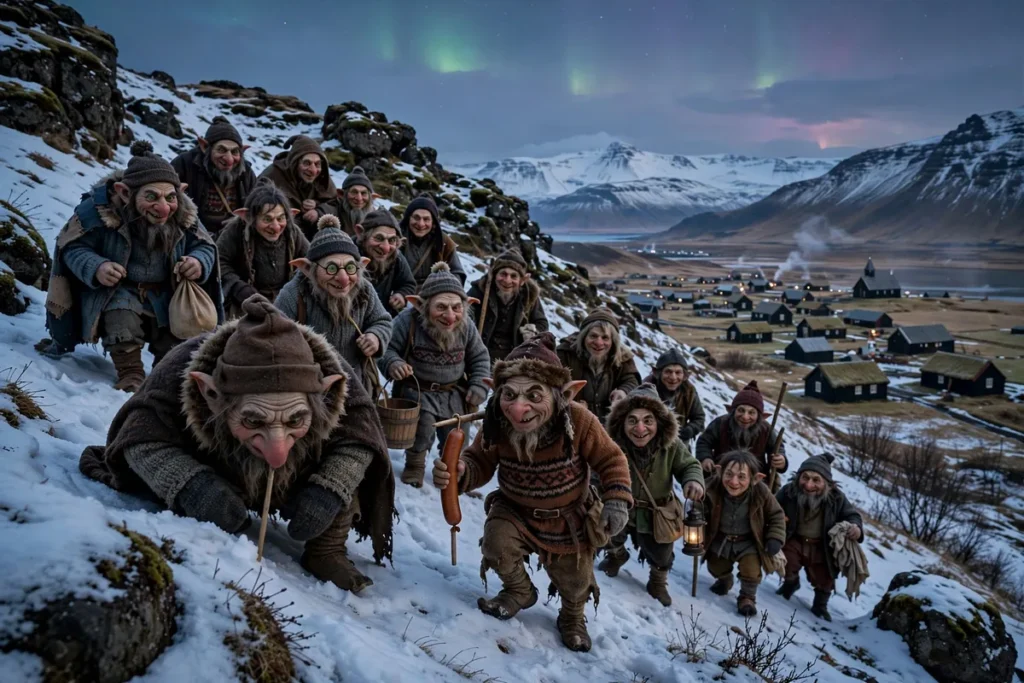
The Jólasveinar coming down: thirteen mischievous Yule Lads descending from the snowy Icelandic mountains toward the village at dusk.
Watch: Iceland's 13 Yule Lads
Iceland with a View introduces the 13 Yule Lads — the mischievous troll brothers who visit Icelandic homes every December, from Sheep-Cote Clod to Candle-Stealer.
At a Glance: Iceland's 13 Yule Lads
The lads, their family, and the folklore of Iceland's Christmas trolls.
| Element | What it is | Key detail |
|---|---|---|
| 13 nights | The arrivals | One Yule Lad descends from the mountains each night in the 13 nights leading up to Christmas |
| Shoes in the window | The custom | Children leave shoes in the window: good children find small gifts, naughty ones get a potato |
| Grýla | Their mother | A child-eating ogress from 13th-century texts — the mother of the thirteen brothers |
| Leppalúði | Their father | Grýla's husband and the lads' father, the idler of Icelandic folklore |
| The Yule Cat | The cat | A giant cat said to devour anyone who did not receive new clothes for Christmas |
| The names | The lads | Sheep-Cote Clod, Spoon-Licker, Window-Peeper, Candle-Stealer, and nine more — each with his own obsession |
| The 1746 ban | The history | Iceland's authorities tried to ban the Yule Lads in 1746 — they came back anyway, and scarier than ever |
Frequently Asked Questions
How many Icelandic Yule Lads are there?
Thirteen. The Jólasveinarnir are thirteen troll-brothers, the sons of the ogress Grýla and the troll Leppalúði. They arrive one by one from December 12 to December 24 and depart in the same order from December 25 to January 6. Earlier folklore mentioned varying numbers, but the canon of thirteen was fixed in the 19th century.
What do the Yule Lads leave in children’s shoes?
Good children receive candy, small gifts, or treats; naughty children traditionally receive a potato (in older tales, a rotten one). The shoe is placed in the bedroom window each night from December 12 onward, and each morning reveals what that night’s Lad has left.
Who is Grýla?
Grýla is the Yule Lads’ mother — a giant ogress of Icelandic folklore who, in the oldest tales, collected naughty children in a sack and cooked them into stew. Her stories were once so frightening that a 1746 decree banned parents from using them to scare children. Today she’s a gruff, threatening figure rather than an active child-eater, but she remains the heavy of Icelandic Christmas.
What is the Yule Cat?
The Yule Cat (Jólakötturinn) is the enormous, ferocious pet cat of Grýla’s family. According to legend, it roams at Christmas and eats anyone who hasn’t received new clothes for the holiday. The tale likely originated as an incentive for farmworkers to finish wool processing before Christmas. Icelanders still take clothes-giving at Christmas particularly seriously.
When do the Yule Lads arrive and leave?
Stekkjastaur, the first Lad, arrives on December 12; one more arrives each night through December 24 (Kertasníkir). Each stays thirteen days, so departures run from December 25 (Stekkjastaur) through January 6 (Kertasníkir), Twelfth Night.
Are the Yule Lads related to Santa Claus?
Not originally — they’re native Icelandic troll folklore, far older than Santa’s arrival in Iceland. Over the 20th century they absorbed Santa-like gift-giving duties, and today they function as Iceland’s thirteen Santas. But they’ve kept their distinct personalities, pranks, and deliciously dark family — Grýla, Leppalúði, and the Yule Cat have no parallel in Santa mythology.
The Bottom Line
The Icelandic Yule Lads 13 Santas remind us that Christmas doesn’t have to be sanitized to be magical. Thirteen prankster trolls, a child-eating ogress, a lazy troll father, and a monstrous cat — and out of this gloriously dark menagerie, Iceland has built one of the world’s most enchanting December traditions: thirteen nights of shoes in windows, nightly surprises, and stories told in the dark. Put a shoe in your window on December 12. Mind the doors on the 18th. Guard the skyr on the 19th. And whatever you do, make sure someone gives you new clothes — the Cat is watching.