

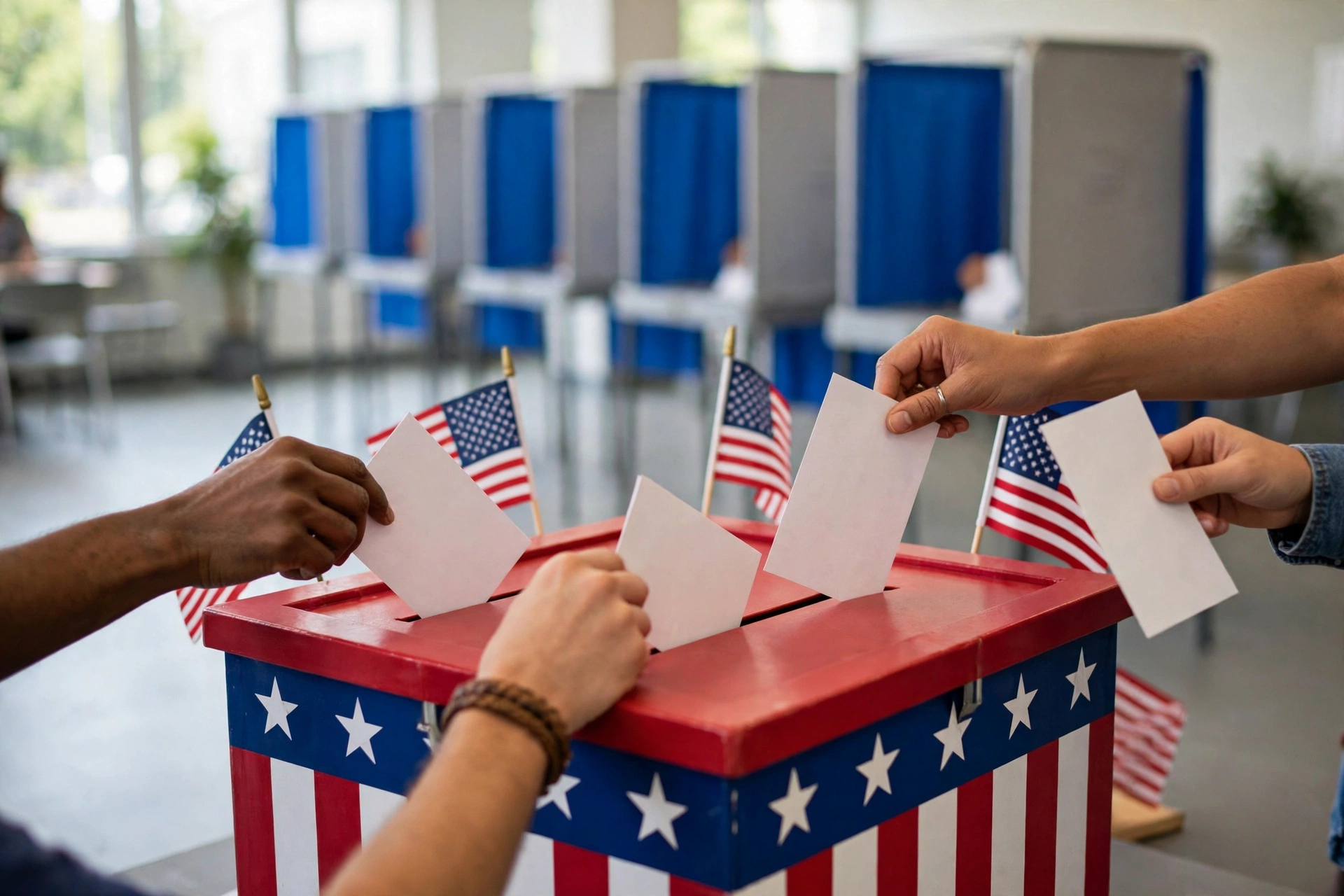
Every election season brings the same questions: who can vote, how do you register, and what actually happens to your ballot after you cast it? This guide explains how voting works in the US from start to finish — the rules that decide who is eligible, the many ways to cast a ballot, how ballots are counted and certified, and why elections look different in every state. Whether you are a first-time voter, a newly naturalized citizen, or just want to understand the system better, here is the complete picture.
Who Is Allowed to Vote in the US?
Voting in the United States is a right of citizenship with a few basic conditions. To vote in federal elections, you must be a US citizen, at least 18 years old on or before Election Day, and a resident of the state where you vote. Most states also require you to register before you can cast a ballot — there is no automatic national voter roll. Beyond those federal baselines, the details are set by each state:
| Requirement | Federal rule | State variation |
|---|---|---|
| Citizenship | Must be a US citizen | Noncitizens cannot vote in federal elections, period |
| Age | 18 by Election Day (26th Amendment) | Many states let 17-year-olds vote in primaries if they turn 18 by the general election |
| Residency | Must be a resident of the voting state | Durations vary; college students can usually choose their home or school state |
| Registration | No federal registration system | About half the states offer same-day or Election Day registration; others close registration 2–4 weeks before |
| Criminal convictions | No federal rule | Varies enormously — some states restore voting rights automatically after a sentence; others restrict them permanently for certain offenses |
One of the most common sources of confusion is that there is no single US election authority that runs voting. Elections are administered by state and local governments — more than 10,000 local jurisdictions run the actual voting. The federal government sets broad guardrails (like the Voting Rights Act and the Help America Vote Act), but your county or city election office is the one that prints ballots, staffs polling places, and counts votes. That decentralization is why how voting works in the US depends so much on where you live.
How Voter Registration Works
In almost every state, you must register before you vote — being eligible is not enough. Registration tells your local election office who you are, where you live (which determines your ballot), and your party affiliation (which matters for closed primaries in some states).
The main ways to register
- Online: The fastest option. More than 40 states offer online voter registration through their secretary of state or election board website. You typically need a driver’s license or state ID number.
- Motor voter (at the DMV): Under the National Voter Registration Act of 1993, states must offer registration when you apply for or renew a driver’s license. Some states have gone further with automatic voter registration — you are registered unless you opt out.
- By mail: You can download the National Mail Voter Registration Form and send it to your state election office. Federal law requires states to accept it.
- In person: At your county election office, and often at public assistance agencies, military recruitment offices, and voter registration drives.
- Same-day registration: Available in roughly half the states plus DC, letting you register and vote in one trip — though lines can be long.
Registration deadlines are the tripwire that catches new voters every cycle. States that require advance registration typically cut off 15 to 30 days before Election Day. If you move — even within the same state — you generally need to update your registration. Check your status early at your state’s election website rather than discovering a problem at the polling place.
The Ways You Can Cast Your Ballot
How voting works in the US has changed dramatically in the past two decades. Where almost everyone once voted in person on a single Tuesday, most states now offer several options:
1. In-person voting on Election Day
The classic method. Polls are open at assigned polling places — usually schools, libraries, churches, or community centers — and hours vary by state (typically morning to evening; some open as early as 5 a.m. local time, others close as late as 9 p.m.). You check in with poll workers, receive your ballot or access a voting machine, and vote in privacy. If you are in line when the polls close, you are entitled to vote — do not leave.
2. Early in-person voting
Most states now offer a period of early voting before Election Day, ranging from a few days to several weeks. Early voting uses the same ballots and machines, often at the same or additional locations. It is one of the biggest reasons turnout has risen — voters can choose a convenient time instead of squeezing voting into one workday.
3. Absentee and mail-in voting
Every state allows some form of absentee voting, and most states now let any voter request a mail ballot without giving a reason (“no-excuse absentee voting”). About a third of states conduct elections largely or entirely by mail. Mail ballots must be requested in advance, filled out following the instructions carefully (a signature matching issue is the most common reason ballots get rejected), and returned by the state’s deadline — which in many states means received by Election Day, not merely postmarked.
4. Provisional ballots
If your eligibility is questioned at the polls — your name is missing from the rolls, you lack required ID, or you are at the wrong precinct — federal law guarantees you a provisional ballot. Your vote is set aside and counted once officials verify your eligibility. Always take the provisional ballot rather than leaving.
What Is on Your Ballot?
A general-election ballot is much more than the presidential race. Depending on the year and your address, it may include:
- Federal races: President and vice president (every 4 years), your US House representative (every 2 years), and one of your state’s US senators (staggered 6-year terms).
- State races: Governor, lieutenant governor, attorney general, secretary of state, state legislators, and other statewide offices.
- Local races: Mayor, city council, county officials, school board, sheriff, judges — the offices that most directly affect your daily life.
- Ballot measures: Initiatives, referendums, and constitutional amendments that let voters decide policy directly, plus bond measures for schools and infrastructure.
- Judicial retention: In many states, voters decide whether appointed judges stay on the bench.
This is why “down-ballot” races matter: the president gets the headlines, but your mayor, school board, and state legislators shape your roads, schools, taxes, and policing. Turnout plummets in off-year and local elections even though those races touch daily life most directly.
How Votes Are Counted
After you vote, your ballot enters a carefully regulated counting process. Understanding it helps explain why results take time — and why taking time is a sign the system is working, not failing.
- Tabulation: Most votes are counted by optical scanners that read paper ballots, or by ballot-marking devices. Hand-marked paper ballots with machine counting is the national standard, and paper provides an auditable trail.
- Canvassing: Election officials reconcile the numbers — checking that the count of ballots matches the count of voters who checked in, resolving provisional ballots, and verifying mail-ballot signatures.
- Certification: Counties certify their results, then the state certifies the statewide totals. Deadlines vary by state but typically fall within two to four weeks of Election Day.
- Audits and recounts: Many states conduct post-election audits comparing machine counts to hand counts of sampled ballots. Recounts happen automatically when margins fall below a threshold, or can be requested by candidates.
Different states count mail ballots at different times — some begin processing weeks before Election Day, others cannot start until the polls close — which is why results can appear to swing as different batches are reported. Election-night “calls” by news organizations are projections based on counted votes and exit data, not official results. The official result is the certified one.
Why Voting Rules Differ So Much by State
The Constitution gives states the primary role in running elections, and states have used that power to build very different systems. Compare the extremes:
| Feature | More accessible states | More restrictive states |
|---|---|---|
| Registration | Automatic or same-day registration | Registration closes 30 days before Election Day |
| Mail voting | All-mail elections; ballots sent to every registered voter | Excuse required (illness, travel, work) |
| Early voting | Several weeks of early in-person voting | Limited or no early voting |
| Voter ID | No ID required beyond signature match | Strict photo ID required |
| Felony voting rights | Restored automatically, in some states never lost | Restricted for years or permanently for some offenses |
These differences are the subject of constant political debate and frequent court cases. What is not in dispute is the practical advice: look up your own state’s rules well before the deadline. Your state’s secretary of state or board of elections website is the authoritative source for registration deadlines, ID requirements, polling locations, and ballot tracking.
Voter ID Laws: What You Need to Know
About three dozen states ask for or require identification at the polls, but the strictness varies enormously. Some accept a utility bill or bank statement; others demand a government-issued photo ID and offer free IDs to voters who lack one. A handful of states with strict photo-ID laws also provide provisional ballots to voters without ID, counted if the voter’s identity is later verified.
If you are voting by mail, the “ID” is usually your signature — election workers compare it to the signature on file. This is the single most common point of failure for mail ballots, so sign carefully and consistently, and make sure your registration signature is current.
Common Myths About How Voting Works in the US
- Myth: You need to register with a party to vote. Party registration only matters for partisan primaries in states with closed primaries. In the general election, you can vote for any candidate regardless of registration.
- Myth: If you don’t vote, it doesn’t matter. Nonvoters still live under the decisions of those elected by voters. And many local races are decided by dozens of votes.
- Myth: Your vote for president is counted nationally. There is no national tally that decides the presidency — votes are counted state by state, which you can follow in our national news election coverage.
- Myth: Mail-in voting is new or experimental. Absentee voting dates back to the Civil War, when Union soldiers voted from the field. It has been used securely for over 150 years.
- Myth: Results announced on election night are official. They are projections. Official results come after canvassing and certification, days or weeks later.
- Myth: Voting machines are connected to the internet. Voting machines are not supposed to be internet-connected, and the paper ballots they produce or scan can be audited and recounted.
Your Election-Day Checklist
- Confirm your registration at your state’s election website at least a month before the election — earlier if you have moved recently.
- Know your options: Check whether your state offers early voting or no-excuse mail voting, and note the request and return deadlines.
- Find your polling place in advance — locations change, and going to the wrong precinct can complicate your vote.
- Bring ID if your state requires it (check the rules; requirements vary).
- Research the whole ballot, including local races and ballot measures — many counties publish sample ballots online.
- Make a plan: Decide when and how you will vote, and how you will get there. Voters with a plan turn out at much higher rates.
- If you vote by mail, return it early — through a drop box or in person if your state allows, to avoid postal delays.
- Stay in line: If you are in line when the polls close, you have the legal right to vote.
How Voting Works in the US: The Bigger Picture
Voting is the point where the American system of self-government becomes personal. The decentralized design — states running elections, local officials counting ballots, citizens serving as poll workers — reflects a deep American instinct: elections should be run close to the people they serve. It also means the system depends on participation at every level, from voters to the neighbors who staff the polling places.
If this guide helped you understand the mechanics, keep going. Our national news coverage follows each presidential race from the primaries to the inauguration, while our guide to how local government works explains the level of government closest to your daily life, and the US news hub covers the races, rules, and results as they develop. Technology also shapes modern voting — see our US technology news coverage for stories on voting systems and election security.
Frequently Asked Questions
How does voting work in the US in one paragraph?
Eligible citizens register with their state, then cast a ballot in person on Election Day, early in person, or by mail. Local officials count the ballots, verify the totals, and certify the results. States run their own elections under federal guardrails, so exact rules — deadlines, ID, mail voting — vary by state.
Do I have to register before every election?
No — registration stays valid as long as your address and name are current and you remain eligible. But you must update it when you move, and some states remove voters who have not voted or responded to mailings for several cycles, so verify your status before each election.
Can I vote if I just moved to a new state?
Usually yes, once you establish residency and register there. Registration deadlines in your new state apply. You cannot vote in two states in the same election.
What is a provisional ballot?
A ballot cast when your eligibility cannot be confirmed at the polls. It is sealed and counted only if officials later verify you were eligible. Federal law guarantees your right to cast one rather than being turned away.
Why do election results take so long?
Mail ballots arrive over days, signatures must be verified, provisional ballots researched, and close races audited or recounted. Careful counting takes time — speed was never the goal; accuracy was.
Is voting mandatory in the US?
No. Unlike countries such as Australia, the United States has no compulsory voting. Turnout in presidential elections is typically around 60–66% of eligible voters, and much lower in local elections.
Can I vote early?
In most states, yes — either in person during an early voting period or by mail. A few states offer neither, so check your state’s rules.
What should I do if I witness a problem at the polls?
Report it to the poll workers first, then to your county election office. You can also contact nonpartisan voter-protection hotlines, which operate in every state on Election Day. Document what you saw — the time, location, and what happened — while the details are fresh.
Voting FAQs Continued
What does the “help America vote” act cover?
The Help America Vote Act of 2002 sets minimum standards for federal elections, including provisional ballots for voters whose eligibility is uncertain, accessible voting equipment for people with disabilities, and statewide voter registration databases.
Can a naturalized citizen run for president?
No. The Constitution requires the president to be a natural-born citizen, at least 35 years old, and a US resident for 14 years. Naturalized citizens can vote and hold nearly every other office.
What happens if a voting machine malfunctions?
Poll workers can offer an emergency or provisional paper ballot, which is counted after eligibility is verified. Most jurisdictions also keep spare equipment on standby during busy elections.
Do I need to re-register if I move?
Yes — registration is address-specific, so a move within the same state usually requires updating your registration, and a move across state lines means registering fresh in the new state.


