

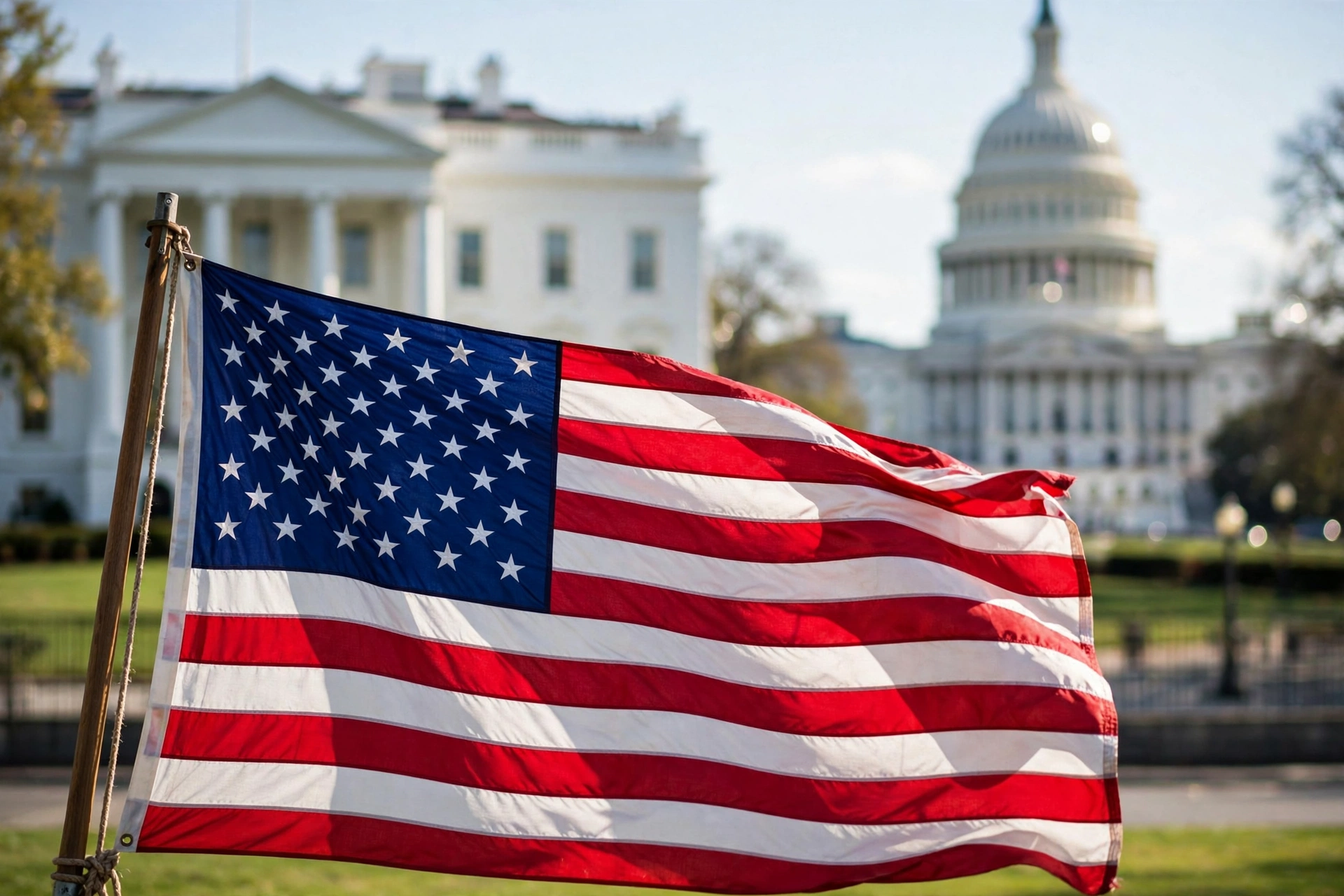
The United States government is the most powerful in the world — and one of the least understood by the people it serves. Surveys consistently find that large shares of Americans cannot name all three branches, let alone explain what each one does. This guide explains how the US government works in clear, plain language: the three branches and their powers, the system of checks and balances that keeps any one of them from dominating, and how federal, state, and local governments divide responsibility. By the end, the structure that shapes everything from your taxes to your local school board will make sense.
The Big Idea: Separation of Powers
The founders of the United States had just fought a revolution against a king, and they were determined not to replace him with another all-powerful ruler. Their solution, drawn from Enlightenment thinkers like Montesquieu, was to divide government power into three separate branches, each with its own responsibilities and each able to limit the others. The Constitution — written in 1787 and still the supreme law of the land — sets out this design in its first three articles:
- Article I creates the legislative branch (Congress) — it makes the laws.
- Article II creates the executive branch (the president and the administration) — it enforces the laws.
- Article III creates the judicial branch (the courts) — it interprets the laws.
No person may serve in more than one branch at the same time. A member of Congress cannot also be a federal judge; the president cannot sit in Congress. This separation is the foundation on which everything else is built.
The Legislative Branch: Congress Makes the Laws
Congress is the lawmaking body of the federal government, and the Constitution gives it the most detailed job description of any branch — a sign of how central the founders considered it. Congress is bicameral, meaning it has two chambers:
The House of Representatives
The House has 435 voting members, apportioned among the states by population — California has 52, while seven small states have just one each. Members serve two-year terms, so the entire House faces the voters every even-numbered year. The House is designed to be the chamber closest to the people: more responsive, more volatile, quicker to reflect the public mood. It has special powers, including initiating revenue (tax) bills and impeaching federal officials.
The Senate
The Senate has 100 members — two per state regardless of population, serving staggered six-year terms (about a third up for election every two years). The Senate was designed to be the more deliberative, stable chamber: it confirms presidential appointments (judges, cabinet secretaries, ambassadors), ratifies treaties by a two-thirds vote, and holds impeachment trials. Its rules allow unlimited debate, which is where the filibuster lives.
What Congress does
Beyond passing laws, Congress controls the federal purse (no money can be spent without its appropriation), declares war, regulates interstate commerce, establishes federal courts below the Supreme Court, and oversees the executive branch through hearings and investigations. Congressional committees are where the detailed work happens — drafting legislation, questioning officials, and shaping policy long before anything reaches a floor vote. You can follow congressional lawmaking as it happens in our US news section, alongside our US economy news coverage of the budget battles that dominate each session.
The Executive Branch: The President Enforces the Laws
The executive branch is headed by the president, who serves as head of state, head of government, and commander-in-chief of the armed forces. But the presidency is far more than one person — it is a vast apparatus:
- The White House and Executive Office: The president’s closest advisers, including the chief of staff, national security adviser, and press secretary.
- The Cabinet: The heads of the 15 executive departments (State, Treasury, Defense, Justice, Education, and others), who advise the president and run their departments.
- Federal agencies: More than two million civilian employees across agencies like the EPA, NASA, the FDA, and the IRS — the people who actually implement federal law day to day.
- The vice president: First in the line of succession, president of the Senate (casting tie-breaking votes), and a key adviser.
The president’s core powers include signing or vetoing legislation, commanding the military, conducting foreign policy and negotiating treaties, appointing federal judges and executive officials (with Senate confirmation), granting pardons, and issuing executive orders directing the executive branch. What the president cannot do is make laws or spend money unilaterally — those belong to Congress — or decide court cases, which belong to the judiciary.
How the president is chosen
The president serves a four-year term, limited to two terms by the 22nd Amendment. Uniquely, the president is not chosen by the national popular vote but by the Electoral College — 538 electors allocated by state, with 270 needed to win. This is one of the most misunderstood features of American government; if you want the full explanation, it is worth reading on its own.
The Judicial Branch: The Courts Interpret the Laws
The judicial branch is headed by the Supreme Court — nine justices who serve lifetime appointments — and includes 13 federal appeals courts and 94 district courts below it. Federal judges are nominated by the president and confirmed by the Senate, and they can only be removed by impeachment.
The courts’ central power is judicial review: the authority to strike down laws and executive actions that violate the Constitution. This power is not spelled out in the Constitution’s text — the Supreme Court claimed it for itself in Marbury v. Madison (1803), and it has defined American government ever since. Through judicial review, the courts act as the final referee on what the Constitution means, from free speech to voting rights to presidential power.
The Supreme Court hears only about 70–80 cases per term out of the thousands it is asked to take, choosing the disputes with the broadest national significance. Its decisions become binding precedent for every court in the country. Below the federal system, each state has its own court system handling the vast majority of America’s legal cases — criminal trials, divorces, contracts, and injuries are overwhelmingly state-court matters.
Checks and Balances: How the Branches Limit Each Other
Separation of powers would mean little without enforcement. Checks and balances are the specific tools each branch has to restrain the others — the founders’ insurance policy against tyranny:
| Branch | Checks on the others |
|---|---|
| Legislative (Congress) | Can override presidential vetoes (two-thirds vote); confirms or rejects presidential appointments and treaties; controls all federal spending; can impeach and remove the president, judges, and other officials; determines the size and structure of the federal courts |
| Executive (President) | Can veto legislation; appoints federal judges; can pardon federal offenses; commands the military; conducts foreign policy |
| Judicial (Courts) | Can declare laws and executive actions unconstitutional; chief justice presides over presidential impeachment trials in the Senate |
In practice, this means almost nothing important happens in Washington without at least two branches cooperating — and often all three. A president’s agenda needs Congress to pass laws and fund them; Congress’s laws need the president’s signature (or a veto-proof supermajority); and both can be undone by the courts. The friction is the point: the system trades efficiency for safety, making it hard for any faction to seize unchecked power quickly.
Federalism: Power Is Shared With the States
How the US government works cannot be understood without federalism — the division of power between the national government and the 50 state governments. The Constitution lists the federal government’s powers (coining money, declaring war, regulating interstate commerce, running foreign policy) and reserves everything else to the states (the 10th Amendment). In practice, the lines blur constantly, but the basic split looks like this:
| Mostly federal | Mostly state | Shared |
|---|---|---|
| National defense, foreign policy | Elections administration | Taxation |
| Immigration and naturalization | Most criminal law | Highway construction |
| Interstate commerce | Education (with federal funding attached) | Environmental protection |
| Currency and bankruptcy | Marriage, divorce, and family law | Law enforcement |
| Social Security, Medicare | Professional licensing | Public health emergency response |
Below the states sit local governments — counties, cities, towns, and special districts — which handle the services you encounter most: police and fire departments, water and sewers, zoning, parks, and public schools. There are nearly 90,000 local governments in the United States. For a closer look at the level nearest you, see our guide to how local government works.
Federalism is why your experience of “the government” depends heavily on where you live: tax rates, gun laws, abortion access, minimum wage, and voting rules all vary by state. The federal government sets floors and frameworks; states fill in — or push back on — the details. Supreme Court cases about federalism are really arguments about who gets to decide.
The Bill of Rights: Limits on Government Power
The original Constitution said mostly what the government could do. Critics demanded a list of what it could not do — and the result was the Bill of Rights, the first ten amendments, ratified in 1791. These are the guarantees that shape daily American life:
- 1st Amendment: Freedom of speech, religion, press, assembly, and petition — the core civil liberties.
- 2nd Amendment: The right to keep and bear arms (its exact scope remains heavily litigated).
- 4th Amendment: Protection against unreasonable searches and seizures — the basis of warrant requirements.
- 5th Amendment: Due process, protection against self-incrimination (“taking the Fifth”), and eminent domain rules.
- 6th Amendment: Rights of criminal defendants, including a speedy trial and trial by jury.
- 8th Amendment: No cruel and unusual punishment, no excessive bail or fines.
- 10th Amendment: Powers not given to the federal government belong to the states or the people.
Later amendments extended the system’s promises: the 13th abolished slavery, the 14th guaranteed equal protection and due process against state governments, the 15th and 19th extended voting rights regardless of race and sex, and the 26th lowered the voting age to 18. The Constitution has been amended only 27 times in more than 230 years — change is possible, but deliberately difficult.
How the US Government Works Day to Day
Strip away the civics-class diagrams and government is, daily, a negotiation among competing power centers. A typical week in Washington might include: the House passing a spending bill, the Senate amending it beyond recognition, the president threatening a veto, federal agencies issuing draft regulations, and a federal judge blocking part of an executive order — all at once. None of this is dysfunction in the constitutional sense; it is the system operating as designed, with each branch checking the others in real time.
What citizens experience as “the government” is mostly the executive branch’s agencies (the IRS, the DMV-equivalent federal offices, Social Security) and their state and local counterparts. Congress and the courts feel distant until a new law, a tax change, or a landmark ruling lands directly in daily life. That distance is worth closing: the officials with the most power over your everyday experience — your mayor, your state legislators, your member of Congress — are the ones you can most directly influence, starting with your vote. Our US news hub follows all three branches so you can see the system in action.
Common Misconceptions
- “The president runs the country.” The president leads the executive branch, but cannot make laws, appropriate money, or overrule the courts. Presidents are powerful — but constrained on every side.
- “Congress and the government are the same thing.” Congress is one branch. The “government” includes all three branches plus the states.
- “The Supreme Court is the most powerful branch.” It has the final word on the Constitution, but it cannot enforce its own rulings — it depends on the executive branch to carry them out, and Congress can reshape the lower courts or (with great difficulty) amend the Constitution.
- “States have to obey everything Washington says.” Only within the federal government’s constitutional powers. States regularly and successfully challenge federal overreach in court.
- “The popular vote chooses the president.” The Electoral College does — one of the system’s most distinctive and debated features.
Frequently Asked Questions
How does the US government work in simple terms?
Power is divided three ways: Congress makes laws, the president enforces them, and the courts interpret them. Each branch can check the others, and power is further shared between the federal government and the states.
What are the three branches of government?
The legislative branch (Congress: House + Senate), the executive branch (the president, Cabinet, and federal agencies), and the judicial branch (the Supreme Court and federal courts).
Who has more power — the president or Congress?
Neither, by design. Congress makes the laws and controls spending; the president enforces laws and commands the military; the courts referee disputes. Each can block the others, so major action usually requires cooperation.
What is federalism?
The constitutional division of power between the national government and the states. The federal government handles matters like defense and interstate commerce; states handle elections, most criminal law, and education; many areas are shared.
Can the government take away constitutional rights?
The Bill of Rights limits what government can do, and courts enforce those limits through judicial review. But rights are not absolute — courts balance them against competing interests (public safety, for example) — and the Constitution can be amended, though that requires overwhelming consensus.
How can I participate in how the US government works?
Vote in every election (especially local and primary races), contact your representatives, attend public meetings, serve on a jury, and stay informed. The system is designed to respond to engaged citizens — but only if they show up.
How the System Evolved: A Brief History
How the US government works today is the product of more than two centuries of change layered onto the founders’ blueprint:
- 1781–1789: The Articles of Confederation. America’s first constitution created a weak central government with no president and no federal courts. It failed — states printed their own money, ignored debts, and nearly went to war with each other — which is why the Constitutional Convention was called.
- 1789: The Constitution takes effect. The new framework created the three-branch system, with George Washington as the first president. The Bill of Rights followed in 1791.
- 1860s: The Civil War amendments. The 13th, 14th, and 15th Amendments abolished slavery, guaranteed equal protection and due process, and protected voting rights — fundamentally expanding who the government served and dramatically increasing federal power over the states.
- 1930s: The New Deal. The Great Depression prompted a vast expansion of the executive branch and federal agencies. The Supreme Court initially resisted, then accepted a broader reading of federal power — the modern administrative state was born.
- 1960s: The rights revolution. Landmark legislation (the Civil Rights Act, the Voting Rights Act) and Supreme Court decisions extended constitutional protections to millions previously excluded, reshaping elections, policing, and public life.
- Today: The same three-branch structure endures, but the scale is unrecognizable — a federal budget in the trillions, millions of federal employees, and a judiciary whose rulings on technology, privacy, and executive power set precedents the founders could never have imagined.
The through-line is adaptation without replacement: Americans have amended, reinterpreted, and stretched the Constitution rather than writing a new one. That continuity is both the system’s greatest strength and the source of its most heated arguments — every generation debates anew what the old words mean for new problems.


