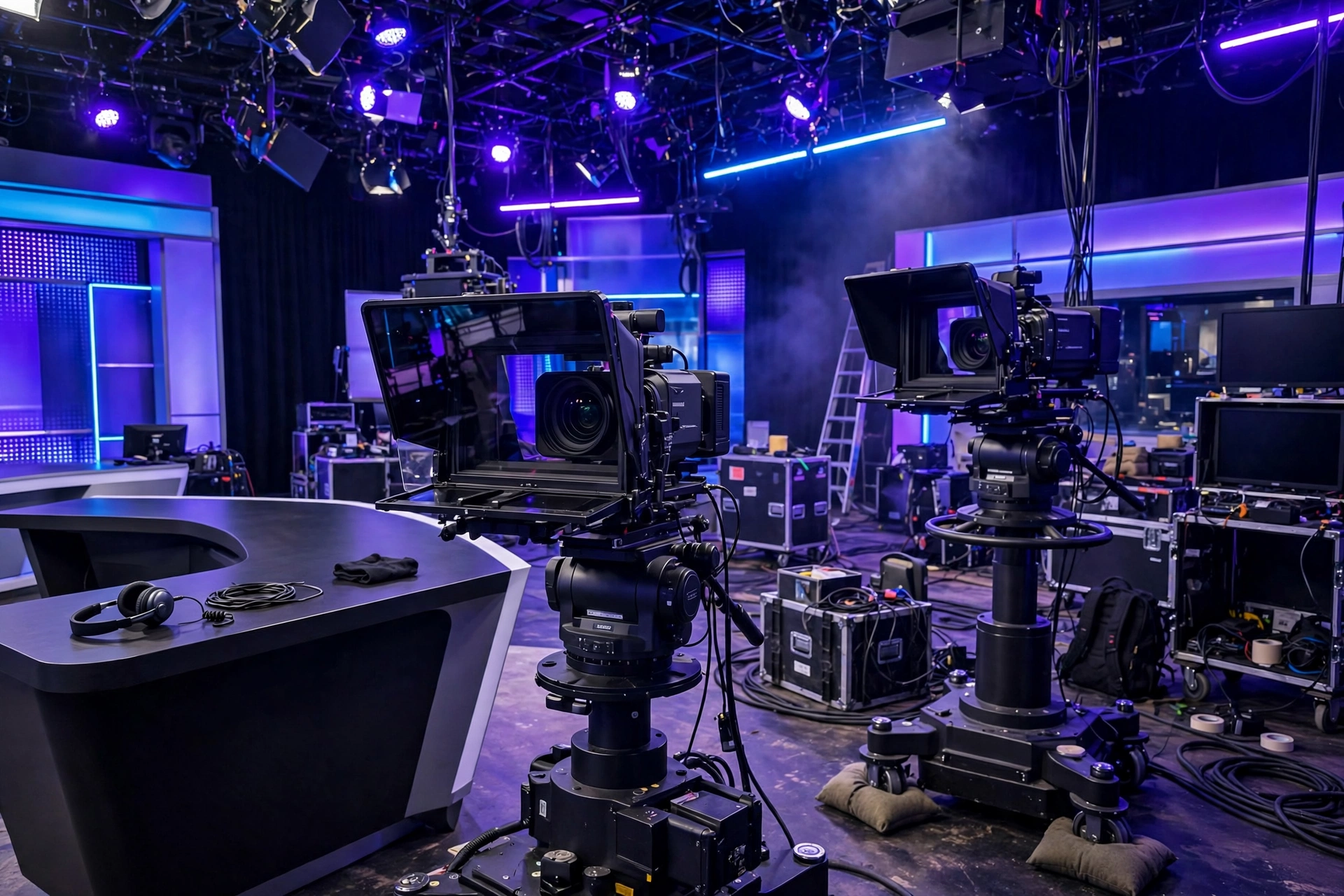
How is TV news made — what really happens behind the camera before the anchor says “good evening”? A television newscast is one of the most complex live productions in media: dozens of people, millions of dollars of equipment, and a minute-by-minute battle plan called the rundown, all assembled fresh every single day and performed live with no safety net. Understanding how TV news is made explains a lot about the news itself — why stories are short, why live shots sometimes go wrong, and why the broadcast looks the way it does. Come behind the scenes for a full day in the life of a TV newscast.
The Big Picture: A Newscast Is Built Fresh Every Day
Unlike a scripted drama filmed over weeks, a local evening newscast is conceived, written, rehearsed, and performed within about eight to twelve hours — and then thrown away. Tomorrow’s show starts from zero. National network broadcasts work on similar cycles with larger staffs and more resources. This daily rebuild is the defining fact of TV news production: everything is optimized for speed, reliability, and the ability to change the plan live on air.
A typical 30-minute newscast contains roughly 22 minutes of actual news content (the rest is commercials). Those 22 minutes hold 15 to 25 individual stories, weather, and sports. Each story gets 20 seconds to two minutes. Every second is planned in advance — and then re-planned constantly as news breaks, stories run long, or technical problems strike. The controlled chaos you sense as a viewer is real; the professionalism is in managing it invisibly.
A Day in the Life: From Morning Meeting to Sign-Off
6:00–9:00 AM: The Morning Editorial Meeting
The day begins with the assignment desk already monitoring overnight developments — fires, accidents, weather, wire alerts. The morning editorial meeting brings together producers, assignment editors, reporters, and managers to decide: What are today’s stories? Who covers what? What are the live-shot locations? The output of this meeting is the day’s story budget — the master list of everything the station plans to cover.
Reporters head out with photographers (in TV, the camera operator is often called the photographer, and the reporter-photographer pair is the basic field unit). Meanwhile, producers begin sketching the evening rundown — the minute-by-minute blueprint of the show. Nothing is final yet; the rundown will be rewritten a dozen times before air.
9:00 AM–2:00 PM: Gathering and Building
Field crews shoot interviews, gather b-roll (supplemental footage), and attend press briefings. Back at the station, the production pipeline hums:
- Writers and producers draft scripts, structuring each story with a clear beginning, middle, and end, timed to the second.
- Video editors cut raw footage into packages — self-contained reported stories, usually 1:00 to 2:00 long — selecting the strongest shots, inserting interview soundbites, and trimming to the exact duration the rundown demands.
- Graphics artists build lower-third name straps, full-screen data graphics, maps, and charts. Modern broadcasts layer augmented-reality graphics onto the studio floor, making data visualizations appear to stand in the room with the anchor.
- The weather team builds forecasts from meteorological data, preparing the graphics sequences that will carry the weather segment.
2:00–4:00 PM: The Afternoon Meeting and Rundown Lock
The afternoon editorial meeting reviews what the field crews found, kills stories that did not pan out, and elevates surprises. The producer now assembles the real rundown: every story in order, with timings, assigned anchors, video sources, and graphics cues. A simplified rundown looks like this:
| Order | Slug | Anchor | Format | Duration |
|---|---|---|---|---|
| A1 | Headlines tease | Both anchors | Voice-over | 0:20 |
| A2 | Downtown fire | Anchor 1 | Package | 1:45 |
| A3 | Fire live shot | Anchor 1 → Reporter | Live | 1:00 |
| A4 | City council vote | Anchor 2 | Reader + graphic | 0:35 |
| A5 | Weather intro | Anchor 1 | Toss | 0:10 |
| A6 | Weather segment | Meteorologist | Live wall | 3:00 |
| B1 | Sports intro | Anchor 2 | Toss | 0:10 |
| B2 | Game highlights | Sports anchor | Voice-over | 2:00 |
| B3 | Kicker (feel-good story) | Both anchors | Package | 1:30 |
Producers arrange stories using the peak-and-valley technique: the strongest stories are distributed through the broadcast rather than front-loaded, so viewers stay tuned through commercial breaks. Teases before each break promise what is coming next. The kicker — a light, uplifting story — traditionally closes the show to send viewers off feeling good.
4:00–5:00 PM: Rehearsal, Hair, Makeup, and Final Changes
Anchors arrive, review scripts, and record voice-overs. The director and technical crew rehearse complex sequences — live shots, graphic builds, camera moves. Makeup and wardrobe prepare the on-air talent (yes, even the weather wall presenters). And the rundown keeps changing: a late-breaking story bumps a weaker one, timings get trimmed, scripts get rewritten. Flexibility is the job.
5:00–6:30 PM: Air Time
The show goes live. In the control room, the director calls camera shots (“ready camera two, take camera two”), the technical director punches the buttons, the audio engineer rides levels, and the producer watches the clock — constantly recalculating whether the show is running long or short and adjusting on the fly. If a story runs 20 seconds long, something later loses 20 seconds. Anchors read from the teleprompter, a beam-splitter glass in front of the camera lens that reflects scrolling text while letting them look straight into the lens — creating the illusion of eye contact with you.
When breaking news hits mid-broadcast, the producer rewrites the rundown live: stories get dropped, reporters get thrown to live shots with seconds of warning, and the anchor ad-libs transitions. This is why live TV sometimes looks ragged around breaking stories — you are watching the plan change in real time. (For what is happening editorially in those moments, follow our US news roundup alongside the broadcast to compare the confirmed facts with the live speculation.)
After Air: Debrief and Tomorrow
The post-show meeting reviews what worked and what failed — a mistimed graphic, a fumbled live shot, a story that deserved more time. Then the cycle resets: the late-news team is already building the 10 or 11 PM show, and the morning team will start fresh at dawn.
The Key Jobs in TV News Production
| Role | What They Actually Do |
|---|---|
| Producer | Owns the show: chooses stories, builds the rundown, writes scripts, times every second, and makes live decisions during broadcast. The most powerful editorial role in the building. |
| Anchor | Presents the newscast on camera, reads the teleprompter, conducts live interviews, and ad-libs through breaking news. The public face — but the producer shapes what they say. |
| Reporter / Correspondent | Gathers news in the field: interviews, investigations, live shots. Writes or co-writes their packages. |
| Photographer (camera operator) | Shoots video, operates the camera on live shots, and often edits. In many markets, reporters now shoot their own video too. |
| Assignment editor | Dispatches crews, monitors scanners and wires, triages breaking news. The newsroom’s air-traffic controller. |
| Director | Calls the show live: chooses cameras, cues graphics and video playback, orchestrates the technical crew second by second. |
| Meteorologist | Forecasts weather and presents it, building custom graphics sequences. Often the most scientifically trained person on air. |
| Sports anchor | Covers local and national sports with highlights packages and analysis. |
| Video editor | Cuts packages and voice-overs under brutal deadlines; timing precision is the core skill. |
| Graphics operator | Builds and triggers on-air graphics, from name straps to full-screen data visualizations. |
| Audio engineer | Manages microphones, live-shot audio feeds, and broadcast sound levels. |
| Teleprompter operator | Scrolls the script in sync with the anchor’s delivery; adjusts instantly when anchors ad-lib. |
The Technology Behind the Broadcast
The Studio
Modern TV studios are marvels of controlled environment: lighting grids tuned to flatter faces on camera, acoustic treatment, and increasingly, LED video walls instead of physical sets. Robotic camera pedestals glide along programmed paths with millimeter precision, replacing the camera operators who once physically pushed massive cameras. Augmented reality graphics, tracked to the cameras, let anchors appear to stand inside 3D data visualizations.
The Control Room
The control room is mission control: rows of monitors showing every camera, every video source, and the program feed going to air. The director sits at the center with the producer beside them. Modern automation systems can link the rundown directly to the equipment — cameras, graphics, teleprompter, and playback all triggered from the show’s script. A single operator can now run sequences that once required five people.
Getting the Signal Out: Live Shots
Field live shots once required satellite trucks with giant dishes. Today, bonded-cellular backpacks stream broadcast-quality video over multiple cell networks from almost anywhere. That is why you now see live reporters in places trucks could never reach — and why live shots sometimes freeze or pixelate when the cell signal struggles. The technology traded reliability for ubiquity.
The Newsroom Computer System
Everything runs on the newsroom computer system (NRCS) — software like iNEWS or ENPS that integrates wire feeds, scriptwriting, rundown building, timing, prompting, and archiving. When a producer changes the rundown, the teleprompter, graphics, and timing update everywhere simultaneously. The NRCS is the invisible nervous system of the entire operation.
TV News Glossary: Terms You Hear Every Night
- Rundown (run order): The minute-by-minute blueprint of the newscast — every story, timing, and technical cue in order.
- Package (pkg): A complete reported story with narration, interviews, and video, usually 1–2 minutes. The prestige format of TV news.
- Voice-over (VO): Anchor reads over video footage, typically 20–30 seconds.
- Soundbite (SOT — “sound on tape”): A short clip of someone speaking, inserted into a package or VO.
- Reader: Anchor reads a story with no video — just them on camera.
- Live shot: Reporter broadcasting live from the field.
- Toss: Anchor’s handoff to another person (“Let’s toss it over to weather”).
- Tease: A preview of an upcoming story, designed to keep you watching through the break.
- Kicker: The light, feel-good story that traditionally ends the newscast.
- B-roll: Supplemental footage cut over narration.
- Lower third: The name/title graphic at the bottom of the screen.
- Backtime: Calculating backward from the show’s end to make sure everything fits — the producer’s constant arithmetic during the broadcast.
Why TV News Looks the Way It Does
Once you understand the production, the format’s quirks make sense:
- Stories are short because the rundown must fit 15–25 stories into 22 minutes. Depth is sacrificed for breadth — TV news surveys the day; it rarely excavates it.
- Live shots dominate because “live” signals urgency and justifies the broadcast’s existence against on-demand alternatives — even when the live reporter has little new to add.
- Anchors seem calm during chaos because that is the job: the teleprompter, the earpiece feeding producer instructions, and years of training let them project steadiness while the control room scrambles.
- Weather and sports get fixed blocks because they are appointment viewing with loyal audiences — and because their timings are the producer’s shock absorbers when news stories run long or short.
- Repetition across the day happens because each newscast serves a different audience slice; the noon, 5, 6, and 11 PM shows overlap heavily by design.
How Production Shapes What You See: A Media-Literacy Lens
Production constraints quietly shape coverage — not through ideological slant, but through structural pressure:
- Visual stories win. A dramatic fire with great footage beats an important-but-boring zoning hearing every time. TV news systematically over-covers what photographs well.
- Speed beats depth. The daily rebuild cycle rewards stories that can be shot, cut, and aired in hours — and punishes slow, complex investigations that do not fit the machine.
- Live rewards the available. Whoever can get to a camera fastest gets covered most. Officials with press operations dominate; ordinary people affected by events appear mainly as emotional soundbites.
- The clock is merciless. Nuance takes time, and time is the one resource the rundown never has. Complex stories get compressed into misleading simplicity — not from malice, but from arithmetic.
None of this means TV news is worthless — it remains most Americans’ primary news source for good reasons: it is accessible, immediate, and often excellent at conveying the human reality of events. But it means TV news should be the start of your understanding, supplemented by reading that has room for depth. Pair your evening broadcast with the day’s US news in text form and you will consistently know more than either medium delivers alone.
How Streaming and Digital Changed TV News Production
The traditional newscast described above still airs every evening, but it no longer stands alone. Every major station now produces a parallel digital operation: website articles, social video clips, streaming newscasts, and push alerts — often staffed by the same people on the same deadlines. This has changed production in three lasting ways.
First, every story is now produced twice. The package cut for broadcast gets re-edited vertically for social platforms, rewritten as a web article, and clipped into shareable moments. Digital producers — a role that barely existed fifteen years ago — handle this second production line, and their metrics (views, shares, watch time) increasingly influence which stories the broadcast itself covers.
Second, the rundown lost its monopoly. Viewers no longer wait for the 6 PM show; they encounter stories as isolated clips stripped of the newscast’s context and sequencing. Producers now design stories to survive on their own, which favors self-contained, emotionally complete segments over stories that built meaning across the full broadcast.
Third, live never stops. Streaming channels and continuous digital coverage mean the “show” is increasingly always on, blurring the line between the produced newscast and raw live coverage. The craft of the rundown — pacing, peaks and valleys, the careful kicker — matters less when the audience arrives mid-stream and leaves mid-story. The stations adapting best treat the broadcast as the flagship and digital as the fleet: same journalism, different formations.
Frequently Asked Questions About TV News Production
Do news anchors write their own scripts?
Sometimes, but usually not entirely. Producers and writers draft most scripts; anchors review, rehearse, and often rewrite portions in their own voice. For their own field reports, anchors-turned-reporters write their packages. During breaking news, anchors frequently ad-lib with guidance from producers speaking through their earpiece.
How does a teleprompter work?
A monitor lies flat beneath the camera, projecting text upward onto an angled sheet of beam-splitter glass in front of the lens. The anchor reads the reflected text while looking directly into the camera, creating the illusion of eye contact. Operators scroll the text to match the anchor’s pace and adjust instantly when the anchor goes off-script.
Why do live interviews sometimes have awkward delays?
Signal latency. The reporter’s audio travels to the studio (via satellite, fiber, or cellular bonding) and the anchor’s questions travel back — each trip adds a fraction of a second to a few seconds. Both parties learn to pause and avoid talking over each other, but the delay is physics, not incompetence.
What happens when a newscast runs long or short?
The producer “backtimes” — recalculating from the fixed end time. If the show runs long, stories get cut or trimmed live (“float” stories, held in reserve, are dropped first). If it runs short, the anchor stretches with ad-libs, longer tosses, or an extended kicker. Hitting the out-time exactly matters because the next program — and its advertising — starts on schedule.
How far in advance is a newscast planned?
The skeleton is built the previous day and that morning, but the real rundown comes together in the afternoon and keeps changing until — and during — airtime. A newscast is less like a published document and more like a battle plan: detailed, essential, and revised the moment it meets reality.
Why does every station cover the same stories?
Because they draw from the same raw materials: wire services, press releases, scanner traffic, and scheduled events (press conferences, trials, games). Differentiation comes from enterprise reporting — the stories a station digs up itself — which is expensive and therefore rarer than viewers might hope. This shared pipeline is also why local outlets matter: finding good local news sources gets you coverage shaped by your community, not the national feed.