

If you have ever wondered how the nba draft lottery works, you are not alone. Every spring, millions of basketball fans tune in to watch a handful of envelopes opened on live television, knowing those envelopes will shape the future of their favorite franchises for a decade. The lottery decides which struggling teams get first crack at the next generation of superstars, and the math behind it is stranger — and more dramatic — than most fans realize. It involves 14 numbered ping-pong balls, 1,001 possible combinations, an independent accounting firm standing guard, and odds deliberately designed so that losing on purpose does not guarantee a reward.
This guide walks through the entire process from start to finish: which teams qualify, how the drawing is actually conducted behind closed doors, the exact odds for every lottery seed, what happens with traded picks and tiebreakers, and how the system evolved from a simple coin flip into one of the most scrutinized rituals in professional sports. Whether you are a new fan or a draft obsessive, here is everything you need to know.
What Is the NBA Draft Lottery?
The NBA Draft Lottery is the annual event that determines the order of the first 14 picks in the NBA Draft. Those 14 picks belong to the 14 teams that failed to make the playoffs in the season that just ended. Instead of simply awarding the top pick to the team with the worst record — which would encourage teams to lose games deliberately — the league uses a weighted random drawing so that every non-playoff team has at least a mathematical chance at the number one selection.
The lottery is held each May, a few weeks after the regular season ends and before the draft itself in June. The televised portion that fans see — the deputy commissioner opening sealed envelopes in ascending order from pick 14 to pick 1 — is only the ceremony. The actual drawing takes place about an hour earlier in a separate, sealed room in front of team representatives, a small group of media members, and auditors from the accounting firm Ernst & Young, which has overseen the process for years to guarantee its integrity.
Understanding the lottery matters because the draft is the primary way NBA franchises acquire transformational talent. Unlike free agency, where stars choose their destinations, the draft forces elite young players to go to the teams that need them most — and the lottery is the mechanism that decides exactly who picks where at the very top.
Which Teams Qualify for the Lottery?
Exactly 14 teams participate in the lottery each year: every team that did not qualify for the playoffs. With 30 teams in the league and 16 playoff spots (eight per conference), the remaining 14 form the lottery pool.
A few nuances are worth knowing:
- Play-in tournament losers are in the lottery. Teams that lose in the play-in tournament and miss the playoffs join the lottery pool, seeded by their regular-season records.
- Traded picks complicate things. A lottery team’s pick might actually belong to another franchise because of a previous trade. The lottery determines the position of each pick; which team ultimately uses it depends on past deals and any protections attached to them.
- Playoff teams never enter the lottery. Picks 15 through 30 are assigned to playoff teams in reverse order of regular-season record, and the entire second round (picks 31 through 60) follows record order as well.
For a broader look at how drafts function across sports, see our guide to how sports drafts work — the NBA’s lottery is one of the most unusual systems among them.
How the Drawing Actually Works: Ping-Pong Balls and Combinations
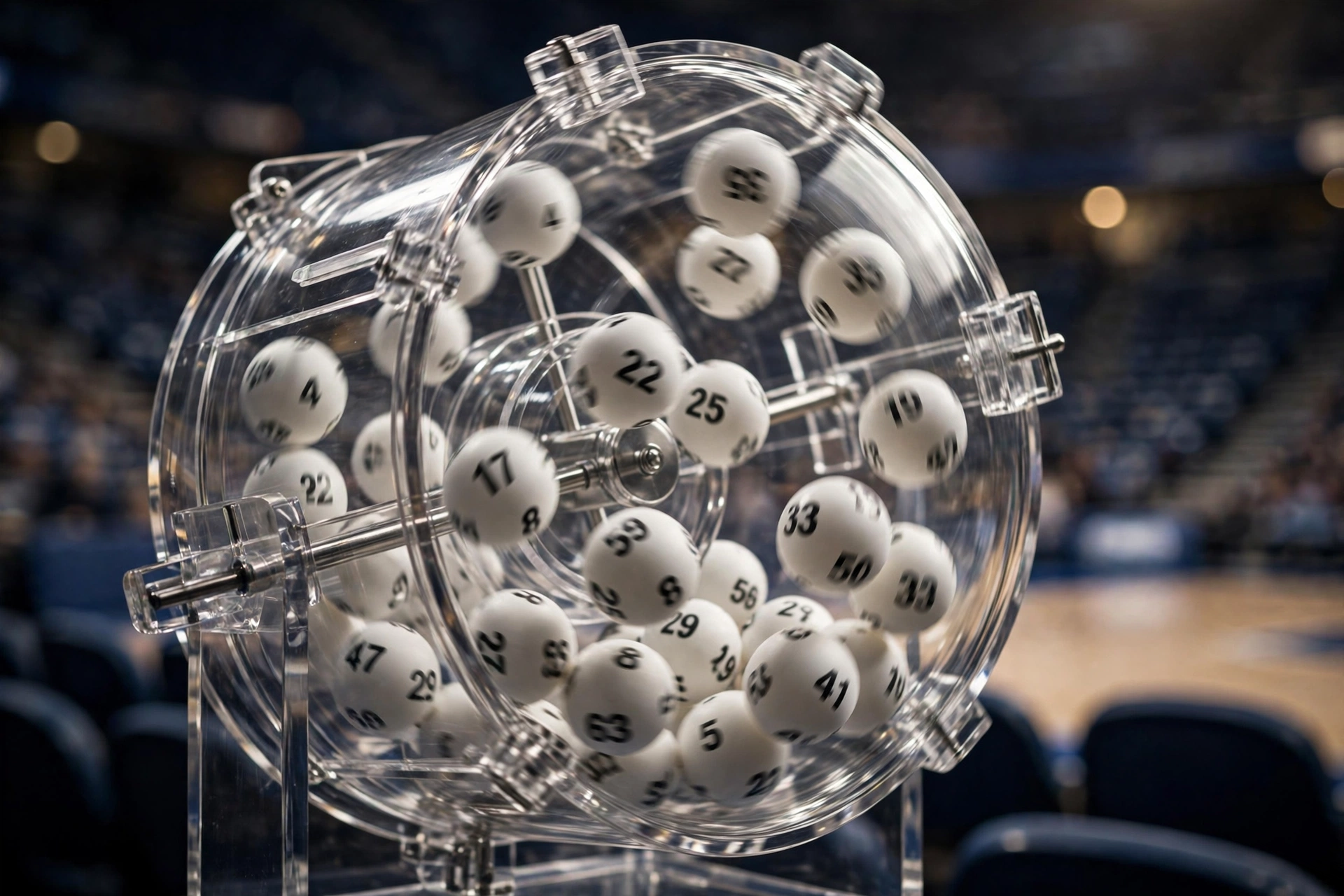
Here is the mechanical heart of the process, and it is delightfully old-school. Fourteen ping-pong balls, numbered 1 through 14, are placed into a lottery machine — the same kind of machine used in state lottery broadcasts, which spits the balls out one at a time. Before the drawing begins, officials assign combinations of the balls to the 14 participating teams.
The math works like this:
- Drawing 4 balls out of 14, where order does not matter, produces 1,001 possible combinations.
- Of those 1,001 combinations, 1,000 are assigned to the lottery teams in proportion to their odds. One combination is left unassigned and simply discarded if it comes up.
- The team with the worst record receives the most combinations (140, representing a 14.0% chance at the top pick), and the assignments scale down from there.
- Four balls are drawn to determine the No. 1 pick. The team holding that combination wins the top selection.
- The balls are returned to the machine and the process repeats for the No. 2, No. 3, and No. 4 picks. If a combination belonging to a team that has already won a top-four pick is drawn again, that drawing is thrown out and the balls are drawn again.
Only the first four picks are decided by the lottery drawing. Once those are set, picks 5 through 14 are assigned in reverse order of regular-season record among the remaining lottery teams. That means the team with the worst record can fall no lower than fifth overall — a built-in consolation prize that softens the blow of brutal lottery luck.
NBA Draft Lottery Odds: The Full Table
Since the 2019 reform, the odds have been flattened so that the three teams with the worst records each share identical 14.0% chances at the No. 1 pick. Here is the complete odds breakdown by lottery seed (seed 1 = worst record):
| Lottery Seed | Odds at No. 1 Pick | Combinations Assigned | Worst Possible Pick |
|---|---|---|---|
| 1 (worst record) | 14.0% | 140 | 5th |
| 2 | 14.0% | 140 | 6th |
| 3 | 14.0% | 140 | 7th |
| 4 | 12.5% | 125 | 8th |
| 5 | 10.5% | 105 | 9th |
| 6 | 9.0% | 90 | 10th |
| 7 | 7.5% | 75 | 11th |
| 8 | 6.0% | 60 | 12th |
| 9 | 4.5% | 45 | 13th |
| 10 | 3.0% | 30 | 14th |
| 11 | 2.0% | 20 | 14th |
| 12 | 1.5% | 15 | 14th |
| 13 | 1.0% | 10 | 14th |
| 14 (best non-playoff record) | 0.5% | 5 | 14th |
A few things jump out from this table. First, even the worst team in the league has only a 14% chance at the top pick — meaning there is an 86% chance it picks somewhere else. Second, teams seeded 11 through 14 cannot move up beyond the top four drawing; if they do not win one of the four drawn picks, they stay exactly where their record placed them. Third, the flattened top-three odds were a deliberate anti-tanking measure, which we will explore in the history section below.
What Happens After the Top Four Picks Are Drawn?
Once the lottery machine has produced the winners of picks 1 through 4, the drama is over — but the order still needs to be completed. The remaining ten lottery teams are slotted into picks 5 through 14 strictly by reverse order of regular-season record: the worst remaining record picks fifth, the next-worst sixth, and so on down to the team with the best record among non-playoff teams at pick 14.
This is why you will sometimes see a team “fall” in the draft despite having the worst record. If the three worst teams by record all miss out on the top four drawings, they slide to picks 5, 6, and 7 in record order. It feels cruel, but it is the mathematically expected outcome more often than not — remember, the worst team has an 86% chance of not winning the top pick.
After the lottery sets the first 14 picks, the rest of the first round falls into place by record: playoff teams are ordered by regular-season record in reverse, with teams eliminated earlier generally picking before teams that advanced further. The second round follows the same principle across all 30 teams.
Tiebreakers: When Teams Finish With Identical Records
Ties in the standings happen almost every year, and the league has a formal process for breaking them before lottery combinations are assigned. When two or more lottery teams finish with the same record, a random drawing — conducted by league officials and overseen by the auditors — determines their relative order for both odds assignment and final pick slotting.
For example, if two teams tie for the worst record, a coin-flip-style random draw decides which one is treated as seed 1 (140 combinations) and which is seed 2 (also 140 combinations under the flattened system, but with different tiebreak positioning for picks 5 through 14). These tiebreaker drawings are small procedural affairs compared to the televised lottery, but they can shift millions of dollars in expected draft value, so teams watch them closely.
Traded Picks, Protections, and Pick Swaps
The lottery determines pick positions, not necessarily which franchise uses each pick. NBA teams trade draft picks years in advance — picks can be dealt up to seven years into the future — and those trades often come with protections.
Common protection structures include:
- Top-N protection: If a traded pick lands in the protected range (say, top 4 or top 10), the original team keeps it, and the obligation typically rolls over to a future draft, sometimes with loosening protections.
- Lottery protection: The pick only conveys if it falls outside the lottery (picks 15-30); otherwise the original team retains it.
- Pick swaps: Two teams agree that one may exchange its pick for the other’s if the other’s pick is higher. The famous example pattern: a contending team gives a rebuilding team swap rights, betting its own pick will be worse.
- The Stepien Rule: A team cannot trade away its first-round pick in consecutive future drafts, a safeguard named for a former owner whose aggressive dealing left a franchise barren. Teams get around it by trading picks every other year or using swaps.
This is why draft night can look like an accounting exercise: the lottery sets the order, and then a cascade of “if this, then that” conditions from old trades determines who actually walks to the podium. Our explainer on how sports drafts work covers the general logic, while baseball and hockey fans can compare with the MLB draft and NHL draft systems.
A Brief History: From Coin Flip to Flattened Odds
The lottery has not always existed, and each iteration was a response to teams gaming the previous one.
The coin flip era (1966-1984)
Originally, the top pick was decided by a simple coin flip between the worst teams in each division (later conference). The winner got No. 1, the loser got No. 2, and everyone else picked by record. The problem was obvious: if you were already bad, losing a few extra games to reach the coin flip was enormously valuable — and several late-season collapses made a mockery of competitive integrity.
The first lottery (1985)
Commissioner David Stern introduced the lottery in 1985, giving all non-playoff teams an equal shot at the top pick through — you guessed it — envelopes drawn at random. The very first lottery produced one of the most debated moments in league history, but the equal-odds format had its own flaw: the worst team had no better chance than the best non-playoff team, which felt unfair to genuinely struggling franchises.
Weighted odds (1990-2018)
The league moved to a weighted system where worse records meant better odds. Over time the weighting grew extreme: by the mid-2010s, the worst team had a 25% chance at the top pick and could fall no lower than fourth. That created the modern tanking era — teams openly stripping rosters for multiple seasons to chase those odds, most notoriously during the multi-year rebuilds of the 2010s.
The 2019 flattening
To discourage tanking, the Board of Governors approved a reform that took effect in 2019: the three worst teams now share identical 14% odds (down from 25% for the worst team alone), the drawing expanded from the top three picks to the top four, and the worst team can now fall as far as fifth. The message was clear: finishing dead last barely improves your odds over finishing third-worst, so there is little incentive to race to the bottom.
Did it work? Tanking has not disappeared — late-season rest strategies and roster teardowns still happen — but the flattened odds unquestionably reduced the payoff of finishing last. The expected value of the worst record versus the fifth-worst record is now far narrower than it used to be.
Why the Worst Team Rarely Wins: Understanding the Math
Fans of bad teams often feel the system is rigged when their team falls to fifth despite the worst record. It is not rigged — it is just probability doing its thing. With a 14% chance at No. 1, the worst team will, on average, win the top pick roughly once every seven years. The other six years, it picks somewhere between second and fifth.
It also helps to think in terms of expected pick position rather than best-case scenarios. The worst team’s average draft position under the current system hovers around the middle of the lottery, not at No. 1. Meanwhile, a team seeded 8th or 9th — with 6% or 4.5% odds — jumps into the top four far more often than intuition suggests, because 14 teams drawing for four spots means someone is always moving up, and the math spreads those jumps around.
The practical takeaway for fans: hope for luck, but evaluate your team’s draft position by the strength of the draft class at picks 3 through 7, not by fantasies of the No. 1 pick. Championship cores are frequently built on picks in that range.
How to Watch the NBA Draft Lottery
The lottery is typically held in mid-May in Chicago, airing live on ESPN. The broadcast follows a familiar ritual:
- The sealed room: About an hour before airtime, the real drawing happens in a private room with team representatives (often a star player or the general manager), league officials, media witnesses, and the auditors.
- The envelopes: The results are placed in 14 sealed envelopes, one per pick, ordered from 14 down to 1.
- The reveal: On air, the deputy commissioner opens the envelopes in reverse order — 14th pick first — building suspense until the final envelope reveals the lottery winner.
- The aftermath: Within minutes, mock drafts reshuffle, trade rumors ignite, and fan bases either celebrate or mourn.
If you enjoy the spectacle side of the league, our complete fan guide to NBA All-Star Weekend covers the league’s other great made-for-TV showcase.
Frequently Asked Questions
How many ping-pong balls are used in the NBA draft lottery?
Fourteen numbered balls (1 through 14) go into the machine. Four are drawn at a time, creating 1,001 possible four-number combinations, of which 1,000 are assigned to the 14 lottery teams.
Can the team with the worst record lose the No. 1 pick?
Yes — and it usually does. The worst team has only a 14% chance at the top pick under the current flattened odds, and it is guaranteed to pick no lower than fifth overall.
How many picks does the lottery decide?
The lottery drawing determines only the first four picks. Picks 5 through 14 are then assigned in reverse order of regular-season record among the remaining lottery teams.
Who oversees the lottery to make sure it is fair?
The accounting firm Ernst & Young oversees the drawing, which takes place in a sealed room with representatives from each lottery team and members of the media as witnesses, about an hour before the televised envelope reveal.
Why does the NBA use a lottery instead of giving the worst team the top pick?
To discourage tanking — teams deliberately losing games to secure better draft position. The weighted lottery ensures every non-playoff team has a chance while still giving worse teams better odds, balancing fairness with competitive integrity.
Can lottery picks be traded?
Yes. Teams routinely trade lottery picks years in advance, often with protections (for example, top-4 protected). The lottery sets the pick’s position; prior trades and protections determine which franchise actually uses it.
The Bottom Line
The NBA draft lottery is a carefully engineered compromise: random enough to punish tanking, weighted enough to help genuinely bad teams, and theatrical enough to become must-watch television. Fourteen balls, 1,001 combinations, and one sealed room decide who gets first choice of the next wave of talent — and every spring, the ping-pong balls remind us that in the NBA, hope is distributed by probability, not by record alone.


