

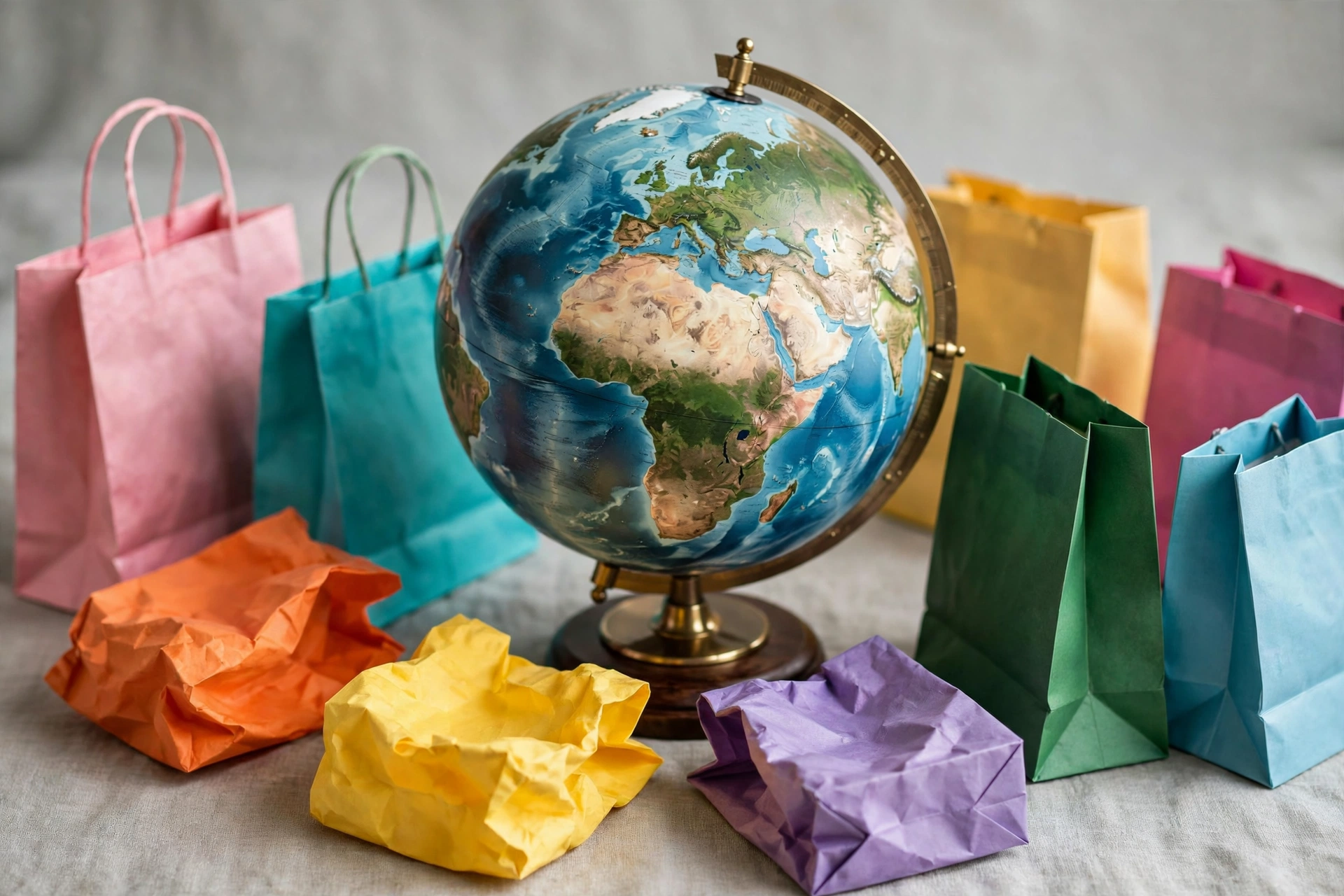
How Black Friday became a global shopping event is one of the most remarkable stories in modern retail: a chaotic Philadelphia traffic day in the 1960s transforming, within a single generation, into a sales phenomenon observed on every inhabited continent. Black Friday 2026, falling on November 27, will see coordinated promotions in dozens of countries — from London to Lagos, Sydney to São Paulo — most of which had never heard of the event twenty years ago. No other retail invention has traveled so far, so fast. This is the story of how that happened: the cross-border shoppers who carried it north, the e-commerce giant that planted it in Britain, the year it exploded into the British mainstream, and the local adaptations — White Friday, Buen Fin, Click Frenzy — that made it stick worldwide.
For the origin of the name itself, read why it is called Black Friday; for the verified facts, see Black Friday facts and statistics.
Phase One: Canada Catches It First (1990s–2000s)
The first country to import Black Friday was the one sharing a 5,500-mile border with its inventor. Through the 1990s and 2000s, Canadians living near the US border made a tradition of driving south for American Black Friday deals — stronger purchasing power and aggressive US discounting made the trip worthwhile. Canadian retailers watched their customers’ cars stream across the border every November and did the rational thing: they created Canadian Black Friday sales to keep the spending at home.
Canada’s adoption was organic and defensive rather than orchestrated — no single company ‘launched’ it — which made it feel authentically local from the very start. By the late 2000s, Black Friday was an established, if secondary, event in Canadian retail, sitting alongside the country’s own Boxing Day tradition. The Canadian story established the template for global expansion: cross-border exposure first, local retailer response second, cultural normalization third.
Phase Two: Amazon Plants the Flag in Britain (2010)
The event’s first deliberate export came in 2010, when Amazon UK ran Black Friday promotions — transplanting the American sales event to British soil as a straightforward e-commerce play. For the first couple of years, it remained a niche online phenomenon, noticed mainly by deal forums and tech shoppers. Britain in 2010 had no cultural connection to Thanksgiving, no tradition of November sales, and considerable skepticism about an imported American shopping day.
What Amazon understood — and what would prove decisive everywhere — was that the deals themselves needed no cultural translation. A discounted television is appealing in any country. The Thanksgiving backstory was irrelevant; the price cuts were universal. This insight — that Black Friday could travel as pure commerce, stripped of its American context — became the operating principle of its global expansion.
Phase Three: 2013 — Britain’s Black Friday Goes Mainstream
The tipping point came in 2013, when Asda — then owned by American retail giant Walmart — brought full-scale Black Friday to its British stores with major in-store promotions. The result was national news: widely reported chaotic scenes as shoppers competed for discounted televisions and electronics, with footage that dominated the British media for days. Overnight, Black Friday went from an online curiosity to a household term.
The 2013 frenzy was a double-edged sword. It cemented the event in British culture, but the disorder also triggered a backlash — police criticism, media hand-wringing, and retailer soul-searching. The industry’s response was telling: subsequent years saw British Black Friday deliberately steered online, with retailers spreading deals across the week to avoid in-store chaos. The event survived its own hype by evolving — a pattern that would repeat in other markets.
Phase Four: Continental Europe (Mid-2010s)
From the UK beachhead, Black Friday spread across continental Europe in the mid-2010s. Germany embraced it through electronics giants MediaMarkt and Saturn, whose Black Friday weeks became major national retail moments. France adopted it via its large e-commerce and hypermarket sectors. The Nordics, the Netherlands, Spain, and Italy followed, each market adapting the event to local retail structures.
Europe’s adoption highlighted an important dynamic: in countries with strong consumer-protection traditions, Black Friday slotted into existing sale cultures rather than replacing them. France’s legally regulated soldes (sales periods), for instance, continued alongside the imported November event. Black Friday did not conquer European retail so much as join it as a genuinely welcome additional peak in the yearly commercial cycle across the continent — one more peak in an already rhythmic promotional calendar, welcomed by shoppers and retailers alike.
The Middle East: White Friday
The most creative adaptation came in the Middle East, where the regional e-commerce platform Souq — later acquired by Amazon — rebranded the event as ‘White Friday.’ The reasoning was cultural: Friday is the week’s holy day in Islam, and the ‘black’ label carried negative connotations that sat uneasily with the occasion. ‘White Friday’ kept the commercial mechanics and the alliterative punch while respecting local sensibilities.
The rebrand was a masterstroke, and White Friday became one of the region’s biggest shopping events, spanning the Gulf states and beyond. It proved that Black Friday’s global formula was flexible: the name could change, the cultural framing could change, but the core proposition — concentrated, time-limited discounts — worked everywhere.
Latin America: Buen Fin and the Southern Wave
Mexico developed its own parallel tradition: El Buen Fin (‘The Good Weekend’), launched in 2010 and typically held in mid-November. Conceived as an economic stimulus measure, it overlaps with the Black Friday season and features the region’s distinctive promotional mechanics — notably months-long interest-free installment plans, which matter more to Mexican shoppers than headline discounts. American-style Black Friday promotions also run in Mexico, creating a layered November sales season.
Further south, Brazil embraced Black Friday enthusiastically in the 2010s, though not without controversy — early editions were marred by inflated reference prices, prompting consumer-protection scrutiny and the mocking nickname ‘Black Fraude.’ The market matured, regulations tightened, and Brazilian Black Friday is now a major e-commerce event. Across Latin America, the pattern held: local retailers adopted the format, adapted the mechanics, and made it their own.
Asia-Pacific: Parallel Festivals and Late Arrivals
Asia’s relationship with Black Friday is layered over even bigger local events. China’s Singles’ Day on November 11 — created as an e-commerce festival in 2009 — remains the world’s largest single-day online shopping event by sales, dwarfing Black Friday globally and anchoring the region’s November. India’s sale calendar revolves around Diwali (October–November), which overshadows Black Friday domestically, though global platforms now run Black Friday promotions in India as well.
Australia and New Zealand were later arrivals: Black Friday took hold in the late 2010s, layered over the southern hemisphere’s summer and sitting alongside the entrenched Boxing Day sales tradition of December 26. The Australian event is now firmly established, with local retailers running full Black Friday weeks. Across Southeast Asia, platforms run synchronized November sale events that blend Black Friday branding with regional festival mechanics.
Africa: The Newest Frontier
Africa is Black Friday’s newest frontier, and its growth story is really a mobile-commerce story. In South Africa, Nigeria, Kenya, and Egypt, e-commerce platforms have driven rapid adoption of Black Friday promotions through the late 2010s and 2020s. Smartphone-first shopping, mobile money, and a young, urban consumer base created fertile ground. South African Black Friday, in particular, has grown into a major retail moment. The continent’s adoption underscores the event’s final form: not an American export but a global e-commerce template, infinitely adaptable to local payment systems and logistics.
The Engines of Globalization: Why It Spread So Fast
Four forces drove the two-decade conquest. E-commerce platforms with global footprints — Amazon above all — could launch the event in a new country almost overnight, with no stores required. Smartphones put deal discovery in every pocket, collapsing the distance between a promotion and a purchase. Social media turned Black Friday into shareable spectacle — unboxing videos, deal threads, viral queues — marketing the event for free in every market it touched. And the universal appeal of a bargain needed no cultural translation: every society understands a discount.
Notably, what did not travel was the Thanksgiving context. Outside North America, almost nobody connects Black Friday to the holiday — it is simply ‘the big November sale.’ The event succeeded globally precisely because it shed its origin story and became pure commerce.
Timeline: The Global Conquest
- 1960s: The name is born in Philadelphia.
- 1990s–2000s: Canada adopts Black Friday defensively against cross-border shopping.
- 2005: Cyber Monday is coined, giving the online event its own brand.
- 2009: China’s Singles’ Day e-commerce festival launches (November 11).
- 2010: Amazon UK introduces Black Friday to Britain; Mexico launches El Buen Fin.
- 2013: Asda’s in-store Black Friday makes it mainstream — and controversial — in the UK.
- Mid-2010s: Continental Europe, Brazil, and the Middle East (as White Friday) adopt the event.
- Late 2010s: Australia, New Zealand, and African markets come aboard.
- 2020s: The pandemic accelerates the online shift worldwide; Black Friday becomes a global e-commerce template.
- 2026: Black Friday on November 27 is observed, in some form, on every inhabited continent.
The Role of Deal Media: How the Internet Sold Black Friday to the World
Black Friday’s global conquest was not just a retail story — it was a media story. Deal forums, price-comparison sites, and later social media turned the event into participatory entertainment: leaked ad scans were pored over like sports drafts, live deal threads ran for days, and unboxing videos extended the excitement past the purchase. This user-generated hype machine marketed Black Friday in every country it touched, for free.
The mechanism was self-reinforcing: coverage created awareness, awareness created participation, participation created content, and content created more coverage. By the mid-2010s, ‘Black Friday deals’ was a content category unto itself, with publishers producing gift guides, deal roundups, and live blogs that further amplified the event. The globalization of Black Friday is inseparable from the globalization of the deal-hunting internet culture that carried it. Every market’s adoption followed the same media arc: first the curious forum threads, then the mainstream news segments, then the inevitable backlash pieces about consumerism — and finally, quiet normalization into the annual calendar.
When Black Friday Flopped: Cautionary Tales
The expansion was not frictionless. Brazil’s early Black Fridays were marred by inflated reference prices so blatant that shoppers coined the nickname ‘Black Fraude’ (Black Fraud) — consumer-protection agencies intervened, and the market took years to rebuild trust. Britain’s 2013 in-store chaos produced a media backlash that forced retailers to redesign the event around online shopping. France saw cultural resistance, with critics framing the imported event as American consumerism clashing with local traditions — adoption came, but slower and more adapted.
The lesson from each flop: Black Friday succeeds when it adapts to local retail culture and fails when it is imposed crudely. Markets that localized the name, the mechanics, or the timing thrived; markets that got a copy-paste import stumbled. Globalization worked because the event proved flexible, not because it was forced.
The Pandemic Acceleration
The COVID-19 pandemic years permanently reshaped Black Friday worldwide. With physical stores restricted or avoided, the event shifted decisively online — and the shift stuck after restrictions lifted. Retailers, forced to spread deals across weeks to manage logistics and avoid crowds, discovered that the elongated ‘Black Friday season’ worked better than the single-day frenzy: more total sales, fewer operational nightmares. Curbside pickup, which barely existed as a concept in 2019, became a standard Black Friday fulfillment method. The pandemic did not create the online Black Friday, but it completed the transformation in two years that might otherwise have taken a decade.
What Is Next for Global Black Friday
Three trends are shaping the event’s future. Elongation: the single day keeps dissolving into a season — ‘Black November’ is already industry slang in some markets. Personalization: AI-driven pricing and targeted promotions mean ten shoppers may see ten different ‘Black Friday prices’ for the same item. Values-driven alternatives: Green Friday, Small Business Saturday, and Giving Tuesday are growing as counter-programming, especially among younger shoppers. The likely future is not a bigger Black Friday but a more diffuse one: a month-long, highly personalized, globally synchronized sale season with the old single-day frenzy preserved mainly as marketing theater. Emerging markets will write the next chapters — Africa’s mobile-first shoppers, Southeast Asia’s super-app ecosystems, and Latin America’s installment-driven buyers will reshape the event just as surely as Britain and Brazil did. The Philadelphia traffic jam has a long way left to travel.
The Economics of Going Global: Why Retailers Exported the Event
Behind the cultural story lies a hard commercial logic. For global e-commerce platforms, Black Friday is nearly pure profit to export: the branding, the marketing playbook, and the logistics templates are built once in the home market and deployed everywhere at minimal marginal cost. Each new country added incremental revenue against almost no incremental creative investment — the same countdown timers, the same email templates, translated and launched.
For local retailers, the logic was defensive — as Canada demonstrated first. Once a global platform starts running Black Friday promotions in your market, standing aside means watching your customers’ spending migrate. Joining the event becomes compulsory, which is why adoption often cascaded: one major player moved, and the rest followed within a season or two. This competitive dynamic explains the event’s speed: it spread not through persuasion but through competitive necessity, market by market, until opting out became the riskier choice.
There was also a calendar logic. November sits in a retail dead zone in most northern-hemisphere markets — after autumn, before Christmas — and in many southern markets it fills a similarly quiet slot. Retailers everywhere hunger for a demand event in that window, and Black Friday arrived as a ready-made solution with proven mechanics. It did not need to be invented locally; it just needed to be switched on.
What Other Countries Call Their Sale Days
Black Friday’s global family of sale events is worth mapping, because the savvy international shopper can play them against each other. Singles’ Day (November 11, China/global): the world’s largest single-day online shopping event, anchored by Chinese e-commerce giants but increasingly open to international shoppers. El Buen Fin (mid-November, Mexico): the government-backed ‘Good Weekend’ with its distinctive installment-plan mechanics. White Friday (November, Middle East): the culturally adapted Black Friday of the Gulf and surrounding markets. Boxing Day (December 26, UK/Commonwealth): the venerable post-Christmas sale, still a major event in Britain, Canada, and Australia. Diwali sales (October–November, India): the subcontinent’s true retail Super Bowl. Click Frenzy (Australia): the local online sale event that parallels Black Friday. Together they form a nearly continuous global sale season from late October through January — and the borderless online shopper can harvest the best of each.
The View From 2026
Standing in late 2026, Black Friday’s global journey looks complete — yet it is still evolving. The event that Philadelphia police named as a complaint, that Amazon exported as an experiment, and that Britain mainstreamed through controversy is now a permanent fixture of the planetary retail calendar. New payment systems, new logistics networks, and new generations of shoppers will keep rewriting what it looks like, but the core proposition — concentrated discounts in late November — has now proven itself on every inhabited continent. The traffic jam has become a tradition.
In Pictures: How Black Friday Became a Global Shopping Event
From one city's traffic headache to a sales season on every continent — the export of Black Friday is a retail story like no other.

A neon-lit shopping street at night, packed with shoppers from many cultures carrying bags under strings of festive lights. This is Black Friday's modern form: a global festival of consumption that no longer belongs to any single country.
Watch: How Black Friday Became a Global Shopping Event
A fast-paced history documentary tracing Black Friday from Philadelphia traffic nightmares to doorbuster campouts to today's worldwide online shopping frenzy.
At a Glance: How Black Friday Became a Global Shopping Event
The milestones that carried a Philadelphia police term around the world.
| Era | Milestone | How it spread the event |
|---|---|---|
| 1960s | Philadelphia traffic chaos | Local police slang for the day after Thanksgiving; shopkeepers failed to rename it 'Big Friday' |
| 1980s | The retail rebrand | Stores pushed the 'in the black' profit story and the term went national across the US |
| 2000s | E-commerce arrives | Cyber Monday (coined 2005) and online deals detached Black Friday from physical stores |
| 2010s | Amazon exports the concept | Amazon's UK and European Black Friday events seeded the holiday in countries with no Thanksgiving |
| 2010s | Rivals respond worldwide | Alibaba's Singles' Day (Nov 11) and regional sale days created a global November discount season |
| 2020s | The month-long sale | 'Black Friday' stretched into weeks of deals, with early-October events now opening the season |
| Today | Observed on every continent | From Mexico's El Buen Fin to the Middle East's White Friday, the format has been localized worldwide |
Frequently Asked Questions
When did Black Friday become global?
The international expansion ran roughly from 2010 (Amazon UK) through the late 2010s, with Canada adopting it earlier in the 2000s. By the 2020s it was a genuinely worldwide event.
Why is it called White Friday in the Middle East?
The regional platform Souq chose ‘White Friday’ because Friday is Islam’s holy day and ‘black’ carried negative connotations. The commercial event is the same; only the branding was localized.
Is Black Friday bigger than Singles’ Day?
By single-day online sales volume, China’s Singles’ Day (November 11) is larger. But Black Friday’s strength is its multi-week season and its presence across dozens of countries.
Do other countries have their own versions?
Yes: Mexico’s Buen Fin, the Middle East’s White Friday, Australia’s Click Frenzy (a local parallel event), China’s Singles’ Day, and India’s Diwali sales all overlap or parallel the Black Friday season.
Did Thanksgiving travel with Black Friday?
No — and that is the key to its global success. Outside North America, the event shed its Thanksgiving context entirely and traveled as pure commerce: concentrated November discounts.
Will Black Friday keep growing globally?
The mature markets (US, UK) show signs of the event flattening into a longer, less frenzied season, while emerging markets in Africa, Latin America, and Southeast Asia still show strong growth. The future is longer and more global, not bigger in a single day.
Conclusion
How Black Friday became a global shopping event is ultimately a story about the portability of a good deal. It traveled north with Canadian cross-border shoppers, crossed the Atlantic on Amazon’s servers, exploded into British consciousness in 2013, rebranded itself White Friday for the Middle East, and rode smartphones into Africa — shedding its Thanksgiving origins at every border until only the discounts remained. On November 27, 2026, that Philadelphia traffic jam’s namesake will be celebrated on every inhabited continent: proof that commerce, unlike culture, needs no translation. From a police complaint to a planetary shopping season in sixty years — that is the fastest journey any retail idea has ever made, and it is still accelerating. For the name’s origin story, read why it is called Black Friday, test your knowledge with our facts and statistics, and explore the full Black Friday guides hub.


