


Black Friday facts and statistics: what is actually true, what is myth, and what the numbers-free reality looks like. Every November, the internet fills with dramatic claims about the world’s biggest shopping day — record spending figures, wild shopper behavior, and origin stories of wildly varying accuracy. This guide takes a different approach: only verified, well-documented facts, organized for quick reading, with the myths clearly labeled as myths. No invented statistics, no unsourced superlatives — just the genuine history, calendar mechanics, global spread, and shopping realities of Black Friday.
Whether you are a curious reader, a student writing a paper, or a deal hunter who likes to know the game you are playing, these are the facts worth knowing. For the narrative version of the origin story, read why it is called Black Friday; for the worldwide expansion, see how Black Friday became a global shopping event.
Origin Facts
1. The earliest documented use of ‘Black Friday’ for the day after Thanksgiving comes from the early 1950s, when American factory managers used it to describe mass worker absenteeism — employees calling in sick to stretch the holiday into a four-day weekend.
2. The modern meaning of the name comes from Philadelphia in the early 1960s, where police officers used ‘Black Friday’ for the chaotic post-Thanksgiving crowds — they worked long shifts managing traffic and shoplifters, and could not take the day off.
3. Philadelphia newspapers in the mid-1960s printed the term in its crowd-chaos sense, giving historians contemporary written evidence of the usage.
4. The famous ‘in the black’ explanation — that the name marks the day retailers turn profitable — was popularized by the retail industry in the late 1970s and 1980s, decades after the phrase was already in use. It is a folk etymology, not the origin.
5. The claim that ‘Black Friday’ has anything to do with slavery is a modern internet fabrication with no historical evidence. Historians have thoroughly debunked it.
6. A separate, older financial meaning of ‘Black Friday’ exists: the term was used for disastrous days in financial markets, most famously the 1869 US gold-market crash. This is unrelated to the shopping event.
7. Retailers initially disliked the name’s negative connotations and tried to rebrand the day as ‘Big Friday’ — the attempt failed, and ‘Black Friday’ stuck.
8. The ‘in the black’ myth survived because it served everyone’s interests: retailers got flattering branding, the media got a tidy explanation, and shoppers got a story that felt intuitively true.
Calendar Facts
9. Black Friday is always the day after American Thanksgiving, which falls on the fourth Thursday of November — so Black Friday always lands between November 23 and November 29.
10. Black Friday 2026 falls on November 27. Cyber Monday 2026 follows on November 30.
11. The date range means the shopping season’s length varies: when Thanksgiving is early, the season between Black Friday and Christmas is longer, giving retailers more selling days.
12. ‘Black Friday’ has expanded far beyond a single day: retailers now run Black Friday week events, a Black Friday weekend, and a full ‘Cyber Week’ stretching through Cyber Monday.
13. Pre-Black Friday sales now begin weeks in advance — early November deals are a standard part of the modern season, not an anomaly.
14. Small Business Saturday, the day after Black Friday, was created in 2010 to promote local independent retailers during the big-box-dominated weekend.
15. Giving Tuesday, the Tuesday after Thanksgiving, was created in 2012 as a charitable counterpoint to the consumption of Black Friday and Cyber Monday.
16. Green Friday has emerged as a sustainability-minded alternative, encouraging buying less, buying secondhand, or opting out of the frenzy entirely.
Global Facts
17. Canada adopted Black Friday early, driven by Canadians cross-border shopping in the US — Canadian retailers created their own sales to keep spending at home.
18. Amazon introduced Black Friday to the UK in 2010, planting the seed of the event in Britain.
19. The UK’s Black Friday went mainstream in 2013, when Asda (then owned by Walmart) ran major in-store promotions that made national news — including widely reported chaotic scenes.
20. In the Middle East, the event is widely known as ‘White Friday,’ a name chosen because Friday is the week’s holy day and the ‘black’ label carried negative connotations. The name was popularized by the regional platform Souq, later acquired by Amazon.
21. Mexico runs its own parallel event, El Buen Fin (‘The Good Weekend’), typically held in mid-November — it overlaps with the Black Friday season and was created to stimulate the domestic economy.
22. China’s Singles’ Day on November 11 predates Black Friday’s global expansion as an e-commerce phenomenon and remains the world’s largest single-day online shopping event by sales volume.
23. India’s biggest sale season centers on Diwali (October–November), which overshadows Black Friday domestically — though global platforms now run Black Friday promotions in India too.
24. Australia’s Black Friday arrived later than in the northern hemisphere and sits alongside the long-established Boxing Day sales (December 26) as a major discount event.
25. Black Friday is now observed, in some form, on every inhabited continent — a remarkable journey for a term coined by Philadelphia traffic cops.
Shopping Behavior Facts
26. Black Friday is consistently among the busiest shopping days of the year in the United States, in both foot traffic and online sales — the exact ranking varies by year and by measurement.
27. The event has shifted decisively online over the past decade: e-commerce now accounts for a large and growing share of Black Friday spending, and the pandemic years accelerated the shift permanently.
28. Mobile devices account for a large share of Black Friday online traffic — a substantial proportion of shoppers now browse and buy primarily on phones.
29. ‘Doorbusters’ — limited-quantity headline deals — are designed as much to generate foot traffic and publicity as to sell the specific item; they frequently sell out within hours or minutes.
30. Many ultra-cheap Black Friday TVs are ‘derivative models’ built specifically for the season with cheaper components and retailer-specific model numbers — they cannot be directly compared to the reviewed flagship versions.
31. Electronics, appliances, and toys are perennially among the most discounted categories — a pattern that has held for decades.
32. A significant share of Black Friday purchases are Christmas gifts, which is why many retailers extend return windows into January.
33. Impulse buying peaks during Black Friday: urgency mechanics (countdowns, stock warnings) measurably increase unplanned purchases — and subsequent returns.
34. Price-tracking data consistently shows that some ‘discounts’ are measured against inflated reference prices — the genuine deals are identifiable only by checking an item’s price history.
Money Facts (Patterns, Not Figures)
35. Total Black Friday spending has trended upward over the long term, with online growth outpacing in-store growth — though year-to-year figures fluctuate with the economy.
36. The holiday season is when many retailers earn the largest share of their annual profit — the kernel of truth inside the ‘in the black’ myth.
37. Average discounts vary enormously by category: electronics and apparel see deep cuts, while categories like flagship smartphones and luxury goods see only modest ones.
38. Retailers’ margins on doorbuster items are often razor-thin or negative — the items are loss leaders designed to pull shoppers into buying full-margin products alongside.
39. January routinely beats Black Friday for several categories — winter apparel, fitness equipment, bedding, furniture — because post-holiday clearance is structural, not promotional.
40. Credit-card rewards, cashback portals, and stacked coupons can add meaningful extra savings on top of sale prices — the headline discount is rarely the whole story.
Cyber Monday and Cyber Week Facts
41. The term ‘Cyber Monday’ was coined in 2005 to brand the Monday after Thanksgiving as the online-shopping counterpart to Black Friday.
42. Cyber Monday traditionally favors online-native categories — tech accessories, software, small electronics — while Black Friday favors big-ticket items.
43. The two events have increasingly blurred: many ‘Cyber Monday’ deals are extensions of Black Friday pricing, and Black Friday itself is now largely an online event.
44. ‘Cyber Week’ — the full stretch from Black Friday through Cyber Monday — is now marketed as a single season by many retailers.
45. Some retailers extend Black Friday pricing into early December to clear remaining stock, creating a quiet ‘second wave’ of deals after Cyber Monday.
Consumer Psychology Facts
46. The ‘doorbuster’ concept exploits loss aversion: shoppers fear missing a deal more than they value an equivalent gain, which is why limited-quantity framing is so effective.
47. ‘Anchoring’ is the mechanism behind inflated reference prices: the first price you see sets a mental benchmark, making the sale price feel like a windfall even when the benchmark was fictional.
48. Decision fatigue is measurable during long deal-hunting sessions: after many comparisons, shoppers make progressively worse choices — which is why shortlists beat marathon browsing.
49. Social proof drives Black Friday stampedes both physical and digital: visible crowds, ‘X sold’ counters, and trending deal threads all signal that others have validated the purchase.
50. The ‘sunk cost’ of time spent hunting a deal makes shoppers buy to justify the hunt — even when the deal turns out mediocre.
51. Gift-buying under time pressure produces more expensive, less thoughtful purchases than planned giving — the calendar, not the discount, is the real cost driver in December.
Retail Strategy Facts
52. ‘Loss leaders’ are items sold at or below cost to pull shoppers in: the retailer expects to profit on the full-margin items bought alongside.
53. ‘Derivative models’ — products built specifically for Black Friday with cheaper components and unique model numbers — exist precisely to defeat price comparison and price matching.
54. Many retailers raise prices weeks before Black Friday so the event ‘discount’ returns to the normal price — a practice consumer groups have repeatedly documented.
55. ‘While supplies last’ is both a real inventory constraint and a psychological tool; the two functions are deliberately intertwined.
56. Extended warranties sold at Black Friday checkouts are among the highest-margin items in retail — which is why they are pushed so aggressively at the moment of purchase.
57. Free-shipping thresholds are calibrated to raise average basket size: the threshold is set just above the typical single-item order value.
Technology Facts
58. Price-tracking tools and browser extensions have measurably shifted power toward shoppers: inflated reference prices are now exposed in seconds.
59. Dynamic pricing means the ‘price’ of an item can change multiple times during Black Friday week based on demand, competitor moves, and inventory algorithms.
60. Mobile commerce drove the online transformation of Black Friday: the event’s growth years coincide with smartphone adoption curves in market after market.
61. Chatbots and AI shopping assistants now handle a large share of Black Friday customer-service volume, from order tracking to return initiation.
62. Livestream shopping — already massive in China — is growing as a Black Friday channel in Western markets, blending entertainment with flash sales.
International Oddities
63. In Iran, Black Friday promotions run despite the event having no cultural roots there — pure e-commerce globalization.
64. Some countries’ Black Friday sales peak on different days: where the weekend structure differs, retailers adapt the event to local shopping rhythms.
65. Cross-border Black Friday shopping is a major phenomenon: shoppers routinely buy from other countries’ sites, navigating currency, duties, and shipping for the discount.
66. In several markets, Black Friday now competes directly with entrenched local sale traditions — Boxing Day in Commonwealth countries, Diwali sales in India, soldes in France — creating layered sale seasons.
67. The southern hemisphere experiences Black Friday in summer, flipping the seasonal logic: Australian ‘winter clearance’ happens in July, not January.
A Note on Numbers: Why This Guide Avoids Them
You may have noticed this facts guide contains almost no spending figures or percentages — and that is deliberate. Black Friday statistics are notoriously slippery: different research firms use different methodologies, industry groups have incentives to report growth, inflation quietly inflates every ‘record,’ and single-year figures rarely replicate. A fact like ‘spending rose 8% last year’ tells you almost nothing without knowing what was measured, by whom, and against what baseline. The patterns in this guide — the calendar mechanics, the category behaviors, the global spread — are far more reliable than any specific number, and they are what actually help you shop smarter. When you encounter dramatic Black Friday statistics elsewhere, ask who measured them and why before believing them.
Myths vs Facts: Quick Reference
- Myth: The name comes from retailers going ‘into the black.’ Fact: A 1980s retail invention; the real origin is 1960s Philadelphia.
- Myth: Black Friday is always the cheapest day for everything. Fact: Many categories get cheaper in December and January.
- Myth: Doorbuster deals are available all day. Fact: They are limited-quantity and often sell out fast.
- Myth: The ‘was’ price shows what everyone paid. Fact: Reference prices are sometimes inflated; check price history.
- Myth: Black Friday is an American-only event. Fact: It is observed on every inhabited continent.
- Myth: You must shop on Friday itself. Fact: Deals now span weeks; patience often wins.
Quiz: Test Your Black Friday Knowledge
Ten quick questions to check what you have learned. 1: What decade gave us the Philadelphia police origin of the name? (The 1960s.) 2: What year was Cyber Monday coined? (2005.) 3: Which company brought Black Friday to the UK in 2010? (Amazon.) 4: What is the Middle Eastern name for the event? (White Friday.) 5: Is the ‘in the black’ profit story the true origin? (No — a 1980s retail invention.) 6: Which categories reliably get cheaper in January? (Winter apparel, fitness equipment, bedding, furniture.) 7: What are ‘derivative models’? (Products built for Black Friday with cheaper components and unique model numbers.) 8: When is Black Friday 2026? (November 27.) 9: What is Mexico’s parallel November sale called? (El Buen Fin.) 10: What is the most reliable way to verify a discount is real? (Checking the item’s price history.) Score 8 or above and you know more than most retail executives.
Revisit These Facts Every November
The facts in this guide do not change, but the hype does — which makes an annual refresher valuable. Each November, re-read the myths-vs-facts table before you shop, re-check the calendar mechanics, and remind yourself that the reference price is often fiction. Deal marketers count on shoppers forgetting these lessons between seasons; the shopper who revisits them starts every Black Friday with calibrated expectations and a decisive edge. Bookmark this page alongside your price tracker and make it part of your October preparation ritual, right alongside building the shopping list and setting the budget. Knowledge compounds: each year you shop with these facts, your instincts get sharper and the hype gets easier to see through. Share the myths-vs-facts table with friends and family before the season — an informed shopping circle is the best defense against manufactured urgency.
How to Use These Facts
Facts are only useful if you act on them. Use the origin facts to win trivia nights and correct the myths gracefully. Use the calendar facts to plan: knowing Black Friday always falls between November 23 and 29 lets you schedule your preparation (list-building in October, price tracking from early November) with precision. Use the shopping-behavior facts as armor: every ‘doorbuster’ you see, ask whether it is a loss leader, a derivative model, or a genuine deal — the facts above tell you which is most likely. Use the money-pattern facts to set expectations: no single day is the cheapest for everything, and the patient shopper beats the frantic one. And use the international facts to shop smarter if you buy cross-border: knowing that sale cultures differ by country helps you judge whether that foreign site’s ‘Black Friday’ is the real event or a branding exercise.
In Pictures: Black Friday Facts and Statistics
Behind the hype sit some genuinely startling numbers — about how many of us shop, what we spend, and how real the 'deals' are.
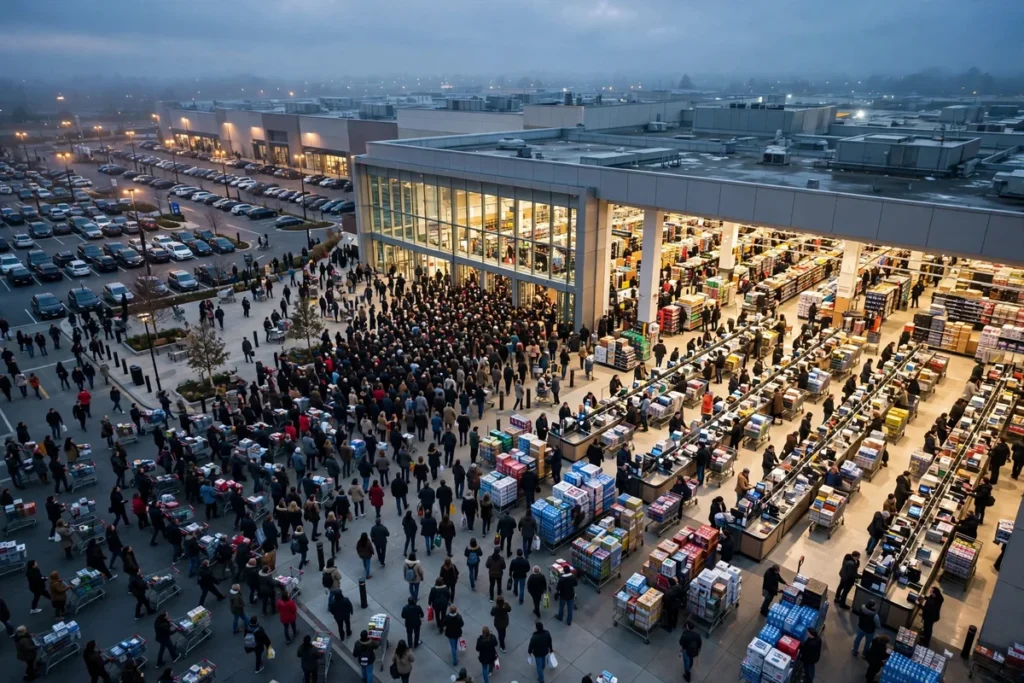
Dawn breaks over a mega-store as hundreds of shoppers stream through the entrance, carts at the ready. Scenes like this are why Black Friday keeps breaking records — roughly two hundred million Americans now shop the Thanksgiving weekend.
Watch: Black Friday Facts and Statistics
A data-driven explainer built from published figures — NRF, Adobe, Which? and the FTC — on how big Black Friday really is, how cheap it really is, and the five habits that make it work for you.
At a Glance: Black Friday Facts and Statistics
Figures are as reported by the cited sources; treat each as a snapshot of its year, not a permanent law.
| Statistic | Figure | Source and context |
|---|---|---|
| Deals at their true lowest price | 0 of 175 tracked deals | Which? tracked 175 UK Black Friday deals for a year; 83% were the same price or cheaper on an ordinary day |
| US Thanksgiving-weekend shoppers | Roughly 200 million | National Retail Federation estimates for the five-day Thanksgiving-to-Cyber-Monday stretch in recent years |
| Average spend per shopper | About $335 | NRF survey data for the 2017 Thanksgiving weekend, widely cited since |
| Busiest shopping day ranking | Top spot since 2004 | In the 1990s the day after Thanksgiving often ranked only 5th–10th among the year's shopping days |
| Online Thanksgiving-weekend sales | Record highs yearly | Adobe Analytics has reported new e-commerce records nearly every season as shopping shifts online |
| Buy-now-pay-later usage | Rising every season | Adobe and industry trackers show BNPL financing a growing share of holiday checkouts |
Frequently Asked Questions
When is Black Friday 2026?
November 27, 2026 — the day after American Thanksgiving (the fourth Thursday of November). Cyber Monday follows on November 30.
What is the true origin of the name ‘Black Friday’?
The best-documented origin is 1960s Philadelphia, where police used it for the chaotic post-Thanksgiving crowds. The ‘in the black’ profit story was invented by retailers decades later. Full detail: why it is called Black Friday.
Is Black Friday really the biggest shopping day of the year?
It is consistently among the biggest, by both foot traffic and online sales — the exact ranking varies by year, country, and how you measure. The broader holiday season matters more than any single day.
Which countries observe Black Friday?
Dozens, across every inhabited continent — including the UK, Canada, Germany, France, Australia, Brazil, Mexico, South Africa, India, and the Middle East (often as ‘White Friday’). See how it became a global event.
Are Black Friday statistics reliable?
Treat specific figures with caution: methodologies differ, industry groups have incentives to report growth, and ‘records’ are often broken by inflation as much as by volume. Patterns and trends are more trustworthy than any single number.
What is the most misunderstood fact about Black Friday?
That it is the cheapest day of the year for everything. The name’s profit myth and the marketing hype combine to create that impression — but category-by-category, January and other months frequently win.
Conclusion
Black Friday facts and statistics, honestly assembled, tell a richer story than the hype: a 1950s factory complaint, a 1960s Philadelphia traffic jam, a 1980s marketing reinvention, and a 21st-century global conquest. The verified facts are more interesting than the myths — and more useful, because they reveal how the event actually works: the calendar mechanics, the category patterns, the global variations, the psychology of the checkout. Shop with the facts, not the folklore, test yourself with the quiz above, and the season gets both cheaper and more fun. Continue exploring with our history of the name, the global story, and the full Black Friday guides hub.


