Learning the hockey rules for beginners is easier than it looks — most of the whistles you hear during a game come down to a handful of core rules that exist to keep play fair, fast, and safe. New fans often feel overwhelmed because hockey moves so quickly and the rulebook uses terms like “icing,” “offside,” and “delay of game” without explanation. But you do not need to memorize the entire NHL rulebook to enjoy a game. Master the dozen or so rules covered in this guide and you will understand roughly 95 percent of everything the referees call.
This beginner’s rulebook covers how games start and stop, the two big territorial rules (offside and icing), every common penalty and what happens next, how power plays work, overtime rules, and the finer points that separate casual viewers from confident fans.
How Play Starts and Stops
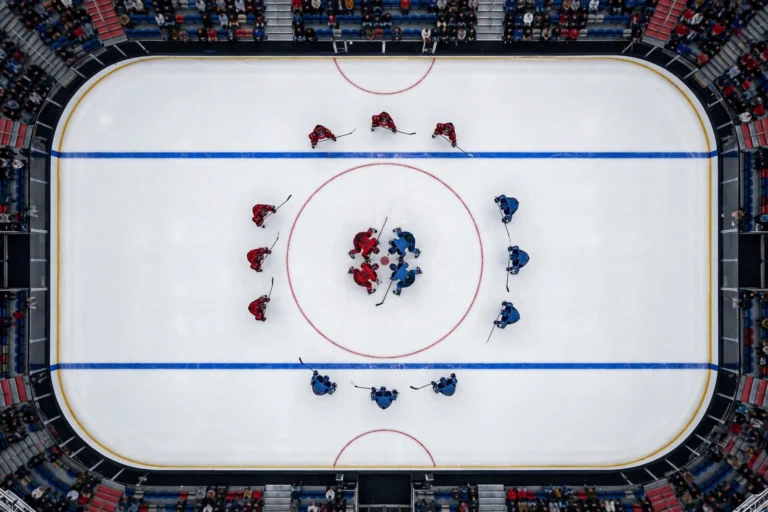
Every period begins — and play restarts after most stoppages — with a faceoff. Two opposing centers line up at one of the nine faceoff dots, the referee drops the puck between their sticks, and both battle to win possession for their team. Faceoffs happen after goals, penalties, offsides, icings, pucks frozen by the goalie, and pucks leaving the playing surface.
The game clock runs only while the puck is live. When the whistle blows, the clock stops. Officials stop play for goals, penalties, offsides, icing, injuries, broken sticks creating danger, the puck going out of play, or the goaltender freezing the puck. After each stoppage, the referee chooses the correct faceoff dot based on what caused the stoppage — and that choice is often strategically significant, since teams prefer faceoffs in the offensive zone.
Offside: The Head-Start Rule
Offside is the rule new fans ask about most. It is simple at its core: an attacking player may not cross the offensive blue line before the puck does. If a skater enters the attacking zone ahead of the puck, the linesman raises an arm, the whistle blows, and the faceoff moves out to the neutral zone.
The Details That Matter
- The puck must completely cross the blue line first. A player’s skates can be in the air over the line, but if a skate is still touching the blue line ice when the puck crosses, the player is onside.
- Delayed offside: if attacking players enter early but do not touch the puck, the linesman raises an arm for a delayed call. If all attackers clear the zone (tag up) before touching the puck, play continues — no whistle.
- Carrying vs. passing: a player can skate the puck across the line himself or pass it in, as long as the puck crosses first.
- Deflections: if a defending player carries or passes the puck back into his own zone, attackers already there are not offside.
Offside exists to prevent cherry-picking — parking a player behind the defense for easy breakaways. It forces teams to enter the zone with control or dump the puck in and chase it, which is the foundation of hockey’s forechecking game.
Icing: The Anti-Stalling Rule
Icing is whistled when a player shoots the puck from behind the center red line all the way down past the opponent’s goal line without anyone touching it. The purpose is to stop teams from just firing the puck the length of the ice to waste time. The punishment is meaningful: the faceoff comes all the way back to the offending team’s defensive zone, and the offending team may not change players before the draw — leaving tired defenders stuck on the ice.
Icing Exceptions
- Shorthanded teams can ice the puck. A team killing a penalty is allowed to clear the puck the length of the ice freely — a huge relief valve that makes penalty kills survivable.
- If the goalie touches it or could have played it, icing is waved off.
- Hybrid icing: the NHL uses a race-based system where the linesman judges which player would reach the puck first at the faceoff dot. If the defending player is going to win the race, icing is called; if the attacker would get there first, play continues. This replaced the old touch-icing system to reduce dangerous races into the end boards.
- Goals and near-misses: if the puck enters the net, it is a goal, not icing; if it was going to be icing but an attacker touches it first, play continues.
Penalties: What Players Get Punished For
Penalties are the heart of hockey’s rulebook. When a player commits an infraction, the referee signals it and the offender serves time in the penalty box, leaving his team shorthanded. Here are the infractions you will see most, in plain English:
| Penalty | What the Player Did | Time |
|---|---|---|
| Tripping | Used a stick, leg, or arm to make an opponent fall | 2 min |
| Hooking | Used the stick to tug, hold back, or slow an opponent | 2 min |
| Holding | Grabbed an opponent’s body, stick, or sweater | 2 min |
| Slashing | Swung the stick at an opponent’s body or stick forcefully | 2 min |
| High-sticking | Contacted an opponent with the stick above shoulder height | 2 min (4 if it draws blood) |
| Cross-checking | Hit an opponent with the shaft of the stick using both hands | 2 min |
| Interference | Impeded a player who did not have the puck | 2 min |
| Roughing | Unnecessary shoving or punching, often after the whistle | 2 min |
| Boarding / Charging | Violently checking an opponent into the boards or from a distance | 2 or 5 min |
| Delay of game | Shot the puck over the glass from the defensive zone | 2 min |
| Too many men on the ice | Had more than six skaters involved in play during a change | 2 min (bench minor) |
| Fighting | Dropped the gloves and fought an opponent | 5 min |
| Misconduct | Continued misbehavior; sits 10 minutes but team stays at full strength | 10 min |
Minor, Major, and Misconduct: Penalty Tiers
- Minor penalty (2 minutes): the standard call. It ends early if the opposing power play scores.
- Double minor (4 minutes): usually high-sticking that draws blood. Scored-upon ends only the first two minutes; the second minor must still be served.
- Major penalty (5 minutes): for fighting and serious infractions. The full five minutes are served no matter how many goals are scored.
- Misconduct (10 minutes): the player sits, but the team does not play shorthanded. It is a personal punishment, often stacked on top of another penalty.
- Game misconduct / match penalty: the player is ejected; a teammate serves the shorthanded time.
Power Plays and Penalty Kills
When one team has a player in the box, the other team skates with a man advantage — the power play (usually 5-on-4). The shorthanded team is on the penalty kill. Power plays are structured like a siege: the attacking team sets up in the zone, moves the puck quickly around the perimeter, and looks for one-timers and backdoor passes while the four defenders scramble to cover.
Key power-play rules to know:
- A minor penalty ends as soon as the power-play team scores.
- Coincidental minors (both teams penalized at once) result in 4-on-4 play with no power play for either side.
- If a team takes two penalties at once, it can play 5-on-3 — a massive advantage that produces goals at a very high rate.
- A shorthanded goal — scored by the penalty-killing team — does not end the penalty, but it is one of the most exciting plays in hockey.
- Goalies can also take penalties; a teammate serves the time in the box for them.
Penalty killing is an art: aggressive forechecking by the shorthanded forwards, shot-blocking by everyone, and a goalie who controls rebounds. Teams that kill penalties at a high rate can survive undisciplined stretches; teams that cannot will get buried.
Goals: What Counts and What Does Not
A goal is scored when the entire puck crosses the entire goal line between the posts and under the crossbar. Close calls go to video review in the league’s situation room. Here is the quick reference:
| Situation | Goal or No Goal? |
|---|---|
| Shot off the stick, clean | Goal |
| Deflected off a skate or body (not kicked) | Goal |
| Distinct kicking motion with the skate | No goal |
| Batted in with a high stick (above the crossbar) | No goal |
| Puck crosses after the whistle | No goal |
| Net dislodged before the puck crosses | No goal (unless the defense caused it) |
| Attacking player in the crease interfering with the goalie | No goal (goaltender interference) |
| Puck thrown or punched into the net | No goal |
Goaltender Interference
One of the most debated calls in hockey: an attacking player may not impair the goalie’s ability to defend the net inside the crease. Incidental contact outside the crease is usually fine; pushing into the goalie or screening him from inside the blue paint will wipe out a goal and often draw a penalty. Coaches can challenge these calls, and the reviews are notoriously tight.
Overtime and Shootout Rules
Tied after three periods? In the regular season, teams play a five-minute sudden-death overtime at 3-on-3 — three skaters aside plus goalies. The extra ice makes it end-to-end chaos. First goal wins.
If overtime solves nothing, a shootout decides it: three shooters per team alternate attempts, one skater against the goalie, and if still tied it goes to sudden-death rounds. Players cannot be reused until everyone eligible has shot. Shootout goals do not count toward a player’s season goal total — they are recorded separately.
In the playoffs, there are no shootouts: teams play continuous 20-minute sudden-death overtime periods at full 5-on-5 strength until someone scores.
Fighting: The Rule Everyone Asks About
Hockey is the only major North American team sport where fighting is essentially regulated rather than immediately ejecting players. When two players mutually agree to fight, each receives a five-minute major penalty — they sit, their teams play at full strength once replacements are on, and play continues. However, there are strict lines: fighting with a visor, leaving the bench to join a fight, or being deemed the instigator brings additional punishment, and staged fights off faceoffs draw instigator minors.
Fighting has declined sharply over the years as the game has gotten faster and teams value every roster spot for skill. Enforcers whose only job was fighting have largely vanished. But the rule remains, rooted in hockey’s culture of players policing dangerous plays themselves.
Line Changes, Too Many Men, and Other Procedural Rules
- Changing on the fly: players may substitute during live play by hopping over the boards at the bench, as long as the change does not interfere with play. Changing too slowly or with too many skaters involved draws a too many men bench minor.
- Freezing the puck: only the goaltender may cover and freeze the puck to force a whistle. A skater who falls on the puck and freezes it deliberately takes a delay-of-game penalty.
- Hand pass: players may bat the puck with an open hand to a teammate, but a hand pass in the offensive zone that leads directly to a goal is disallowed, and faceoffs move accordingly.
- Kicking the puck: players may kick the puck to a teammate (no goal on a distinct kicking motion into the net), which is why you see skaters redirect pucks with their skates all game.
- Broken sticks: a player who breaks his stick must drop it immediately — playing with a broken stick is a penalty. He can grab a teammate’s stick or head to the bench.
- Pulling the goalie: trailing teams may replace the goalie with an extra attacker at any stoppage or on the fly, creating a 6-on-5. An empty-net goal against seals it, which is why the gamble usually comes in the final two minutes.
Referees and Linesmen: Who Calls What
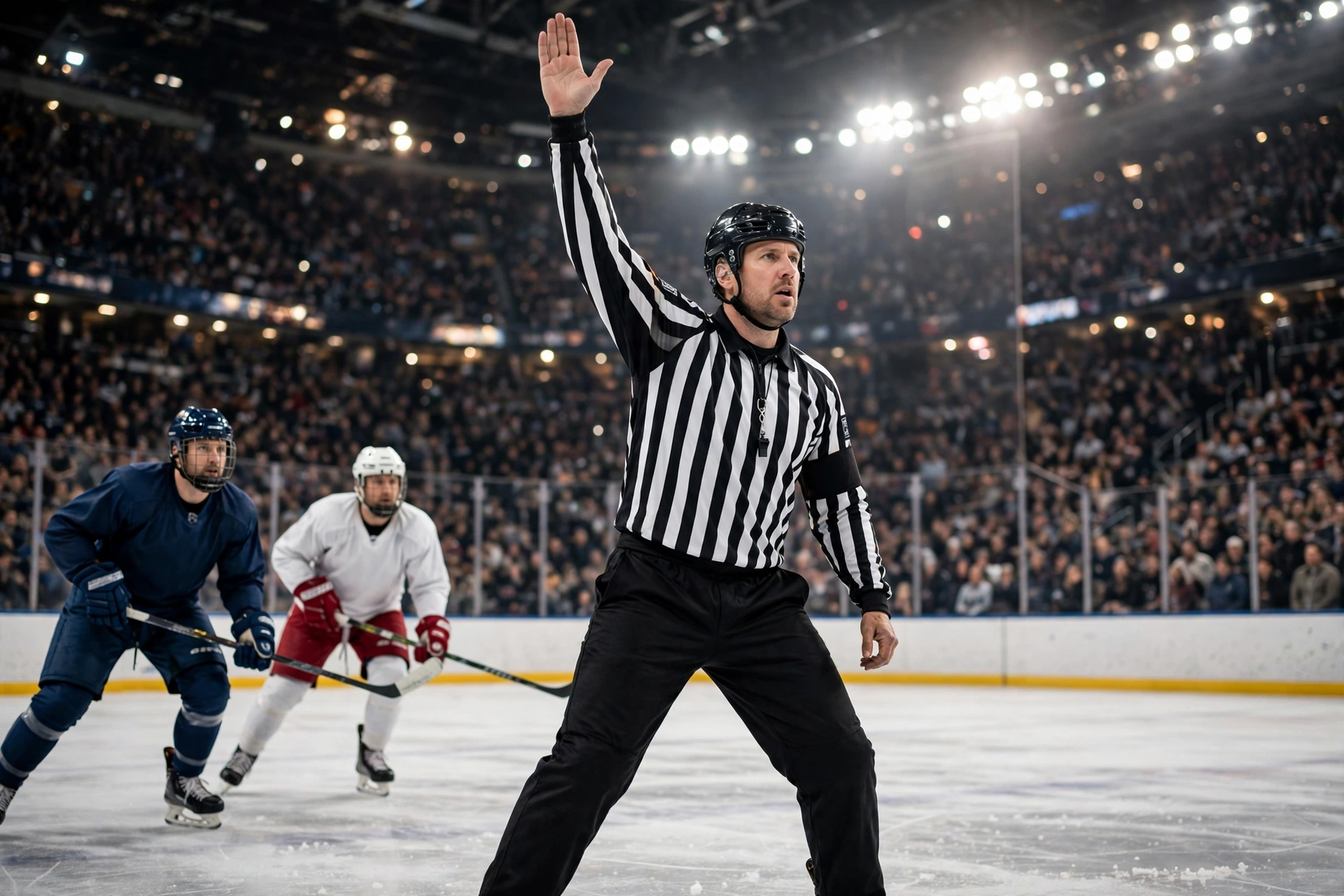
NHL games use four officials: two referees and two linesmen. Referees call penalties, award goals, and manage the game’s discipline. Linesmen handle offside and icing calls, conduct faceoffs, and break up altercations. When you see a striped arm shoot up without a whistle, that is a linesman signaling a delayed offside or a referee signaling a delayed penalty — play continues until the offending team touches the puck, giving the other team a chance to score with the goalie pulled for an extra attacker.
That delayed-penalty sequence is one of hockey’s most exciting rule quirks: the team about to go on the power play pulls its goalie for a sixth attacker, creating a frantic 6-on-5 scramble that sometimes produces a goal before the penalty is even officially called.
Spectator Rules: Hockey Etiquette for New Fans
Knowing the hockey rules for beginners on the ice is one thing; the unwritten rules in the stands matter too. Our guides to concert etiquette and theater etiquette cover the same spirit of being a good audience member, but hockey has its own flavor:
- Do not bang on the glass excessively — it startles players and annoys everyone around you.
- Throw hats for hat tricks — three goals by one player is the one time throwing things on the ice is tradition, not trouble.
- Stand and respect the anthems, and stay off the concourse stairs during play so you do not block views.
- Learn the goal song — every team has one, and singing along is half the fun of a home goal.
- Respect the handshake line in playoff series; even rival fans acknowledge it.
Fans who love sports traditions will also enjoy the best college sports traditions and, for a rules comparison across sports, how college football works.
Frequently Asked Questions
What is offside in hockey?
Offside is when an attacking player crosses the offensive blue line before the puck does. Play is whistled dead and the faceoff moves to the neutral zone, unless all attackers clear the zone first (delayed offside).
What is icing in hockey?
Icing is called when a player shoots the puck from behind center ice past the opponent’s goal line untouched. The faceoff returns to the offender’s defensive zone and they cannot change players. Shorthanded teams are exempt.
How long is a hockey penalty?
Minor penalties are 2 minutes (ending early if the power play scores), double minors are 4 minutes, majors are 5 minutes (served in full), and misconducts are 10 minutes with no shorthanded play.
What is a power play in hockey?
A power play is the man advantage a team enjoys while an opponent serves a penalty — usually 5 skaters against 4. It ends early if the power-play team scores on a minor penalty.
Can you fight in hockey?
Mutual fighting draws a 5-minute major for each combatant rather than an ejection, though instigating, leaving the bench, or fighting with a visor brings extra punishment. Fighting has become much rarer as the game has sped up.
How does overtime work in hockey?
Regular-season overtime is 5 minutes of sudden-death 3-on-3, then a shootout if needed. Playoff games use continuous 20-minute 5-on-5 sudden-death overtimes with no shootout.
What is goaltender interference?
It is a violation where an attacking player impairs the goalie’s ability to defend — usually by contact in the crease. It wipes out goals and can draw a penalty; coaches may challenge the call.
Why was that goal disallowed?
The most common reasons: a distinct kicking motion, a high stick above the crossbar, goaltender interference, the puck crossing after the whistle, or the net being dislodged before the puck crossed the line.