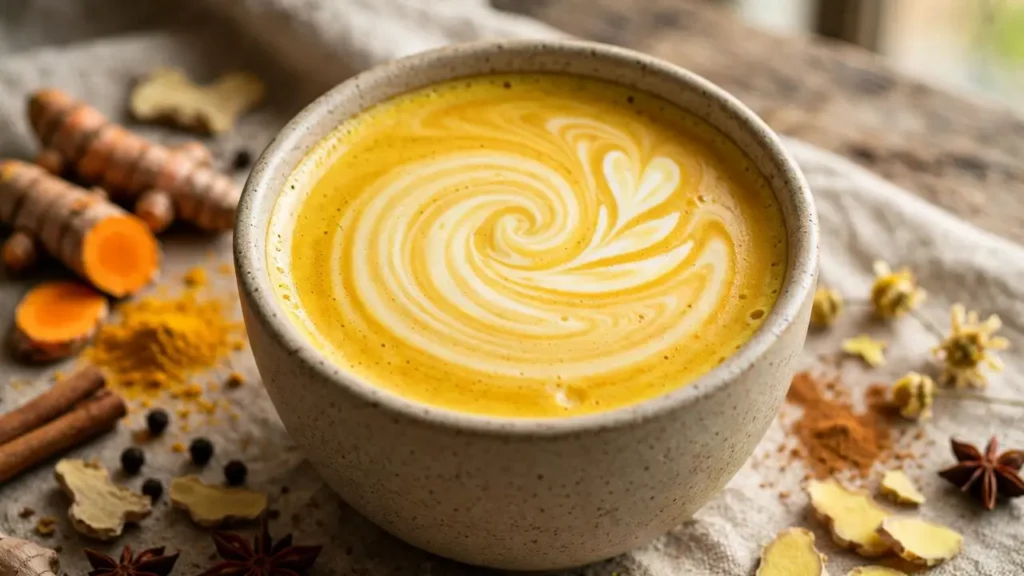
Golden milk — warm milk steeped with turmeric, black pepper, and spices — is centuries old in Ayurvedic tradition and thoroughly modern in your local cafe, where the turmeric latte has earned a permanent menu spot. The appeal is easy to understand: it is creamy, warming, gently spiced, naturally caffeine-free, and that vivid golden color makes it as beautiful as it is comforting. It is the evening drink for people who love the ritual of a latte but not the 9 p.m. espresso.
This guide gives you the definitive golden milk latte recipe with exact spice ratios, explains why black pepper is non-negotiable (it is about absorption, not flavor), compares stovetop, frother, and blender methods, and offers five variations from iced golden milk to a chai-spiced version. Make it part of your wind-down ritual alongside our easy brunch at home ideas — or rather, the cozy evening counterpart to those slow mornings. easy brunch at home ideas.
In This Guide
- The Classic Golden Milk Latte Recipe (Stovetop)
- Milk Choices and Frothing Methods
- 5 Variations and Troubleshooting
- Recipe Ratios: The Formula Behind Every Drink
- Sweeteners and Syrups, Simplified
- Batching Drinks for Guests Without the Stress
- Garnishes and Finishing Touches
- Washed, Natural, Honey: Processing Methods Explained
- Coffee and Sustainability: Shade-Grown, Fair Trade, and Beyond
- A Brief History of Coffee: From Legend to Global Ritual
- Golden Milk Methods Compared
- Watch: Golden Milk Latte Recipe: Creamy Turmeric Latte, Perfected at Home
- Frequently Asked Questions
- Keep Exploring
- Final Thoughts
The Classic Golden Milk Latte Recipe (Stovetop)
For one 12-ounce serving: combine 1.5 cups (360 ml) of milk, 1 teaspoon of ground turmeric, 1/4 teaspoon of ground cinnamon, 1/8 teaspoon of ground ginger (or 1 teaspoon freshly grated), a generous pinch of black pepper (about 1/16 teaspoon), and 1 to 2 teaspoons of honey or maple syrup in a small saucepan. Warm over medium-low heat, whisking frequently, until steaming — about 150°F (65°C) — but never boiling. Boiling scalds the milk and dulls the spices. Strain into a mug if you used fresh ginger, and dust with a little extra cinnamon.
The black pepper deserves emphasis: turmeric’s active compound, curcumin, is poorly absorbed on its own, and piperine — the compound that makes pepper pungent — increases curcumin absorption dramatically (studies suggest up to 2,000%). You will not taste the pepper at this quantity; it disappears into the spice blend while doing important work. Do not skip it. Similarly, a little fat helps absorption, which is one reason whole milk or coconut milk makes a better golden milk than skim — the traditional recipe was always made with rich milk.
Turmeric quality matters enormously. Old, stale ground turmeric tastes dusty and flat; fresh, high-quality turmeric is bright, peppery, and almost floral. Buy from a store with high turnover, check dates, and replace your jar yearly. Even better, use fresh turmeric root — about a 1-inch piece, peeled and grated, per serving. It gives a brighter, more complex flavor than powder, though you will want to strain the finished drink. A note of honesty: the wellness claims around turmeric are often overstated online. Enjoy golden milk because it is delicious and comforting; treat any health promises with appropriate skepticism.
Milk Choices and Frothing Methods
Milk choice shapes the drink. Whole dairy milk gives the richest, most dessert-like result and froths beautifully. Coconut milk (the drinking kind in a carton, or light canned diluted half-and-half with water) is the traditional-feeling pairing — its flavor marries perfectly with turmeric and it adds the fat that aids absorption. Oat milk (barista edition) steams into gorgeous microfoam and adds natural sweetness. Almond milk works but is thinner; choose a creamy variety and add 1/2 teaspoon of coconut oil to compensate. cafe drinks for non-coffee drinkers.
Method options beyond the stovetop: milk frother method — warm the spiced milk in a saucepan, then froth with a handheld frother for a cafe-style cap of foam. Blender method — blend everything (warmed milk plus spices) on high for 30 seconds; the vortex emulsifies the spices completely and creates a lovely froth, no straining needed. Espresso-machine steam wand — if you have one, steam the milk with the spices already whisked in, exactly like a chai latte; the texture is unmatched. Batch paste method — simmer turmeric, pepper, ginger, and a splash of water into a thick paste, refrigerate for up to two weeks, and whisk a tablespoon into warm milk whenever you want one. The paste method is the move if golden milk becomes a nightly habit.
Sweetener is adjustable to taste, but do not skip it entirely — a little sweetness balances turmeric’s earthy bitterness the way salt balances caramel. Honey is traditional and lovely; maple syrup adds depth; brown sugar gives a caramel note. Start with 1 teaspoon per cup and adjust. And serve it hot but not scalding — golden milk is a slow-sipping drink, and the spices bloom as it cools slightly.
5 Variations and Troubleshooting
Iced golden milk: whisk the spice blend into a small amount of hot milk to dissolve, then pour over ice and top with cold milk — shake in a jar for foam. Chai-spiced golden milk: add 2 crushed cardamom pods, 2 cloves, and a star anise to the simmer; strain before serving. Chocolate golden milk: whisk in 1 tablespoon of cocoa powder for a mocha-golden hybrid that children actually request. Vanilla-cashew golden milk: blend soaked cashews with water, turmeric, and vanilla for a rich dairy-free version. Dirty golden milk: add a shot of espresso for a caffeinated morning version — the coffee-turmeric combination is surprisingly harmonious.
Troubleshooting: gritty texture means the turmeric didn’t fully hydrate — simmer a full 5 minutes and whisk constantly, or use the blender method. Bland flavor means stale turmeric or too little spice; be generous — 1 teaspoon per cup is the floor, not the ceiling. Bitter or harsh notes mean the milk boiled; keep it at steaming, never bubbling. Separation in iced versions is normal; just stir or shake. And if the color is pale yellow rather than rich gold, your turmeric is old — replace it.
Golden milk fits the same cozy-drink occasion as the recipes in our cozy Thanksgiving coffee drinks collection — it is the caffeine-free anchor of a holiday drinks spread, the thing you serve the kids, the non-coffee drinkers, and anyone who wants a second warm cup without a second dose of caffeine. Batch the spice paste, keep good honey on hand, and it becomes a two-minute ritual.
Recipe Ratios: The Formula Behind Every Drink
Every cafe drink is built from the same handful of components — coffee, milk, water, sweetener, flavor — combined in ratios. Learn the ratios and you can reconstruct, adjust, or invent any recipe instead of memorizing dozens of them. The latte formula, for example, is roughly 1 part espresso to 5–8 parts steamed milk; a cappuccino is 1:1:1 espresso to steamed milk to foam; a mocha adds chocolate at about 1 part to the latte base.
Sweetness is the most personal ratio and the easiest to misjudge. Cafe syrups are typically dosed at 2–4 pumps (roughly 15–30ml) per 12-ounce drink, but homemade simple syrup is less concentrated than commercial pumps suggest — start with half what you think and adjust. Remember that milk itself contributes significant sweetness through lactose, especially when steamed properly; many “not sweet enough” lattes are actually under-textured milk rather than under-sweetened recipes.
Scaling recipes up or down is linear for everything except ice and espresso extraction. Double the milk and syrup for a double batch; do not double-brew a single espresso longer (it over-extracts) — pull two separate shots instead. For iced drinks, account for dilution: ice melt contributes roughly 10–20% of the final volume, so build iced recipes slightly stronger or with slightly less milk than their hot equivalents.
Use ratios as a diagnostic tool, too. If a homemade version of a cafe favorite tastes wrong, compare component by component: is your milk ratio higher? Your sweetener lower? Your coffee weaker? Nine times out of ten the gap is ratio, not technique — cafes use more syrup and more milk than home brewers guess. Once the ratios match, fine-tune with technique. The formula-first mindset turns every recipe into a starting point you own rather than a script you follow.
Converting cafe recipes to home scale is mostly division. A cafe’s 16-ounce latte formula halves cleanly to an 8-ounce home version — halve every component, keep the espresso at a double shot (never halve the coffee; instead use a smaller cup). Syrup pumps are the tricky conversion: one commercial pump is roughly 7–8ml, so “3 pumps” means about 22ml, or roughly 4–5 teaspoons of homemade syrup. When a recipe says “two shots,” it means 2 ounces of espresso — if your setup pulls singles, pull two. Write the converted recipe down once and it becomes yours permanently; the second time you make it, you will not measure at all.
Sweeteners and Syrups, Simplified
Simple syrup — equal parts sugar and water, heated until dissolved — is the foundation of drink sweetening because it mixes instantly into cold drinks, unlike granulated sugar. A 1:1 syrup keeps about a month refrigerated; a richer 2:1 syrup lasts longer and sweetens more per drop. From there, flavored syrups are just simple syrup plus an ingredient: vanilla beans, cinnamon sticks, citrus peel, or cocoa for mocha.
Sugar choice changes flavor, not just sweetness. White sugar is neutral; demerara or turbinado add subtle molasses notes that flatter coffee; brown sugar leans caramelly; honey brings floral complexity (dissolve it into syrup form for cold drinks). Maple syrup pairs beautifully with milk drinks and chai spices. Each sweetener has a personality — match it to the drink rather than defaulting to white sugar out of habit.
For lower-sugar options, the landscape has improved. Allulose and monk-fruit/erythritol blends dissolve reasonably and avoid the bitter aftertaste of older sweeteners, though they sweeten less cleanly than sugar in delicate drinks. Unsweetened cocoa, cinnamon, and vanilla extract add perceived sweetness without sugar — a dash of cinnamon in a latte genuinely reduces the sugar needed. Cold drinks need more sweetener than hot ones to taste equally sweet, since cold dulls sweetness perception.
Homemade syrup technique is brief but worth doing right: simmer (do not boil hard) the flavoring in the syrup for 5–10 minutes, cool, strain, and refrigerate. Most flavored syrups keep 2–4 weeks; watch for cloudiness as the spoilage signal. Label with the date — enthusiasm fades, but a dated bottle gets used. A small rotation of two or three house syrups (vanilla, cinnamon, and one seasonal) covers nearly every drink recipe worth making.
Seasonal syrups keep the home menu fresh with minimal effort. Spring: strawberry or rhubarb syrup for iced lattes. Summer: citrus (lemon, orange) and mint for cold drinks and tonics. Fall: the obvious pumpkin spice (real pumpkin puree plus spice in simple syrup beats any commercial version), apple-cider reduction, maple. Winter: peppermint, gingerbread spice, cranberry. The method never changes — simmer the flavoring in simple syrup, strain, refrigerate — only the ingredient rotates. A seasonal syrup on the counter makes ordinary drinks feel like an occasion, and guests remember “the place with the homemade gingerbread lattes” far longer than they remember any single recipe.
Batching Drinks for Guests Without the Stress
Making one great latte is a skill; making eight for brunch guests is logistics. The secret is separating what can be batched from what must be fresh. Syrups, cold brew concentrate, chai concentrate, and spiced milk bases all batch beautifully a day ahead. Espresso and steamed milk do not — they degrade within minutes. Design your menu around that split.
The winning format for crowds is the self-serve bar: a batched base (cold brew, chai, or lemonade-style espresso tonic components), plus milk options, syrups, and ice, with a one-line instruction card per drink. Guests enjoy the interactivity, you enjoy your party, and nobody waits on a single-portafilter bottleneck. For hot drinks, a large batch of strong brewed coffee in a thermal carafe plus frothed milk in a French press (pump the plunger for surprisingly good foam) serves a crowd with minimal gear.
Math for planning: assume 12 ounces per guest per round and two rounds for a two-hour gathering. Cold brew concentrate at 1:1 dilution means a quart of concentrate serves about five generous drinks. Buy 50% more ice than you think — it melts, it gets used for chilling, and running out mid-party is the classic failure. Prep garnishes (citrus wheels, cinnamon sticks, cocoa shakers) in small bowls; they make simple drinks feel considered.
Do a trial run. Seriously — make the full recipe once, at the planned scale, before the event. Scaling surprises (syrup that was balanced at single-serve overwhelming at batch scale, concentrate that needs more dilution over ice) reveal themselves only in practice. The trial also gives you timing: how long setup really takes, what can be done the night before. Your guests will remember a relaxed host with good drinks far longer than they will remember any single recipe.
The 24-hour timeline takes the stress out of hosting. Day before: make syrups and concentrates (cold brew, chai), prep garnishes, chill glasses if you are fancy, set out the bar station with cups, napkins, and instruction cards. Morning of: brew the hot components, fill the ice bucket (last, so it does not melt), set out milks. During: replenish ice and milk, nothing else — the system runs itself. After: everything batch-made stores for days, so leftovers are a gift, not waste. The timeline’s real purpose is psychological: with prep done, you are a host who happens to serve great drinks, not a barista trapped behind the counter while the party happens without you.
Garnishes and Finishing Touches
Garnishes are not decoration — they are aroma, texture, and the first impression before the first sip. The rule is that every garnish should be edible and complementary: it should add something to the drink, not just sit on it. Cocoa powder on a cappuccino adds bitter chocolate aroma that primes the palate; cinnamon on a latte adds warmth; a expressed citrus coin on an espresso tonic adds bright oils that transform the first sip.
Powder garnishes reward technique. Use a fine-mesh shaker or sieve for even distribution — clumpy cocoa is worse than none. Dust just before serving; powders absorb moisture and spot within minutes. Stencils (a simple cut-paper shape laid over the cup) create professional-looking designs with zero skill: dust cocoa over the stencil, lift, and you have a heart or star. Layered powders — cocoa under cinnamon, or matcha over powdered sugar on a latte — add visual depth.
Fresh garnishes need freshness discipline. Citrus wheels and twists must be cut to order; a dried-out lemon wheel is sad. Herbs (mint, rosemary) should be slapped between your palms before placing — this releases the aromatic oils that are the entire point. Whipped cream, when used, should be lightly sweetened and freshly whipped; canned is acceptable for casual settings, but real whipped cream’s texture is noticeably better. Chocolate shavings beat chocolate syrup drizzles for texture contrast every time.
The restraint principle: one or two garnishes, purposefully chosen. A drink wearing cocoa, cinnamon, chocolate drizzle, whipped cream, and a cookie is not garnished — it is upholstered. The best finishing touches look inevitable, as if the drink could not exist without them: the orange twist on the espresso tonic, the cocoa heart on the cappuccino, the single cinnamon stick in the chai. Choose the garnish that echoes the drink’s dominant flavor, execute it cleanly, and stop. Your guests will notice the confidence more than the complexity.
Washed, Natural, Honey: Processing Methods Explained
After picking, the coffee cherry must be stripped down to the seed (the “bean”) inside — and how this happens, called processing, shapes the cup as profoundly as origin. The three main methods are washed, natural, and honey, each a different negotiation between fruit, fermentation, and drying.
Washed (wet) process: the cherry’s fruit is mechanically removed, the beans ferment briefly in water to dissolve the sticky mucilage, then wash clean and dry. The result is clarity — the coffee tastes most transparently of its varietal and terroir, with bright acidity and clean flavors. Washed coffees are the connoisseur’s baseline for evaluating origin character, and they dominate in regions with abundant water like Colombia and Kenya. The trade-off is environmental: washing uses significant water and produces wastewater needing treatment.
Natural (dry) process: whole cherries dry in the sun on beds or patios, fruit intact, for weeks — the oldest method, born where water is scarce. The bean absorbs fruit sugars and fermentative compounds throughout, producing heavy body, intense fruitiness (blueberry, strawberry, wine-like notes), and sometimes boozy or funky complexity. Naturals are the extroverts of coffee: thrilling at their best, uneven at their worst, since uneven drying risks mold and off-flavors. Ethiopia and Brazil produce the great naturals.
Honey process (pulp natural): the middle path, pioneered in Costa Rica — the skin is removed but some mucilage (“honey”) stays on during drying. White, yellow, red, and black honey denote increasing mucilage left on, correlating with sweetness and body. Honeys balance washed clarity with natural fruit: syrupy sweetness, rounded acidity, approachable complexity. They are also a water-saving compromise gaining ground as climate pressures mount. Experimental frontiers — anaerobic fermentation, carbonic maceration borrowed from winemaking — push these categories further, producing wild, divisive cups. When a bag lists its process, it is telling you which flavor family to expect before you ever brew.
Coffee and Sustainability: Shade-Grown, Fair Trade, and Beyond
Coffee is grown by roughly 25 million smallholder farmers, most farming a few acres, many living near the poverty line — and the price you pay connects directly to their livelihoods. The commodity “C price” (the global benchmark) has repeatedly crashed below farmers’ production costs, most painfully in the early-2000s crisis that devastated Central America. Every sustainability label is an attempt to fix some part of this broken equation.
Fair Trade certification guarantees a minimum price plus a community premium — a floor under the market’s volatility. Critics note the floor has sometimes lagged production costs and that certification costs burden the smallest farmers, but for cooperatives it provides real stability. Direct Trade (a roaster’s own sourcing relationships, not a certification) often pays higher premiums with more transparency, though standards vary by roaster’s integrity. Rainforest Alliance/UTZ focuses on environmental and labor standards at farm level. No label is perfect; all beat anonymous commodity sourcing.
Shade-grown coffee addresses the ecological side. Traditional coffee grew under forest canopy, preserving bird habitat (shade farms are among the most biodiverse agricultural systems on earth) and needing fewer chemical inputs. The “technified” sun-coffee push of the 1970s–90s boosted yields while devastating habitats and increasing pesticide dependence. Bird Friendly certification (Smithsonian) is the strictest shade standard; seeking it (or simply buying from roasters who publish farm practices) votes for canopy with your wallet.
What can one drinker do? Buy from roasters who name farms, publish prices paid, or hold credible certifications — transparency is the practical proxy for ethics. Waste less coffee (grounds waste is farm labor wasted). And understand the deepest lever is price acceptance: genuinely sustainable coffee costs more to produce, and the industry’s future depends on drinkers who understand that a $8 bag and a $20 bag represent different realities for the people who grew them. Your daily cup is a small economic vote; cast it deliberately.
A Brief History of Coffee: From Legend to Global Ritual
Coffee’s origin story begins, as all good origin stories do, with goats. The legend credits Kaldi, an Ethiopian goatherd around the 9th century, who noticed his flock dancing energetically after eating red cherries from a certain shrub. Whether or not Kaldi existed, the geography checks out: coffee arabica evolved in the highlands of Ethiopia, where it still grows wild today, and Ethiopians were brewing the leaves and cherries long before the roasted-seed beverage emerged.
The drink as we know it took shape in Yemen by the 15th century, where Sufi monks used it to stay awake through night prayers — coffee’s first performance-enhancing use case. From Yemen’s port of Mocha, it spread through the Ottoman Empire; by the 1500s, Istanbul’s coffeehouses (“schools of the wise”) were centers of conversation, news, and political debate — so much so that rulers periodically tried to ban them. The pattern repeated everywhere coffee arrived: clergy and kings suspicious of a drink that made commoners alert and talkative.
Europe met coffee in the 1600s via Venetian traders, and the coffeehouse era ignited: London’s penny universities, Paris’s Café Procope (where revolutionaries plotted), Vienna’s grand kaffeehäuser. Each culture bent the drink to its habits — the Italians invented espresso in the early 1900s to brew faster for a hurried urban workforce, a technology born of impatience that became an art form. Colonial powers carried coffee cultivation to Java, the Caribbean, and Brazil, often through brutal plantation labor — a history the specialty industry’s focus on farmer equity is still reckoning with.
The American story runs through three waves: the post-war era of canned commodity coffee (convenience over quality), the Starbucks-led second wave (espresso drinks as lifestyle), and the third wave (coffee as craft, origin as identity). Instant coffee’s wartime logistics, the moka pot’s Italian households, the flat white’s Australia-New Zealand rivalry — every preparation method carries cultural DNA. Understanding this history does not change how your morning cup tastes, but it changes what it means: you are participating in a thousand-year conversation about energy, community, and craft that started with some very energetic goats.
Golden Milk Methods Compared
| Method | Time | Texture | Best For |
|---|---|---|---|
| Stovetop + whisk | 8 min | Smooth, classic | The definitive everyday method |
| Blender | 5 min | Frothy, fully emulsified | Grit-free results, no straining |
| Handheld frother | 8 min | Cafe-style foam cap | Latte lovers |
| Steam wand | 5 min | Silkiest microfoam | Espresso machine owners |
| Batch spice paste | 15 min once, 2 min after | Consistent | Nightly golden-milk habits |
| Iced shaker | 5 min | Light, refreshing | Summer evenings |

Watch: Golden Milk Latte Recipe: Creamy Turmeric Latte, Perfected at Home
Video: Golden Milk for Deep Sleep 😴 | Turmeric Latte Ready in 10 Minutes — watch on YouTube.
Frequently Asked Questions
What is a golden milk latte made of?
Milk simmered with ground turmeric, black pepper, cinnamon, ginger, and a sweetener like honey. The classic ratio is about 1 teaspoon of turmeric per 1.5 cups of milk, with a pinch of black pepper to aid curcumin absorption.
Why do you put black pepper in golden milk?
Piperine in black pepper dramatically increases the absorption of curcumin, turmeric’s active compound — research suggests up to a 2,000% increase. At a pinch per cup, you won’t taste the pepper; it’s functional, not flavor.
Can I make golden milk with fresh turmeric?
Yes, and it’s excellent — use about a 1-inch piece of peeled, grated fresh turmeric per serving. The flavor is brighter and more complex than powder. Strain the finished drink to remove fibrous bits.
Is golden milk good before bed?
It’s naturally caffeine-free and warm, which makes it a popular evening ritual drink. Enjoy it for the comfort and routine; treat specific sleep or health claims you see online with healthy skepticism.
Why is my golden milk gritty?
The turmeric didn’t fully hydrate. Simmer a full 5 minutes while whisking constantly, or switch to the blender method, which emulsifies the spices completely. Using fresh, fine-ground turmeric also helps.
How long does golden milk spice paste keep?
A refrigerated turmeric-ginger-pepper paste (simmered with a splash of water) keeps about 2 weeks in a sealed jar. Whisk a tablespoon into warm milk per serving for a near-instant golden milk.
Keep Exploring
If you enjoyed this guide, you may also like:
Final Thoughts
Golden milk is the rare wellness-adjacent drink that earns its place on flavor alone: creamy, warming, gently spiced, and beautiful in the cup. Master the stovetop classic, keep a jar of spice paste in the fridge for busy nights, and do not skip the black pepper. Whether it is your evening wind-down or the caffeine-free star of your next gathering (see our cafe drinks for non-coffee drinkers guide for more ideas), it is a recipe worth making permanent. easy brunch at home ideas.