France did not invent dessert, but it perfected the idea that dessert deserves the same seriousness as the meal before it. French pâtisserie is a discipline with its own vocabulary, apprenticeships, and fierce regional loyalties — and its greatest hits have colonized dessert menus on every continent. You have eaten French desserts even if you have never been to France. This guide introduces the twelve classics worth knowing by name: their stories, what makes each one special, what to order when you see them, and which ones are realistic to make in an American home kitchen.
A note on pronunciation: included phonetically where it helps, because ordering “kwah-SAHN oh shoh-koh-LAH” with confidence is half the pleasure.
1. Crème Brûlée (krem broo-LAY) — “Burnt Cream”
The most famous custard on earth: vanilla-flecked cream baked gently, chilled, then topped with sugar torched into a glassy caramel shell. The drama is the point — you crack the surface with your spoon and hear it shatter. Despite its restaurant mystique, crème brûlée is one of the easiest French desserts to make at home: five ingredients, one water bath, and a kitchen torch (or a very hot broiler in a pinch).
Order it when: You want the classic fine-dining ending. Make it when: You own ramekins and a torch — it is genuinely beginner-friendly. Difficulty at home: Easy.
2. Macarons (mah-kah-ROHN)
The almond-meringue sandwich cookies that launched a thousand pastel boxes. Crisp shells, chewy centers, endless fillings — and a technique that rewards precision (our full macaron guide covers the method). In Paris, the great houses (Ladurée, Pierre Hermé) treat flavor development like haute couture, with seasonal collections.
Order them when: You want the perfect edible souvenir or party favor. Make them when: You own a kitchen scale and enjoy a technical challenge. Difficulty at home: Medium-Project.
3. Tarte Tatin
The upside-down apple tart born of a happy accident at the Hôtel Tatin in the 1880s — apples caramelized in butter and sugar, topped with pastry, baked, and flipped. The apples become jammy and deep, the pastry shatters. Served warm with crème fraîche, it is arguably France’s greatest apple dessert.
Order it when: You see it on a bistro menu — it is always made to order-ish and worth it. Make it when: You are comfortable with caramel. A cast-iron skillet is the traditional vessel. Difficulty at home: Medium.
4. Opéra Cake
Nine layers of almond sponge, coffee buttercream, and chocolate ganache, topped with a mirror glaze — the tuxedo of cakes. Created (disputedly) in the 1950s, named for the Paris Opéra. It is architecture you can eat: every layer visible in cross-section, every bite balanced.
Order it when: You want to taste pâtisserie at its most precise. Make it at home when: Never, unless you enjoy suffering beautifully — this is a buy-it dessert for 99% of people. Difficulty at home: Project-plus.
5. Profiteroles
Cream puffs (pâte à choux) filled with vanilla ice cream and drowned in warm chocolate sauce. The contrast — crisp-warm pastry, cold cream, hot chocolate — is the whole argument, and it is a convincing one. Choux pastry is far easier than its reputation; it is essentially a cooked dough that puffs with steam.
Order them when: The menu lists them — they are often assembled to order. Make them when: You want to learn choux; the technique unlocks éclairs and gougères too. Difficulty at home: Medium.
6. Éclair (ay-KLEHR) — “Flash of Lightning”
Named because it is eaten in a flash: choux pastry piped into fingers, filled with pastry cream, glazed with fondant or chocolate. The chocolate éclair is the icon, but coffee, vanilla, and salted caramel versions are all canonical. A great éclair has crisp shell, generous filling, and glaze that cracks slightly when bitten.
Order it when: At a real pâtisserie, where they are filled fresh. Make it when: You have mastered profiteroles — same dough, different shape. Difficulty at home: Medium.
7. Mille-Feuille (meel-FOY) — “A Thousand Leaves”
Layers of caramelized puff pastry and pastry cream, traditionally topped with marbled fondant. The name is literal-ish: properly made puff pastry has hundreds of layers. Eating it gracefully is impossible — it shatters, it slides, cream escapes — and that is part of the joy. The vanilla mille-feuille is the purist’s choice; fruit versions appear in summer.
Order it when: You want to watch a pastry chef show off lamination. Make it at home when: You buy good all-butter puff pastry and focus on the pastry cream — a legitimate shortcut the French themselves use. Difficulty at home: Medium (with store-bought puff pastry).
8. Clafoutis (klah-foo-TEE)
The rustic one: cherries baked in a flan-like batter that puffs around the fruit. From the Limousin region, traditionally made with unpitted cherries (the pits add almond flavor — warn your guests). It is the French dessert equivalent of a farmhouse table: simple, seasonal, perfect.
Order it when: In France in cherry season (June-July). Make it when: Cherries are in season — it is barely more work than pancake batter. Try it with plums, apricots, or berries off-season. Difficulty at home: Easy.
9. Paris-Brest
A ring of choux pastry filled with praline mousseline cream, created in 1910 to commemorate the Paris-Brest-Paris bicycle race — the ring represents a bicycle wheel. Hazelnut praline cream is the soul of it: nutty, buttery, not too sweet. It is the connoisseur’s celebration cake.
Order it when: You see it — it is less common than éclairs and always a treat. Make it when: You have choux confidence and love hazelnut. Difficulty at home: Medium-Project.
10. Baba au Rhum
A yeasted cake soaked in rum syrup until saturated, often served with whipped cream. Born in 18th-century Paris (legend credits the exiled Polish king Stanisław), it is the boozy ancestor of every soaked cake since. The cake should glisten with syrup but still hold its shape — restraint in soaking is the skill.
Order it when: You enjoy rum and drama. Make it when: You bake with yeast comfortably. Brush, do not drown. Difficulty at home: Medium. Note: The alcohol does not fully bake out — this is a grown-ups dessert.
11. Île Flottante (eel floh-TAHNT) — “Floating Island”
Poached meringue clouds floating on a sea of crème anglaise, drizzled with caramel. It looks like a dream and tastes like one — ethereal, light, barely-there. Old-fashioned in the best way; when a bistro does it well, it is unforgettable.
Order it when: You want the lightest possible ending to a rich meal. Make it when: You are comfortable poaching meringue (a spoonful at a time in simmering milk). Difficulty at home: Medium.
12. Fondant au Chocolat (The French Chocolate Cake)
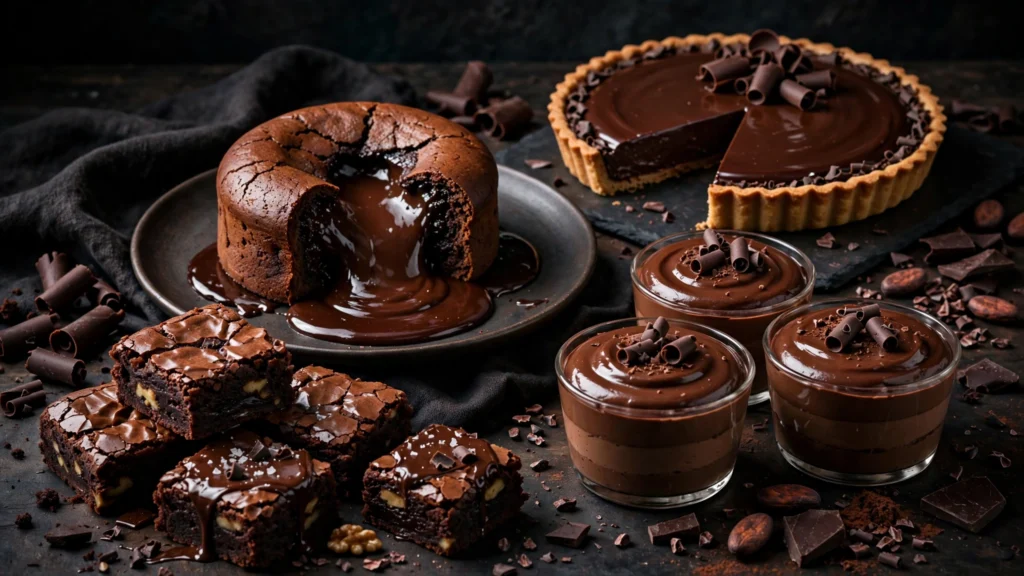
Not the British fondant (icing) — the French fondant is a dense, fudgy chocolate cake, often served warm with a molten center (the ancestor of the American lava cake). Less sweet than American chocolate cake, more intense. Every French home cook has a version; every version is correct.
Order it when: The menu lists “moelleux au chocolat” — order it, thank us later. Make it when: Anytime — it is one of the easiest French desserts, essentially a flourless-leaning chocolate cake. Difficulty at home: Easy.
The French Dessert Vocabulary: A Cheat Sheet
- Pâtisserie: The shop and the craft of fine pastry.
- Crème pâtissière: Pastry cream — the vanilla custard filling éclairs and tartes.
- Crème anglaise: Pouring custard — the “sea” under île flottante.
- Ganache: Chocolate + cream — glaze, filling, truffle base.
- Mousseline: Buttercream lightened with pastry cream — Paris-Brest filling.
- Pâte à choux: The cooked dough behind profiteroles, éclairs, Paris-Brest.
- Pâte sucrée / sablée: Sweet tart doughs — the base of fruit tartes.
- Meringue (française/italienne/suisse): Three methods, one idea — whipped egg whites and sugar.
Which French Desserts to Make at Home (Ranked by Effort)
Start here (easy): Crème brûlée, clafoutis, fondant au chocolat. Maximum France, minimum fuss.
Level up (medium): Tarte Tatin, profiteroles, éclairs, baba au rhum, île flottante, Paris-Brest, mille-feuille with store-bought puff pastry.
Admire from afar (project): Opéra cake, handmade puff pastry mille-feuille, macarons (medium, but precision-demanding).
Where the Classics Come From: A Quick Tour
- Paris: Opéra cake, Paris-Brest, éclairs perfected — the capital’s pâtisseries set the standard.
- Southeast / Provence: Calissons, nougat — the candied, honeyed south.
- Southwest: Canelés from Bordeaux (caramelized custard cups with rum and vanilla — seek them out; they are extraordinary).
- Limousin: Clafoutis — cherry country.
- Alsace: Kouglof — the yeasted, raisin-studded crown cake.
- Brittany: Kouign-amann — the buttery, caramelized “butter cake” that is really a laminated pastry and worth a pilgrimage.
If a French dessert road trip is on your bucket list, the canelé alone justifies Bordeaux.
The Goûter: France’s Sacred Afternoon Snack
To understand French dessert culture, understand the goûter — the afternoon snack, traditionally for children at 4pm, that the French take as seriously as any meal. A proper goûter is a piece of bread with chocolate, a crêpe with sugar, a pain au chocolat, or a slice of pound cake (quatre-quarts). It is small, it is ritualized, and it explains why French pâtisserie never feels excessive: sweetness has its appointed hour.
Adults observe their own version — the pause-café with something small and perfect. The lesson for American bakers: French desserts are portioned for pleasure, not excess. Serve smaller slices than you think. The elegance is in the restraint.
Building a French Dessert Pantry
You do not need a Parisian épicerie, but a few staples unlock the repertoire:
- Good vanilla: Vanilla beans or pure vanilla extract (not imitation) — crème brûlée and pastry cream live or die on vanilla quality.
- European-style butter: Higher fat content (82%+) makes a real difference in tart doughs and buttercream. American butter works; European-style is better.
- Dark chocolate (60–70%): For fondant, ganache, and Paris-Brest glaze. Buy bars, not chips — chips contain stabilizers that resist melting smoothly.
- Almond flour: For macarons and frangipane tarts. Store in the freezer to keep it fresh.
- Rum and orange flower water: Baba au rhum needs real rum; orange flower water scents madeleines and some regional cakes.
- Crème fraîche: Tangier and richer than sour cream — the traditional tarte Tatin accompaniment. Available in most US supermarkets now.
- A kitchen torch: For crème brûlée. The broiler works, but the torch is $20 of pure joy.
French Dessert Etiquette Worth Borrowing
- Cheese or dessert? In France, it is often both — cheese course, then dessert. At home, pick one unless it is a holiday.
- Bread is not for dessert. The French do not mop up dessert with bread (save the bread for the cheese course).
- Coffee comes after, never with. Dessert first, then espresso — the coffee is the period at the end of the meal’s sentence.
- Portions stay small. A proper French dessert portion would look skimpy by American standards. That is the point — it leaves you wanting the memory, not regretting the excess.
Frequently Asked Questions
What is the most famous French dessert?
Crème brûlée and macarons compete for global fame; within France, the tarte Tatin and Paris-Brest inspire the deepest affection. All four appear on this list.
What is the difference between crème brûlée and flan?
Crème brûlée is baked custard with a torched sugar top, served in its ramekin. Flan (crème caramel) is custard baked with caramel on the bottom, inverted to serve so the caramel flows over. Different textures, different presentations, both delicious.
Are French desserts very difficult to make?
Some are (opéra cake), but many classics are weeknight-friendly: crème brûlée, clafoutis, and fondant au chocolat are all easy. The reputation for difficulty comes from the showpieces, not the everyday repertoire.
What do the French eat for dessert at home?
Simpler than the pâtisserie case suggests: yogurt, fruit, a simple tart, or cheese (which in France often replaces dessert). The elaborate pastries are mostly for Sundays, celebrations, and the pâtisserie window.
What is a canelé and why is everyone obsessed?
A small Bordeaux pastry: caramelized, crunchy exterior with a soft custardy center, flavored with rum and vanilla. The texture contrast is extraordinary. They require special copper molds for the true version, which is why most people buy rather than bake them.
Which French dessert is best for beginners?
Crème brûlée — five ingredients, no special technique beyond a water bath, and the torch step is pure theater. Clafoutis is the even-easier backup.
A French Dessert Tasting Menu at Home
For the ultimate dinner party, serve dessert the French way — as a progression, not a single event. Here is a five-course dessert tasting for six, all make-ahead friendly:
Course 1 — L’amuse-bouche sucré: A single perfect madeleine with tea. Warm, small, welcoming. (Madeleines take 15 minutes; the hump on top comes from a cold batter hitting a hot oven.)
Course 2 — Le fruit: A simple fruit course — poached pears in spiced red wine, or fresh figs with honey and crème fraîche. Cleanses and resets.
Course 3 — Le classique: The centerpiece — tarte Tatin served warm, or individual chocolate fondants with molten centers. This is the course people photograph.
Course 4 — Le fromage (optional): A small cheese board — one blue, one bloomy rind, one aged — with honey and walnuts. The savory interlude that makes the final sweet land harder.
Course 5 — La mignardise: Tiny bites with coffee — mini macarons, chocolate truffles, candied orange peel. Served with espresso, standing up, the way Parisian dinners end.
Timing: Make madeleines and fondants day-of (both fast). Poach pears and bake the tart a day ahead. Buy the cheese and macarons. Total active cooking on party day: about 90 minutes, mostly unattended.
5 French Desserts You Have Probably Never Heard Of
Beyond the famous twelve, France hides regional treasures worth seeking:
1. Canelé de Bordeaux: Caramelized custard cups with a crunchy, almost-burnt exterior and a soft rum-vanilla center. The texture contrast is unlike anything else in pastry. They demand special copper molds for the true version — which is why even the French mostly buy them.
2. Kouign-amann: From Brittany, where butter is a religion. Laminated dough layered with staggering amounts of butter and sugar, baked until caramelized and shattering. It is a croissant’s decadent cousin and worth every calorie.
3. Tarte Tropézienne: A brioche split and filled with orange-blossom mousseline cream, created in Saint-Tropez in the 1950s. Light, fragrant, and dangerously easy to eat in large quantities.
4. Far Breton: Brittany’s answer to clafoutis — a dense, custardy flan studded with prunes (traditionally), with a texture somewhere between flan and cake. Humble, comforting, perfect.
5. Galette des Rois: The Epiphany cake — puff pastry filled with frangipane (almond cream), hiding a porcelain charm (la fève). Whoever finds the charm is king for the day. Available in French bakeries every January; the tradition is as delicious as the cake.
French Bakery Vocabulary for Travelers
Walk into a French pâtisserie with confidence using this decoder:
- Viennoiserie: The croissant/pain au chocolat family — laminated breakfast pastries. Technically distinct from pâtisserie (which is more dessert-oriented).
- Tarte aux fruits: Fruit tart — pastry cream and glazed fresh fruit on sweet tart dough. Order by the season: strawberry in spring, apricot in summer, apple in fall.
- Religieuse: Two stacked choux puffs (one small, one large) filled with cream and glazed — named for its resemblance to a nun’s habit.
- Merveilleux: Meringue discs sandwiched with whipped cream and coated in chocolate shavings — Belgian-origin, beloved in northern France.
- Fraisier: Strawberry and mousseline cream cake with a marzipan top — the spring celebration cake.
- Saint-Honoré: Puff pastry base ringed with caramel-dipped cream puffs, filled with Chiboust cream. The pâtissier’s showpiece — if you see a good one, order it.
- Conversation starter: Ask “Qu’est-ce que vous me conseillez?” (What do you recommend?) — French bakery staff love this question and will steer you to what’s best that day.
Vive la Pâtisserie
French desserts endure because they respect both the eater and the craft — nothing is fussy without reason, and the reason is always flavor. Start with the crème brûlée, work your way to the tarte Tatin, and keep the opéra cake as a beautiful aspiration. France will still be there, in the pâtisserie case and in your kitchen, whenever you are ready for the next one.