On Christmas Eve in Finland, before the ham is carved, before the presents are opened, before a single carol is sung, millions of Finns do the same thing: they go to the sauna. In the blue twilight of the Finnish December afternoon, the sauna stove is heated, the birch whisks are soaked, and families take turns in the cleansing heat — washing away the year’s dust, inside and out, before the festivities begin. The Finnish Christmas sauna tradition is one of the world’s most distinctive holiday rituals: a quiet, sacred, steam-filled pause at the heart of Christmas Eve, and a window into the Finnish soul.
The Sauna at the Center of Finnish Life
To understand the Christmas sauna, you have to understand what the sauna means in Finland. This is a country of about 5.5 million people and an estimated 3 million saunas — roughly one for every two Finns. The sauna is not a spa luxury or a gym amenity; it is a fixture of homes, summer cottages, apartment buildings, and offices. Finns are born into sauna culture (some, famously, almost literally) and take multiple saunas a week as a matter of course.
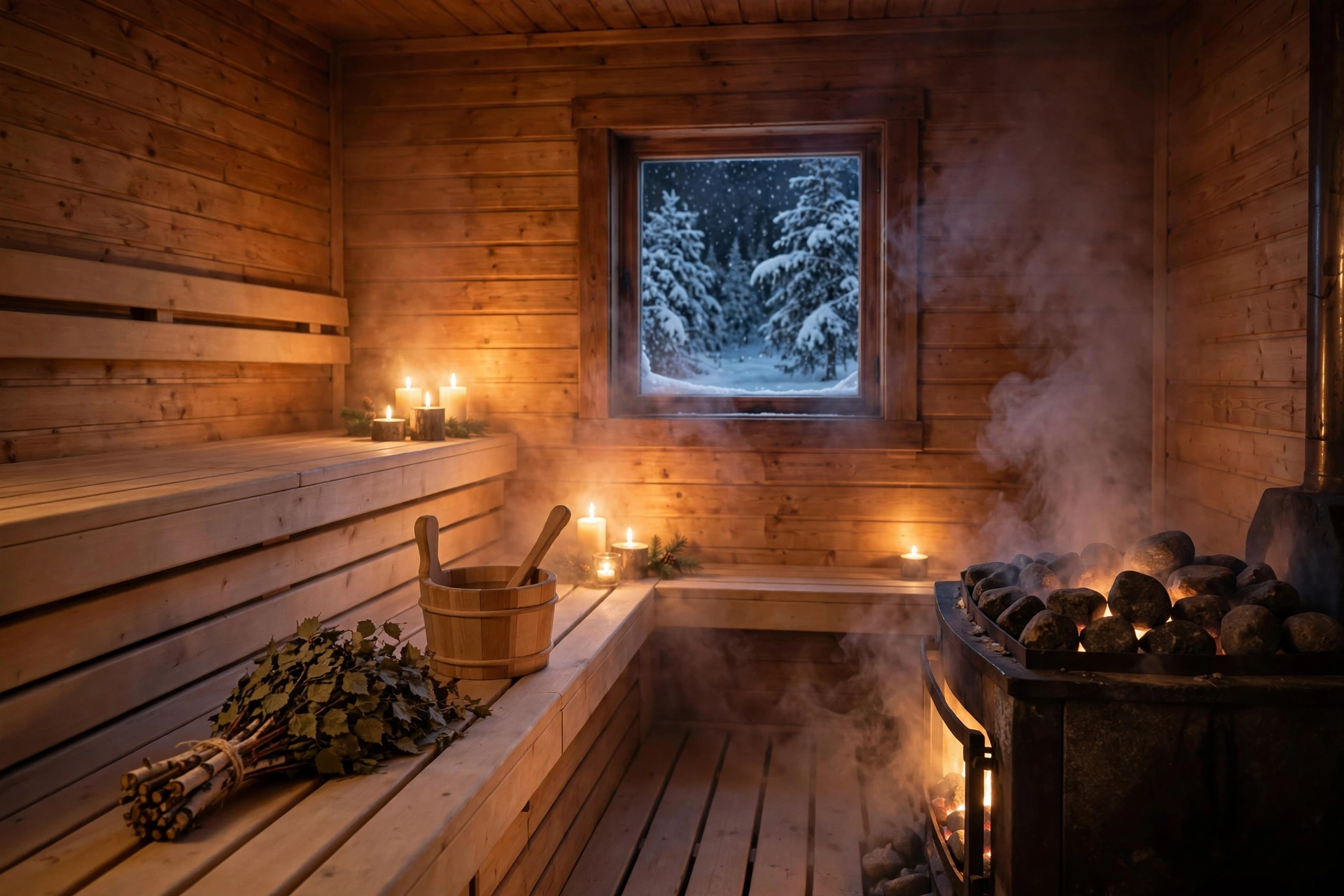
The Finnish sauna is a wood-paneled room heated by a stove (kiuas) topped with stones. Water thrown on the hot stones creates löyly — the wave of steam-heat that is the soul of the experience. Temperatures typically run 70–100°C (160–210°F). Sessions alternate between intense heat and cooling off — often with a roll in the snow or a plunge into an icy lake in winter — and the whole practice is social, meditative, and deeply egalitarian. In the sauna, titles and pretensions are left at the door with the clothes.
Historically, the sauna was Finland’s cleanest room — the place where women gave birth, where the sick were tended, where the dead were washed. It has always carried a spiritual charge: a place of purification, thresholds, and quiet. The Christmas sauna inherits all of that weight.
Christmas Eve: The Sauna Before the Feast
The Finnish Christmas Eve (jouluaatto) follows a rhythm as fixed as liturgy, and the sauna is its first movement. The day typically unfolds like this:
Morning: preparation
Christmas Eve morning is for final preparations — the joulupöytä (Christmas table) dishes are finished, the tree is decorated if not already done, and the sauna is heated. Heating a wood-fired sauna takes an hour or more, and the task often falls to the head of the household — a quiet, almost ceremonial duty.
Afternoon: the sauna
In the early afternoon, as the December darkness settles (in Helsinki the sun sets around 3 PM; in the north it does not rise at all), the family goes to the sauna. This is not the ordinary weekly sauna. The Christmas sauna is slower, quieter, more deliberate. Candles or lanterns replace electric light. The saunavihta or vasta — the bundle of birch twigs used to whisk the skin — may be a special one. Conversation is hushed. Many families observe a near-silence, treating the sauna as a time of reflection on the year ending.
Tradition holds that the sauna elf — the saunatonttu — watches over the sauna, and old custom warned against loud or disrespectful behavior in the heat. Whether or not anyone still believes in the elf, the etiquette survives: the Christmas sauna is approached with reverence.
Evening: the feast
Clean and calm, the family dresses in festive clothes and gathers for the Christmas meal. Only now does the celebration begin: the joulupöytä with its Christmas ham (joulukinkku), casseroles, gravlax, and rice porridge (riisipuuro) hiding a single almond; the Declaration of Christmas Peace; the visit from Joulupukki (the Finnish Santa, whose name means “Christmas Goat” — a nod to the old Yule goat traditions); and the opening of presents. The sauna has done its work: everyone arrives at the feast purified, relaxed, and present.
The Sauna Elf and Old Beliefs
Finnish folklore populates the sauna with spirits, chief among them the saunatonttu — the sauna elf or guardian. Like the house-elves (tonttu) of broader Nordic folklore, the sauna elf was believed to protect the sauna and its users, provided it was treated with respect. Offerings might be left; misbehavior — especially loud, drunken, or disrespectful conduct — was said to anger the elf, with unpleasant consequences.
These beliefs were never entirely playful. In a world where the sauna was the site of birth and death, the sense of the sauna as a threshold place — between clean and unclean, health and sickness, life and death — was profound. The Christmas sauna, occurring at the threshold of the year’s holiest night, concentrates that liminal charge. Even thoroughly modern, secular Finns often describe the Christmas sauna in language that brushes against the sacred: peace, stillness, gratitude, renewal.
Visitors should know that sauna etiquette is taken seriously in Finland. The rules are simple: wash before entering, sit on a towel or bench cover, respect others’ quiet, and never wear a swimsuit in a traditional sauna (it is unhygienic and marks you instantly as a tourist). In mixed company, Finns are matter-of-fact about nudity — it is non-sexual, practical, and entirely normal. Follow the lead of your hosts, keep your voice down, and enjoy one of the world’s great bathing traditions.
The Declaration of Christmas Peace
No account of the Finnish Christmas Eve is complete without the joulurauhanjulistus — the Declaration of Christmas Peace, proclaimed from the balcony of the Brinkkala House in Turku, Finland’s former capital, at noon on Christmas Eve. The tradition dates back centuries (the custom of declaring Christmas peace is medieval), and the proclamation has been broadcast on radio and television across Finland for generations.
The declaration calls on all citizens to observe a peaceful Christmas and warns, in archaic and solemn language, against disturbing the peace. Millions watch or listen. It is a remarkable piece of living history: a medieval legal proclamation, delivered in formal Finnish, marking the moment when the Christmas peace officially begins. For many families, the declaration plays in the background as the sauna heats — the old words and the rising steam, the past and the present, together.
The Joulupöytä: What Comes After the Sauna
Emerging from the sauna, the family sits down to the joulupöytä — the Yule table — a groaning board of Finnish Christmas dishes. The centerpiece is the joulukinkku, the Christmas ham: a large cured ham baked with a mustard-and-breadcrumb crust, served with sides for days afterward. Around it cluster the great Finnish casseroles — carrot (porkkanalaatikko), rutabaga (lanttulaatikko), potato — sweet, creamy, and deeply comforting; gravlax and pickled herring; mushroom salad; and riisipuuro, the rice porridge with a single hidden almond (finding it is said to bring luck, or at least the right to make a wish).
Dessert brings joulutorttu — star-shaped puff-pastry tarts with prune jam — and gingerbread. Drinks include glögi, the Finnish mulled wine. The meal is long, warm, and unhurried — the reward for the day’s preparations and the sauna’s purification. Then comes Joulupukki‘s visit (in many families, a relative in costume), the presents, and the long Christmas night.
The Christmas Sauna for Visitors: A How-To
If you are lucky enough to be invited to a Finnish Christmas sauna — or if you want to honor the tradition on your own — here is how to do it right.
Timing
The Christmas sauna happens on Christmas Eve afternoon, before the evening meal. Allow unhurried time: this is not a quick gym sauna. Plan for an hour or more, including cooling-off periods.
Preparation
Heat the sauna thoroughly — a proper Christmas sauna is hot. Soak the vihta/vasta (birch whisk) in warm water. Set out candles or lanterns instead of electric light if you want the traditional atmosphere. Have cold drinks ready (water, or for the full Finnish experience, a cold beer) and warm robes for afterward.
The session
Shower first — always. Enter the heat and sit quietly. Throw water on the stones sparingly at first; the löyly builds. Use the birch whisk gently on the skin — it stimulates circulation and releases a wonderful birch scent. Cool off between rounds: step outside into the cold air, or, if you are brave and a snowy or lakeside spot is available, roll in the snow. Repeat two or three times. Talk little. Breathe.
The mindset
The Christmas sauna is reflective. Many Finns use the quiet to think over the passing year — its losses and gifts — and to arrive at the evening’s celebration with a clear mind. You do not need to meditate formally; the heat and the silence do the work. Leave your phone outside. This is the point.
Afterward
Dress in your Christmas best — the contrast between the sauna’s simplicity and the evening’s festivity is part of the pleasure — and join the feast calm, clean, and present. You will understand, then, why Finns consider the sauna not a prelude to Christmas but its first and most essential rite.
Sauna and the Finnish Christmas Spirit
Visitors sometimes ask what the sauna has to do with Christmas — whether it is religious, or merely habitual. The honest answer is that in Finland, the distinction barely exists. The sauna is where Finns go to be clean, quiet, and honest; Christmas Eve is when those qualities matter most. The tradition needs no theological justification because it is not really about theology. It is about preparation — the deliberate, physical act of making oneself ready for joy.
There is a Finnish proverb: “Saunassa ollaan kuin kirkossa” — “In the sauna, behave as you would in church.” The Christmas sauna is where that proverb is most fully lived. The heat, the steam, the dark, the silence: it is the year’s deepest pause, placed exactly where the year needs it, on the afternoon before the celebration.
And perhaps that is the tradition’s gift to the rest of us. The modern Christmas is frantic — shopping, cooking, traveling, performing. The Finnish answer is to stop, get hot, get quiet, and wash the year off before the feast. It is the most sensible Christmas ritual ever devised, and it requires nothing but heat, water, and the willingness to sit still.
In Pictures: Finnish Christmas Sauna Tradition
On Christmas Eve afternoon, Finns cleanse body and mind in the joulusauna — the Christmas sauna — before the evening celebration, leaving the steam afterward to the spirits.
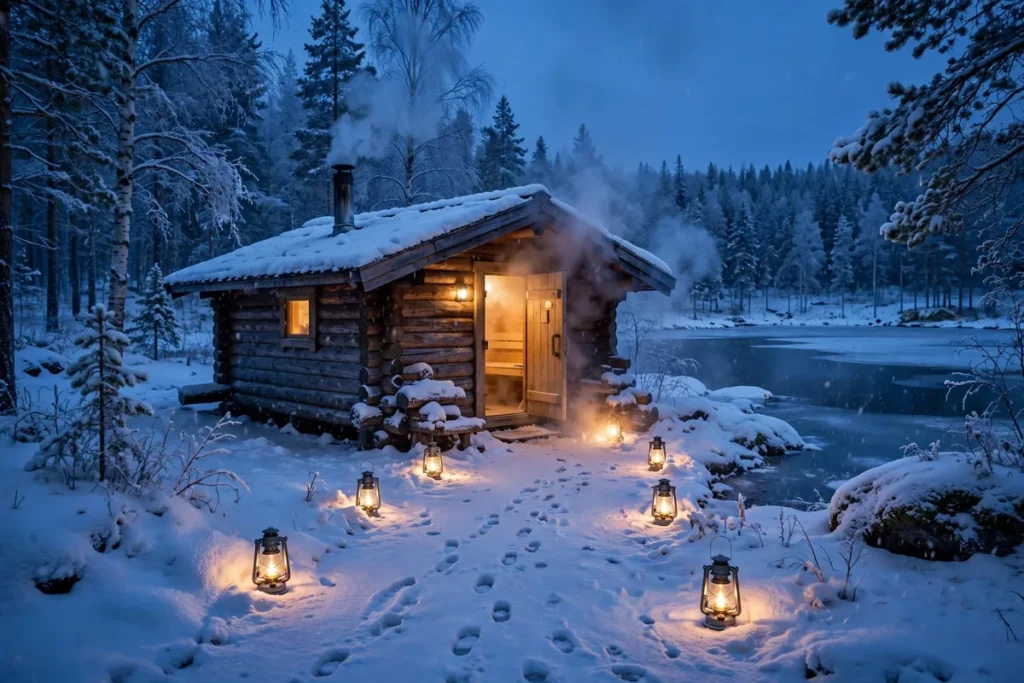
The joulusauna in the blue twilight: a wooden lakeside sauna glowing warm in the snowy forest, lanterns marking the path on Christmas Eve.
Watch: Finnish Christmas Sauna Tradition
Visit Central Finland declares Christmas Sauna Peace — the region's devotion to the Christmas sauna, an essential part of Finnish holiday tradition.
At a Glance: Finnish Christmas Sauna Tradition
The cleansing, the gnome, and the spirits of Finland's Christmas Eve sauna.
| Element | What it is | Key detail |
|---|---|---|
| Joulusauna | Christmas Eve afternoon | Families bathe in the sauna before the evening celebration — cleansing body and mind for Christmas |
| Christmas Sauna Peace | The declaration | Central Finland, the Sauna Region of the World, declares Christmas Sauna Peace about a week before Christmas Eve |
| Saunatonttu | The sauna gnome | The guardian spirit of the sauna — acknowledged and thanked, lest a disrespected gnome spoil the mood |
| The spirits' turn | After sunset | Tradition holds that elves, gnomes, and the spirits of dead family members take their turn in the sauna after dark |
| The sacred place | The history | For centuries the sauna served as church, pharmacy, and social room — the place of birth and of washing the dead |
| One sauna per two Finns | The scale | Finland has over 3 million saunas for about 5.5 million people — roughly one for every two Finns |
Frequently Asked Questions
Do Finns really take a sauna on Christmas Eve?
Yes — the Christmas Eve sauna is a deeply rooted Finnish tradition. Most families sauna on the afternoon of December 24th, before the Christmas meal and festivities. It is a quieter, more deliberate sauna than the everyday kind, often by candlelight.
What is the sauna elf?
The saunatonttu (sauna elf) is a figure from Finnish folklore believed to guard the sauna. Traditional custom held that the sauna should be treated with respect — no loud or rowdy behavior — lest the elf take offense. The etiquette of quiet reverence survives in the Christmas sauna tradition.
What temperature is a Finnish sauna?
Traditional Finnish saunas run 70–100°C (160–210°F), with löyly — the steam created by throwing water on the hot stove stones — providing waves of intense heat. Sessions alternate between heat and cooling off, sometimes with a snow roll or cold plunge.
What is the Declaration of Christmas Peace?
The joulurauhanjulistus is a traditional proclamation of Christmas peace read from Turku’s Brinkkala House balcony at noon on Christmas Eve — a custom dating back to the Middle Ages, now broadcast across Finland. It officially marks the beginning of the Christmas peace.
What do Finns eat for Christmas dinner?
The joulupöytä (Yule table) centers on joulukinkku (Christmas ham with a mustard crust), with carrot, rutabaga, and potato casseroles, gravlax, pickled herring, rice porridge (riisipuuro) with a hidden almond, joulutorttu star pastries, gingerbread, and glögi (mulled wine).
Can tourists experience a Finnish Christmas sauna?
Many hotels, holiday cottages, and public saunas in Finland offer Christmas-season sauna experiences, and some tour operators arrange traditional Christmas Eve saunas. If invited to a Finnish home, accept — it is a genuine honor. Remember the etiquette: shower first, sit on a towel, keep voices low, and leave the swimsuit off in traditional saunas.
Finland’s steamy Christmas Eve is the perfect prelude to a Nordic holiday — pair it with Sweden’s St. Lucia Day candlelight for the full Scandinavian season. For more on the region’s winter magic, see the best places to spend Christmas, and bring the calm home with Christmas activities for families, kids, and couples. If the sauna has you craving the feast, our Christmas dinner ideas await.
The Smoke Sauna: Christmas’s Oldest Heat
For the deepest version of the tradition, seek out the savusauna — the smoke sauna. The oldest form of Finnish sauna, the smoke sauna has no chimney: wood burns in a large stove, smoke fills the room, and then the fire is extinguished, the smoke vented, and the retained heat of the massive stones provides a soft, long-lasting warmth. The experience is extraordinary — gentle, deeply penetrating heat scented with woodsmoke, utterly unlike the sharp blast of a modern electric sauna.
Smoke saunas are treasures, often at summer cottages and rural homesteads, heated for hours before use. A Christmas Eve smoke sauna is the connoisseur’s choice: the preparation itself becomes part of the day’s ritual, the fire-tending a meditation, the first löyly a revelation. If you are offered a Christmas smoke sauna in Finland, cancel everything else. This is the peak of the tradition.
The smoke sauna also connects the Christmas ritual to its deepest roots. This is how Finns saunad for centuries — how the sauna-elves were honored, how births and deaths were marked, how the year’s turning was observed. The electric sauna is convenient; the smoke sauna is sacred. On Christmas Eve, the distinction matters.
Christmas in Lapland: The Sauna at the Edge of the World
For the ultimate Finnish Christmas sauna, head north — to Lapland, where the sun does not rise at all in December (kaamos, the polar night) and the Christmas sauna takes place in a blue twilight that never quite becomes day. Rovaniemi, the self-declared hometown of Santa Claus, offers Christmas-season sauna experiences that combine the tradition with Arctic spectacle: sauna followed by a roll in the snow under the northern lights, if fortune favors you.
Wilderness lodges and glass-igloo resorts across Lapland offer private Christmas Eve saunas — book far ahead, as the holiday season sells out. The experience is the tradition distilled: intense heat, Arctic cold, darkness, silence, and then the warm glow of the lodge and the Christmas feast. It is expensive, it is unforgettable, and it is arguably the single greatest Christmas Eve available on earth.
A practical note: the Arctic sauna demands respect. The temperature contrasts are extreme — from 90°C to -20°C in seconds — and while Finns do this routinely, visitors should take it gradually, stay hydrated, and listen to their bodies. The snow roll is optional; the löyly is mandatory.
Sauna Diplomacy: The Sauna as Finland’s Social Institution
Outsiders are often surprised to learn how thoroughly the sauna permeates Finnish public life. Business deals are discussed in saunas; political negotiations have been known to continue in the heat; the country’s leaders sauna with visiting dignitaries as a matter of protocol. The sauna is Finland’s great equalizer and its most honest meeting room — no titles, no posturing, just heat and conversation.
The Christmas sauna is the domestic expression of this institution. It is where the family, stripped of the year’s roles and pretensions, meets itself honestly before the celebration. Grudges do not survive the löyly well; gratitude thrives in it. Family therapists could do worse than prescribe a Christmas Eve sauna.
This social dimension also explains the tradition’s resilience. Finland has modernized at breakneck speed — from agrarian poverty to tech prosperity in two generations — but the sauna has survived every transformation, because it is not a relic but a practice: adaptable, essential, and deeply personal. The Christmas sauna will outlive every other tradition on this list, because it is the one Finns would keep if they could keep only one.
Bringing the Spirit Home: A Sauna-Less Christmas Pause
Most readers do not have a sauna — and certainly not a smoke sauna in Lapland. But the Christmas sauna’s essence is transferable: a deliberate pause, a physical cleansing, a quiet hour before the feast. Here is how to honor the tradition without the heat:
Take the long bath
On Christmas Eve afternoon, take an unhurried hot bath or shower — longer than usual, by candlelight, with no phone. The point is the ritual: washing off the year’s dust, arriving at the evening clean and calm.
Observe the quiet hour
Declare one hour before the Christmas meal a quiet hour: no cooking frenzy, no last-minute wrapping, no screens. Sit, breathe, reflect on the year. The Finns use steam; you can use stillness.
Write the year’s accounting
Some Finnish families use the sauna’s quiet for reflection. Borrow the practice: spend the quiet hour noting the year’s gifts and losses, the people you are grateful for, the hopes for the year ahead. Arrive at dinner present — the sauna’s true product.
The form is Finnish; the need is universal. Every Christmas could use an hour of heat and silence before the feast. Give yourself one.
Löyly: The Soul of the Sauna
No account of the Finnish sauna is complete without löyly — the word, untranslatable in a single English term, for the steam-heat that rises when water hits the hot stove stones. Löyly is both the physical phenomenon and the spirit of the sauna: Finns speak of “good löyly” the way wine lovers speak of a good vintage. It depends on the stove, the stones, the water, the timing — and the thrower’s skill.
In the Christmas sauna, the löyly is thrown slowly and deliberately. There is no rush, no competition for heat endurance — the Christmas löyly is gentle, enveloping, meditative. Old tradition holds that the löyly carries the sauna’s cleansing power: each wave of steam washes away not just sweat but the year’s accumulated heaviness. Whether or not you believe in the metaphysics, the physiology is real — the heat relaxes muscles, clears the mind, and slows the frantic pre-Christmas nervous system to a walk.
Visitors learning to throw water should start small: a single ladleful, wait for the wave, breathe. The stones hiss, the steam blooms, and the wooden walls seem to exhale. That sound — water on hot stone in a dark, quiet room on Christmas Eve afternoon — is, for many Finns, the true beginning of Christmas.
Frequently Asked Questions (Continued)
What is löyly?
Löyly is the Finnish term for the steam-heat created by throwing water on the sauna stove’s hot stones — both the physical wave of heat and, in Finnish understanding, the spirit or essence of the sauna experience. Good löyly is the mark of a good sauna.