Christmas traditions in Romania are among the most ancient and vividly folkloric in Europe — a world of star-carrying carolers in embroidered folk costumes, masked goat and bear dancers parading through snowy villages, midnight liturgies in wooden churches, and Christmas Eve tables laden with sarmale and cozonac. Romania’s caroling ritual, the colindat, is so culturally significant that UNESCO inscribed it on the Intangible Cultural Heritage list. This is Christmas as it was celebrated centuries ago — and in Romania’s villages, it still is.
What makes Christmas traditions in Romania so extraordinary is their unbroken continuity. While much of Europe modernized its holidays, Romania — especially its rural heartlands of Maramureș, Moldavia, and Transylvania — preserved pre-Christian winter rituals, medieval caroling customs, and Orthodox liturgical traditions in living practice. The result is a Christmas of remarkable depth: pagan and Christian, solemn and exuberant, all at once. This deep-dive explores every layer, from the sacred colinde to the dancing bears.
The Colinde: Romania’s UNESCO Caroling Tradition
The soul of Christmas traditions in Romania is the colindat — the ritual caroling performed on Christmas Eve. Groups of colindători (carolers), often dressed in traditional folk costumes with embroidered blouses, wool vests, and fur hats, go from house to house singing colinde — ancient carols that blend Christian Nativity themes with older, pre-Christian winter motifs of light, fertility, and renewal.
How Colindat Works
The ritual follows a precise etiquette. The carolers arrive at a house and ask permission to sing (“Primim colindătorii?” — do you receive the carolers?). They perform their colinde — often several, each with complex harmonies — and the hosts reward them with colaci (ritual breads), nuts, apples, and money. The exchange is ceremonial: the carolers’ songs confer blessings on the household for the coming year, and the hosts’ gifts honor the singers. To turn carolers away is a serious breach of custom.
In 2013, UNESCO inscribed “Colindat, Christmas-time ritual” (jointly with Moldova) on the Representative List of the Intangible Cultural Heritage of Humanity — international recognition of what Romanians have always known: that their caroling is not mere entertainment but a sacred art, carrying the spiritual memory of the nation across generations.
The Colinde Themselves
Romanian colinde are musically and poetically extraordinary. Unlike the simple melodies of Western carols, many colinde feature complex modal harmonies, irregular rhythms, and haunting archaic lyrics. Classics like “O, ce veste minunată” (O, What Wonderful News) and “Steaua sus răsare” (The Star Rises Above) are known nationwide, but every region has its own repertoire — Maramureș’s colinde are particularly renowned for their beauty and antiquity. Ethnomusicologists consider the Romanian colinde among Europe’s richest folk-music treasures.
Ajunul Crăciunului: Christmas Eve, the Fasting Day
Christmas Eve — Ajunul Crăciunului — is a day of fasting and preparation in Romania. Traditionally, the faithful eat lightly or fast until the evening, when the Christmas Eve table is laid. Like the Polish Wigilia tradition explored in our guide to Polish Wigilia’s 12 dishes, the Romanian Christmas Eve meal was historically meatless — though in modern practice, many families now serve the full feast on Christmas Eve evening.
The evening centers on the colindători: as darkness falls, the carolers begin their rounds, and families await their arrival with the traditional rewards ready. Children are especially excited — for them, the carolers’ visit is the evening’s main event. After the caroling, families attend the evening church service, and the night ends with the first tastes of the Christmas feast.
The Romanian Christmas Table: Sarmale, Cozonac & Piftie
The Romanian Christmas table is a monument to abundance, and its dishes are the taste of the holiday itself.
Sarmale: The Essential Dish
No Romanian Christmas is complete without sarmale — cabbage rolls stuffed with minced pork (and sometimes beef), rice, and herbs, slow-cooked until meltingly tender, traditionally in a clay pot. Families make them by the hundred in the days before Christmas; the rolling of sarmale is a communal activity, with grandmothers supervising the technique. Served with sour cream, polenta (mămăligă), and hot peppers, sarmale are the undisputed centerpiece — so essential that “Christmas without sarmale” is practically a contradiction in terms.
Cozonac: The Christmas Sweet Bread
Cozonac is Romania’s beloved Christmas sweet bread — a rich, yeasted dough swirled with fillings of ground walnuts, cocoa, poppy seeds, or rahat (Turkish delight). Baked in loaf pans until deeply golden, sliced to reveal its beautiful spiral, cozonac is served throughout the season with coffee or tea. Every family has its recipe; the walnut cozonac is the classic, but poppy-seed and chocolate versions have passionate followings. Making cozonac is a multi-hour labor of love — the dough must rise twice — and the first slice of the season is a genuine event.
The Full Feast
Around the sarmale and cozonac gather the supporting dishes: salată de boeuf (the Romanian “beef salad” with mayonnaise and pickles, decorated elaborately), piftie or răcituri (pork aspic, a traditional Christmas delicacy), roast pork or turkey, ciorbă (sour soup) to start, and an array of pickles, cheeses, and cured meats. For drinks: țuică (plum brandy) as the aperitif, Romanian wines with the meal, and plenty of toasts. The Christmas lunch on December 25th — often lasting hours — is the week’s social pinnacle.
Capra and Ursul: The Masked Dancers
Among the most spectacular Christmas traditions in Romania are the masked folk performances — pagan-rooted rituals that survive in glorious color. The Capra (Goat) features a performer in an elaborate goat costume — a carved wooden goat head with moving jaws, draped in a shaggy costume of goat skins or colorful fabrics — who dances, capers, “dies,” and is miraculously revived, accompanied by musicians and a retinue of characters. The performance is comic, chaotic, and deeply symbolic: the goat’s death and resurrection represent the year’s cycle.
Even more striking is the Ursul (Bear) dance, centered in Moldavia — particularly around Comănești, famous for its bear-dance festival. Performers wear full bear skins (real, traditionally) and dance to drums and pipes in a powerful, rhythmic performance meant to drive away evil spirits for the new year. The bear dancers’ procession through snowy villages, drums pounding, is one of Europe’s most primal winter spectacles — a direct line to pre-Christian ritual, performed with total conviction.
Pluguşorul and Sorcova: New Year Rituals
Romania’s winter rituals extend past Christmas into the New Year, with two more UNESCO-worthy customs. The Pluguşorul (Little Plough) is performed on New Year’s Eve: a group — traditionally young men — recites an epic, rhythmic poem celebrating the plough and the agricultural year, accompanied by bells, whips cracked in rhythm, and sometimes a decorated miniature plough. The recitation is long, virtuosic, and celebratory, ending with wishes for a fruitful year.
On New Year’s morning comes the Sorcova: children carry a decorated stick (sorcova) adorned with colorful paper flowers and recite a traditional good-luck verse while gently tapping the recipient’s shoulder — a ritual blessing for health and happiness in the new year. The tapped person rewards the child with money or sweets. Together with the colinde, these rituals make Romania’s holiday season a continuous pageant of folk performance from Christmas Eve through New Year’s Day.
Steaua: The Star Boys
Another beloved custom is the Steaua (Star): children carry a large, decorated star — often illuminated from within — on a pole, going from house to house singing “Steaua sus răsare” and other star carols that tell the story of the Magi following the star to Bethlehem. The star itself is a work of folk art: wooden frame, colored paper, tinsel, and religious images, sometimes quite large and elaborate.
The Steaua custom beautifully embodies the blend at the heart of Christmas traditions in Romania: a Christian story (the Epiphany star) expressed through folk artistry and children’s joyful performance. In villages, the star-bearers’ procession through the snow, star glowing, is pure magic.
Maramureș: Christmas in Romania’s Living Museum
For the most traditional Christmas in Romania, go to Maramureș — the northern region of wooden churches (eight of which are UNESCO World Heritage sites), tall carved gates, and villages where folk costume is still daily wear. Here, Christmas traditions in Romania survive in their fullest form: the colindători in magnificent embroidered dress, midnight liturgy in a wooden church by candlelight, horse-drawn sleighs in the snow, and feasts of sarmale and cozonac in timber farmhouses.
Maramureș at Christmas feels like time travel — and it’s increasingly discovered by travelers seeking authenticity. Village guesthouses (pensiuni) offer Christmas packages: home-cooked feasts, caroling performances, sleigh rides, and the warmest hospitality in Romania. Book far ahead — the best guesthouses fill for Christmas months in advance.
Christmas Markets: Sibiu, Bucharest, and Beyond
Romania’s Christmas markets have grown into major attractions. Sibiu — the former European Capital of Culture with its stunning medieval Grand Square — hosts one of Eastern Europe’s most beautiful Christmas markets, with an ice rink, Ferris wheel, and stalls beneath the Council Tower. Bucharest’s market in Constitution Square (before the Palace of the Parliament) is the country’s largest, with concerts, an ice rink, and Santa’s house.
Cluj-Napoca, Brașov (beneath the Tampa mountain, often snowy), Timișoara, and Craiova all mount charming markets. The markets blend the Germanic Christmas-market tradition (a legacy of Transylvania’s Saxon heritage) with Romanian crafts: painted eggs, embroidered textiles, wooden carvings, and cozonac by the loaf. Carolers in folk costume perform on market stages, and the scent of vin fiert and roasting chestnuts fills the cold air. Mulled wine (vin fiert) and kürtőskalács (chimney cake, from the Hungarian tradition) fuel the browsing.
Moș Crăciun and Gift-Giving
Romanian children receive Christmas gifts from Moș Crăciun (Father Christmas), with presents opened on Christmas morning — often discovered under the brad (Christmas tree) after the children’s delighted discovery. The tree itself is a cherished tradition: families decorate it on Christmas Eve or in the days before, with ornaments, tinsel, and lights, topped with a star or angel.
Gift-giving emphasizes family and thoughtfulness: new clothes, toys, books, and practical gifts. Children write letters to Moș Crăciun with the earnest hope of children everywhere, and the tradition of finding the tree surrounded by presents on Christmas morning — after the magic of the night’s visit — never loses its power. Godparents traditionally give gifts to godchildren, and the exchange extends through the season’s visiting. For gift inspiration, our best Christmas gifts guide offers ideas for everyone on your list.
Decorating and the Nativity
Romanian Christmas decorating centers on the brad — often a real fir, filling the house with its scent — dressed in treasured ornaments, many handmade or inherited. The nativity scene (ieslea or peștera) holds a place of honor, from simple to elaborate. Windows glow with lights; the house is deep-cleaned and prepared; and new linens and curtains are traditional.
In villages, the decorations include wheat-sheaf ornaments, dried-flower arrangements, and the straw and wood crafts of local artisans. The overall effect is warm, handmade, and abundant — a celebration of craft as much as of the season. For decorating ideas spanning every tradition, see our Christmas decoration ideas.
The Romanian Diaspora: Colinde Across the World
Romania’s vast diaspora — in Italy, Spain, Germany, the UK, and North America — keeps these traditions with passion. December in diaspora communities brings colinde concerts, sarmale-making marathons, cozonac shipped from home (or baked from grandmother’s recipe), and Capra performances at community events. Romanian Orthodox churches abroad hold the Christmas liturgy with full ceremony; children learn the colinde in Saturday schools.
For second-generation Romanians, the winter rituals are the strongest connection to the homeland — and many make the pilgrimage home for Christmas at least once, to hear the colindători in a Maramureș village or watch the bears dance in Comănești. Like the Croatian Advent traditions in our guide to Christmas traditions in Croatia, Romania’s Christmas proves that the oldest celebrations are often the most alive.
The Vicleim: Romania’s Folk Nativity Play
Beyond the carols and dances, Christmas traditions in Romania include a remarkable folk theater: the Vicleim (also called Irozi, after Herod) — a traditional Nativity play performed by groups of children or young men on Christmas Eve. The performers, in handmade costumes and masks, enact the biblical story: the Magi, the shepherds, King Herod, and the Holy Family, with dialogue in verse and interspersed colinde.
The Vicleim is performed from a small portable stage or simply in the round, moving from house to house like the carolers. The Herod scenes — with the tyrant’s dramatic comeuppance — are played with gusto, and the young performers take visible pride in their roles. This living folk theater, passed from older children to younger ones, is one of the tradition’s most charming survivals: Christmas as participatory drama, centuries old and still performed with total seriousness by its young actors.
Christmas in Transylvania’s Saxon Villages
Transylvania’s Saxon villages — with their fortified churches and pastel houses — celebrate Christmas with a distinctive German-Romanian blend. In towns like Sighișoara, Mediaș, and the villages around Sibiu, the Saxon heritage survives in Christmas markets, brass-band concerts, and church services that mix Lutheran and Orthodox traditions. The fortified churches — massive, medieval, extraordinary — host Christmas concerts in settings of breathtaking historical resonance.
The Saxon Christmas table adds its own dishes: stollen-like sweet breads, sausages, and the hearty fare of the Transylvanian winter. And the region’s Hungarian communities contribute the kürtőskalács (chimney cake) that has become a Christmas-market staple nationwide. This multi-ethnic Christmas — Romanian, Saxon, Hungarian — is Transylvania’s special gift to the season: three traditions, one celebration.
Winter Folk Beliefs: Garlic, Weather, and the New Year
Christmas traditions in Romania carry a rich substratum of folk belief — customs that predate Christianity and survive as seasonal superstition. On Christmas Eve, garlic is hung in doorways and rubbed on children’s foreheads to ward off evil spirits (the strigoi of Romanian folklore are said to roam on this night). Farmers practice weather divination: the twelve days of Christmas are watched for signs of the coming year’s twelve months, and onion peels filled with salt are used to predict rainfall.
Young women practice love divination on Christmas Eve — counting fence posts, listening for dogs’ barks to divine the direction of a future husband — customs shared across Eastern Europe. Livestock are said to speak at midnight on Christmas Eve (a belief found from England to Russia); the pious leave extra feed for the animals. These beliefs, half-remembered and half-believed, add a layer of mystery to the Romanian Christmas — a reminder that the season’s magic runs deeper than the decorations.
The Week Between: Visiting and Celebration
The days between Christmas and New Year’s in Romania are a continuous round of visiting. Families travel between villages and cities; the Christmas leftovers fuel endless hospitality; and the colindători’s visits are discussed and compared. This is the season’s social heart: unhurried days of eating, drinking țuică, playing cards, and catching up with relatives seen too rarely.
New Year’s Eve then brings the second peak: the Pluguşorul recitations, parties, fireworks, and the midnight transition. New Year’s Day features the Sorcova ritual and the traditional New Year’s lunch. Only after this full fortnight — Christmas Eve through New Year’s Day, with Epiphany customs to follow — does the Romanian holiday season truly close. It’s one of Europe’s longest and richest Christmas seasons, and experiencing even part of it is unforgettable.
Bukovina’s Painted Monasteries: Christmas in Blue and Gold
For a Christmas of extraordinary beauty, visit Bukovina’s painted monasteries — Voroneț, Sucevița, Moldovița, Humor — whose exterior walls are covered in 16th-century frescoes, including the famous “Voroneț blue.” At Christmas, these monasteries hold services of profound beauty: the liturgy sung beneath walls depicting the Last Judgment and the Nativity, candles flickering against 500-year-old paint, snow softening the courtyards.
The monasteries’ nuns and monks welcome visitors respectfully, and the Christmas services — in Romanian Orthodox chant — are deeply moving even for non-believers. Combine a monastery visit with the region’s Christmas markets and the bear-dance traditions of nearby Moldavia, and you have a holiday journey through the very heart of Christmas traditions in Romania: faith, folk art, and winter beauty, inseparable.
In Pictures: Christmas in Romania
Romania’s Christmas runs on carols and feasts — colinde from door to door, sarmale and cozonac on the table, and masked goat dancers in the streets.
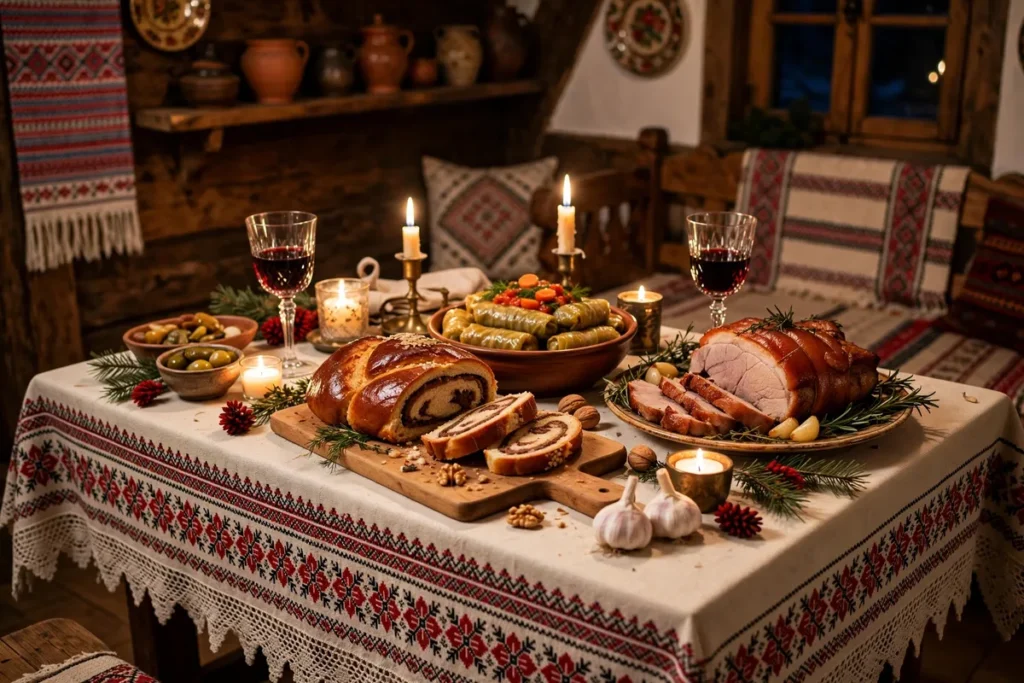
A Romanian Christmas Eve table: sarmale cabbage rolls, cozonac sweet bread and roasted pork on a rustic wooden table, candles glowing in a Transylvanian dining room.
Watch: Christmas in Romania
Traditional Romanian Christmas carols as sung for centuries in the villages of Maramureș, Northern Romania — recorded by TRINITAS TV.
At a Glance: Christmas in Romania
The customs of a Romanian Crăciun.
| Tradition | Date | Key detail |
|---|---|---|
| Colinde | 24 December | Carolers go door to door — children sing “O, ce veste minunată” and are rewarded with sweets and cozonaci |
| Ajunul Crăciunului | 24 December | Christmas Eve is a fasting day — the tree is decorated in the evening before the feast begins |
| Sarmale & cozonac | 25 December | The Christmas table: cabbage rolls with mămăligă, piftie aspic, and cozonac sweet bread |
| Capra & Ursul | Dec – Jan | Masked goat and bear dancers bring good luck — mischievous, noisy street rituals |
| Steaua | Dec – Jan | The Star Boys carry a lit star from house to house, singing of the Nativity |
| Plugușorul | 31 December | A decorated plough is paraded on New Year’s Eve, with poems wishing good crops |
| Sorcova | 1 January | Children tap adults with a decorated apple-twig bouquet, wishing health and good fortune |
Frequently Asked Questions
What are colinde in Romania?
Colinde are traditional Romanian Christmas carols, sung by groups of carolers (colindători) who go from house to house on Christmas Eve. The ritual caroling (colindat) blends Christian Nativity themes with ancient winter motifs, and was inscribed by UNESCO on the Intangible Cultural Heritage list in 2013 (jointly with Moldova).
What is the Capra dance in Romania?
The Capra (Goat) is a traditional Romanian folk performance in which a costumed performer wearing an elaborate goat mask dances, “dies,” and is revived, accompanied by musicians. The ritual symbolizes the cycle of the year and the driving away of evil, with pre-Christian roots.
What do Romanians eat at Christmas?
The essential Romanian Christmas foods are sarmale (cabbage rolls stuffed with minced meat and rice), cozonac (sweet bread swirled with walnut, poppy seed, or cocoa filling), salată de boeuf, piftie (pork aspic), roast meats, and an array of pickles and cheeses. Țuică (plum brandy) is the traditional aperitif.
What is Pluguşorul?
Pluguşorul (Little Plough) is a Romanian New Year’s Eve ritual in which young men recite an epic rhythmic poem celebrating the plough and agriculture, accompanied by bells and whip-cracks, wishing households a fruitful new year. It’s paired with the Sorcova (New Year’s morning good-luck ritual performed by children with decorated sticks).
When do Romanians open Christmas gifts?
Romanian children traditionally open gifts from Moș Crăciun (Father Christmas) on Christmas morning, finding them under the decorated Christmas tree. Christmas Eve is devoted to fasting, caroling, and church services, making the morning’s discovery all the more magical.
Where is the best Christmas market in Romania?
Sibiu’s Christmas market in the medieval Grand Square is widely considered Romania’s most beautiful, with an ice rink and Ferris wheel beneath the Council Tower. Bucharest’s market in Constitution Square is the largest, while Brașov, Cluj-Napoca, and Timișoara all host charming markets blending Saxon heritage with Romanian crafts.