Christmas traditions in Greece unfold against a backdrop unlike anywhere else in Europe: whitewashed island villages strung with lights, Athenian squares glowing beneath the Acropolis, fishing boats decorated in harbors instead of (or alongside) Christmas trees, and a holiday season that stretches from Christmas Day through Epiphany’s dramatic Blessing of the Waters. Greek Christmas — Christougenna — is an Orthodox celebration rich with Byzantine echoes, from the kalanta carols sung by children with triangles on Christmas Eve morning to the mischievous kallikantzaroi goblins of folklore, kept at bay by fires and holy water. This deep-dive explores every facet of the Greek Christmas: the bread, the boat, the carols, the sweets, and the twelve holy days that make the Greek holiday season one of Europe’s most distinctive.
Christmas in Greece: An Orthodox Celebration
To understand Christmas traditions in Greece, start with the calendar of faith. Greece is overwhelmingly Greek Orthodox, and Christmas (December 25) is one of the great feasts of the church year — preceded by the 40-day Nativity Fast (Nistia), during which observant believers abstain from meat and dairy. Christmas Eve and Christmas Day break the fast with feasting, and the celebration continues through the Twelve Days of Christmas (Dodekaimero) until Epiphany on January 6 — a period considered holy and set apart, when, according to folklore, the boundaries between worlds grow thin.
The Greek Christmas season has a different emotional temperature than the Northern European jul. December in Athens averages around 13°C (55°F); on the islands, Christmas can be mild enough for a seaside walk. There is snow in the northern mountains — and a proper wintry Christmas in places like Metsovo and Arachova — but the Greek Christmas is fundamentally a Mediterranean holiday: outdoor lights, evening voltes (strolls), harbor celebrations, and a warmth that is as much about climate as hospitality.
Gift-giving in Greece traditionally centers not on Christmas but on New Year’s Day — the feast of St. Basil (Agios Vasilios), the Greek gift-bringer. Children historically received their presents on January 1st, and while Christmas Day gift-giving has grown with Western influence, St. Basil’s Day retains its special association with gifts and the cutting of the vasilopita (St. Basil’s cake). It is one of many ways the Greek Christmas follows its own logic.
Kalanta: The Greek Christmas Carols
The most beloved of Christmas traditions in Greece is the kalanta — carols sung by children on three mornings: Christmas Eve, New Year’s Eve, and Epiphany Eve (January 5). Small groups of children go door to door, singing the kalanta while playing the triangle (trigono) — that humble percussion instrument is the signature sound of the Greek Christmas. The Christmas kalanta begin with the famous opening “Kalimera, kalimera” and narrate the Nativity story, ending with wishes for the household: “Kai tou chronou!” (“And again next year!”).
Householders reward the carolers with coins, sweets, or melomakarona (Christmas honey cookies). The custom is joyful, musical, and deeply communal — entire neighborhoods echo with triangles on Christmas Eve morning. Regional variations abound: in some areas, children carry decorated boats or elaborate paper lanterns; in others, the kalanta include verses specific to local saints or events. The New Year’s kalanta honor St. Basil, and the Epiphany kalanta celebrate the Baptism of Christ.
For adults, the kalanta tradition extends to evening kalesmata — groups of friends and family visiting homes to sing — and to the church services of the season, where Byzantine chant gives the Greek Christmas its solemn, ancient musical signature. The contrast between the children’s bright triangles and the deep resonance of Orthodox hymnody captures the Greek Christmas perfectly: joy and reverence in equal measure.
The Christopsomo: Christ’s Bread
At the center of the Greek Christmas table stands the Christopsomo — “Christ’s Bread.” This round, rich, slightly sweet loaf is the most symbolic food of Christmas traditions in Greece, and its preparation is a ritual. Baked on Christmas Eve, the bread is decorated with elaborate designs worked into the dough: crosses, flowers, and symbolic patterns made with dough ropes, nuts, and sometimes a walnut pressed into the center. The decoration is traditionally done by the family’s eldest woman, and the designs vary by region — in Crete, the bread may be shaped with particular intricacy; in Macedonia, sesame and spices feature prominently.
The Christopsomo is blessed and cut at the Christmas table, with the head of the household making the sign of the cross over it before slicing. A piece is set aside for the poor, for St. Basil, or for the family’s animals, depending on local custom. The bread embodies the Greek understanding of Christmas as fundamentally about sharing — the loaf is literally too significant to be merely eaten; it must be distributed, blessed, and honored.
Related festive breads include the vasilopita (cut on New Year’s Day with a coin hidden inside for luck) and regional Christmas loaves like the prosimni. Bread, in the Greek Christmas, is never just bread — it is theology you can taste. For more on festive breads and holiday tables worldwide, see our Christmas dinner ideas.
Decorating the Karavaki: Greece’s Christmas Boat
Here is the tradition that most surprises visitors: in Greece, the Christmas boat (karavaki) is the traditional decoration, older than the Christmas tree. Greece is a seafaring nation, and for centuries, Greek families — especially on the islands and in coastal towns — decorated small wooden boats with lights and ornaments to honor the sailors returning home for Christmas and to celebrate St. Nicholas, the patron saint of sailors (whose feast day, December 6, opens the festive season).
The karavaki tradition is experiencing a proud revival. Athens’ Syntagma Square now features a grand illuminated boat alongside (or in some years, in place of) the municipal Christmas tree; the port of Piraeus and island harbors decorate full-sized fishing boats with thousands of lights, creating floating Christmas displays reflected in the water. In homes, small wooden karavakia — often handmade, painted in the blue and white of the Greek flag — sit beside or beneath the Christmas tree, which has become common in Greece since the 19th century but never fully displaced the boat.
The boat-versus-tree debate is a gentle but real cultural conversation in Greece: traditionalists champion the karavaki as authentically Greek, while the tree represents the globalized Christmas. Many families now display both — a perfect emblem of how Christmas traditions in Greece balance heritage and modernity. For decorating inspiration that spans cultures, our Christmas decoration ideas include Mediterranean and nautical themes.
The Kallikantzaroi: Greece’s Mischievous Goblins
No deep-dive into Christmas traditions in Greece would be complete without the kallikantzaroi (singular kallikantzaros) — the mischievous goblins of Greek folklore who emerge during the Twelve Days of Christmas. According to legend, these grotesque, hairy creatures spend the year underground, sawing at the world-tree that holds up the earth; during the Dodekaimero, when Christ is “unbaptized” (before Epiphany), they surface to cause mischief: souring milk, tangling loom threads, riding horses to exhaustion, and generally terrorizing households.
Folk defenses against the kallikantzaroi are wonderfully specific: keeping a fire burning (they fear flame), hanging a pig’s jawbone by the chimney, marking doors with a black cross on Christmas Eve, and — most effectively — the Epiphany Blessing of the Waters, whose holy water banishes them back underground. In some regions, sausages and treats are left out to appease them; in others, children dress as kallikantzaroi for mischievous fun.
The kallikantzaroi are Greece’s answer to Krampus and the Perchten — the dark midwinter spirits that haunt European folklore. They remind us that the Greek Christmas, for all its sunshine, shares the ancient European sense that the darkest days are when the strange things walk. Compare with the Alpine demons in our guide to Christmas traditions in Austria.
Greek Christmas Food: Melomakarona, Kourabiedes, and the Feast
The Christmas sweets of Greece are legendary, and the season’s great rivalry — melomakarona versus kourabiedes — divides the nation as passionately as any sports derby.
Melomakarona are oval honey cookies, spiced with cinnamon, cloves, and orange, soaked in honey syrup after baking and sprinkled with crushed walnuts. Dark, fragrant, and sticky, they are the taste of the Greek Christmas for their devotees — and they happen to be dairy-free, a legacy of the Nativity Fast.
Kourabiedes are buttery almond shortbread crescents, buried under avalanches of powdered sugar. Crumbly, rich, and snowy-white, they are melomakarona’s great rival. Every Greek has a position; families often bake both, diplomatically.
The supporting cast: diples (crisp fried dough ribbons with honey and nuts), vasilopita (the New Year’s cake with the hidden coin — whoever finds it has luck for the year), and christopsomo as described above.
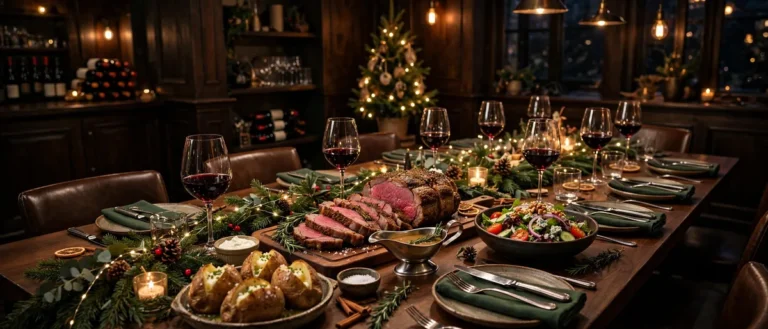
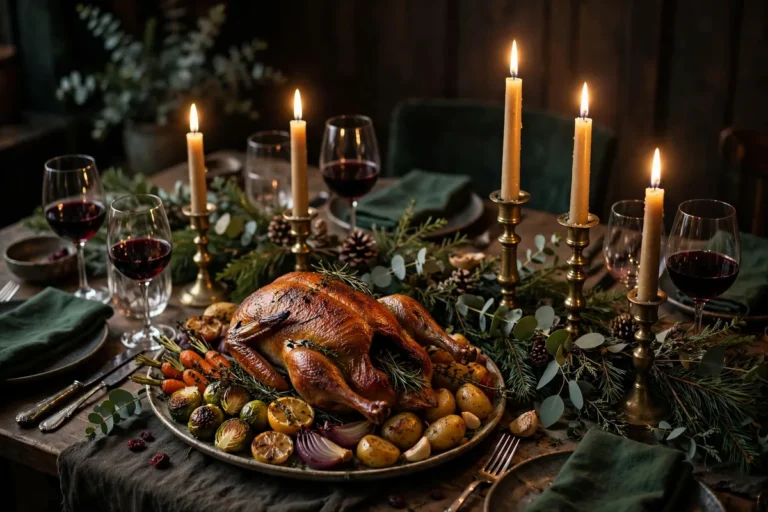
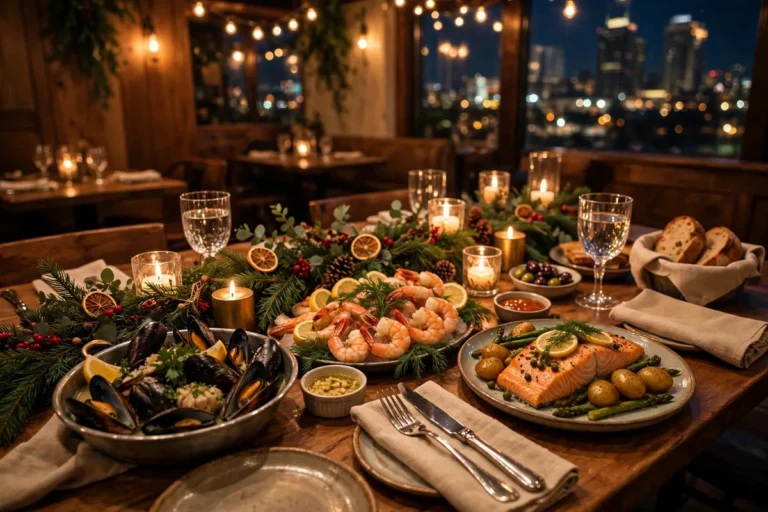
The Christmas Day feast itself breaks the Nativity Fast with abundance: roast pork (chirino) is traditional in many regions — Christmas pig feasts have ancient roots in rural Greece — while turkey stuffed with chestnuts, lamb, and gemo (stuffed cabbage or vine leaves) appear across the country. Avgolemono soup (egg-lemon) often opens the meal. Island tables feature fresh fish and seafood; mountain tables, game and hearty stews. The through-line is generosity: the Greek Christmas table groans, and guests are pressed to eat more as a matter of honor.
Epiphany: The Blessing of the Waters
January 6 — Theofania (Epiphany) — is the spectacular climax of Christmas traditions in Greece, and one of the most dramatic religious celebrations in Europe. Commemorating the Baptism of Christ, the day centers on the Blessing of the Waters (Agiasmos): after a Divine Liturgy, the priest leads a procession to the sea, a river, or a harbor, and casts a cross into the water. Young men dive in to retrieve it — in January water — and the one who surfaces with the cross is blessed with luck for the year.
The ceremony is magnificent: in Piraeus, Thessaloniki, and island ports, crowds gather at the waterfront, boats decorated with flags and greenery bob in the harbor, bands play, and the moment of the dive draws cheers. The blessed water (agiasmos) is believed to purify and protect; the faithful take bottles home to bless their houses. Epiphany also banishes the kallikantzaroi back underground — the holy water ends their twelve days of mischief.
For visitors, Epiphany in Greece is an extraordinary experience — arguably more visually dramatic than Christmas Day itself. If your travels can extend into early January, time a harbor town visit for the morning of January 6th. It is a fitting, triumphant close to the Greek holiday season.
New Year’s Eve and St. Basil: Greece’s Gift-Bringer
As noted, New Year’s Day in Greece belongs to St. Basil the Great (Agios Vasilios), whose feast day is January 1st. St. Basil — a fourth-century bishop of Caesarea, one of the most revered saints of Orthodoxy — is the traditional Greek gift-bringer, the figure Greek children historically awaited instead of (or alongside) Santa Claus. He is depicted as a tall, thin, bearded bishop rather than a jolly elf, and his legend includes the story of the vasilopita: during a siege, he baked the town’s collected jewelry into bread to return it to citizens — hence the hidden coin.
New Year’s Eve (Protochronia) is celebrated with festive dinners, the cutting of the vasilopita at midnight (slices are distributed in order of age and honor, with pieces reserved for Christ, the Virgin, St. Basil, the house, and the poor), card games (a beloved Greek New Year’s tradition — the season is the one time of year when gambling laws are traditionally relaxed for friendly play), and fireworks. The children’s kalanta on New Year’s Eve morning honor St. Basil specifically.
St. Basil’s Day is also when many Greeks exchange their main gifts — though Christmas Day gift-giving has grown, the saint’s association with presents endures, especially among older generations. It is a reminder that in Greece, the Christmas season’s generosity unfolds across weeks, not a single morning.
Christmas in Athens and the Greek Islands
Athens at Christmas is a revelation: Syntagma Square’s illuminated boat (or tree), the National Garden’s lights, Ermou street’s shopping crowds, and the Acropolis floodlit above it all. The city’s tavernas serve Christmas specials, plateies (squares) host events and concerts, and the mild weather makes evening strolls — the beloved volta — a pleasure. The Stavros Niarchos Foundation Cultural Center stages spectacular Christmas programming, and the city’s churches offer the full Byzantine splendor of the season’s liturgies.
Thessaloniki, Greece’s second city, mounts a grand Christmas celebration around Aristotelous Square, with its own illuminated displays and a festive market atmosphere. The islands offer a quieter, more traditional Christmas: in places like Hydra, Syros, and Crete, the kalanta, the karavaki, and the church services proceed as they have for generations, with the added magic of harbors full of lit boats. Northern mountain villages — Metsovo, Arachova, Karpenisi — provide the snowy, fireside Greek Christmas, complete with local festivals and hearty mountain cuisine.
Planning a Greek Christmas trip? December weather is mild but unpredictable — pack layers and a waterproof jacket. Christmas Eve and Day are family days with limited restaurant hours; Epiphany (January 6) is a public holiday with its own closures. Our best places to spend Christmas roundup includes Mediterranean options for sun-seekers.
Greek Christmas Markets and Urban Celebrations
Greece’s Christmas markets are a newer tradition than its ancient customs, but they have been embraced with enthusiasm. Athens hosts festive markets at Syntagma and Thissio, with the city’s Christmas tree (or karavaki boat) as centerpiece, street food stalls serving souvlaki and loukoumades (honey puffs), and concerts in the squares. Thessaloniki’s Aristotelous Square becomes a Christmas village with rides, stalls, and the city’s towering tree.
The most distinctive Greek Christmas event is in Drama, northern Greece: Oneiroupoli (“Dream City”), one of Greece’s largest Christmas theme parks, transforms the city’s park into a festive wonderland each December with workshops, performances, and Santa’s village. Trikala’s Mylos ton Xotikon (Mill of the Elves) similarly converts an old mill complex into a Christmas attraction. These large-scale events reflect how Christmas traditions in Greece blend the ancient (kalanta, karavaki) with the enthusiastically modern.
Urban Greeks also embrace the Christmas shopping season with gusto: Ermou street in Athens and Tsimiski in Thessaloniki are pedestrian rivers of shoppers in December, and the tradition of the New Year’s poda — the first person to enter the house in the new year (ideally someone lucky) — adds a folk-custom frisson to January 1st. Check municipal sites for 2026 event schedules, as dates and programs vary yearly.
Regional Variations: Crete, Macedonia, and the Islands
Christmas traditions in Greece vary beautifully by region. In Crete, the Christmas table features christopsomo of particular elaborateness, kserotigana (fried honey pastries), and the custom of the Christ’s log — a great log burned in the fireplace through the Twelve Days, its ashes considered protective. Cretan mantinades (rhyming couplets) sung as carols give the island’s kalanta a distinctive flavor.
In Macedonia (northern Greece), the kallikantzaroi folklore is strongest, with bonfires lit to keep the goblins away and the custom of ragoutsaria — masked revelers parading in Kastoria in early January, a Dionysian-tinged winter festival that overlaps the Christmas season. Epirus contributes the spordia — ritual breads — and polyphonic carols of haunting beauty.
On the islands, Christmas is maritime: the karavaki tradition is strongest here, St. Nicholas (patron of sailors) is honored with particular devotion on December 6th, and island tables feature the day’s catch alongside the Christmas classics. In the Dodecanese, the custom of pannychides — all-night Christmas Eve church vigils — survives in ancient churches. Each island, it is said, keeps Christmas slightly differently — and each is convinced its way is best.
In Pictures: Christmas in Greece
Greece celebrates an Orthodox Christmas of carols, decorated boats, mischievous goblins, and the Blessing of the Waters on Epiphany.
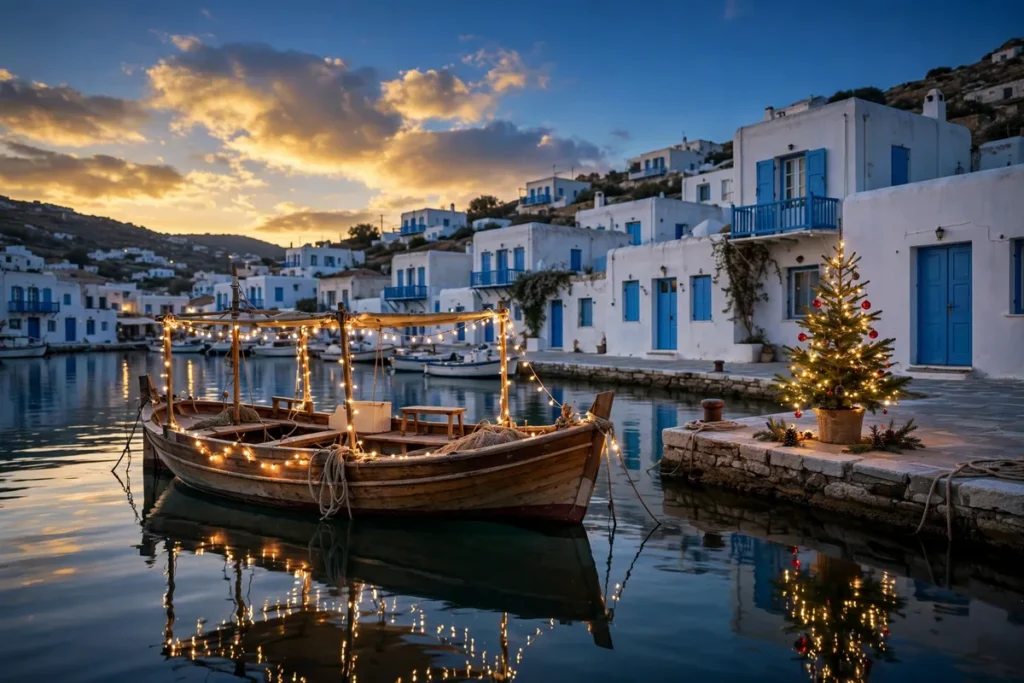
A Greek island harbor at Christmas dusk: a traditional wooden boat draped in fairy lights floating on calm water, whitewashed houses glowing behind.
Watch: Christmas in Greece
A guided tour of Greek holiday traditions — the decorated Christmas boats, kalanta carols, the pomegranate smash, vasilopita, and Epiphany’s Blessing of the Waters.
At a Glance: Christmas in Greece
The key customs of a Greek Christmas, from the carols to the cross-diving.
| Tradition | Date | Key detail |
|---|---|---|
| Kalanta | 24 Dec, 31 Dec, 5 Jan | Children go door to door singing Christmas carols with triangles, asking “Na ta poume?” — rewarded with sweets and coins |
| The Karavaki | December | The decorated Christmas boat — Greece’s older, seafaring alternative to the Christmas tree |
| Christopsomo | 25 December | “Christ’s bread” — a round sweet loaf with a decorated crust, baked for the Christmas table |
| Kallikantzaroi | 25 Dec – 6 Jan | Mischievous goblins said to emerge during the Dodekaimero; fires, basil and the Epiphany blessing drive them back underground |
| Melomakarona & kourabiedes | December | Honey-soaked melomakarona and powdered kourabiedes shortbread — the two essential Christmas cookies |
| St. Basil’s Day | 1 January | Agios Vassilis brings the gifts; families cut the vasilopita cake — the slice with the hidden coin (flouri) brings luck |
| Epiphany — Blessing of the Waters | 6 January | The priest throws a cross into the sea; young men dive for it — the finder is blessed with a lucky year |
Frequently Asked Questions
What is the Greek Christmas boat?
The karavaki (little boat) is Greece’s traditional Christmas decoration — small wooden boats adorned with lights, honoring the nation’s seafaring heritage and St. Nicholas, patron saint of sailors. Older than the Christmas tree in Greece, the karavaki is experiencing a revival, with illuminated boats displayed in harbors and city squares nationwide.
What are kalanta?
Kalanta are Greek Christmas carols sung by children on Christmas Eve, New Year’s Eve, and Epiphany Eve mornings. Groups of children go door to door singing the Nativity story while playing triangles, ending with wishes of “Kai tou chronou!” (And again next year!). Householders reward them with coins and sweets.
What are melomakarona and kourabiedes?
The two iconic Greek Christmas cookies: melomakarona are spiced honey-soaked oval cookies topped with walnuts (dairy-free, a legacy of the Nativity Fast), and kourabiedes are buttery almond shortbread crescents buried in powdered sugar. Greeks debate passionately over which is superior; most families bake both.
Who brings gifts in Greece — Santa or St. Basil?
Traditionally, St. Basil (Agios Vasilios) brings gifts on New Year’s Day (January 1st), his feast day. Christmas Day gift-giving has grown with Western influence, and Santa Claus (Agios Vasilis is also used for Santa) appears in modern celebrations — but St. Basil’s Day retains its special gift-giving association, especially the cutting of the vasilopita cake with its hidden lucky coin.
What happens on Epiphany in Greece?
On January 6 (Theofania), priests bless the waters by casting a cross into the sea or a river; young men dive to retrieve it, with the retriever blessed with luck for the year. The ceremony — with processions, decorated boats, and crowds at harbors — is the dramatic climax of the Greek Christmas season and banishes the kallikantzaroi goblins back underground.
What are the kallikantzaroi?
The kallikantzaroi are mischievous goblins of Greek folklore who emerge during the Twelve Days of Christmas (December 25–January 6) to cause household mischief. Folk defenses include keeping fires burning, marking doors with crosses, and the Epiphany Blessing of the Waters, whose holy water drives them back underground.
Christmas traditions in Greece prove that Christmas belongs as much to the Mediterranean as to the snowy north. In the children’s triangles on Christmas Eve morning, the honey-soaked melomakarona, the boats glowing in island harbors, and the cross plunging into January waters, Greece keeps a Christmas of light, music, and deep Orthodox soul. Kala Christougenna! — and Kai tou chronou!