Christmas traditions in Austria unfold like a scene from a storybook: snow-dusted Alpine villages, the scent of roasted chestnuts and glühwein drifting through medieval market squares, church bells echoing off mountainsides, and a Christmas Eve presided over not by Santa Claus but by the Christkind — the Christ Child, a golden-haired angel who brings gifts while the family waits in another room. Austria is the birthplace of “Silent Night,” the home of the terrifying Krampus, and the keeper of some of Europe’s most beloved Christmas markets. In this listicle, we count down the essential Austrian Christmas traditions — from devilish December 5th processions to the chime of the Pummerin bell — plus the food, markets, and music that make an Austrian Christmas unforgettable.
Austrian Christmas at a Glance
Before the countdown, the essentials of Christmas traditions in Austria. The season runs from Advent (late November) through Epiphany (January 6). December 24 — Heiliger Abend (Holy Evening) — is the main celebration, when families gather for dinner, the tree is lit, and gifts appear as if by magic. December 25 and 26 (Christtag and Stefanitag) are public holidays for church, family visits, and rest. New Year’s Eve (Silvester) is celebrated with fireworks, champagne, and the famous Blue Danube waltz at midnight.
Two figures dominate the Austrian December: the Christkind and St. Nicholas — with the Krampus lurking as their dark counterpart. Gifts on Christmas Eve are traditionally brought by the Christkind, often imagined as a young, golden-haired angel in white and gold. Children are sent out of the living room while the tree is decorated and the gifts arranged; a bell rings, the doors open, and the glowing tree is revealed — the Christkind has just left. It is a moment of genuine magic that Austrian adults remember vividly from childhood.
Austria’s Christmas sits at the crossroads of German and Alpine culture, sharing much with its northern neighbor — compare our guide to Christmas traditions in Germany — but with a distinctly Austrian warmth, musicality, and love of the grand gesture. Vienna’s Christmas markets alone draw millions of visitors each December.
14 Enchanting Austrian Christmas Traditions
1. The Christkind Brings the Gifts
The most distinctive of Christmas traditions in Austria is the Christkind — the Christ Child as gift-bringer. Unlike the American Santa, the Christkind is ethereal: a radiant, golden-haired figure in white robes who arrives unseen on Christmas Eve. Families keep children out of the living room while adults decorate the tree and arrange gifts; when the little bell (Christkindglöckchen) rings, the doors open to reveal the illuminated tree and presents. Many Austrian adults insist they believed in the Christkind far longer than seems reasonable — the ritual is that convincing.
2. Krampus: The Christmas Devil
On the evening of December 5th, Austria’s most infamous tradition takes to the streets: Krampus. This horned, cloven-hoofed, chains-rattling demon is St. Nicholas’s dark companion, who punishes misbehaving children while the saint rewards the good ones. Krampusläufe — Krampus runs — see dozens of elaborately costumed Krampusse parading (and playfully menacing) through towns across Austria, especially in Alpine regions like Tyrol and Salzburg. The costumes are extraordinary works of folk art: hand-carved wooden masks, real horns, cowbells, and shaggy pelts. It is terrifying, thrilling, and utterly unmissable — though parents of small children should preview before committing.
3. St. Nicholas Day (December 6)
The morning after Krampus comes St. Nicholas Day (Nikolaustag). Children polish their shoes and leave them outside their doors (or on windowsills) on the evening of December 5th; overnight, St. Nicholas fills them with nuts, mandarins, chocolate, and small gifts. Naughty children may find a bundle of twigs (Rute) — traditionally left by the Krampus. In many Austrian towns, a costumed St. Nicholas visits kindergartens and schools, accompanied (at a safe distance) by his horned counterpart.
4. “Silent Night” — Born in Austria
The world’s most beloved Christmas carol was born in Austria. “Stille Nacht” (Silent Night) was first performed on Christmas Eve 1818 in the village church of Oberndorf bei Salzburg, with words by Father Joseph Mohr and music by Franz Xaver Gruber — reportedly accompanied on guitar because the church organ was broken. Today, the Silent Night Chapel (Stille-Nacht-Kapelle) stands on the site, and the song has been translated into some 300 languages. Visiting Oberndorf in December, where the carol is sung in its original setting, is a pilgrimage for Christmas lovers worldwide.
5. Advent Wreaths and Advent Calendars
The Adventkranz — Advent wreath with four candles — is the centerpiece of the Austrian December home. Families gather each Sunday of Advent to light the next candle and sing carols; the ritual gives the season its structure. Advent calendars, from simple paper to elaborate homemade creations with 24 small gifts, count down the days. Many Austrian families also observe Barbarazweige: cherry branches cut on St. Barbara’s Day (December 4) and forced indoors to bloom by Christmas — blossoms on Christmas Eve are said to bring luck.
6. The Christkindlmärkte: Christmas Markets
Austria’s Christkindlmärkte (Christmas markets) are among the finest in Europe and a cornerstone of Christmas traditions in Austria. Vienna hosts the grandest: the Christkindlmarkt on Rathausplatz, with over a hundred stalls beneath the illuminated City Hall, plus markets at Schönbrunn Palace, Belvedere, and Spittelberg’s charming lanes. Salzburg’s market on Cathedral Square, beneath the Hohensalzburg fortress, is the most romantic. Innsbruck’s market, with the snow-capped Nordkette mountains towering above the Golden Roof, is the most dramatic. Expect glühwein, roasted chestnuts (Maroni), Vanillekipferl cookies, hand-blown ornaments, and nativity scenes — and go on a weeknight to avoid the worst crowds.
7. Glühwein, Punsch, and Maroni
The flavors of the Austrian market season deserve their own entry. Glühwein (mulled red wine with spices) is the classic warmer, served in collectible mugs that many visitors keep as souvenirs. Punsch — a rum-spiked punch, often with tea and fruit juices — is the stronger alternative. Maroni (roasted chestnuts), sold from street vendors in paper cones, are the essential market snack, alongside roasted almonds and Kartoffelpuffer. These tastes are the Austrian December for many visitors — plan your market strategy accordingly.
8. Christmas Eve: Heiliger Abend
December 24th follows a beloved script. The day is for last preparations and, traditionally, fasting until evening. In the afternoon, children are banished from the living room while the tree is decorated and the Christkind does its work. The family attends an afternoon or early-evening church service, then returns home for the Christmas dinner. After dinner comes the Bescherung — the gift-giving — heralded by the little bell and the revelation of the glowing tree. Carols are sung around the tree (“Stille Nacht” is mandatory), and many families attend midnight Mass (Christmette) to close the evening.
9. The Austrian Christmas Dinner
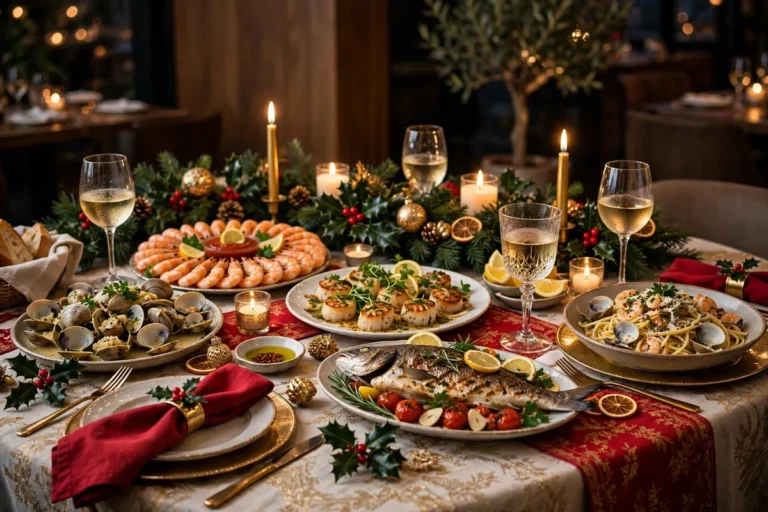
The traditional Austrian Christmas Eve dinner is carp (Karpfen) — often breaded and fried, served with potato salad — a custom shared with much of Central Europe and rooted in the old Christmas Eve fast (no meat). In recent decades, many families have shifted to goose, turkey, or fondue/raclette, but carp remains the classic. Christmas Day dinner is the meatier affair: roast goose (Weihnachtsgans) with red cabbage and dumplings is the traditional centerpiece. For broader festive menu inspiration, our Christmas dinner ideas collection spans the globe.
10. Vanillekipferl and Christmas Baking
Austrian Christmas baking (Weihnachtsbäckerei) is a high art, and its queen is the Vanillekipferl — the crescent-shaped vanilla-almond cookie dusted thickly with vanilla sugar. No Austrian Christmas is complete without tins of them. The supporting cast includes Lebkuchen (gingerbread, often elaborately iced), Linzer Augen (jam-filled sandwich cookies), Zimtsterne (cinnamon stars), and Husarenkrapferl (jam thumbprints). Baking is traditionally a multi-generational December activity, with recipes guarded like family heirlooms.
11. Sternsinger: The Star Singers
Around Epiphany (January 6), groups of children dressed as the Three Kings go door to door as Sternsinger (star singers), singing carols and collecting donations for children’s charities — one of Austria’s largest annual charitable drives. They chalk the traditional blessing C+M+B (Christus mansionem benedicat — “Christ bless this house,” popularly read as the Magi’s initials) above doorways. It is a charming, meaningful coda to the season.
12. Silvester: New Year’s Eve, Austrian Style
Austrians call New Year’s Eve Silvester (after St. Sylvester, whose feast day it is), and they celebrate with characteristic grandeur. Vienna’s Silvesterpfad (New Year’s Path) turns the city center into a giant street party with stages, food stalls, and waltz lessons. At midnight, the Pummerin — the great bell of St. Stephen’s Cathedral — tolls, followed by the Blue Danube waltz broadcast on national radio and television; Austrians traditionally waltz in the new year, even in their living rooms. Bleigießen (lead pouring — melting lead and dropping it in water to divine the future from the shapes) is the classic Silvester parlor game, and lucky charms (Glücksbringer) — marzipan pigs, chimney sweeps, four-leaf clovers — are exchanged.
13. The Neujahrskonzert: New Year’s Concert
The Vienna Philharmonic’s New Year’s Concert (Neujahrskonzert), held every January 1st in the Musikverein’s Golden Hall, is Austria’s gift to the world’s New Year — broadcast to tens of millions in dozens of countries. The program of Strauss waltzes and polkas, with its flower-decked hall and encores of the Blue Danube and Radetzky March, is the elegant bookend to Austria’s holiday season. Tickets are allocated by lottery a year in advance; the rest of us watch on television with coffee and Vanillekipferl.
14. Perchten: The Wild Midwinter Spirits
Deeper in Alpine tradition, the Perchten — wild, shaggy midwinter spirits led by Frau Perchta — parade in early January (especially around Epiphany) in Perchtenläufe. Older and stranger than Krampus, the Perchten represent the untamed forces of winter being driven out. Their massive horned masks and deafening cowbells make for one of Europe’s most primal winter spectacles — a reminder that beneath Austria’s elegant Christmas lies something ancient and wild.
Austria’s Legendary Christmas Markets: A Visitor’s Guide
For many travelers, the Christmas markets are the Austrian Christmas, so here is practical guidance. Vienna’s Rathausplatz Christkindlmarkt is the largest and most iconic — arrive at dusk when the lights come on, skate the illuminated ice paths, and work the stalls systematically: glühwein first, Maroni second, ornaments third. Schönbrunn’s market, before the imperial palace, is the most elegant; Spittelberg’s, in the Biedermeier quarter’s narrow lanes, is the most atmospheric.
Salzburg’s Christkindlmarkt (on Domplatz and Residenzplatz, typically late November to December 26) pairs Mozart’s birthplace with fortress views and nightly choir performances. Innsbruck hosts six markets, the main one before the Golden Roof with the Nordkette Alps as backdrop — the most photogenic Christmas market setting in Europe. Smaller towns — Hallstatt, St. Wolfgang, Graz — offer intimate, less crowded alternatives.
Markets typically open mid-to-late November; exact 2026 dates vary by city, so verify on official tourism sites before booking. Our best Christmas markets in the USA guide offers the American counterpart for those staying stateside — though veterans will tell you the Austrian originals set the standard.
Austrian Christmas Food and Sweets: The Full Spread
Beyond the Vanillekipferl tin, the Austrian Christmas table deserves a full accounting. Christmas Eve’s traditional carp gives way on Christmas Day to roast goose with bread dumplings (Serviettenknödel) and red cabbage. Backhendl (fried chicken) and turkey appear on modern tables. Soups — clear beef broth with Frittaten (pancake strips) or liver dumplings — open festive meals.
The sweet course is where Austria truly shines: Sachertorte and Linzer Torte grace holiday tables; Stollen (borrowed from Germany but beloved); Kletzenbrot, the dense Tyrolean fruit-and-nut bread; and the full Weihnachtsbäckerei cookie arsenal. Christstollen, mulled Most (cider), and Jagatee (hunter’s tea with rum) warm the Alpine evenings. For decorating a table worthy of this feast, see our Christmas decoration ideas.
Austrian Christmas Music: The Vienna Boys’ Choir and Beyond
Austria’s contribution to Christmas music extends far beyond “Silent Night.” The Vienna Boys’ Choir (Wiener Sängerknaben) — founded in 1498 — performs Christmas concerts that are among the most coveted tickets of the Austrian December, their pure treble voices filling the Musikverein and St. Stephen’s Cathedral with the season’s repertoire. The choir’s Christmas recordings are classics in their own right.
The Austrian Christmas musical canon includes “Stille Nacht” (of course), “Es wird scho glei dumpa” (the beloved Austrian dialect carol — “It Will Soon Be Dark”), “Leise rieselt der Schnee” (Softly Falls the Snow), and “O Tannenbaum.” Church music is central: the Christmette (midnight Mass) in Austria’s great abbeys — Melk, St. Florian, Wilhering — features full orchestras and choirs performing Mozart, Haydn, and Schubert’s sacred works in the settings they were written for. Attending a Christmette in an Austrian abbey church is a transcendent experience; arrive very early, as these services draw enormous crowds.
December in Vienna is also peak concert season: the Vienna Philharmonic, the Vienna Symphony, and countless chamber ensembles program Christmas and New Year concerts, from the grand Musikverein to intimate palace venues. Street musicians play carols in the markets, brass ensembles perform from church towers (Turmblasen — tower blowing — is a beloved tradition in many Austrian towns), and the whole country seems to hum. In Austria, Christmas is not just celebrated — it is performed, beautifully.
Christmas in the Austrian Alps: Villages, Ski Resorts, and Snow
Beyond Vienna and Salzburg, the Austrian Alps offer the storybook Christmas: villages like Hallstatt (famous for its lakeside Christmas market), St. Wolfgang (whose giant floating Advent lantern lights the lake), Alpbach, and Seefeld stage intimate, snow-guaranteed celebrations. Tyrol is the heartland of Krampus and Perchten traditions — the mountain valleys take their midwinter demons seriously, and the Krampusläufe here are the most spectacular in Austria.
The great ski resorts — St. Anton, Kitzbühel, Lech-Zürs, Ischgl — do Christmas in style: torchlit descents on Christmas Eve, open-air concerts, mountain restaurants serving Christmas dinners at altitude, and New Year’s fireworks over the slopes. A ski-resort Christmas is the luxurious end of the Austrian spectrum, and it books out far in advance. For a quieter Alpine Christmas, the farm-stay (Urlaub am Bauernhof) tradition offers self-catering apartments on working farms — children can help feed animals, sleigh rides can be arranged, and the Christmas Eve is as peaceful as it gets.
Practical notes for an Alpine Christmas: snow is reliable above ~1,000 meters in December but not guaranteed in the valleys — check conditions. Mountain roads require winter tires or chains (Austrian law mandates winter equipment from November). And book Christmas Eve dinner well ahead wherever you stay — Austrian kitchens take the holiday seriously, and walk-ins on December 24th are a fantasy.
New Year’s Day: Lucky Foods and the Season’s Last Notes
January 1st in Austria (Neujahrstag) is a day of rest, recovery, and lucky foods. Tradition holds that eating pork on New Year’s Day brings luck (the pig roots forward, symbolizing progress), while poultry is avoided (chickens scratch backward). Glücksschwein — marzipan or chocolate lucky pigs — are exchanged as tokens. Lentil soup, sauerkraut, and carp also feature as good-luck dishes in various regions.
The day’s cultural centerpiece is the Vienna Philharmonic New Year’s Concert, watched by millions over breakfast and brunch. Many Austrians follow it with a long walk — the traditional Neujahrsspaziergang — to clear the head after Silvester’s excesses. The Christmas markets wind down, the trees stay up until Epiphany (or Candlemas, February 2nd, in traditional households), and the Sternsinger make their rounds. Austria’s holiday season does not end with a bang but with a waltz — which, on reflection, is exactly right.
In Pictures: Christmas in Austria
Austria's December runs from devilish Krampus processions to the chime of the Pummerin bell — with the world's most storied Christmas markets in between.

An Alpine Christmas market at dusk: wooden stalls glowing with warm lights beneath snow-dusted mountains.
Watch: Christmas in Austria
A guided evening tour of Vienna's Christkindlmarkt at Rathausplatz plus five other markets, with historical facts in the captions.
At a Glance: Christmas in Austria
Austria's essential Christmas dates and traditions.
| Tradition | Date | Key detail |
|---|---|---|
| 'Silent Night' (Stille Nacht) | First sung 24 December 1818 | Lyrics by Joseph Mohr, music by Franz Xaver Gruber; premiered at St. Nicholas Church in Oberndorf bei Salzburg; declared UNESCO intangible cultural heritage in 2011 |
| Krampusnacht | 5 December | The eve of St. Nicholas Day: costumed Krampus figures — half-goat demons with chains and hand-carved masks — parade in Krampuslauf runs |
| St. Nicholas Day | 6 December | Children leave shoes or boots out overnight, filled with sweets and nuts by morning |
| Vienna Christkindlmarkt | Mid-November to Christmas | The main market at Rathausplatz with a giant tree, ice-skating and wooden stalls; hot Punsch and Glühwein sold everywhere |
| Vienna Boys' Choir | Founded 1498 by Emperor Maximilian I | The imperial chapel choir that sings Sunday Mass at the Imperial Chapel with the Vienna Philharmonic |
| Christmas sweets | Advent season | Vanillekipferl (vanilla crescent biscuits), Lebkuchen (gingerbread) and Sachertorte are the classic Austrian Christmas treats |
Frequently Asked Questions
Who brings Christmas gifts in Austria?
In Austria, gifts are traditionally brought by the Christkind (Christ Child) — imagined as a golden-haired angel — on Christmas Eve. Children wait outside the living room until a bell rings, signaling that the Christkind has decorated the tree, delivered the gifts, and departed unseen.
What is Krampus?
Krampus is a horned, demonic figure from Alpine folklore who accompanies St. Nicholas on December 5th, punishing misbehaving children while the saint rewards the good. Krampusläufe (Krampus runs) — parades of elaborately costumed Krampusse — are held in towns across Austria in early December, especially in Tyrol and Salzburg.
Where was “Silent Night” written?
“Silent Night” (Stille Nacht) was first performed on Christmas Eve 1818 in Oberndorf bei Salzburg, Austria, with lyrics by Father Joseph Mohr and music by Franz Xaver Gruber. The Silent Night Chapel now stands on the site of the original church, and Oberndorf is a popular December pilgrimage destination.
What do Austrians eat for Christmas dinner?
The traditional Christmas Eve dinner is carp (often breaded and fried) with potato salad, honoring the old fast-day custom. Christmas Day typically features roast goose with dumplings and red cabbage. The cookie tin — led by Vanillekipferl — is essential throughout the season.
When do Austrian Christmas markets open?
Austrian Christmas markets typically open in mid-to-late November and run through late December (Vienna’s main market usually closes around December 26; some smaller markets extend into early January). Exact dates vary each year — check official city tourism sites for 2026 schedules.
What is Silvester in Austria?
Silvester is the Austrian name for New Year’s Eve. Celebrations include Vienna’s Silvesterpfad street party, the midnight tolling of the Pummerin bell at St. Stephen’s Cathedral, dancing the Blue Danube waltz at midnight, Bleigießen (lead-pouring fortune telling), and exchanging lucky charms.
Christmas traditions in Austria blend the celestial and the demonic, the imperial and the Alpine, into a holiday season of extraordinary richness. Whether you are facing down a Krampus in Tyrol, hearing “Silent Night” where it was born, or simply watching the Blue Danube waltz in the new year, Austria offers a Christmas that engages every sense. Frohe Weihnachten! May your December be filled with candlelight, carols, and the unmistakable magic of an Austrian Christmas — whether you experience it in Vienna’s grand squares, a Tyrolean mountain village, or your own home inspired by these timeless traditions.