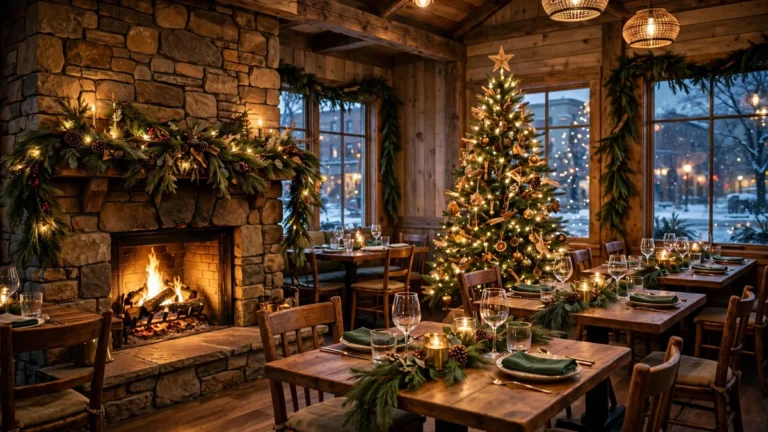
Christmas traditions in Belgium come wrapped in chocolate, lit by medieval market squares, and delivered by two different gift-bringers. This small country at the crossroads of Europe — split between Dutch-speaking Flanders and French-speaking Wallonia — celebrates Christmas with a blend of solemn Catholic ritual and legendary indulgence in food, beer, and sweets.
Here are 12 of Belgium’s most beloved Christmas traditions, from Sinterklaas and Saint-Nicolas to the Winter Wonders festival in Brussels, the world’s best Christmas chocolate culture, and the festive tables groaning under gourmet abundance.
12 Beloved Christmas Traditions in Belgium
1. Sinterklaas Comes First (December 6)
In Flanders, the main gift-giving day for children is December 6 — the feast of Sinterklaas (St. Nicholas). On the evening of December 5, children put out a shoe with a carrot or hay for Sinterklaas’s horse, sing Sinterklaas songs, and wake to find the shoe filled with chocolate, marzipan, mandarins, and small gifts. Sinterklaas arrives by steamboat from Spain in mid-November (check local parade dates for 2026), a tradition Belgium shares with its Dutch neighbors — see our guide to Christmas traditions in the Netherlands.
2. Saint-Nicolas in Wallonia
French-speaking Wallonia honors Saint-Nicolas on the same December 6 date, with the same shoe-filling ritual. The saint is often accompanied by the frightening Père Fouettard (Father Whipper), who — in the old stories — deals with naughty children. Modern celebrations keep the treats and drop the terror.
3. Christmas Day Gifts Too
Many Belgian families do gifts twice: Sinterklaas/Saint-Nicolas on December 6 for the children, then a second round on Christmas Day (or Christmas Eve) for the whole family — often with Père Noël (Father Christmas) as the bringer. Double the magic, double the Christmas gifts.
4. Brussels Winter Wonders
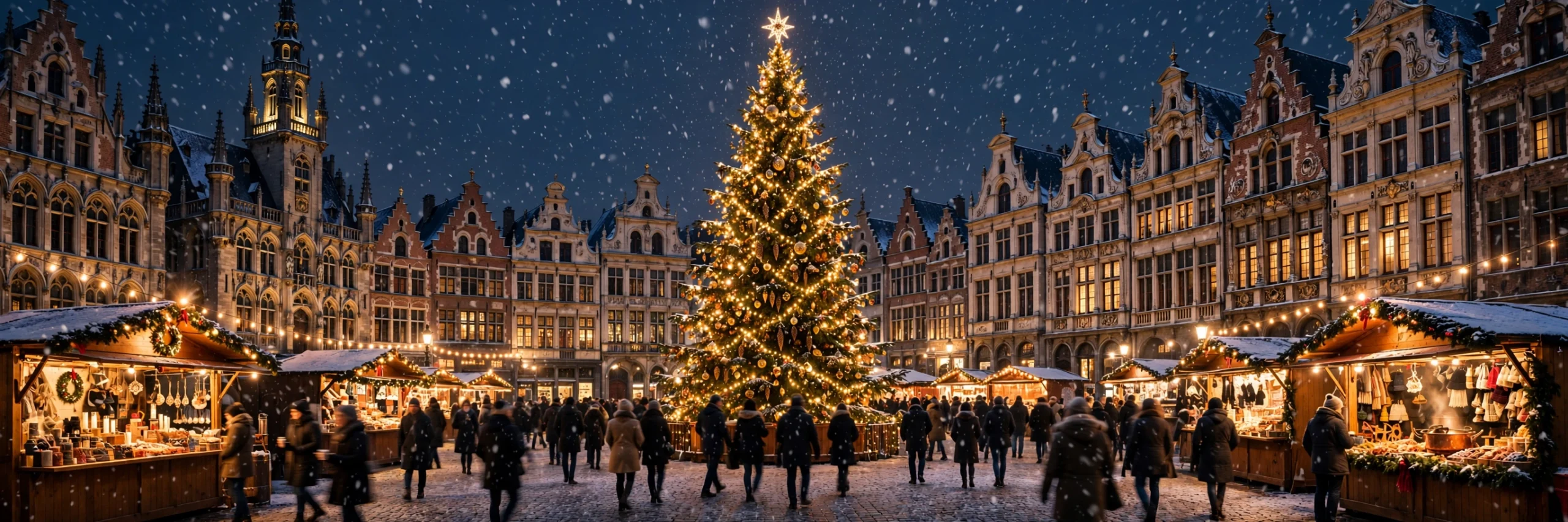
Plaisirs d’Hiver / Winterpret — Brussels’ Winter Wonders festival — transforms the city center into one of Europe’s great Christmas spectacles: 200+ wooden chalets stretching from the Grand-Place to the fish market, a giant Christmas tree on one of the world’s most beautiful squares, a sound-and-light show on the guild houses, an ice rink, and a Ferris wheel. It typically runs from late November through early January.
5. Christmas Markets in Every City
Beyond Brussels, Bruges hosts a storybook market on the Markt square beneath the Belfry, Ghent fills its historic center with chalets along the Graslei, Antwerp sparkles around the cathedral, and Liège runs Belgium’s oldest Christmas market. Vin chaud (mulled wine), gaufres (waffles), and croustillons (fried dough) fuel the browsing.
6. Chocolate: The True Belgian Christmas Religion
Belgium’s chocolate culture reaches its peak at Christmas. Chocolatiers create elaborate holiday collections — pralines, truffles, chocolate Santas, and bûches de Noël (yule logs). Christmas wouldn’t be Christmas without a box of fine Belgian pralines, and chocolate shops in Brussels, Bruges, and Antwerp do a huge share of annual business in December.
7. The Bûche de Noël
The yule log cake (bûche de Noël / kerststronk) is Belgium’s essential Christmas dessert: a rolled sponge cake filled with buttercream and decorated to look like a log, often with meringue mushrooms. Patisseries compete for the most beautiful bûche each year.
8. Speculoos and Speculaas
Speculoos — the caramelized, spiced shortcrust biscuit — is Belgium’s signature Christmas cookie, traditionally associated with St. Nicholas Day but eaten all season. The spiced flavor (cinnamon, nutmeg, cloves, ginger) defines the Belgian December bakery.
9. The Christmas Eve Seafood Feast
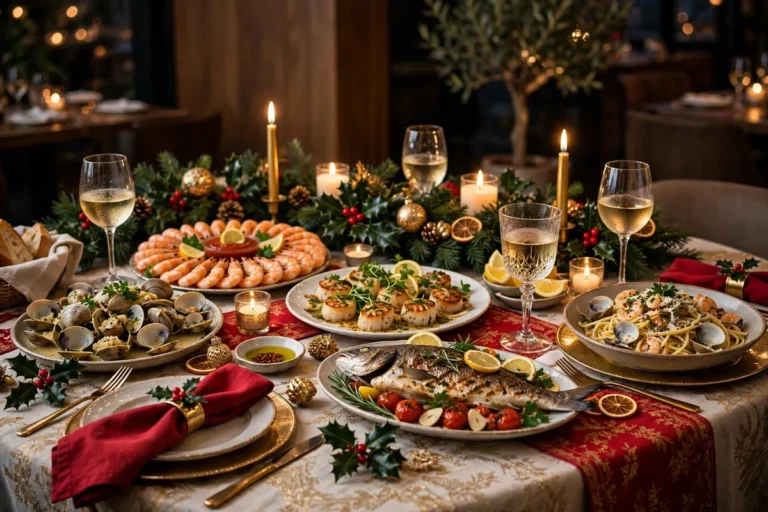
Many Belgian families serve a luxurious Christmas Eve dinner centered on seafood: oysters, lobster, shrimp croquettes (garnaalkroketten), and smoked salmon as starters, followed by game (pheasant, venison, wild boar) or turkey. Christmas Day lunch is often the second feast. For menu ideas, browse our Christmas dinner ideas.
10. Cougnou: The Sweet Bread Baby Jesus
In Wallonia, the traditional Christmas bread is the cougnou (also cougnolle) — a sweet, buttery brioche shaped like the baby Jesus, sometimes decorated with sugar. Children receive a cougnou at Christmas, and bakeries sell them by the thousand through December.
11. Nativity Scenes and Church Concerts
Catholic tradition runs deep: crèches (nativity scenes) appear in churches and homes, midnight mass (middernachtmis / messe de minuit) fills historic churches, and December brings a rich calendar of Christmas concerts — choirs and organ recitals in Belgium’s magnificent cathedrals and beguinages.
12. New Year’s Day: The Bigger Celebration?
In Belgium, New Year’s Day rivals Christmas for family importance: it’s the traditional day for formal wishes (nieuwjaarswensen), when children recite New Year’s verses to grandparents and godparents in exchange for treats or money. Many families hold their biggest gathering on January 1 rather than December 25.
The Belgian Christmas Table in Detail
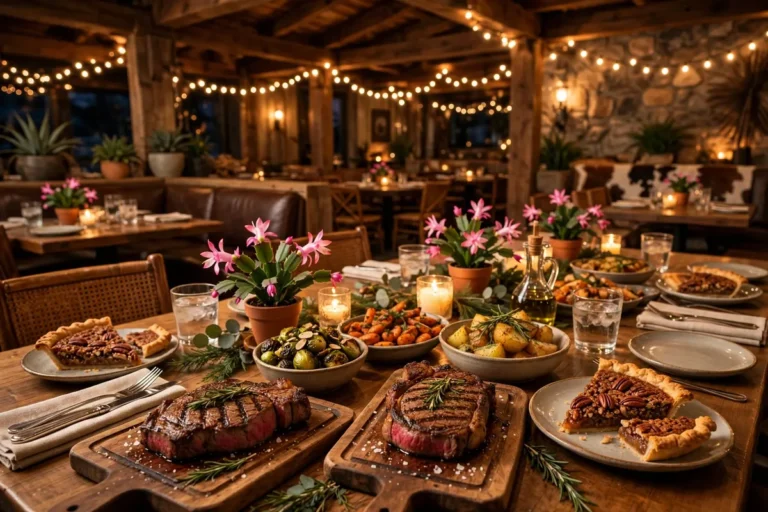
Belgian Christmas dining is an exercise in gourmet abundance — the French word the Belgians use for their festive table. Christmas Eve dinner (réveillon) is often the year’s most luxurious meal: oysters, foie gras, lobster, and smoked salmon to start, followed by pheasant, venison, or turkey with croquettes (crispy potato croquettes — a Belgian essential) and witloof (Belgian endive).
Christmas Day lunch is the second feast: roast goose or capon, more croquettes, and the all-important bûche de Noël. In Flanders, konijn met pruimen (rabbit with prunes) or stoofvlees might appear; in Wallonia, boulets or game. Belgian Christmas beers — the strong, spiced seasonal ales brewed by Trappist and craft breweries — are the proper accompaniment, and no Belgian Christmas is complete without them. For more festive menu ideas, see our Christmas dinner ideas.
Belgian Christmas Markets: A Closer Look
Belgium’s markets deserve detail because they’re among Europe’s best. Brussels Winter Wonders (typically late November to early January — check official dates for 2026) spans the city center with 200+ chalets, the Grand-Place tree and light show, an ice rink at Place de la Monnaie, and the Ferris wheel’s panoramic views. It’s free to enter and draws millions.
Bruges offers the most romantic setting: the market on the Markt and Simon Stevinplein, ice skating, and the city’s canals and medieval streets dressed in lights. Ghent’s market stretches along the Graslei and Korenlei with the castle of the Counts as backdrop. Antwerp combines its market with the city’s fashion and diamond districts, and Liège hosts the country’s oldest market with a Walloon flavor.
What to eat at a Belgian market: gaufres de Liège (dense, caramelized-sugar waffles), croustillons (hot fried dough dusted with sugar), tartiflette, raclette, escargots, and vin chaud or jenever (Belgian gin) to warm up. What to buy: chocolate (obviously), lace from Bruges, speculoos, and Christmas beer gift packs.
Sinterklaas Season: November into December
The Sinterklaas season deserves its own spotlight because it is the Belgian Christmas season for children. Sinterklaas arrives by steamboat from Spain in mid-November (the exact date varies by city — Antwerp’s intocht is a major event), then parades through towns for weeks. Children put out their shoes every night in the weeks before December 6, hoping for small treats — and sing Sinterklaas songs at school.
The season’s treats are specific: chocolate Sinterklaas figures, marzipan fruits and animals, speculoos, mandarins, and pepernoten/kruidnoten (small spiced biscuits). On December 5 (pakjesavond), families gather for the main gift exchange — often with surprises (gifts disguised in elaborate handmade packaging) and rhyming poems that tease the recipient. It’s a warmer, more personal ritual than the Christmas-morning gift pile, and many Belgian adults cherish it more.
New Year’s Day: Belgium’s Other Big Holiday
Don’t leave Belgium after Christmas — New Year’s Day is arguably the bigger family holiday. The tradition of New Year’s wishes (nieuwjaarswensen / vœux de Nouvel An): children recite memorized verses or letters to their parents, grandparents, and godparents, wishing them health and happiness for the new year. In return, they receive treats, money, or small gifts.
Many families hold their largest gathering on January 1: a long lunch, the exchange of wishes, and the sense of a fresh start. Combined with Christmas, the Belgian festive season runs from Sinterklaas’s arrival in November through Epiphany — nearly two months of celebration. For beautiful messages to share, see our 100 Christmas wishes and greetings.
Belgian Christmas Decorations and Home Style
Belgian Christmas décor blends French elegance with Flemish coziness (gezelligheid). The tree goes up in early December, decorated with baubles, lights, and — in many homes — chocolate ornaments (eaten progressively through the season, a delicious advent calendar). Nativity scenes (kerststal / crèche) are important in Catholic homes, from simple tabletop sets to elaborate village scenes.
Advent wreaths with four candles count the Sundays, and window decorations — stars, lights, silhouettes — glow in the long December nights. Belgian chocolate shops double as decoration: their windows fill with chocolate Santas, praline pyramids, and edible art. For styling ideas, see our Christmas decoration ideas.
Christmas Parties Belgian-Style
Belgians party through December with characteristic gusto. Office Christmas parties feature the Sinterklaas gift exchange (with rhyming poems and surprises), Christmas markets serve as open-air party venues, and New Year’s Eve brings champagne, fireworks, and cotillons (party favors).
For hosting inspiration with a Belgian twist: serve Christmas beer tastings (strong Trappist and craft Christmas ales), set out pralines and speculoos, play Secret Santa with poems, and end the night with bûche de Noël. For more party ideas, see our 50 Christmas party ideas.
In Pictures: Christmas in Belgium
Belgium does Christmas twice over — Sinterklaas on December 6, then Winter Wonders in Brussels with chocolate at every turn.
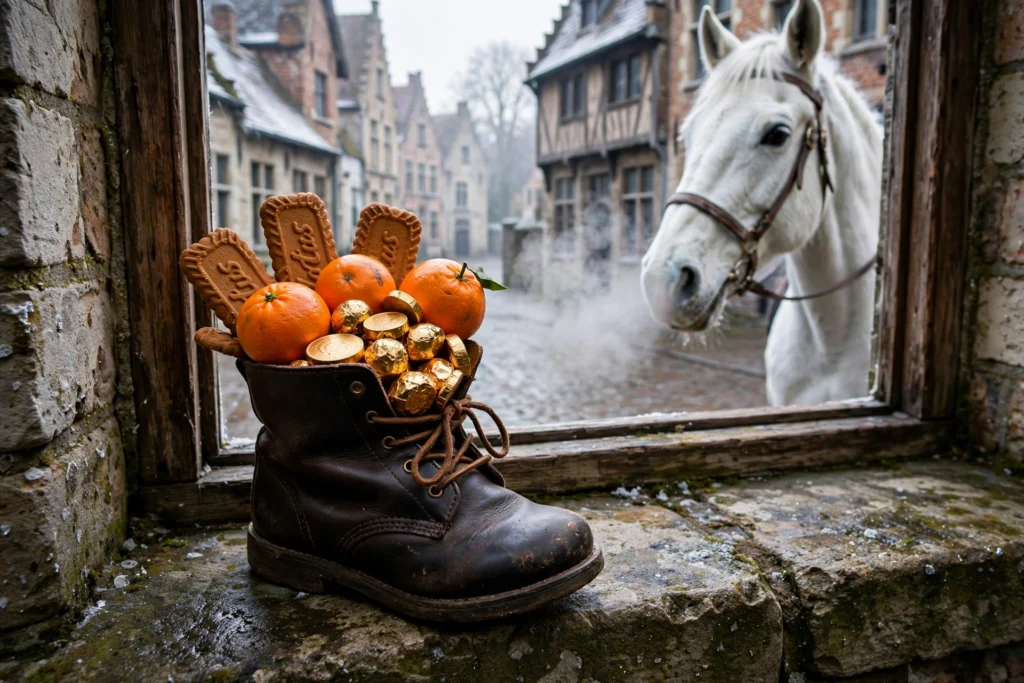
A child's polished boot on a Flemish windowsill, filled with chocolate coins, speculoos and mandarins — left out for Sinterklaas.
Watch: Christmas in Belgium
A 4K walking tour of Brussels' Winter Wonders — the Grand-Place tree and light show, 200+ chalets, the ice rink and Ferris wheel.
At a Glance: Christmas in Belgium
Belgium's two gift-bringers, its great market and its Christmas table.
| Tradition | Date | Key detail |
|---|---|---|
| Sinterklaas | 6 December (gifts on the eve of the 5th) | Arrives by steamboat from Spain in mid-November; children set out a shoe with a carrot or hay for his horse |
| Saint-Nicolas (Wallonia) | 6 December | The French-speaking counterpart with the same shoe ritual; old stories pair him with the fearsome Père Fouettard |
| Winter Wonders, Brussels | Late November to early January | Over 200 chalets stretching about 2.5 km from Grand-Place to Marché aux Poissons, with a sound-and-light show on the guild houses |
| Speculoos | St. Nicholas season | The caramelised spiced shortcrust biscuit; Belgium's variant is listed on Brussels' Intangible Cultural Heritage inventory |
| Cougnou ('bread of Jesus') | Christmas | Wallonia's baby-Jesus-shaped brioche, given to children and served with hot chocolate |
| Bûche de Noël / kerststronk | Christmas | Belgium's essential yule-log cake dessert; pâtisseries compete over it every year |
Frequently Asked Questions
How does Belgium celebrate Christmas?
Belgium celebrates with Sinterklaas/Saint-Nicolas on December 6 (shoes filled with chocolate and gifts), Christmas Eve and Christmas Day feasts (oysters, game, bûche de Noël), spectacular Christmas markets (Brussels Winter Wonders, Bruges, Ghent, Antwerp), world-famous chocolate culture, speculoos cookies, midnight mass, and a huge New Year’s Day family celebration with traditional wishes. Many families do gifts twice — December 6 and Christmas.
Who brings gifts in Belgium — Sinterklaas or Santa Claus?
Both! Sinterklaas (Flanders) / Saint-Nicolas (Wallonia) brings children’s gifts on December 6, arriving by steamboat from Spain in mid-November. Then Père Noël (Father Christmas) brings a second round of family gifts on Christmas Eve or Christmas Day. The December 5 pakjesavond (gift evening) with rhyming poems and disguised surprise gifts is often the more cherished ritual.
What is Winter Wonders in Brussels?
Plaisirs d’Hiver / Winterpret (Winter Wonders) is Brussels’ giant Christmas festival, typically running late November to early January (check official dates for 2026). It features 200+ wooden chalets from the Grand-Place to the fish market, a giant Christmas tree, a sound-and-light show on the guild houses, an ice rink, and a Ferris wheel. It’s free to enter and one of Europe’s great Christmas events.
What do Belgians eat at Christmas?
Christmas Eve (réveillon) is luxurious: oysters, foie gras, lobster, smoked salmon, then pheasant, venison, or turkey with potato croquettes. Christmas Day brings roast goose or capon. Desserts: bûche de Noël (yule log), speculoos, cougnou (sweet Jesus-shaped bread in Wallonia), and Belgian pralines. Christmas beers — strong seasonal Trappist and craft ales — are the classic drink.
What is speculoos?
Speculoos (speculaas in Dutch) is Belgium’s signature spiced shortcrust biscuit — thin, crisp, caramelized, flavored with cinnamon, nutmeg, cloves, ginger, and pepper. Traditionally associated with St. Nicholas Day (often molded into Sinterklaas figures), it’s eaten all season, crumbled over desserts, and — in its spreadable form (speculoos paste) — beloved worldwide.
Is New Year’s Day a big holiday in Belgium?
Yes — New Year’s Day rivals Christmas in Belgium. It’s the traditional day for formal New Year’s wishes: children recite verses to parents, grandparents, and godparents, receiving treats or money in return. Many families hold their biggest gathering on January 1 rather than December 25, with a long festive lunch. Combined with Sinterklaas season, Belgium’s celebrations run nearly two months.
Day Trips: Christmas in Belgium Beyond Brussels
Christmas traditions in Belgium reward exploration beyond the capital. Bruges is the fairy tale: the Markt square market beneath the Belfry, ice skating, canal-side lights, and chocolate shops on every corner — arrive early in December to beat the crowds. Ghent offers a more local vibe: the market along the Graslei, the castle of the Counts floodlit, and superb food halls.
Antwerp combines its cathedral market with world-class shopping (Meir) and fashion; the Rubens House dresses for the season. Liège hosts Belgium’s oldest Christmas market with a Walloon accent — vin chaud, gaufres, and the city’s famous stairs of Bueren lit for December. Leuven, Mechelen, and Namur offer smaller, charming markets without the crowds.
Practical tips: Belgium’s trains make day trips easy — Bruges is an hour from Brussels, Ghent 30 minutes. Markets typically run late November to early January (check official dates for 2026). Book restaurants ahead for Christmas Eve and Christmas Day — the réveillon menus sell out. And pack for cold, damp weather: Belgian December is atmospheric but chilly.
Belgian Christmas for Kids
Belgian children get the double magic: Sinterklaas on December 6 AND Père Noël at Christmas. The Sinterklaas season is the year’s highlight: the steamboat arrival in November, shoes by the fireplace nightly, Sinterklaas songs at school, and the December 5 pakjesavond with surprises and rhyming poems.
Then Christmas: the tree, chocolate ornaments (eaten through the season), Christmas markets with carousels, midnight mass for Catholic families, and gifts on Christmas morning. New Year’s Day brings the wishes ritual — reciting verses to grandparents for treats. Belgian kids also love ice skating (Brussels, Bruges, and Antwerp all have rinks), speculoos baking, and the Epiphany galette des rois (in Wallonia) with its hidden fève. For family activities, see our 75 Christmas activities for families.
Belgian Christmas Beer Culture
No account of Christmas traditions in Belgium is complete without Christmas beer (kerstbier / bière de Noël) — a whole category of strong, spiced seasonal ales brewed for the holidays. Trappist breweries (Chimay, Rochefort, Westmalle, Orval, Westvleteren, Achel) and craft brewers release winter warmers: dark, malty, spiced with cinnamon, clove, orange peel, and coriander, typically 8–12% ABV.
Belgians collect Christmas beers the way others collect ornaments — special gift packs with branded glasses are the default host gift. Beer-pairing Christmas dinners are a thing: oysters with a tripel, game with a dark strong ale, bûche de Noël with a kriek. Christmas beer festivals (like the Essen Christmas Beer Festival, typically mid-December — check dates for 2026) draw connoisseurs from around the world.
The etiquette: serve in the proper glass (every Belgian beer has its own), at the right temperature (cellar-cool, not ice-cold), and savor — these are sipping beers for long winter nights. Santé! / Proost!
Belgian Christmas Desserts Beyond the Bûche
The bûche de Noël may be the star, but Belgian Christmas desserts run deep. Speculoos appears in everything — speculoos tiramisu, speculoos cheesecake, speculoos ice cream. Cougnou (Wallonia’s Jesus-shaped brioche) is served with hot chocolate on Christmas morning. Kerststronk (Flemish yule log) rivals its French cousin.
Chocolate desserts multiply: chocolate mousse (Belgians make the world’s best), moelleux au chocolat (molten cakes), truffles, and praline tarts. Sinterklaas brings marzipan fruits, chocolate letters, and pepernoten. Apple beignets (appelbeignets) — fried apple rings — are a New Year’s tradition. And oliebollen (Dutch-style doughnuts, popular in Flanders) fuel New Year’s Eve.
Pâtisserie windows in December are edible art galleries — the bûche competition among Brussels pâtissiers is serious business, with flavors from classic mocha to passion fruit to speculoos. Order yours days ahead — the best sell out.
Christmas Traditions in Belgium: Wallonia vs. Flanders
Belgium’s linguistic divide shapes its Christmas. Flanders (Dutch-speaking): Sinterklaas on December 6, kerstmarkt markets, kerststronk, speculaas, middernachtmis (midnight mass), and nieuwjaarswensen (New Year’s wishes). The traditions lean Dutch — compare with our Christmas traditions in the Netherlands.
Wallonia (French-speaking): Saint-Nicolas on December 6, marchés de Noël, bûche de Noël, speculoos, messe de minuit, and vœux de Nouvel An. The traditions lean French — the réveillon feast, oysters, foie gras, cougnou. Brussels blends both — bilingual markets, double traditions.
The German-speaking east (Eupen-Malmedy) adds a third flavor: Weihnachtsmärkte in the German style, Stollen, Glühwein. Three Belgiums, three Christmases — one small country with more festive variety than nations ten times its size.
Epiphany in Belgium: Kings, Cakes, and the Season’s End
Belgium closes the season on Epiphany (January 6, Driekoningen). In Flanders, children dress as the Three Kings and go door to door singing and collecting candy and coins for charity — star lanterns in hand. In Wallonia, the galette des rois (kings’ cake) is shared — whoever finds the fève (hidden bean) is crowned king or queen for the day.
Driekoningen also means chalking the door: C+M+B (the kings’ initials, also Christus mansionem benedicat) inscribed above the lintel for the year’s blessing. Then the tree comes down, the lights go dark, and Belgium exhales — until carnival season (Binche’s famous Gilles!) begins. Two months of celebration, from Sinterklaas’s steamboat to the kings’ chalk: that’s Christmas traditions in Belgium, complete.
Why Belgium Does Christmas Best (A Case)
The case for Christmas traditions in Belgium as Europe’s most underrated: two gift-bringers (Sinterklaas AND Père Noël), world-class chocolate as a food group, Christmas beer as a cultural institution, medieval market squares that put others to shame, a two-month season from steamboat to Epiphany, and three regional Christmases in one small country. Belgium doesn’t do Christmas loudly — it does it deliciously. Come for the Winter Wonders, stay for the pralines, and leave understanding why the Belgians consider gourmet a Christmas tradition in itself. Vrolijk kerstfeest! Joyeux Noël!
Bring Belgium home this Christmas: buy real Belgian chocolate (not imitations), bake speculoos from scratch, try a Christmas beer tasting with friends, and attempt the bûche de Noël — even a rustic one impresses. The Belgian secret is simple: never compromise on quality, and always save room for chocolate.