Christmas traditions in the Netherlands are really two holidays in one — and understanding that duality is the key to the Dutch December. Weeks before most countries hang their first decoration, the Netherlands is already deep in celebration: Sinterklaas, the feast of St. Nicholas, dominates from mid-November through December 5th, with children setting out shoes for treats, the saint’s steamboat arrival broadcast on national television, and the climactic gift-giving night of pakjesavond. Only then does Kerstmis (Christmas) begin — a quieter, cozier, two-day family holiday of gourmetten (tabletop grilling), kerststol (fruit loaf), and candlelit gezelligheid. This guide walks you through both halves of the Dutch December in order: how Sinterklaas works, how to celebrate pakjesavond, and how the Netherlands transitions into its own distinctive Christmas.
Two Holidays in One: Sinterklaas and Kerstmis
Visitors are often confused to learn that in the Netherlands, the big children’s gift-giving holiday is not Christmas but Sinterklaas (St. Nicholas’ Eve, December 5th). Christmas traditions in the Netherlands treat December 5th as the equivalent of Christmas morning elsewhere: it is when children receive their main presents, when families gather for the festive climax, and when the nation’s excitement peaks. Christmas itself (December 25–26) is a separate, more subdued holiday focused on family meals, church services, and rest.
This split has historical roots. The Dutch Sinterklaas — a tall, white-bearded bishop in red robes, riding a white horse named Amerigo (formerly Schimmel) — is the direct ancestor of the American Santa Claus: Dutch settlers brought Sinterklaas to New Amsterdam (New York) in the 17th century, and the figure evolved into Santa. But in the Netherlands, Sinterklaas never merged with Christmas. He kept his own feast day, his own mythology, and his own fierce place in Dutch hearts.
The practical result: the Dutch December is a marathon. Sinterklaas season runs roughly mid-November to December 5th; Christmas season runs December 6th through early January. Each has its own treats, songs, decorations, and rituals. Our guide to Christmas traditions in Germany offers an interesting contrast — the German Nikolaus (December 6th) is a minor prelude, while the Dutch Sinterklaas is the main event.
The Arrival of Sinterklaas: Mid-November
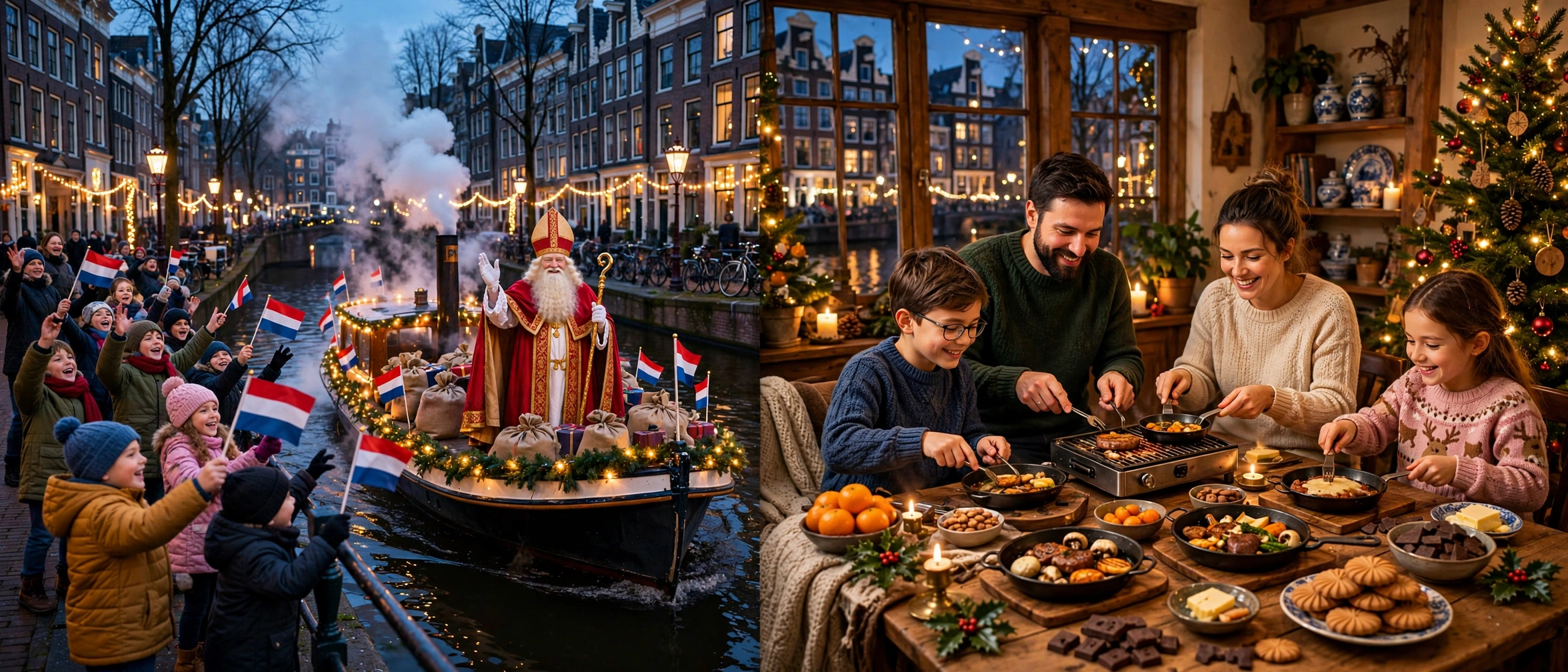
The Sinterklaas season officially begins with the intocht — the saint’s ceremonial arrival, traditionally in mid-November. According to tradition, Sinterklaas travels by steamboat from Spain (why Spain? The historical St. Nicholas was bishop of Myra, in what is now Turkey — but Dutch legend settled on Spain centuries ago, and the story stuck). The national intocht — held in a different Dutch city each year and broadcast live on television — draws enormous crowds: Sinterklaas disembarks from a festooned steamboat, mounts his white horse, and parades through streets lined with hundreds of thousands of children waving flags.
Every town and city holds its own intocht on the same weekend, making it one of the largest coordinated children’s events in the country. The arrival is genuine national theater: news programs cover it straight-faced, adults debate the logistics, and children experience it with complete sincerity. For the Dutch, the intocht is the true start of the holiday season — more significant than any Black Friday or tree-lighting.
A note on the Pieten: Sinterklaas is traditionally accompanied by helpers once known as Zwarte Piet (Black Pete), whose depiction has been the subject of intense national debate and significant change in recent years, with many celebrations now featuring Roetveegpieten (soot-sweep Piets, with soot smudges rather than full blackface) or rainbow Piets. Visitors should be aware this is a live, sensitive cultural conversation in the Netherlands — and that the tradition is actively evolving.
Setting Your Shoe: The Weeks Before December 5
Once Sinterklaas has arrived in the country, the daily ritual begins: setting the shoe (schoen zetten). On designated evenings (and in some families, nightly), children place a shoe by the fireplace or door, traditionally containing a carrot or hay for Sinterklaas’s horse, and sing Sinterklaas songs. Overnight, the saint (read: parents) replaces the offerings with small treats — pepernoten, chocolate, mandarins — and occasionally a small gift.
The shoe-setting weeks are the heart of the Dutch children’s December: a nightly micro-Christmas of anticipation and reward. The songs are essential — classics like “Sinterklaas kapoentje” and “Zie ginds komt de stoomboot” are known by every Dutch child, sung with gusto at school, at home, and at the endless Sinterklaas events (school visits, shopping-center appearances, neighborhood parties) that fill late November.
For parents, the shoe weeks are also strategic: they are when children’s behavior is most attentively managed, via the saint’s legendary big book (het grote boek van Sinterklaas), in which he records every child’s deeds. The book is referenced constantly — “Sinterklaas is watching” carries real weight in a Dutch November.
Pakjesavond: The Big Night (December 5)
Pakjesavond (presents evening), on December 5th, is the climax of Sinterklaas and the emotional peak of Christmas traditions in the Netherlands. The evening follows a beloved script. Children are told Sinterklaas is making his rounds; there is often a staged moment — a loud knock at the door, a burlap sack of presents discovered on the doorstep, sometimes a glimpse of the saint’s helpers. Then the family gathers to open gifts.
But Dutch Sinterklaas gifts come with a twist that makes pakjesavond uniquely delightful: the surprise and the gedicht (poem). A surprise is a gift disguised in elaborate homemade packaging — a book presented inside a giant papier-mâché shoe, a gift card hidden in a hand-built castle. Adults especially compete to create the most ingenious surprises. Each gift is accompanied by a gedicht: a personal, often teasing poem, written by the giver, that roasts the recipient’s habits and foibles with affectionate humor. Writing a good Sinterklaas poem is a Dutch literary art form, and families read them aloud to howls of laughter.
The evening’s treats are specific to Sinterklaas: pepernoten and kruidnoten (small spiced cookies, tossed by the handful), speculaas (large spiced biscuits, often windmill-shaped), taaitaai (chewy spiced figures), chocolate letters (the recipient’s initial in chocolate — a must), marzipan fruits and figures, and borstplaat (melt-in-the-mouth fondant tablets). After pakjesavond, Sinterklaas departs (back to Spain on the steamboat, per tradition), and the Netherlands exhales — for about a day — before Christmas begins.
Sinterklaas Treats: A Field Guide
The Sinterklaas sweets deserve their own catalog, because they vanish from shops after December 5th and are mourned until the following November:
Kruidnoten (often called pepernoten, though technically distinct): small, round, intensely spiced cookies — the everyday currency of the Sinterklaas season, scattered by the handful at every event. Modern varieties include chocolate-covered kruidnoten in a dozen flavors.
Speculaas: the large, flat, elaborately molded spiced biscuits depicting windmills, figures, and scenes. Speculaas spice (speculaaskruiden — cinnamon, cloves, nutmeg, ginger, cardamom, white pepper) is the defining flavor of the Dutch December.
Chocolate letters: hollow or solid chocolate in the shape of the recipient’s initial. The letter hunt — finding your letter among the family’s — is part of the fun, and the quality of the chocolate is taken seriously.
Marzipan (marsepein): molded into fruits, animals, and figures, often painted in bright colors. The marzipan pig is the classic.
Taaitaai: tough, chewy, anise-and-honey-flavored figures — an acquired taste, beloved by traditionalists.
Borstplaat: creamy fondant tablets, often flavored with vanilla, chocolate, or rum.
Stock up before December 5th — after Sinterklaas departs, these treats disappear from shelves with remarkable speed, replaced by Christmas stock.
From Sinterklaas to Christmas: The Transition
December 6th in the Netherlands is a day of collective recovery — and rapid redecoration. Down come the Sinterklaas decorations; up go the Christmas trees, lights, and kerststallen (nativity scenes). The transition is one of the charming absurdities of Christmas traditions in the Netherlands: a country that essentially celebrates Christmas twice, back to back, with a full set change in between.
The Christmas half of December is deliberately calmer. Where Sinterklaas is loud, public, and child-focused, Kerstmis is intimate, candlelit, and family-centered. The Dutch word for the Christmas atmosphere is gezelligheid — untranslatable, but close to coziness, conviviality, and warm togetherness (the Dutch cousin of Danish hygge). Christmas in the Netherlands is gezelligheid season: candles, good food, board games, long conversations, and the Christmas tree glowing in the window.
How the Dutch Celebrate Christmas: Eerste and Tweede Kerstdag
The Netherlands celebrates two days of Christmas: Eerste Kerstdag (First Christmas Day, December 25) and Tweede Kerstdag (Second Christmas Day, December 26, a public holiday). The two-day structure shapes the holiday: one day is typically spent with one side of the family, the other with the other side — or one day for the big dinner, one for visits and leftovers.
The signature Dutch Christmas meal is gourmetten: tabletop grilling, where each diner cooks small portions of meat, fish, and vegetables on a shared electric grill-plate at the table. Gourmetten is the essence of Dutch Christmas gezelligheid — slow, interactive, conversational, lasting for hours. The other classic is the kerststol: the rich fruit loaf with almond paste (amandelspijs) center, dusted with powdered sugar, served at Christmas breakfast. Kerstkransjes (Christmas wreath cookies) hang on the tree and are eaten through the season.
Christmas Eve (Kerstavond) is a quieter affair than in many countries — often a family dinner or church service, but without the gift-giving climax (that was pakjesavond). Midnight Mass (nachtmis) and Christmas morning services draw the faithful; others attend the increasingly popular Christmas concerts and carol services in the days before. Gift exchange at Christmas is growing, especially among younger families, but Sinterklaas remains the traditional gift holiday.
For hosts planning a Dutch-inspired Christmas dinner with international touches, our Christmas dinner ideas and Christmas party ideas, games, and themes offer plenty of complementary inspiration.
Dutch Christmas Decorations and Markets
Dutch Christmas decor favors the gezellig: real trees (the Dutch are enthusiastic about Nordmann firs), candles everywhere, and windows dressed to be seen from the street — the Dutch tradition of uncovered windows means December streets glow with visible Christmas trees and lights. Kerststukjes (Christmas arrangements of greenery, candles, and ornaments) adorn tables and sills.
Christmas markets in the Netherlands are a growing tradition, though they run after Sinterklaas — typically mid-December through late December. Maastricht’s market on the Vrijthof, with its Ferris wheel and ice rink, is the country’s most famous. Valkenburg’s Christmas market — held inside the Velvet Cave (Fluweelengrot), a marlstone cave beneath the town — is Europe’s oldest and largest underground Christmas market, genuinely unique. Dordrecht hosts the Netherlands’ largest Christmas market, and Amsterdam’s various markets (including at the Museumplein with its ice rink) draw the crowds.
Practical note: because the Dutch celebrate Sinterklaas first, Christmas markets and decor appear later than in neighboring Germany or Belgium — plan market visits for mid-to-late December. Check official city sites for 2026 dates and hours.
New Year’s Eve: Oliebollen and Fireworks
The Dutch holiday season closes with Oud en Nieuw (Old and New) — New Year’s Eve — celebrated with two essentials: oliebollen and fireworks. Oliebollen (“oil balls”) are deep-fried dough balls, studded with raisins and dusted with powdered sugar, sold from street stalls (oliebollenkramen) throughout December. Eating the year’s first oliebollen is a minor ritual; the Algemene Dagblad newspaper’s annual oliebollen test is a major one.
Fireworks are a huge Dutch New Year’s tradition — the Netherlands has historically allowed extensive consumer fireworks, with neighborhoods staging spectacular (and loud) midnight displays. Regulations have tightened in recent years, with growing numbers of municipalities organizing official shows or restricting private fireworks — check local rules for 2026. The traditional New Year’s Day dip (nieuwjaarsduik) — thousands plunging into the North Sea at Scheveningen — is the bracing coda to the season.
Dutch Christmas Music and Sinterklaas Songs
The Dutch December has two soundtracks. The Sinterklaas songs — “Sinterklaas kapoentje,” “Zie ginds komt de stoomboot,” “Hoor wie klopt daar kinderen” — are the cheerful, slightly mischievous anthems of late November, sung by children at every shoe-setting, school visit, and intocht. Every Dutch adult knows them all; they are among the first songs Dutch children learn, and they vanish from the airwaves on December 6th as abruptly as they arrived.
The Christmas repertoire then takes over: “Stille Nacht” (Silent Night), “O denneboom” (O Christmas Tree), and the Dutch carol “Nu zijt wellekome” (Now Be Welcome) — a 17th-century carol still sung in churches. December is concert season: the Christmas concerts of the Royal Concertgebouw Orchestra in Amsterdam are world-famous, and churches nationwide host candlelit carol services. The Dutch tradition of midwinter horn blowing (midwinterhoornblazen) — playing long, mournful notes on enormous wooden horns in the eastern provinces — is an ancient Advent custom experiencing a revival, its sound drifting over frosty fields like something from another century.
Christmas in Amsterdam, Rotterdam, and Utrecht
Amsterdam at Christmas is a canal-lit dream: the Amsterdam Light Festival (typically late November through mid-January; verify 2026 dates) illuminates the canals with large-scale light art installations, best viewed from a canal cruise. The Museumplein hosts an ice rink and market, the Nine Streets glitter with boutique decorations, and the city’s churches program exceptional Christmas concerts. Note that Amsterdam’s Christmas markets are modest compared to Germany’s — the city shines more through lights and atmosphere than market stalls.
Rotterdam offers a more modern Christmas: the Erasmus Bridge lit for the season, the market hall (Markthal) in festive dress, and the city’s contemporary architecture providing a striking backdrop. Utrecht’s medieval wharf cellars along the Oudegracht host intimate shops and cafés perfect for December browsing, and the Dom Tower presides over the city’s Christmas market. The Hague (Den Haag) stages a royal Christmas around the Noordeinde Palace area, with an elegant market and ice rink.
For all Dutch cities, the practical rhythm is the same: Sinterklaas dominates until December 5th, Christmas decor and markets follow from mid-December. Plan market visits accordingly, and book canal cruises and concert tickets ahead — December Amsterdam sells out.
Tweede Kerstdag: Making the Most of Second Christmas Day
Tweede Kerstdag (December 26th) is a full public holiday in the Netherlands, and the Dutch use it well. Traditionally the day for visiting the other side of the family (Christmas Day with one family, Second Christmas Day with the other), it has also become a major day for outings: museums (the Rijksmuseum and Van Gogh Museum are packed), zoos, Christmas fairs, and winter walks. Furniture Boulevard (meubelboulevard) shopping on Tweede Kerstdag is a modern tradition — the Dutch equivalent of Boxing Day sales, with crowds hunting post-Christmas deals.
Many families serve a second festive meal — often simpler than Christmas Day’s gourmetten, sometimes a Christmas brunch with kerststol, or a buffet of leftovers. The day has a relaxed, sociable energy: the pressure of Christmas Day is past, the whole country is off work, and there is nowhere to be but together. If you visit the Netherlands at Christmas, Tweede Kerstdag is the day to join the Dutch at play.
Celebrating a Dutch-Style December Outside the Netherlands
You do not need to be Dutch to borrow the best of Christmas traditions in the Netherlands. Host a pakjesavond-inspired evening: assign each guest a recipient, require every gift to come with a teasing poem and disguised as a homemade surprise, and serve speculaas, kruidnoten, and chocolate letters. It is the most fun gift-exchange format in the Christmas world, and our Christmas party ideas, games, and themes can help you plan the evening around it.
Try gourmetten for Christmas dinner: a tabletop grill, small portions of marinated meats, fish, and vegetables, and an evening of slow cooking and conversation. Bake a kerststol (recipes are widely available; the almond-paste center is the key). Set out a shoe for the children in early December with a carrot for the horse — a charming countdown ritual whatever your traditions. And embrace gezelligheid: candles, no phones at the table, and the Dutch conviction that coziness is a practice, not an accident. For gift inspiration, our best Christmas gifts guide covers every recipient.
In Pictures: Christmas in the Netherlands
The Dutch celebrate twice — Sinterklaas and Pakjesavond in early December, then the quieter Kerstmis with gourmetten and candles.
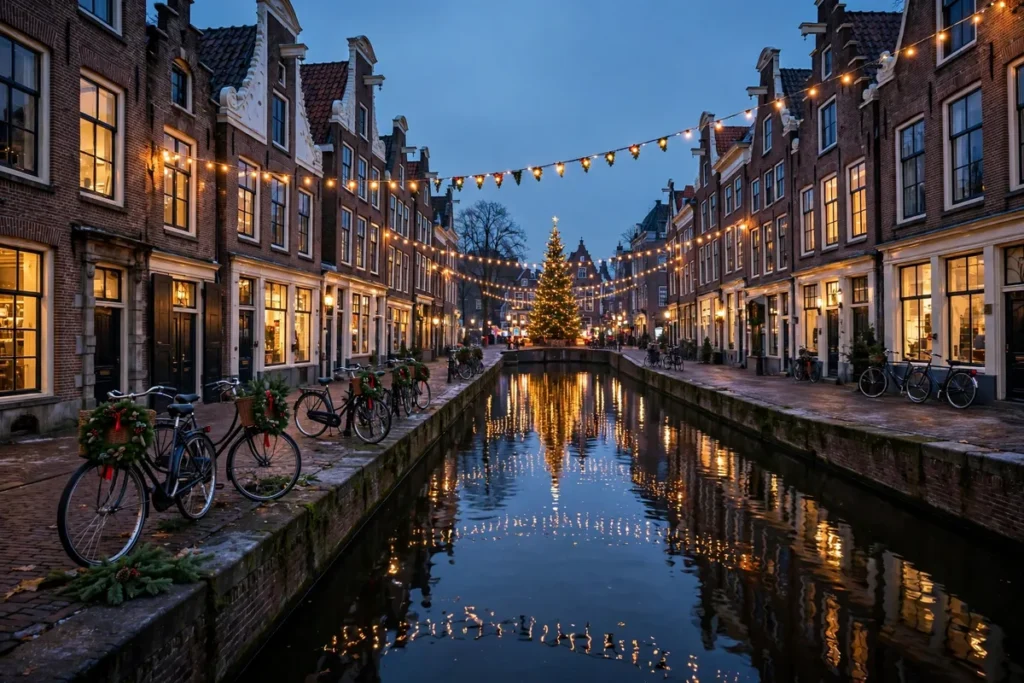
A Dutch canal street at Christmas: gabled houses reflected in the water, lights strung across the canal, and a Christmas tree glowing in the distance.
Watch: Christmas in the Netherlands
How the Dutch celebrate Sinterklaas — from the Turkish bishop to the December 5th gift-bringer who inspired Santa Claus himself.
At a Glance: Christmas in the Netherlands
Two holidays in one month.
| Tradition | Date | Key detail |
|---|---|---|
| Sinterklaas arrives | Mid-November | He sails in by steamboat from Spain — his official arrival airs on national TV |
| Setting your shoe | Mid-Nov – Dec 5 | Children leave a shoe with a carrot for his horse, hoping for pepernoten or a chocolate letter |
| Pakjesavond | 5 December | The big gift night — rhyming poems, surprise presents, and bags of treats |
| Pepernoten & chocolate letters | Nov – Dec | The season’s treats: spiced cookies, marzipan, and a chocolate initial for everyone |
| Kerstmis | 25–26 December | A quieter Christmas — church, family dinners, and Tweede Kerstdag on the 26th |
| Gourmetten | 25–26 December | The classic Dutch Christmas dinner: tabletop grilling with tiny pans of meat and vegetables |
| Kerstpakket | December | Employers give staff a Christmas gift box — a beloved national tradition |
Frequently Asked Questions
Do the Dutch celebrate Sinterklaas or Christmas?
Both — but they are separate holidays. Sinterklaas (December 5th) is the traditional children’s gift-giving feast, with shoe-setting, pakjesavond, and Sinterklaas treats. Christmas (December 25–26) is a quieter family holiday focused on meals, church, and gezelligheid. Many Dutch families celebrate both fully.
What is pakjesavond?
Pakjesavond (“presents evening”) on December 5th is the climax of Sinterklaas: families gather to exchange gifts, which are traditionally disguised as homemade surprises and accompanied by teasing personal poems (gedichten). It is the Dutch equivalent of Christmas morning in gift-giving importance.
What are chocolate letters?
Chocolate letters are a beloved Sinterklaas treat: large chocolate letters shaped like the recipient’s initial. Every family member receives their letter, and the hunt for one’s own letter among the gifts is part of the tradition.
What is gourmetten?
Gourmetten is the signature Dutch Christmas meal: tabletop grilling where each diner cooks small portions of meat, fish, and vegetables on a shared electric grill at the table. It is slow, social, and interactive — the culinary embodiment of gezelligheid.
When do Dutch Christmas markets run?
Because Sinterklaas comes first, Dutch Christmas markets typically run from mid-December through late December — later than in neighboring countries. Maastricht, Valkenburg (underground, in caves), Dordrecht, and Amsterdam host the most famous markets. Verify 2026 dates on official city tourism sites.
What is the difference between Sinterklaas and Santa Claus?
Sinterklaas is the original: Dutch settlers brought him to America in the 1600s, where he evolved into Santa Claus. In the Netherlands he remains distinct — a bishop in red robes arriving by steamboat from Spain on December 5th, separate from Christmas. Santa Claus (Kerstman) appears in Dutch Christmas imagery but is secondary to Sinterklaas.
Christmas traditions in the Netherlands offer the best of both worlds: the theatrical, treat-filled magic of Sinterklaas and the candlelit, gourmetten-long gezelligheid of Kerstmis. It is a December in two acts — and twice the celebration. Vrolijk kerstfeest!