Few moments in life demand a bottle of bubbly like New Year’s Eve — and nothing deflates the moment faster than serving it warm, opening it dangerously, or overpaying for a label you did not understand. This champagne guide will make you the most confident person in the room: how champagne is actually made, how to decode any label in seconds, how to choose the right bottle for your budget and occasion, how to serve it at the perfect temperature in the right glass, and how to open it safely — no ceiling redecoration, no lost eyes.
Whether you are buying your first bottle or your fiftieth, the knowledge here pays for itself immediately: you will learn when true Champagne is worth it and when a $15 prosecco is the smarter buy, what “brut” really means, why the glass shape matters more than the brand, and the sommelier’s technique for opening a bottle with a whisper instead of a bang. For putting these skills to festive use, see our New Year’s Eve cocktails and mocktails; for the midnight feast, our dinner menu and desserts await.
What Champagne Actually Is
True champagne comes from exactly one place: the Champagne region of northeastern France, about 90 miles east of Paris. By French law and international treaty, only sparkling wine made there — from specific grapes, using a specific method — may be called “champagne.” Everything else, no matter how delicious, is sparkling wine: prosecco (Italy), cava (Spain), sekt (Germany), or American/English/Australian sparkling wine.
Three grapes dominate: Chardonnay (elegance, citrus, minerality), Pinot Noir (body, red fruit, structure), and Pinot Meunier (fruitiness, approachability). Most champagne is a blend of all three, though blanc de blancs (100% Chardonnay) and blanc de noirs (100% black grapes) showcase single sides. The magic is the méthode champenoise (traditional method): the wine undergoes a second fermentation inside the bottle, which creates the fine, persistent bubbles and the toasty, brioche-like flavors that define great champagne. Cheaper sparkling wines often get their fizz from fermenting in large tanks (charmat method, used for prosecco) — pleasant and fruity, but without champagne’s signature depth.
Most champagne on shelves is non-vintage (NV) — a blend of multiple years, designed to taste consistent every time. It is the house’s signature style and, for most occasions, the smart buy. Vintage champagne comes from a single exceptional year, ages longer, costs more, and rewards patience. For New Year’s Eve toasting, NV from a good producer beats a mediocre vintage every time.
Decoding the Label: Sweetness, Style & Jargon
Champagne labels look intimidating but follow a simple code. Sweetness levels (from driest to sweetest): Brut Nature / Zero Dosage (bone dry, 0–3 g/L sugar), Extra Brut (very dry), Brut (dry — the default, and what you want 90% of the time), Extra Dry (confusingly, slightly sweet), Sec (noticeably sweet), Demi-Sec (sweet — built for dessert), Doux (very sweet, rare). For toasts and appetizers, buy Brut. For dessert pairing, buy Demi-Sec — dry champagne with sweet dessert tastes sour by contrast.
Style terms: Blanc de Blancs = 100% white grapes (Chardonnay), lighter and more mineral — superb with seafood and as an aperitif. Blanc de Noirs = 100% black grapes, fuller-bodied — great with richer foods. Rosé = pink, usually via blended red wine — festive, food-friendly, and gorgeous in the glass. Cuvée just means “blend” (every champagne is a cuvée); Prestige Cuvée or Tête de Cuvée means the house’s top bottling (think Dom Pérignon, Cristal — special-occasion splurges, not Tuesday bottles).
Producer codes (tiny letters on the label): NM (négociant-manipulant) = big house buying grapes (Moët, Veuve Clicquot); RM (récoltant-manipulant) = grower champagne, made by the family that grew the grapes — often the best value and the connoisseur’s choice. CM = cooperative. If you want to impress a wine lover, bring a grower champagne (RM) — it signals you know something.
Champagne vs. Prosecco vs. Cava: When Each Wins
Champagne (France, traditional method): toasty, complex, fine persistent bubbles; $40+ for good NV, $60+ for excellent. Worth it for: the midnight toast, milestone celebrations, impressing a wine enthusiast.
Prosecco (Italy, charmat method): fruity, floral, fresh — pear, apple blossom, honeysuckle; $12–20 for very good bottles. Worth it for: big-batch champagne cocktails and punches (never waste real champagne in a punch), casual aperitifs, large parties where volume matters. Look for “DOCG” (e.g., Valdobbiadene) for the best quality.
Cava (Spain, traditional method): the insider’s value pick — made like champagne, priced like prosecco; toasty and citrusy; $10–18 for excellent bottles. Worth it for: anyone who wants traditional-method character on a prosecco budget. Look for “Reserva” or “Gran Reserva” for longer-aged complexity.
The honest rule: for the midnight toast itself, buy the best champagne your budget allows — the moment deserves it. For everything before midnight (cocktails, punch, cooking), prosecco or cava is not just acceptable, it is smarter: their fruit-forward style actually mixes better. Anyone who tells you otherwise is selling something.
How to Choose: A Budget-by-Budget Field Guide
Under $20: Buy cava (look for Reserva) or prosecco DOCG. You will get a genuinely delicious bottle — this tier has never been better. $20–40: Entry-level champagne from smaller houses or well-made crémant (French traditional-method sparkling from outside Champagne — Alsace and Loire crémants are superb values). $40–70: The sweet spot for real champagne — NV from respected houses (look for Veuve Clicquot, Moët & Chandon, Nicolas Feuillatte) or, better, a grower champagne (RM) from a good importer. This is the “impress without anxiety” tier. $70–150: Vintage champagne or top NV cuvées — for anniversaries and once-a-year toasts. $150+: Prestige cuvées (Dom Pérignon, Krug Grande Cuvée) — buy for the story as much as the wine, and only from reputable retailers (counterfeits exist at this tier).
Choosing for the occasion: Midnight toast for a crowd? Two bottles of $45 NV beat one $90 bottle — nobody remembers the label at midnight, everybody remembers running out. Gift? Champagne in the $50–70 range with a recognizable house name is the safe, generous choice. Pairing with dinner? Match weight: blanc de blancs with seafood and sushi, brut rosé with duck or mushroom dishes, demi-sec with dessert (never brut with cake — the clash is real). And always buy from a store that stores bottles cool and upright-ish (sparkling wine should be stored lying down long-term, but shop turnover makes this less critical) — heat-damaged champagne tastes flat and tired no matter what you paid.
How to Serve: Temperature, Glassware & Pouring
Temperature is everything. Serve champagne at 45–48°F (7–9°C) — cold enough to be refreshing, not so cold it mutes flavor. Achieve it with 3–4 hours in the refrigerator, or 30 minutes in an ice bucket filled half with ice, half with water (water conducts cold far faster than ice alone). Never the freezer for more than 20 minutes — forgotten bottles explode, and rapid chilling shocks the wine. The touch test: the bottle should feel distinctly cold in your hand, with light condensation forming.
Glassware: The tall, narrow flute preserves bubbles and looks festive — the safe classic. The tulip glass (flute with a slightly wider bowl) is the sommelier’s choice: it concentrates aroma while keeping bubbles lively. The wide, shallow coupe is gorgeous and vintage — but bubbles die fast and it spills if you gesture (which, at midnight, you will). For the best experience, use white wine glasses or tulips; for the best photos, coupes. Never plastic for the toast itself — the bubbles go flat and the moment deserves better.
Pouring like a pro: Hold the bottle by the base (never the neck — fingerprints and warmth), tilt the glass at 45 degrees, and pour slowly down the side — this preserves the mousse (the foamy head). Fill only one-third at first, let the mousse settle, then fill to two-thirds full. Never fill to the brim: champagne needs headspace for aroma, and overfilled flutes go flat faster. Between pours, return the bottle to the ice bucket — champagne warms shockingly fast in a warm room.
How to Open Champagne Safely (Step by Step)
A champagne cork leaves the bottle at up to 50 mph with roughly 90 psi of pressure behind it — about three times a car tire. Every year, opening accidents cause serious eye injuries. The pro technique is silent, controlled, and — counterintuitively — produces no pop at all. A loud bang means wasted CO₂ and lost bubbles; sommeliers aim for a soft sigh.
Step 1: Chill the bottle properly (45–48°F). Warm champagne is more volatile — this is a safety step, not just a taste step. Step 2: Remove the foil and loosen the wire cage (muselet), but keep your thumb firmly on top of the cork and do not remove the cage entirely — it is your safety net. Step 3: Drape a napkin or towel over the cork and cage. Hold the cork still with one hand (through the towel) and twist the bottle — not the cork — slowly with the other hand. Step 4: You will feel the pressure pushing the cork out; ease it, controlling the release until it emerges with a soft sigh. Step 5: Pause a moment to let any foam settle, then pour.
Golden rules: Never point the bottle at anyone (or yourself) — keep it angled at 45 degrees toward open space. Never use a sword (sabrage) unless trained — it is spectacular and genuinely dangerous, and shards happen. Never shake the bottle “for fun” — it does not make a better spray, it makes a sticky mess and a flat wine. If the cork will not budge, run warm water over the neck for 30 seconds to expand the glass slightly, then try again — never force it with tools.
Storing & Saving: After the Party
Unopened bottles: Store lying down in a cool (50–55°F / 10–13°C), dark place; champagne ages gracefully for 3–5 years (NV) or a decade+ (vintage). The refrigerator is fine for days, not months — vibration and low humidity dry corks over time. Opened bottles: Champagne goes flat within hours once opened — but a proper champagne stopper (the clamp-down kind, never a regular wine stopper — pressure will launch it) keeps bubbles lively for 1–2 days refrigerated. The old spoon-in-the-neck trick? Myth — controlled tests show it does nothing.
Leftover champagne ideas: flat-ish leftover champagne is still excellent wine — use it in risotto, beurre blanc, or a champagne vinaigrette; freeze it in ice cube trays for future sauces and cocktails; or make morning-after mimosas (flat champagne + fresh orange juice is genuinely delicious). Never re-cork with the original cork — it has expanded and will not reseal safely.
Pairing Champagne with Food
Champagne is one of the most food-friendly wines on earth — its acidity and bubbles cut through fat, salt, and richness like nothing else. The classics: oysters and caviar (brut blanc de blancs), fried foods of all kinds (the bubbles demolish grease — champagne and French fries is a sommelier’s guilty pleasure), sushi and sashimi, triple-cream cheeses. For New Year’s Eve specifically: brut with the appetizers in our appetizer collection (especially anything fried, cheesy, or salty), blanc de noirs with the beef tenderloin in our dinner menu, and demi-sec with the chocolate desserts in our dessert guide.
Rules of thumb: salty loves bubbles (popcorn, parmesan, prosciutto); sweet food needs sweeter wine (demi-sec with dessert, never brut); spicy food wants off-dry or rosé; and when in doubt, brut rosé pairs with almost everything on a NYE table. The only real mistake is serving champagne too warm or in a dirty glass — lipstick and detergent residue both murder bubbles, so polish glasses with a microfiber cloth and skip the scented rinse aid on party day.
Champagne Towers & Sabrage: Party Theater, Done Safely
Two champagne party tricks deserve honest treatment. The champagne tower — coupes stacked in a pyramid, champagne poured from the top — is pure Gatsby glamour and genuinely fun. Practical notes: use sturdy, identical coupes (plastic is actually wise here — a collapsing glass tower is no joke), build on a stable, level table away from foot traffic, and budget roughly one bottle per 8–10 coupes for a modest two-tier tower. Pour slowly from the top and let the cascade do the work. The wine will be slightly flat by the time it reaches the bottom tier — this is theater, not tasting — so use prosecco, not vintage champagne.
Sabrage — opening champagne with a saber — looks incredible and is genuinely dangerous. The technique (sliding a blunt blade along the bottle’s seam to break the neck’s lip) requires a well-chilled bottle, a proper technique learned in person, safety glasses, and a clear outdoor area — glass shards fly. Every year, amateurs chip bottles, spray guests, and occasionally need stitches. Our professional advice: admire it at restaurants that offer it, do not attempt it at home after two cocktails. The towel-twist method above opens every bottle perfectly and keeps all your fingers and all your guests’ eyes intact — which is, arguably, the greater flex.
Sparkling Wine Around the World: Beyond Champagne
Champagne may be the icon, but the world’s sparkling wines offer thrilling variety — often at friendlier prices. Franciacorta (Italy): Lombardy’s traditional-method answer to champagne, elegant and increasingly available — the connoisseur’s Italian pick. Sekt (Germany/Austria): ranges from simple to superb; look for Winzersekt (grower sekt) for genuine quality. English sparkling wine (Nyetimber, Chapel Down): grown on the same chalk soils as Champagne, now winning blind tastings against it — the 21st century’s great sparkling story. American sparkling (Schramsberg, Roederer Estate, Domaine Carneros): California classics made by champagne houses’ own outposts. Tasmanian and Australian sparkling (Jansz, House of Arras): cool-climate finesse from the Southern Hemisphere. South African Cap Classique (Graham Beck): traditional method, excellent value — famously served at a certain historic presidential inauguration.
For New Year’s Eve, this global shelf is your strategic advantage: serve English sparkling or Franciacorta for the toast and watch wine-loving guests light up at the surprise; keep cava and prosecco for the punch bowls; and save true champagne for the moment you want the word itself to do the talking. The worldwide angle is not just trivia — it is how you build a more interesting, more affordable, and more memorable midnight than anyone serving the same famous label as everyone else. Whichever bottle you choose, the principles in this guide — cold, clean glass, gentle opening — apply to all of them.
In Pictures: Champagne Guide for New Year's Eve
Real champagne comes from one place, made one exacting way. Here's a pour from the cellars where the tradition was born.
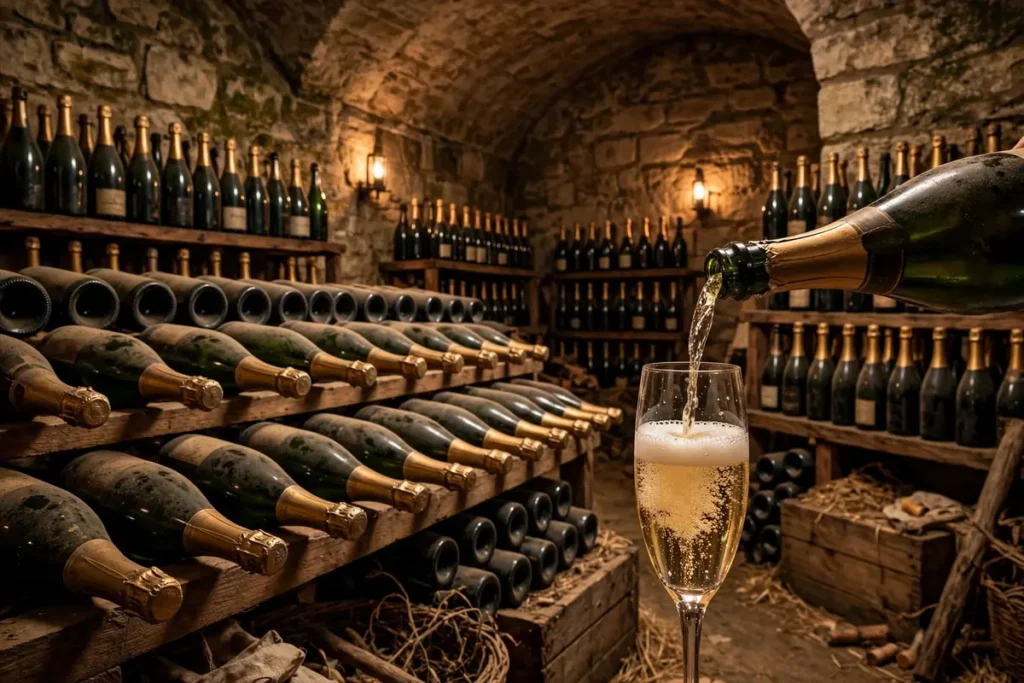
Champagne being poured into a flute inside a historic French wine cellar, rows of dusty bottles aging on wooden racks behind.
Watch: Champagne Guide for New Year's Eve
The 7 levels of champagne, explained — a guided tour through styles, sweetness, and what to buy.
At a Glance: Champagne Guide for New Year's Eve
The verified essentials of real champagne.
| Fact | Detail | Note |
|---|---|---|
| Origin | Champagne region, France | Only sparkling wine from this region may legally be called champagne |
| Grapes | Chardonnay, Pinot Noir, Pinot Meunier | The three main permitted varieties |
| Method | Méthode Champenoise | Second fermentation happens in the bottle |
| Dom Pérignon | Cellar master at Hautvillers from 1668 | Tradition dates his famous tasting to August 4, 1693 |
| Brut | Less than 12 grams of sugar per liter | The standard dryness level for most champagne |
| Serving | Chilled, flute or tulip glass | Often served at 8–10°C; the flute preserves the bubbles |
| Vintage | From a single year's harvest | Non-vintage blends multiple years for consistency |
Frequently Asked Questions
What is the difference between champagne and sparkling wine?
Champagne is sparkling wine from the Champagne region of France, made by the traditional method (second fermentation in the bottle) from regulated grapes. All champagne is sparkling wine, but sparkling wine from anywhere else — prosecco, cava, American sparkling — cannot legally be called champagne. The method and origin create champagne’s signature fine bubbles and toasty complexity.
What does “brut” mean on a champagne label?
Brut means “dry” — the wine contains very little residual sugar (under 12 g/L). It is the default style and the right choice for toasts, appetizers, and most food pairing. Do not confuse it with “extra dry,” which is actually slightly sweeter. For dessert, choose demi-sec (sweet) instead.
How do you open champagne without it exploding?
Chill it to 45–48°F first (warm bottles are volatile). Keep the wire cage on, cover the cork with a towel, hold the cork still, and twist the bottle — not the cork — until it eases out with a soft sigh. Never point the bottle at anyone, and never remove the cage before you are ready: it is your safety net against 90 psi of pressure.
What is the best champagne for New Year’s Eve?
For the midnight toast, a non-vintage brut from a respected house or grower in the $40–70 range is the sweet spot — festive, delicious, and not so precious you are afraid to enjoy it. For cocktails and punch served earlier, use prosecco or cava instead: they mix better and cost far less. Buy one bottle per 6–8 guests for the toast.
Should champagne be served in flutes or coupes?
Flutes preserve bubbles longest and are the safe festive choice; tulip-shaped glasses are the sommelier’s pick for aroma; coupes are beautiful but flatten bubbles quickly and spill easily. For the best of both worlds, use white wine glasses — they showcase aroma and keep bubbles lively. Whatever you choose, polish the glasses: residue kills bubbles.
Is expensive champagne worth it for New Year’s Eve?
Up to a point. The jump from a $15 prosecco to a $50 champagne is dramatic and worth it for the midnight toast. Beyond $70–100, differences become subtle — noticeable to enthusiasts, lost on most midnight revelers. Spend the premium on the toast bottle if the moment matters to you; spend the savings on better food, because great pairings elevate any bottle more than a fancier label does.
How long does champagne last once opened?
With a proper clamp-style champagne stopper and refrigeration, an opened bottle stays pleasantly bubbly for 1–2 days. Without a stopper, it goes flat within hours. Never use a regular wine stopper (pressure can launch it), and ignore the spoon-in-the-neck myth — it does not work. Use leftovers in cooking, vinaigrettes, or morning-after mimosas.
Conclusion
Choosing, serving, and opening champagne like a pro comes down to a handful of principles: buy brut for toasting and demi-sec for dessert, chill to 45–48°F, pour down the side of a clean glass, and open with a sigh instead of a bang. The rest — grower vs. house, flute vs. tulip, vintage vs. non-vintage — is joyful detail to explore over the years, one bottle at a time.
This New Year’s Eve, let the midnight bottle be the moment it deserves to be: cold, safe, and shared with people you love. Practice the opening technique once before the party (on a prosecco — no pressure), polish the glasses, and keep the bottle on ice until the countdown. For the cocktails that lead up to midnight, our festive drink recipes are ready — and from all of us at DayZora, may your 2027 pop with a whisper, not a bang. 🥂