Companies spend fortunes celebrating their own anniversaries — galas, press releases, commemorative logos — and then hand their longest-serving employees a generic gift card from the same vendor everyone uses. It’s a missed opportunity hiding in plain sight. Business anniversary gift ideas for employees deserve the same strategic care as client gifting, because the audience is the one group whose loyalty literally builds the business. A thoughtful anniversary gift tells an employee: “We noticed. We remember what you’ve given. You genuinely matter here.” This guide delivers 35 employee anniversary gift ideas organized by tenure, a fairness-and-budget framework, presentation ceremony ideas, personalization tactics, tax and policy notes, the science of why recognition works, and real program-building advice — everything HR and people leaders need.
The business case is blunt. Replacing an employee costs 50–200% of their annual salary depending on role and seniority, while the marginal cost of a meaningful anniversary gift is a rounding error. Yet most “years of service” programs are bureaucratic afterthoughts: a catalog, a points balance, a pin. Research on workplace recognition consistently finds that employees who feel genuinely recognized are far more likely to stay, engage, and recommend their employer — and that personalized, timely recognition outperforms generic rewards by a wide margin. Anniversary gifts work because they’re expected but rarely delightful: everyone knows the program exists, almost nobody expects it to feel personal. That gap between expectation and experience is where loyalty is won. For the broader career context these gifts live in, our guide to finding a mentor explores how invested relationships — the kind anniversaries celebrate — shape professional lives.
Why Anniversary Gifts Keep Employees: The Recognition Science
Three mechanisms make service-anniversary gifts unusually powerful. First, the peak-end rule: people judge experiences by their peaks and endings. An anniversary gift creates a deliberate “peak” in the employment experience — a moment of feeling valued that colors the entire year around it. Second, identity reinforcement: a gift that references an employee’s specific contributions (“your work on the Meridian launch”) tells them their identity at the company is seen, not just their output. Generic gifts say “you’re headcount”; specific ones say “you’re you here.” Third, reciprocity with dignity: unlike bonuses (expected compensation) or spot awards (manager discretion), anniversary gifts are institutional — the company itself saying thank you. That institutional weight matters; it’s the difference between “my boss likes me” and “this organization values me.” The programs that fail treat anniversary gifts as procurement. The ones that work treat them as storytelling.
35 Business Anniversary Gift Ideas for Employees, by Tenure
Tenure-appropriate gifting respects the journey: year-one gifts celebrate belonging, mid-tenure gifts celebrate mastery, and decade gifts celebrate legacy.
Year 1: Celebrating Belonging (8 ideas)
First anniversaries are about one message: you chose right, and we’re glad you’re here.
- Personalized welcome-to-year-two kit ($40). A quality notebook with their name, a handwritten note from their manager about their first-year highlight, and a small gift card to their favorite coffee spot (ask, don’t guess). It closes year one with warmth.
- Team lunch in their honor ($30/person). Take the immediate team out and let everyone share one thing they appreciate about the anniversary employee. Public appreciation from peers hits differently than a manager’s email.
- Desk upgrade of their choice ($50). A voucher for one desk upgrade — better chair cushion, quality headphones stand, a real plant, a desk lamp they actually like. Letting them choose signals trust.
- First-year story feature ($0). Feature them in the company newsletter or Slack: their photo, their role, one fun fact, one first-year win. Visibility is a gift, especially for newer employees.
- Learning stipend top-up ($75). Add to their professional development budget with a note: “Year two is for growth.” It invests in their future, which is exactly what a first anniversary should signal.
- Custom illustration of their workspace ($35). Commission a small custom illustration — their desk, their pet “helping” them work from home, their city. Playful, personal, frameable.
- Experience duo — coffee tasting or workshop ($60). Two tickets to something enjoyable near them, with a plus-one. First-year employees are still building local roots; experiences help.
- Handwritten notes from the team ($0). Collect short notes from everyone they work with into a card or small book. Costs nothing, means everything — consistently rated the most-kept anniversary gift in employee surveys.
Years 3–5: Celebrating Mastery (9 ideas)
Mid-tenure employees are your cultural carriers. Gifts should acknowledge expertise and deepen investment.
- Premium noise-canceling headphones ($250+). The universally loved upgrade for focused work and travel. Engrave the case with their name and anniversary year — it transforms a great product into a milestone marker.
- Conference or course of their choice ($500). Full funding — ticket, travel, time — for the professional event they pick. Autonomy in development is a profound trust signal at this tenure.
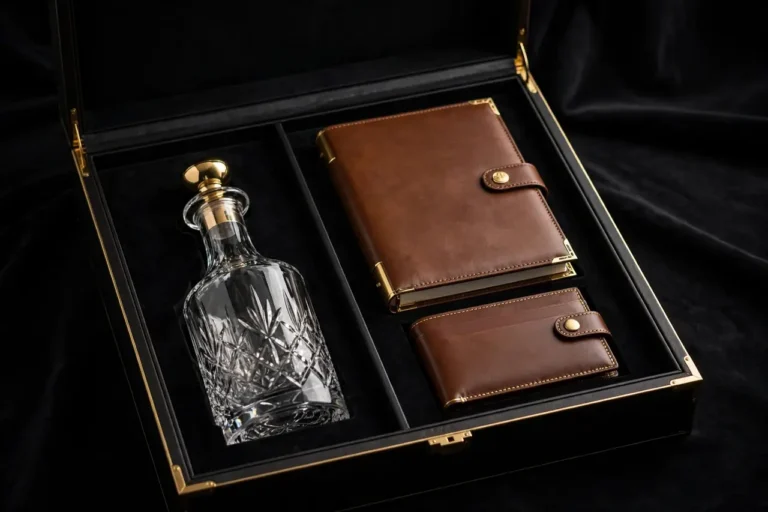
- Executive gift set, personalized ($95). A leather notebook and weighted pen in a presentation box, with their name and a note referencing a specific achievement. Classic because it works.
- Extra PTO day — the “anniversary day” ($0 + policy). A floating day off in their anniversary month, no questions asked. Time is the scarcest gift, and granting it says the company respects their life, not just their labor.
- Home-office upgrade fund ($200). A stipend for the remote-work setup: better chair, monitor light, quality webcam. It improves every workday for years — the gift that keeps giving, literally.
- Custom star map or milestone print ($45). A beautiful print of the night sky on their start date, or a custom timeline of their projects. Symbolic gifts resonate at mid-tenure because the history is now real.
- Gourmet experience box ($80). A curated tasting box — artisan cheeses, small-batch chocolates, specialty coffee — with a note from leadership. Shareable with family, which extends the appreciation home.
- Charitable donation matching ($100). Match their donation to a cause they choose, in honor of their anniversary. It honors their values, not just their output.
- “Mastery” spotlight video ($0 + time). A 90-second video where colleagues describe what this person does best. Play it at a team meeting, then send them the file. Public mastery recognition is rocket fuel for engagement.
Years 5–10: Celebrating Impact (9 ideas)
These employees have shaped the company. Gifts should feel significant and legacy-aware.
- Weekend getaway voucher ($400). Two nights at a quality hotel or resort, their choice of dates. After 5+ years, rest is recognition — and the memory will outlast any object.
- Bespoke leather goods ($200+). A briefcase, weekender, or portfolio in full-grain leather, monogrammed. Decade-grade craftsmanship for near-decade tenure.
- Equity or bonus enhancement (varies). Where possible, tie milestone anniversaries to a tangible financial kicker — extra RSUs, a bonus multiplier, a retirement contribution bump. Money with meaning beats money alone.
- Sabbatical contribution ($1,000+). Seed funding toward a future sabbatical, or an extra week attached to one. Long-tenure employees dream in sabbaticals; funding the dream is unforgettable.
- Commissioned portrait or custom art ($150+). An illustrated portrait of them, their team, or a meaningful work moment. Deeply personal and permanently displayable — the opposite of a catalog gift.
- Premium smartwatch or tech ($300+). The latest smartwatch or tablet, engraved. Practical luxury that integrates into daily life.
- Fine dining experience for two ($250). A chef’s-table or tasting-menu evening, prepaid. Celebration-grade, shareable with a partner who has also sacrificed for those years of service.
- Legacy project dedication ($0 + ceremony). Name something after them — a conference room for a month, a scholarship, an internal award. Institutional immortality is the rarest gift of all.
- Anniversary documentary clip ($0 + effort). Interview colleagues about this person’s impact and edit a 3-minute tribute. Play it at the anniversary celebration. There won’t be a dry eye, and the file becomes a keepsake.

10+ Years: Celebrating Legacy (9 ideas)
Decade-plus employees are institutional memory. Honor them like the founders they effectively are.
- The legacy gift — commissioned crystal or sculpture ($300+). An etched crystal piece marking their decade(s), with their name and years. Boardroom-grade permanence for boardroom-grade loyalty.
- Extended sabbatical or travel fund ($2,000+). A meaningful contribution toward the trip of a lifetime. After a decade, this is the gift that says “go live — you’ve earned it.”
- Named award or annual prize ($0 + prestige). Create an annual company award in their name, given to others going forward. Their legacy becomes structural — it outlives their tenure.
- Equity event or retirement boost (varies). Accelerated vesting, a retirement-account contribution, or a pension enhancement. The most meaningful decade gift is future security.
- Family celebration event ($500+). Host a dinner honoring the employee and their family — the people who supported the late nights. Recognizing the family recognizes the full cost of loyalty.
- Custom timepiece ($400+). An engraved watch marking the decade. The symbolism is perfect — time given, time honored — and it’s worn daily.
- Professional legacy interview ($0 + production). A recorded long-form interview about their career, lessons, and the company’s history. Archive it; it’s organizational gold and personal immortality in one.
- Charitable foundation gift ($500+). A significant donation to their chosen cause with formal recognition. For legacy-tenure employees, meaning consistently beats luxury.
- The “founder’s circle” induction ($0 + status). Formally induct decade employees into a founders’ circle with its own rituals — annual dinner, special pin, a voice in company traditions. Status and belonging, institutionalized.
The Fairness & Budget Framework
Nothing poisons a recognition program faster than perceived unfairness. This framework keeps anniversary gifting equitable, predictable, and defensible.
| Tenure Band | Suggested Spend Range | Gift Character | Presentation Level | Key Principle |
|---|---|---|---|---|
| 1 year | $25–$75 | Belonging: personal, warm, team-oriented | Team setting | Everyone gets the same base; personalization varies |
| 3 years | $75–$150 | Growth: development, choice, visibility | Team + manager note | Choice matters more than cost |
| 5 years | $150–$300 | Mastery: significant, expertise-honoring | Department recognition | Reference specific contributions |
| 10 years | $300–$750 | Impact: legacy-aware, substantial | Company-wide moment | Make it a ceremony, not a transaction |
| 15–20 years | $750–$1,500 | Legacy: permanent, institutional | Leadership-led celebration | Create something that outlasts the gift |
| 25+ years | $1,500+ | Institution: named, historic | Founder/executive honor | Treat them as co-founders of the culture |
The fairness rules: publish the bands internally — transparency kills resentment. Never let managers freestyle budgets within a band (that’s how inequity creeps in). Adjust for local cost of living if you’re multi-site, and review bands annually against inflation. Most importantly: the personal element (the note, the specific mention, the ceremony) must be equal even when budgets differ — a heartfelt year-one recognition should feel as considered as a decade award, just smaller in scale.
Presentation Ceremony Ideas: Make the Moment Matter
A $50 gift presented beautifully beats a $200 gift handed over awkwardly. The team circle: gather the immediate team, share two specific appreciations, present the gift. Five minutes, enormous impact. The all-hands spotlight: for 5+ years, a 2-minute moment in the company meeting — photo, tenure, one story. The manager letter: a genuine letter (not a template) from their manager detailing their impact, read aloud or given privately. The peer video: 60–90 seconds of colleagues’ testimonials, played at the celebration. The anniversary wall: a physical or digital wall where each month’s anniversary employees are featured with their start-date photo. The founder handshake: for decade milestones, a personal congratulations from senior leadership — the institutional weight matters. The surprise element: coordinate with their team for one unexpected touch — decorations, a favorite lunch, a video from a former colleague. Rituals turn transactions into traditions; build yours deliberately. For message inspiration that strikes the right professional tone, our professional wishes collection offers language you can adapt.

Personalization Without Awkwardness
Personalization is the difference between a program and a gesture — but it has failure modes. Do: reference specific projects, use their name (correctly spelled), acknowledge their unique contribution, consider their known interests, and involve their manager for the personal note. Don’t: guess at deeply personal matters (health, family, beliefs), give “funny” gifts that punch down, personalize based on stereotypes, or make the gift about the company’s brand instead of the person. The safe personalization stack: their name + one specific achievement + one human detail (their coffee order, their marathon, their mentorship of interns). That trio fits on any card and transforms any gift. For remote employees: personalization matters more, not less — they miss the hallway congratulations, so the gift and note must carry the full weight. Ship to their home, time it to arrive on the anniversary date, and have their manager call the same day.
Tax & Policy Notes (U.S. Focus — Check Local Rules)
Unsexy but essential. In the U.S., employee gifts are generally taxable income unless they qualify as de minimis (small, infrequent, administratively impractical to track — think holiday turkeys, not $500 watches) or as qualified employee achievement awards — which allow up to $1,600/year tax-free for length-of-service awards if given as part of a meaningful presentation, not disguised compensation, with written program rules. Key requirements: the award can’t be cash or cash-equivalent, must be tangible personal property, and length-of-service awards can’t go to anyone who received one in the prior 4 years. Practical takeaways: document your program in writing, keep gifts tangible (experiences and gift cards usually fail the test), track the 5-year rule per employee, and run the plan past your tax advisor before launch. International? Rules vary wildly — the UK’s trivial benefits exemption (£50), Canada’s gift rules, the EU patchwork — so localize the program rather than copy-pasting. None of this is legal advice; it’s a prompt to get proper advice.
Watch: Corporate Gift Ideas for Employees
See a roundup of top corporate gift ideas for employees — practical picks that show appreciation and boost morale:
What Kills Anniversary Programs (Avoid These)
The catalog trap: letting employees “pick from the catalog” feels like shopping, not recognition — curate, don’t abdicate. The forgotten anniversary: nothing says “you don’t matter” like the company missing your work anniversary; automate reminders, assign owners, build redundancy. The manager opt-out: if managers treat it as HR’s job, the personal element dies — make participation a leadership expectation. The one-size-fits-all gift: identical gifts at identical tenures feel industrial; vary within bands. The delayed gift: arriving two months late communicates exactly what it looks like. The public/private mismatch: some employees love the spotlight, others dread it — ask preference once, record it, honor it. The inflation freeze: a $50 gift in 2016 is a $38 gift today; review bands annually. Fix these and your program runs itself; ignore them and even generous budgets feel hollow.
Pitching the Program: The Leadership Business Case
If your anniversary program needs executive approval, lead with math, not sentiment. Cost: a 200-person company with the bands above spends roughly $15,000–$25,000/year — under 0.1% of payroll. Avoided cost: replacing one mid-level employee costs $30,000–$75,000 in recruiting, onboarding, and lost productivity. If the program prevents even one regretted departure per year, it pays for itself several times over. Compounding benefits: recognized employees refer more candidates (cutting recruiting costs), engage more deeply (lifting team output), and become brand ambassadors (free employer branding). The risk of doing nothing: competitors with real recognition cultures are courting your best people right now; “we have a catalog” is not a defense. Frame the proposal as a retention program with a recognition wrapper — finance understands retention math. Pilot it for one year with a sunset clause if metrics don’t move; they will.
Special Situations: Mergers, Layoffs, and Remote-First Teams
Post-merger anniversaries: honor tenure across both legacy companies — nothing alienates acquired employees faster than resetting their clock. Acknowledge the complexity openly: “Your 8 years — 5 with [LegacyCo], 3 with us — built this.” During layoffs or downturns: don’t cancel the program; scale the spend, never the sincerity. A heartfelt low-cost recognition during hard times is remembered far longer than a lavish one during boom years. Acknowledge reality briefly, celebrate genuinely. Remote-first teams: over-invest in the unboxing experience (beautiful packaging, a QR code linking to the tribute video) and synchronize a live moment — the whole team on video when the gift is opened. Distance demands deliberateness; the programs that thrive remotely are the ones designed for it, not adapted as an afterthought. Global teams: localize gifts (no alcohol where it’s unwelcome, no leather where it’s offensive), respect regional holidays, and let local managers choose within bands — central frameworks, local hearts.
The Wishlist Hack: Let Them Tell You (Elegantly)
The hardest part of personalization is knowing what someone actually wants. Solve it systemically: once a year, ask every employee to privately update a 3-item “appreciation wishlist” — not demands, just ideas (“love pour-over coffee,” “training for a marathon,” “my Kindle is dying”). Frame it as helping the company celebrate them well. Most people love answering; it feels like being asked about themselves, because it is. When anniversaries arrive, managers pick from the wishlist — the gift lands perfectly, the employee feels heard, and the “how did they know?” delight is genuine. Keep wishlists confidential to managers and HR, refresh them annually, and never treat them as obligations. It’s the simplest personalization engine ever built, and it costs nothing.
Frequently Asked Questions
Everything leaders ask before launching or fixing an anniversary recognition program — answered directly.
How much should companies spend on employee anniversary gifts?
Follow the tenure bands: $25–$75 for year one, scaling to $300–$750 at 10 years and $1,500+ at 25 years. Total program cost typically runs well under 0.1% of payroll — trivial against replacement costs of 50–200% of salary. Spend predictably and publish the bands; transparency is part of the gift.
Should anniversary gifts be the same for everyone at the same tenure?
Same budget band, different gift. Identical gifts feel industrial; the personal element — the note, the specific mention, one choice-driven detail — should vary by person. Standardize the framework (budget, presentation, timing) and personalize the content.
Cash bonus or physical gift — which is better for anniversaries?
Both have roles: cash/bonus enhancements are powerful at major milestones (10+ years), but physical gifts create the memory — the peak moment. The best programs pair them: a tangible gift for the ceremony plus a financial kicker for the milestone. Never replace the gift entirely with cash; it converts recognition into compensation.
How do we handle anniversary gifts for remote employees?
Ship to their home to arrive on the anniversary date, have their manager video-call that day, and feature them in the digital anniversary wall or all-hands. Remote employees miss ambient recognition, so be deliberate: the gift, the call, and the public moment must all happen — none is optional.
What if we missed someone’s anniversary?
Acknowledge it honestly and immediately — “we missed your 5-year last month, and that’s on us” — then deliver the full recognition late rather than skipping it. A sincere late celebration beats silent omission. Then fix the system: automated reminders with a human owner and a backup.
Are gift cards acceptable anniversary gifts?
As a supplement, yes; as the whole gift, no. A gift card alone says “we didn’t think about you specifically.” Pair a modest gift card (their choice, their favorite store) with a personal gift and a real note, and it becomes thoughtful flexibility rather than thoughtlessness.
Should managers or HR own the anniversary program?
HR (or People Ops) owns the system — bands, reminders, vendors, tracking. Managers own the moment — the note, the presentation, the specific appreciation. Programs die when either side abdicates: HR-only becomes bureaucratic, manager-only becomes inconsistent. Both, explicitly.
How do we recognize anniversaries without embarrassing introverts?
Ask once, early: “When your work anniversary comes up, do you prefer a team shout-out or something quieter?” Record the preference and honor it. Public recognition for those who love it, a private heartfelt moment for those who don’t — the thoughtfulness is the personalization.
Do anniversary gifts really affect retention?
On their own, no gift saves a broken culture — but recognition is a proven retention lever, and anniversary programs are recognition made systematic. Employees who feel genuinely recognized show markedly higher intent to stay. Think of the program as compound interest on every other good thing you do for your team.
What about contractors, part-timers, and interns?
Include them proportionally. A contractor’s one-year mark deserves acknowledgment (a note, a small gift); part-timers get the same bands pro-rated or the same bands, period — excluding them breeds exactly the second-class feeling you want to avoid. Interns converting to full-time: celebrate the conversion itself. Recognition should follow contribution, not employment classification.
The employees celebrating anniversaries this year are the reason there’s an anniversary to celebrate at all. Build the bands, brief the managers, automate the reminders, launch the wishlist — and then make every single presentation feel like it was planned just for that person. Because the best anniversary programs share one secret: the system is standardized so the moment can be personal. For ongoing inspiration on recognizing the people around you, keep our coworker gift ideas bookmarked — thoughtfulness is a year-round habit, not an annual event — and the companies that treat it that way keep the people that everyone else is trying to hire.