

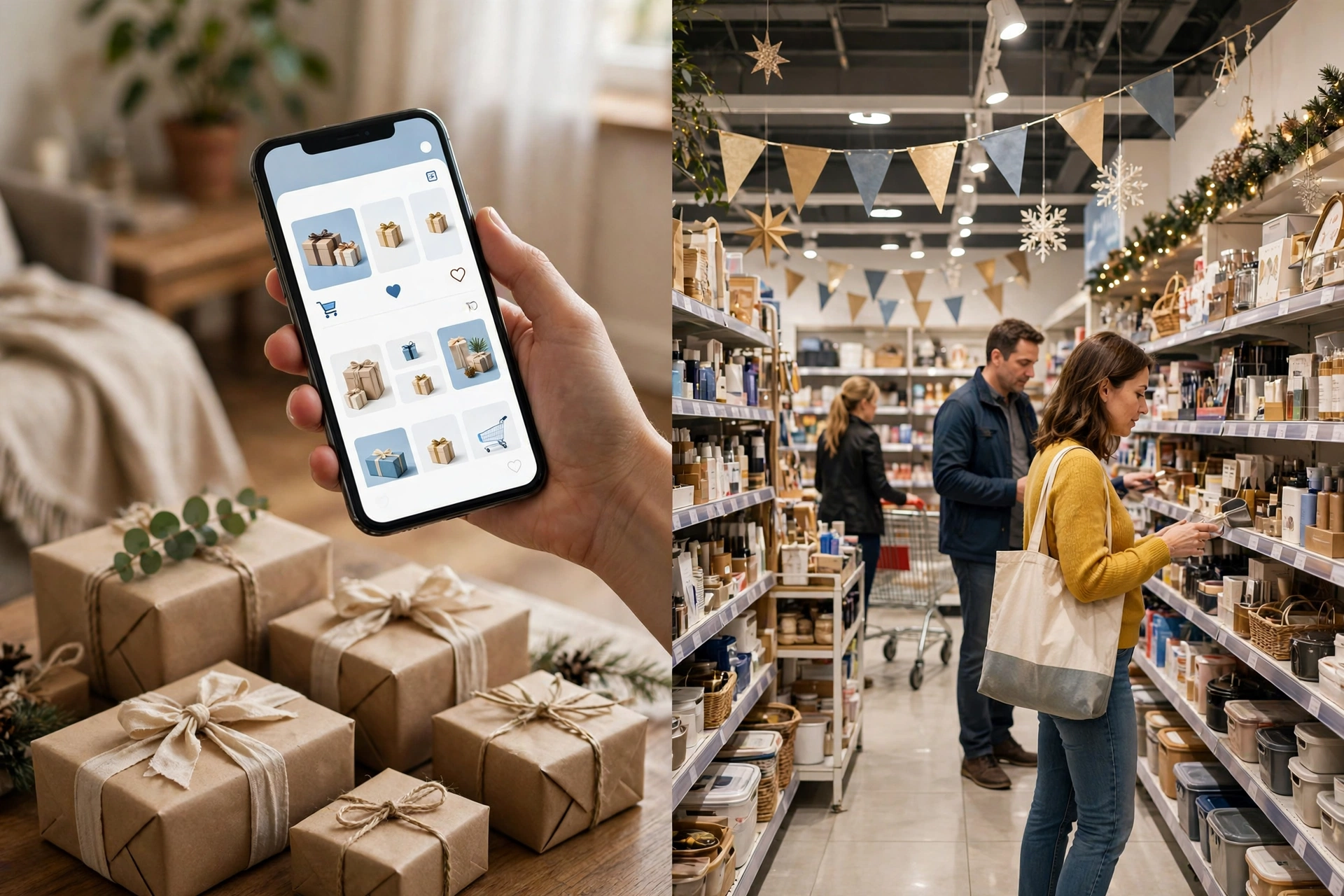
Every Black Friday, shoppers split into two camps: the online deal hunters refreshing tabs at midnight, and the in-store veterans lining up before dawn. The question of black friday online vs in-store: which is better has no universal answer — the better channel depends on what you are buying, where you live, and how you weigh price against convenience, certainty, and experience. This guide compares the two channels across every dimension that matters — prices, selection, doorbusters, returns, safety, and strategy — so you can choose the right channel for each item on your list, or combine both like a professional.
The landscape has shifted decisively over the last decade: online now accounts for the majority of Black Friday spending, and the pandemic years accelerated a shift that was already underway. But in-store Black Friday is far from dead — it retains structural advantages (instant gratification, in-person-only doorbusters, no shipping risk) that online cannot replicate. The sophisticated answer is not “online wins” or “stores win” — it is a channel strategy: buy each item where that item’s deal structure favors you. Here is how to build one.
Online vs In-Store: The Head-to-Head Comparison
| Dimension | Online | In-Store |
|---|---|---|
| Doorbuster access | Midnight go-lives; sell out in minutes | Ticket/voucher systems; sell out to early line |
| Price comparison | Fast — tabs, tools, and history in seconds | Slow — phone-checking in the aisle |
| Selection breadth | Wider — full catalog plus online exclusives | Narrower — shelf space limits |
| Instant gratification | No — shipping takes days | Yes — walk out with the product |
| Shipping risk | Delays, damage, porch theft possible | None — you carry it home |
| Crowds and comfort | Shop from home | Lines, crowds, picked-over shelves |
| Website/app strain | Crashes and queues at peak times | Not a factor |
| Product inspection | Photos and reviews only | See, touch, and test before buying |
| Returns | Ship back or drop off; slower refunds | Walk in, walk out; faster resolution |
| Exclusive deals | Online-only and app-exclusive offers | In-store-only doorbusters |
| Coupon stacking | Easy — auto-applied codes | Possible but clunkier |
| Scam exposure | Higher — fake sites, phishing | Lower — physical presence verifies |
Where Online Wins
1. Price Comparison and Verification
Online shopping’s greatest structural advantage is informational: you can compare prices across retailers, check price histories, and verify model numbers in seconds — the exact workflow our price-tracking guide describes. In a store aisle, the same verification means squinting at your phone while guarding your cart. For any purchase where verifying the deal matters (and it always matters for big-ticket items), online is the superior research environment.
2. Selection and Online Exclusives
Online catalogs dwarf physical shelf space. Retailers routinely offer online-exclusive configurations, colors, and bundles that never appear in stores — and Cyber Monday’s best deals are overwhelmingly online-first. If you want the widest choice, or you are shopping categories where online dominates (laptops, small tech, fashion), the browser beats the parking lot.
3. Coupon Stacking and Cashback
Online checkout is where savings compound: retailer coupon codes, cashback portal rates (which often spike during Black Friday), credit card rewards, and price-tracking alerts all stack at the digital register. In-store stacking is possible but friction-heavy by comparison. The disciplined online shopper routinely beats the sticker price by combining three or four savings layers.
4. Comfort and Accessibility
This matters more than deal culture admits. Shopping from home means no lines, no crowds, no weather, no parking battles — and full accessibility for shoppers with mobility constraints, caregiving responsibilities, or simply no desire to spend a holiday morning in a queue. The best deal is partly the one you can actually, comfortably execute.
5. Thanksgiving Day Access
Online stores never close. Thanksgiving Day has become a major online shopping day with full Black Friday pricing and a fraction of Friday’s traffic — an option that simply does not exist for shoppers limited to physical stores (many of which are closed or on reduced hours). Our timing guide on whether to wake up early covers the Thursday-evening strategy.
Where In-Store Wins
1. In-Store-Only Doorbusters
Some doorbusters are genuinely exclusive to physical stores — no online equivalent, no “add to cart” alternative. Retailers use these to drive foot traffic, and for the specific items so designated, the store is the only game in town. Check the ad fine print for channel markings: “in-store only” means exactly that. Our doorbuster explainer details how to identify these.
2. Instant Gratification and Certainty
Walking out with the product eliminates an entire category of risk: shipping delays, damaged parcels, porch theft, and “lost in transit” limbo. During the holiday crunch, when carriers are overloaded and delivery windows tighten, certainty has real value — especially for gifts with hard deadlines. If the item must be in hand by a specific date, in-store purchase is the only zero-risk option.
3. Product Inspection
For categories where physical inspection matters — apparel fit, furniture comfort, open-box electronics condition, produce-adjacent goods — the store lets you verify before committing. Online’s equivalent (reviews and photos) is a proxy; the store is the thing itself. This advantage is decisive for open-box and clearance items, where condition varies unit by unit.
4. Returns and Problem Resolution
In-store returns are structurally simpler: walk in with the item and receipt, walk out with a refund or exchange. Online returns involve repackaging, shipping, waiting, and occasionally disputing. During the holidays, when return counters are staffed for volume, in-store problem resolution is often same-day while online resolution takes a week or more. If you anticipate a high return probability (sizing-sensitive gifts, experimental purchases), buying in-store buys you an easier exit.
5. Negotiation and Manager Discretion
Online prices are algorithmic and inflexible. In-store, floor staff and managers occasionally have discretion — on open-box items, display models, price-match edge cases, and bundle requests. It is not reliable enough to plan around, but the possibility exists only in person. Polite, informed negotiation at the customer service desk has salvaged many a marginal deal.
Channel Strategy by Product Category
| Category | Better Channel | Why |
|---|---|---|
| Doorbuster TVs & flagship electronics | Depends on the ad — check channel marking | Many are online at midnight; some are in-store only |
| Laptops & computers | Online | Comparison-heavy purchase; online exclusives; Cyber Monday strength |
| Smartphones | Either | Bundle-driven; compare carrier + retailer offers in both channels |
| Major appliances | In-store (or online with delivery) | Inspection matters; delivery logistics favor planned purchase |
| Toys | Whichever has stock — check both | Sellout risk dominates; buy where available |
| Fashion & apparel | Online (in-store for fit) | Coupon stacking online; try on in-store for sizing |
| Video games & consoles | Online for software; either for hardware | Digital deals online; hardware doorbusters split by ad |
| Smart home devices | Online | Standardized products; price competition favors online |
| Furniture | In-store | Comfort and quality inspection; delivery arranged in person |
| Open-box & clearance | In-store | Condition varies by unit — inspect before buying |
For category-specific deal tracking, see our guides to TV deals, laptop deals, appliance deals, and toy deals.
The Hybrid Strategy: Using Both Channels Like a Pro
The highest-performing shoppers do not pick a channel — they choreograph both. Here is the professional hybrid playbook:
Before the Event: Research Online, Recon In-Store
Do your price research online (histories, comparisons, ad analysis), but visit stores in November for reconnaissance: check shelf stock levels on your target items, note store layouts for doorbuster morning, confirm opening times and ticket policies in person, and inspect display models of anything you are considering. This dual preparation means no surprises on the day.
Showrooming (Done Right)
Inspect in-store, buy online — “showrooming” — is legitimate comparison shopping when done honestly. Test the laptop keyboard, feel the jacket fabric, check the TV’s viewing angles — then buy wherever the verified best price is. The ethical line: use display models respectfully, do not monopolize staff time for a purchase you have already decided to make elsewhere, and consider that the store’s price-match policy might make the honest in-store purchase competitive anyway.
Buy Online, Pick Up In-Store (BOPIS)
The hybrid sweet spot: order online at the online price (with coupon stacking and cashback), then collect in-store — combining online pricing with in-store certainty and zero shipping risk. During Black Friday, BOPIS also reserves your item from local stock, protecting against both online sellouts and empty shelves. Check pickup time estimates during the event crunch; windows can stretch, but the reservation is what matters.
In-Store Price Matching Against Online Prices
Many retailers will match their own online price in-store (and sometimes competitors’ online prices) — which lets you get the online deal with in-store immediacy. The catch: price-match policies are often restricted during Black Friday itself, with doorbusters and limited-quantity items commonly excluded. Verify the current policy before relying on this, and have the online listing ready to show at the service desk.
The Split Execution
On the day: handle online doorbusters at the midnight go-live from home; pivot to in-store for in-store-only doorbusters at opening; use the weekend for calm online comparison shopping of everything else. Assign channels per item during your Thanksgiving-week triage — each item gets its channel the way each gets its timing.
Costs Beyond the Price Tag: The Hidden Channel Math
Channel choice affects total cost, not just the sticker price. Factor these in:
- Shipping costs online: Free-shipping thresholds, expedited fees for holiday deadlines, and surcharges can erase an online price advantage. Always compute the delivered total.
- Travel costs in-store: Fuel, parking, and — most expensively — your time. A two-hour round trip for a marginal saving is a loss at any reasonable valuation of your time.
- Return costs: Online returns may involve return shipping fees or restocking fees; in-store returns cost a trip. Factor your personal return probability.
- Impulse exposure: Physical stores are engineered for impulse purchases (endcaps, checkout lanes, the “while I’m here” effect). Online has its own impulse mechanics (recommendations, one-click buying). Know which environment tempts you more and budget accordingly.
- Opportunity cost of queues: Time in line is time not comparison-shopping. For flexible items, the online shopper checking three retailers beats the in-store shopper standing in one.
Safety and Security by Channel
Online shopping carries the fraud risks detailed in our Black Friday scams guide — fake sites, phishing, counterfeit marketplace goods. Defend with the standard toolkit: verified URLs, account hardening, credit over debit, and skepticism toward unbelievable prices. In-store shopping carries physical considerations instead: crowded spaces, parking-lot vigilance after dark, and keeping purchases out of sight in vehicles. Neither channel is risk-free; the risks are simply different, and both are manageable with basic precautions.
Online vs In-Store Around the World
The channel balance varies significantly by market. In the US, both channels are highly developed and the hybrid strategy works fully. In the UK, online dominates Black Friday even more decisively — the event never developed the same in-store doorbuster culture as the US. In Canada, the pattern resembles the US. In Australia, strong online participation pairs with meaningful in-store events. In continental Europe, in-store Black Friday is well established in countries like Germany and France, with online growing fast.
In India, Southeast Asia, Latin America, the Middle East, and Africa, Black Friday-style sales skew heavily online — e-commerce platforms drive the event, and in-store participation varies widely by country and retailer. The universal principle: identify which channel your market’s retailers invest in most heavily (it is usually visible in where the best-advertised deals live), and weight your strategy accordingly. Our Black Friday 2026 hub covers the global landscape.
Price Matching Across Channels: The Fine Print
Price matching sits at the intersection of the two channels, and understanding its Black Friday-specific rules unlocks hybrid strategies that pure-channel shoppers miss. Here is how it typically works — described generically, since every retailer’s exact policy differs and changes.
Retailer-Matches-Own-Online-Price (In-Store)
Many large retailers will honor their own website’s price at the physical register — show the listing on your phone, and the cashier or service desk adjusts. During Black Friday, this is often the most reliable form of price matching because it involves no competitor and no judgment call. The limitation: it only helps when the online price is lower than the shelf price, which happens with online-only deals and app-exclusive offers. Always check the retailer’s app for the online price before assuming the shelf tag is final.
Competitor Price Matching
Some retailers match competitors’ advertised prices on identical items — the classic “we’ll match any lower price” promise. During Black Friday, however, these policies are frequently suspended, restricted, or narrowed: common exclusions include doorbusters, limited-quantity items, “while supplies last” offers, marketplace sellers, and prices that require coupons or loyalty memberships. The practical reality: competitor matching is least available exactly when you most want it (on the headline deals) and most available on standard sale items (where price differences are smaller anyway).
Post-Purchase Price Adjustments
Distinct from matching competitors: if a retailer drops the price on an item you already bought within a set window (commonly 7 to 14 days, varying by retailer), many will refund the difference on request. This is the policy that makes early buying safe — buy Tuesday at a good price, claim the difference if Friday is lower. Critical details to verify in advance: the window length (must span the event), whether doorbusters are excluded (often yes), and the claim process (receipt required, request within days of the drop). Set calendar reminders for every significant purchase.
How to Use Matching Strategically
- Before buying: check whether the retailer’s app or site shows a lower price than the shelf — then ask for the match at the register rather than ordering online and waiting.
- After buying: re-check prices on your purchases through the adjustment window; claim every qualifying difference.
- Document everything: keep receipts and screenshot the lower price with its date — adjustment claims go smoother with evidence.
- Know the exclusions cold: walking to the service desk for a doorbuster match that the policy explicitly excludes wastes the most valuable resource on Black Friday — your time.
The Decision Checklist: Which Channel for Each Item?
Run every item on your list through this checklist during Thanksgiving week. The channel with more “yes” answers wins.
Choose online when: the item needs price verification against history and competitors; it is an online-exclusive configuration or has an app-only coupon; you want to stack cashback portal rates; the item is standardized (no inspection needed); shipping timelines comfortably beat your deadline; or you value calm comparison over instant possession.
Choose in-store when: the deal is marked in-store-only in the ad; you need the item in hand by a hard deadline; the product needs physical inspection (fit, comfort, open-box condition); you anticipate a likely return and want the easy in-person process; or the online listing is from a third-party seller you cannot verify while the shelf item is certain.
Choose BOPIS (buy online, pick up in-store) when: you want the online price with zero shipping risk; local stock is limited and you want to reserve your unit; or you want to inspect at pickup with the option to decline. BOPIS is the hybrid default — when in doubt between channels, it splits the difference.
Write the chosen channel next to each item on your list. On the day, there is no deliberation — only execution.
In Pictures: Black Friday Online vs In-Store
Two camps: the online deal hunters refreshing tabs at midnight, and the in-store veterans lining up before dawn. Which is better?

A shopper checks a smartphone while carrying bags through a bright store — the modern hybrid reality. Online now accounts for the majority of Black Friday spending, but in-store keeps structural advantages no website can replicate.
Watch: Black Friday Online vs In-Store
The numbers behind the shift — why online prices now rival in-store, except for one category.
At a Glance: Black Friday Online vs In-Store
The two channels compared across every dimension that matters.
| Dimension | Online | In-store |
|---|---|---|
| Prices | Usually match in-store now, except for a small slice of doorbusters | Exclusive in-person-only doorbusters still exist |
| Selection | Wider catalogue; easy cross-retailer comparison | Limited to shelf stock — but you see exactly what you get |
| Speed | Delivery waits; shipping cut-offs apply | Instant gratification — walk out with it today |
| Risk | Shipping damage, porch theft, return postage | No shipping risk; try before you buy |
| Experience | Calm, fast, comparable | The event itself — crowds, energy, the hunt |
| The smart play | A channel strategy: buy each item where it wins — doorbusters in-store, everything else wherever the verified price is lowest | |
Frequently Asked Questions
Can I return an online Black Friday purchase in-store?
At most major retailers, yes — online purchases can typically be returned to physical stores, which is faster than shipping them back. Policies vary by retailer, so verify before buying, especially for marketplace-sold items (which often have different return rules than retailer-sold items). Keep the packing slip or order confirmation accessible; in-store returns of online orders usually require it.
Does buy-online-pickup-in-store cost extra on Black Friday?
Generally no — BOPIS is typically free, and it reserves your item from local inventory while letting you pay the online price. During the Black Friday crunch, pickup windows can stretch longer than usual, but the reservation is the valuable part: your item is set aside regardless of shelf sellouts. Confirm the pickup deadline (usually several days) so your reservation does not expire.
Is it better to shop Black Friday online or in-store?
It depends on the item. Online wins for price comparison, selection, coupon stacking, and comfort; in-store wins for instant gratification, product inspection, in-store-only doorbusters, and easy returns. The best strategy is hybrid: assign each item on your list to the channel where its deal structure is strongest.
Are Black Friday prices the same online and in-store?
Often, but not always. Many retailers align online and in-store pricing for advertised sale items, but online-only and in-store-only deals both exist — check the ad fine print for channel markings. Coupon codes and cashback portals can make the effective online price lower even when sticker prices match.
Do in-store Black Friday deals sell out faster than online?
They sell out differently, not necessarily faster. In-store doorbusters are limited by physical stock and the local crowd; online doorbusters are limited by allocated digital inventory and national demand. Both can vanish in minutes. The practical difference: an online sellout sometimes resolves via restock waves, while an in-store sellout at your local store is usually final (though other locations or BOPIS may have stock).
Can I get Black Friday online prices in the store?
Sometimes, through price matching — many retailers match their own online prices in-store. But price-match policies are frequently restricted during Black Friday, with doorbusters and limited-quantity items commonly excluded. Check the current policy and have the online listing ready. BOPIS (buy online, pick up in-store) is often the more reliable way to combine online pricing with in-store pickup.
Is Black Friday still worth going to the store for?
Yes, for the right items: in-store-only doorbusters, products you need to inspect, open-box deals, and anything you must have in hand by a deadline. For standard sale items in competitive categories, the store trip rarely beats calm online shopping. Let your list — not tradition — decide whether you go.
Which channel is safer for Black Friday shopping?
Each channel’s risks differ. Online risks are digital (fake sites, phishing, counterfeits) and are managed with verification habits and account security. In-store risks are physical (crowds, parking lots) and are managed with basic awareness. Shop the channel you can execute safely and attentively — a distracted online shopper clicking phishing links is at more risk than an alert in-store shopper, and vice versa.
Conclusion
Black friday online vs in-store: which is better? The honest answer is both — each for what it does best. Online gives you information, selection, stacking, and comfort. In-store gives you certainty, inspection, exclusives, and immediacy. The shoppers who get the most from Black Friday do not pledge allegiance to a channel; they assign each purchase to its optimal channel, combine them with BOPIS and price matching where it helps, and compute total cost instead of staring at sticker prices.
Build your channel plan during Thanksgiving week alongside your timing plan (see how long sales last and morning timing), verify every deal with price tracking, and shop Black Friday 2026 (November 27) across both channels with a plan for each. The channel is a tool, not a tribe — use the right one for the job.


