Last Checked: October 2, 2026
The best science museums in the USA offer different ways to learn: trying an experiment, examining a fossil, tracing a computer’s development or standing beside a spacecraft. This selection of 30 substantial institutions includes natural science, computing, engineering, aviation and space. It also distinguishes an interactive science center from an artifact-led historical museum.
Choose the learning experience first. A hands-on station rewards repeated testing; an original vehicle rewards context about its mission and design. Some destinations combine both, while others add separately ticketed films, tours or simulations. The admission and booking notes below help prevent a general ticket from being mistaken for access to every experience.

Museums at a glance
Use the linked names to jump to full entries. On a small screen, scroll the comparison table horizontally.
| Museum / location | Focus or collection | Admission |
|---|---|---|
| Exploratorium San Francisco, CA | Interactive science | Paid |
| California Science Center Los Angeles, CA | Science | Free permanent exhibits; IMAX paid |
| Griffin Museum of Science and Industry Chicago, IL | Science and engineering | Paid; some experiences extra |
| Museum of Science Boston, MA | Interactive science | Paid |
| Saint Louis Science Center St. Louis, MO | Science | Free general admission |
| Science Museum of Minnesota St. Paul, MN | Science | Paid; under 4 free |
| Oregon Museum of Science and Industry Portland, OR | Science and technology | Paid; some experiences extra |
| COSI Columbus, OH | Interactive science | Paid; under 2 free |
| The Franklin Institute Philadelphia, PA | Science | Paid; special exhibitions may cost extra |
| Perot Museum of Nature and Science Dallas, TX | Natural science and engineering | Paid; 3D films and special exhibitions extra |
| Science Museum Oklahoma Oklahoma City, OK | Interactive science | Paid; under 3 free |
| National Air and Space Museum Washington, DC | Aviation and space | Free general admission |
| Steven F. Udvar-Hazy Center Chantilly, VA | Aviation and space | Free general admission |
| National Museum of the United States Air Force Dayton, OH | Aviation | Free general admission |
| Kennedy Space Center Visitor Complex Merritt Island, FL | Space | Paid; paid parking |
| Space Center Houston Houston, TX | Space | Paid; Historic Mission Control tour costs extra |
| The Museum of Flight Seattle, WA | Aviation and space | Paid; first Thursday evenings free |
| Intrepid Museum New York, NY | Aviation and naval history | Paid; Concorde interior tour extra |
| USS Midway Museum San Diego, CA | Naval aviation | Ticketed museum; check current admission options |
| U.S. Space & Rocket Center Huntsville, AL | Space and engineering | Paid; ages 4 and under free |
| Computer History Museum Mountain View, CA | Computing | Ticketed museum; check current admission options |
| Henry Ford Museum of American Innovation Dearborn, MI | Technology and social history | Paid |
| National Museum of Nuclear Science & History Albuquerque, NM | Science and history | Paid; Artifact Center extra |
| Smithsonian National Museum of Natural History Washington, DC | Natural history | Free general admission |
| California Academy of Sciences San Francisco, CA | Natural science | Paid |
| North Carolina Museum of Natural Sciences Raleigh, NC | Natural science | Free general admission; optional donation |
| American Museum of Natural History New York, NY | Natural history | Paid; New York residents may pay what they wish |
| Field Museum Chicago, IL | Natural history | Paid; under 3 free |
| Denver Museum of Nature & Science Denver, CO | Natural science | Paid |
| Phillip and Patricia Frost Museum of Science Miami, FL | Science and aquarium | Paid; ages 3 and under free |
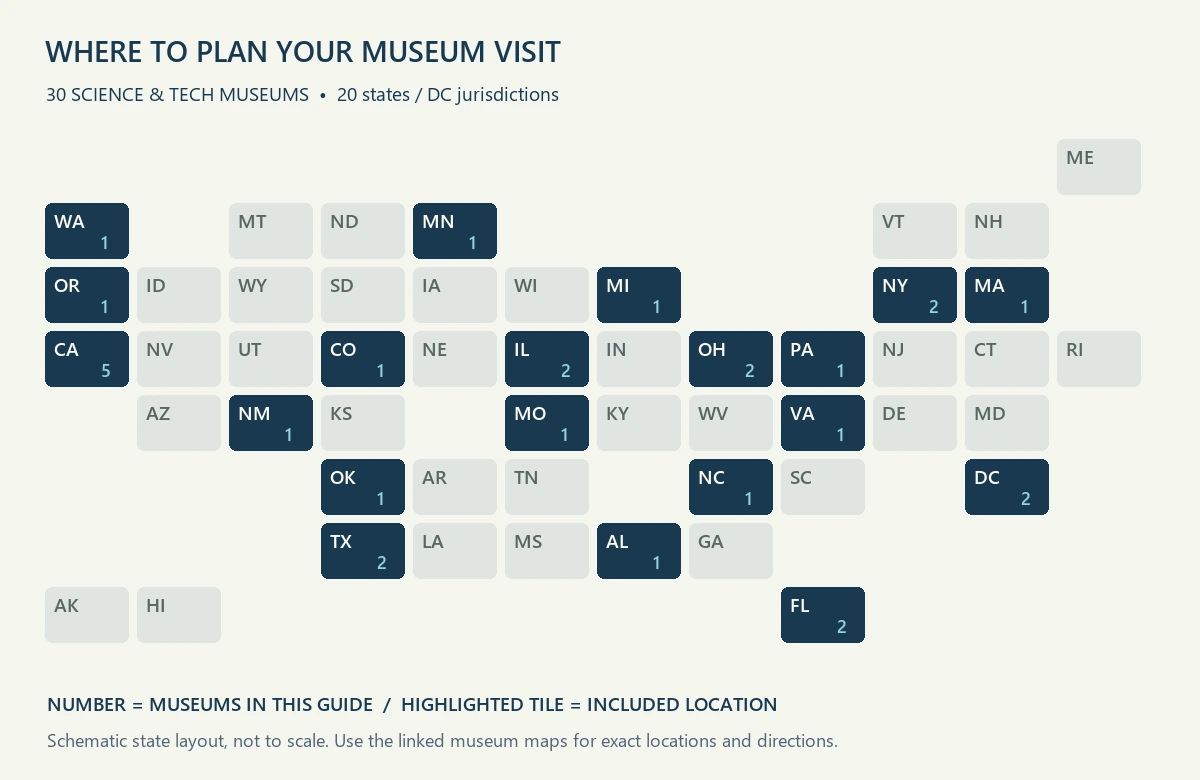
Museum map & regional planning
Interactive science & engineering
1. Exploratorium
San Francisco, CA · Interactive science
Admission: Paid · Time to allow: 3–4 hours (editorial estimate)
This is a strong choice for visitors who want to test an idea repeatedly. Change one variable at a hands-on exhibit, predict the result and try again. Light and perception are especially useful reminders that an intuitive answer can differ from what a careful observation actually shows.
Start with: Hands-on investigations of light, perception and physical phenomena.
Plan the visit: Check dated tickets; Tactile Dome needs reservation. After Dark events are for ages 18 and over. The daytime museum is the family option.
2. California Science Center
Los Angeles, CA · Science
Admission: Free permanent exhibits; IMAX paid · Time to allow: 2–3 hours (editorial estimate)
Choose this Los Angeles stop for hands-on investigation without a general-admission charge. The practical distinction in 2026 is that Endeavour is off display: a free science visit is still possible, but it is not currently a shuttle-viewing trip. Budget separately if an IMAX film is part of the plan.
Start with: Hands-on science exhibits.
Plan the visit: No general reservation; groups of 20+ reserve. Space shuttle Endeavour is off display until the new center opens. Do not plan a visit around seeing it now.
3. Griffin Museum of Science and Industry
Chicago, IL · Science and engineering
Admission: Paid; some experiences extra · Time to allow: 3–5 hours (editorial estimate)
Science Storms, a submarine and model rail transport invite different engineering questions. Distinguish a demonstration of a physical phenomenon from a machine built to solve a practical problem. The U-505 experience has separate ticket layers, so decide whether viewing the exhibit or touring onboard matches your interest.
Start with: Science Storms; U-505; Great Train Story; Idea Factory.
Plan the visit: Check separate experience tickets. U-505 onboard tours require an extra ticket beyond general admission.
Official visitor information · Collection / exhibits · Open location in Google Maps
4. Museum of Science
Boston, MA · Interactive science
Admission: Paid · Time to allow: 3–4 hours (editorial estimate)
The Engineering Design Workshop rewards building, testing and revising instead of seeking one quick correct answer. Exploring AI offers another route into how technologies interpret information. Link those experiences with human biology or the Charles River material to build a visit around systems and their limits.
Start with: Engineering Design Workshop; Exploring AI; Hall of Human Life.
Plan the visit: Check admission and show tickets. Choose a few exhibit areas, then fit scheduled presentations around them.
Official visitor information · Collection / exhibits · Open location in Google Maps
5. Saint Louis Science Center
St. Louis, MO · Science
Admission: Free general admission · Time to allow: 2–3 hours (editorial estimate)
A free general visit can still support a substantial science itinerary. GROW and Life Science Lab give biology a practical direction, while hands-on exhibits encourage experimentation. Choose the included experiences first, then evaluate separately ticketed options so a low-cost plan does not accumulate unplanned extras.
Start with: Hands-on science; GROW; Life Science Lab.
Plan the visit: Check ticketing for additional experiences. Free general entry does not establish that every show, activity or parking option is free.
6. Science Museum of Minnesota
St. Paul, MN · Science
Admission: Paid; under 4 free · Time to allow: 2–3 hours (editorial estimate)
Pair hands-on investigation with an Omnitheater film for two different ways of encountering scientific ideas. A film can supply scale and context, while exhibits let you linger over a question. Review show choices before arrival so the included screening supports your interests rather than interrupting them.
Start with: Hands-on science; Omnitheater.
Plan the visit: Tickets online, by phone or on arrival. One Omnitheater film is included with admission. The parking garage costs extra.
7. Oregon Museum of Science and Industry
Portland, OR · Science and technology
Admission: Paid; some experiences extra · Time to allow: 2–3 hours (editorial estimate)
Labs, engineering-oriented spaces and a submarine make OMSI useful for comparing experiment and application. Select the main museum or a separately ticketed experience with intention. The Physics Lab’s autumn closure matters in 2026; use the current exhibit list to avoid promising a laboratory activity that is unavailable.
Start with: Science Playground; Turbine Hall; natural science labs; USS Blueback.
Plan the visit: Check separate submarine, theater and planetarium tickets. The Physics Lab is closed September 8–November 14, 2026.
Official visitor information · Collection / exhibits · Open location in Google Maps
8. COSI
Columbus, OH · Interactive science
Admission: Paid; under 2 free · Time to allow: 3–4 hours (editorial estimate)
Progress compares technological life in two periods, while Ocean and Gadgets invite different forms of investigation. Together they make a useful argument that technology is both machinery and everyday practice. Allow time to connect an interactive activity to the question it models, rather than moving on after pressing a button.
Start with: Dinosaur Gallery; Ocean; Gadgets; Progress; little kidspace.
Plan the visit: Check advance online tickets. Allow separate time for young children’s play and the larger science galleries.
Official visitor information · Collection / exhibits · Open location in Google Maps
9. The Franklin Institute
Philadelphia, PA · Science
Admission: Paid; special exhibitions may cost extra · Time to allow: 3–4 hours (editorial estimate)
Body Odyssey and Wondrous Space offer a productive contrast between the human scale and the astronomical one. Planetarium and live-science programs can deepen that route when their schedules align. Choose one timed presentation and leave the rest flexible enough for exhibits that unexpectedly hold your attention.
Start with: Wondrous Space; Body Odyssey; Fels Planetarium.
Plan the visit: Check exhibition-specific tickets. General admission includes planetarium shows, live science and the observatory, subject to availability.
10. Perot Museum of Nature and Science
Dallas, TX · Natural science and engineering
Admission: Paid; 3D films and special exhibitions extra · Time to allow: 2–3 hours (editorial estimate)
Engineering and Innovation, fossil material and Earth or space themes let visitors connect scientific evidence with design. A useful route follows one question across halls, such as how a model helps explain something too large or old to observe directly. Films and special exhibitions have separate costs.
Start with: Life Then and Now; Engineering and Innovation; children’s museum.
Plan the visit: Timed admission tickets. Closed Tuesdays through April 7, 2027, with holiday exceptions. Parking is paid.
Official visitor information · Collection / exhibits · Open location in Google Maps
11. Science Museum Oklahoma
Oklahoma City, OK · Interactive science
Admission: Paid; under 3 free · Time to allow: 3–4 hours (editorial estimate)
The Tinkering Garage is a good anchor for visitors who learn by testing and revising. Destination Space adds a spaceflight direction, while the planetarium changes perspective. A Mercury simulator is an interpretive experience, not a claim to a flown spacecraft; keep that distinction in mind when comparing museums.
Start with: CurioCity; Tinkering Garage; KidSpace; Destination Space.
Plan the visit: Check current tickets. Admission includes Love’s Planetarium and Science Live. Certain traveling exhibits can cost extra.
Official visitor information · Collection / exhibits · Open location in Google Maps
Space & aviation
12. National Air and Space Museum
Washington, DC · Aviation and space
Admission: Free general admission · Time to allow: 3–4 hours (editorial estimate)
The Wright Flyer and Apollo 11’s Columbia let visitors compare two very different problems: powered flight and travel beyond Earth. Use the objects to ask what had to be controlled, carried and protected. This is an artifact-rich visit; leave time to read the engineering context instead of only photographing famous machines.
Start with: 1903 Wright Flyer; Apollo 11 command module Columbia; How Things Fly.
Plan the visit: Free timed pass required. This is the National Mall location, not the separate Virginia center.
13. Steven F. Udvar-Hazy Center
Chantilly, VA · Aviation and space
Admission: Free general admission · Time to allow: 3–4 hours (editorial estimate)
Discovery, an SR-71 and Concorde make an unusually effective comparison of mission, speed and design. Their different purposes explain why aircraft and spacecraft do not converge on one ideal shape. Treat the Virginia center as a separate destination, with enough time to study the machines at more than one angle.
Start with: Space Shuttle Discovery; SR-71; Concorde.
Plan the visit: No general admission pass required. This Virginia center is a separate trip from the National Mall museum.
14. National Museum of the United States Air Force
Dayton, OH · Aviation
Admission: Free general admission · Time to allow: 3–5 hours (editorial estimate)
Military aircraft can be read as responses to different constraints: range, payload, speed and the demands of a particular mission. Select one period to study rather than trying to retain every model name. Historical interpretation is essential; technical achievement and the consequences of military use belong in the same conversation.
Start with: Military aviation galleries and aircraft.
Plan the visit: Check current visitor and event arrangements. Choose a historical period before entering the large aircraft galleries.
15. Kennedy Space Center Visitor Complex
Merritt Island, FL · Space
Admission: Paid; paid parking · Time to allow: A full day (editorial estimate)
Atlantis and the Apollo/Saturn V Center make this a destination for understanding the scale of human spaceflight. Compare vehicles built for different missions rather than treating them as interchangeable rockets. Reserve most of a day, account for the bus component and separate museum access from any hoped-for launch viewing.
Start with: Space Shuttle Atlantis; Apollo/Saturn V Center; Apollo 14 command module.
Plan the visit: Advance purchase recommended. Bus access and operations can change. A museum ticket is not a guarantee of seeing a launch.
16. Space Center Houston
Houston, TX · Space
Admission: Paid; Historic Mission Control tour costs extra · Time to allow: 4–6 hours (editorial estimate)
A Saturn V and access to NASA-related tram experiences connect displayed hardware with the work behind missions. The tram routes have different booking rules, particularly Historic Mission Control. Decide which experience matters before choosing tickets, and keep expectations flexible because this is linked to a working space facility.
Start with: Rocket Park Saturn V; NASA tram experiences.
Plan the visit: Timed admission; reserve Historic Mission Control ahead. Included tram routes are subject to availability. Training Facility passes are obtained onsite; strollers cannot go on tram tours.
Official visitor information · Collection / exhibits · Open location in Google Maps
17. The Museum of Flight
Seattle, WA · Aviation and space
Admission: Paid; first Thursday evenings free · Time to allow: 3–4 hours (editorial estimate)
Use the aircraft and APOLLO material to compare flight within the atmosphere with travel beyond it. A focused visit can follow propulsion, crew experience or mission design. Choose a small number of machines to understand well instead of reducing a large collection to a list of models photographed.
Start with: Aircraft galleries; APOLLO exhibit.
Plan the visit: Check ticket options for your date. Free general admission on the first Thursday, 5–9 p.m. Parking is free.
Official visitor information · Collection / exhibits · Open location in Google Maps
18. Intrepid Museum
New York, NY · Aviation and naval history
Admission: Paid; Concorde interior tour extra · Time to allow: 3–4 hours (editorial estimate)
An aircraft carrier places aviation inside a larger system of launch, recovery and life at sea. Compare that setting with the Space Shuttle Pavilion and Growler submarine. Access and interior-tour rules differ, so check the exact experience included before assuming every visible aircraft or vessel can be entered.
Start with: Aircraft carrier; Space Shuttle Pavilion; Growler submarine; Exploreum.
Plan the visit: Advance timed tickets recommended. Check October gallery closures. General admission includes the pavilion and submarine, subject to access.
19. USS Midway Museum
San Diego, CA · Naval aviation
Admission: Ticketed museum; check current admission options · Time to allow: 3–4 hours (editorial estimate)
A carrier is an engineering system as much as an aircraft display. Connect the flight deck with engine-room interpretation to consider how power, maintenance and crew coordination support operations. The ship’s indoor and outdoor spaces create different physical conditions, making weather and personal mobility part of planning.
Start with: Carrier flight deck; restored aircraft; engine-room exhibits.
Plan the visit: Check official ticket availability. Plan for both exposed outdoor decks and interior ship spaces.
20. U.S. Space & Rocket Center
Huntsville, AL · Space and engineering
Admission: Paid; ages 4 and under free · Time to allow: 3–5 hours (editorial estimate)
The Saturn V Hall provides a powerful starting point for thinking about scale, stages and the engineering required for spaceflight. Spark!Lab offers a contrasting hands-on mode. Plan around the current attraction list, and check planetarium choices separately instead of assuming every experience belongs to one general ticket.
Start with: Saturn V Hall; Rocket Park; Spark!Lab; ISS Science on Orbit.
Plan the visit: Check general admission and show options. Check separate planetarium ticket choices and current attraction availability.
Computing, innovation & atomic science
21. Computer History Museum
Mountain View, CA · Computing
Admission: Ticketed museum; check current admission options · Time to allow: 2–3 hours (editorial estimate)
Revolution places computing in a longer history, while Make Software explores how programs alter everyday tasks. The combination is valuable because hardware alone cannot explain computing. If a working-system demonstration matters, consult its schedule; an IBM 1401 demonstration is a timed opportunity, not a continuous exhibit guarantee.
Start with: Revolution; Make Software: Change the World!; IBM 1401 demonstrations.
Plan the visit: Check tickets and demonstration calendar. Closed Mondays and Tuesdays; also closed October 22, 2026 for a private event.
Official visitor information · Collection / exhibits · Open location in Google Maps
22. Henry Ford Museum of American Innovation
Dearborn, MI · Technology and social history
Admission: Paid · Time to allow: 3–5 hours (editorial estimate)
Transportation, manufacturing and everyday objects make innovation a social as well as technical subject. Compare the Dymaxion House with Driving America, then consider who gains access to a design and how it changes daily life. The Rosa Parks bus adds an essential reminder that technology also carries human history.
Start with: Rosa Parks bus; Dymaxion House; Driving America; Mathematica.
Plan the visit: Choose the museum ticket you need. Greenfield Village and the Ford Rouge Factory Tour are separate experiences.
23. National Museum of Nuclear Science & History
Albuquerque, NM · Science and history
Admission: Paid; Artifact Center extra · Time to allow: 2–3 hours (editorial estimate)
Atomic science belongs in a conversation about applications, decisions and consequences. Use the museum’s historical interpretation to distinguish scientific principles from the choices made with them. Heritage Park adds an outdoor component, but its uneven surfaces and the weather can affect how much of the grounds fits your visit.
Start with: Atomic science and history; outdoor Heritage Park.
Plan the visit: Advance tickets recommended. Outdoor surfaces are uneven. Consider weather when splitting indoor and outdoor time.
Natural science, fossils & living systems
24. Smithsonian National Museum of Natural History
Washington, DC · Natural history
Admission: Free general admission · Time to allow: 3–4 hours (editorial estimate)
Natural history works best here as an investigation of evidence. Fossils in Deep Time, marine material and minerals offer different records of Earth’s past and present. Choose one question—how environments change, for example—and follow it across galleries rather than assuming every spectacular specimen tells the same story.
Start with: Deep Time fossil hall; Hope Diamond; Ocean Hall.
Plan the visit: No admission pass required. Strollers are welcome; there is no indoor space for eating a packed lunch.
25. California Academy of Sciences
San Francisco, CA · Natural science
Admission: Paid · Time to allow: 3–5 hours (editorial estimate)
The combination of aquarium, rainforest and natural-history interpretation encourages connections between living organisms and their environments. A planetarium adds a change in scale, but it has reservation and age rules. Plan the sequence deliberately so a timed show does not turn the biological exhibits into a rushed corridor.
Start with: Aquarium; rainforest; planetarium; living roof.
Plan the visit: Check date-specific tickets. Planetarium reservations required; children under 4 cannot attend. Closed October 21, 2026, and closes early October 24.
Official visitor information · Collection / exhibits · Open location in Google Maps
26. North Carolina Museum of Natural Sciences
Raleigh, NC · Natural science
Admission: Free general admission; optional donation · Time to allow: 2–3 hours (editorial estimate)
The distinction between exploring nature and researching it is useful here. Organize your visit around the Nature Exploration and Nature Research centers, paying attention to how questions become investigations. Use the downtown visitor information; Prairie Ridge is a separate site and is closed until 2027.
Start with: Nature Exploration Center; Nature Research Center.
Plan the visit: Check program registration. This listing covers downtown Raleigh. Prairie Ridge is closed until 2027.
27. American Museum of Natural History
New York, NY · Natural history
Admission: Paid; New York residents may pay what they wish · Time to allow: 3–5 hours (editorial estimate)
Fossils provide evidence, not simply impressive skeletons. Use the museum’s natural-history displays to consider how scientists reconstruct organisms and environments from incomplete material. Apex offers a stegosaurus focus within a much broader visit. Select another gallery to avoid making natural science synonymous only with dinosaurs.
Start with: Fossil halls; Apex stegosaurus; natural history galleries.
Plan the visit: Check admission and timed-experience tickets. Resident pay-what-you-wish admission is not a blanket free policy for all visitors.
28. Field Museum
Chicago, IL · Natural history
Admission: Paid; under 3 free · Time to allow: 3–4 hours (editorial estimate)
Evolving Planet provides a framework for asking how life changes over deep time, with SUE a notable collection highlight. Gems introduce different questions about materials and formation. Keep cultural exhibitions such as Native Truths distinct from biological classification: their interpretation concerns people, history and living communities.
Start with: SUE in Evolving Planet; Native Truths; Grainger Hall of Gems.
Plan the visit: Advance tickets recommended. Illinois residents receive free basic admission Wednesdays with identification; reserve ahead.
Official visitor information · Collection / exhibits · Open location in Google Maps
29. Denver Museum of Nature & Science
Denver, CO · Natural science
Admission: Paid · Time to allow: 2–3 hours (editorial estimate)
Denver’s natural-history focus works well for travelers interested in how collections support scientific understanding. Build a route around available paleontology and related galleries rather than a single specimen. Check the live closure calendar first; a named museum department does not mean every associated gallery is accessible on your date.
Start with: Natural history; paleontology; scientific collections.
Plan the visit: Check date-specific admission and show availability. Check the current closure calendar and individual gallery status before traveling.
30. Phillip and Patricia Frost Museum of Science
Miami, FL · Science and aquarium
Admission: Paid; ages 3 and under free · Time to allow: 3–4 hours (editorial estimate)
An aquarium and planetarium make Frost a useful place to compare systems at very different scales. The Explorer ticket’s one included show still depends on onsite availability. Choose a show early in your visit, then allow the aquatic exhibits and science galleries enough time to become more than transitions.
Start with: Aquarium; science galleries; planetarium.
Plan the visit: Check Explorer ticket availability. Explorer includes one planetarium show subject to onsite availability. Parking is paid.
Official visitor information · Collection / exhibits · Open location in Google Maps
Pick the kind of science experience you want
For repeated hands-on testing, start with the Exploratorium, Boston’s Museum of Science, COSI or Science Museum Oklahoma. For computing and industrial change, compare the Computer History Museum and Henry Ford Museum. Natural-history destinations use specimens and interpretation; their collections should not be confused with an all-hands-on play environment.
Space and aviation museums need particular care with names and locations. The National Mall Air and Space Museum and Udvar-Hazy Center are separate trips. Kennedy Space Center, Space Center Houston and Huntsville’s U.S. Space & Rocket Center offer different objects and operational experiences; a shared space theme does not make their tickets interchangeable.
Distinguish original artifacts from replicas, simulators and models. A display may explain the same engineering principle without having flown a mission. Museum labels and official exhibit pages should guide that distinction. The California Science Center currently has no public view of Endeavour, even though older travel articles may still promote it.
Check what a general ticket actually includes. Films, planetariums, submarine interiors and NASA tram routes can require an additional fee or a separate booking. Allow time for timed experiences without sacrificing the main galleries. If visiting with children, choose activities by their interests and the institution’s actual restrictions.
Continue planning with DayZora
Best U.S. museums · Free museum admission · Museums for kids and families · Art museum collections
Build the rest of your itinerary: New York City travel guide · Los Angeles travel guide · San Francisco travel guide · Miami travel guide. Check actual travel times before combining attractions.
How we selected and checked these museums
DayZora selected these institutions for collection or exhibit significance, educational value, distinct visitor experiences and geographic variety. This is an editorial shortlist, not a measured national ranking or a claim of personal visits. Official visitor pages, collection records and current institutional notices support the practical facts. Each entry links to its sources.
We checked dynamic information on October 2, 2026. Admission is described by policy instead of flattening resident, child, exhibition and timed-entry prices into one misleading dollar figure. Museums with material closures retain a clear caution; closed institutions are not presented as open. Recheck the institution before departure, especially for a specific artwork, show or free-admission window.
Frequently asked questions
Which science museums have free general admission?
Listed examples include Smithsonian Natural History, both Air and Space locations, California Science Center’s permanent exhibits, Saint Louis Science Center, North Carolina Museum of Natural Sciences and the National Museum of the U.S. Air Force. Passes and extras vary.
Is Endeavour on display at California Science Center?
Not on the October 2, 2026 check date. It is off display pending the new center. Do not choose this visit specifically to see the shuttle until the institution confirms public access.
Is a simulator the same as an original spacecraft?
No. A simulator is an interpretive or training experience. Original artifacts, replicas and models serve different purposes; read exhibit labels and official descriptions rather than assuming every vehicle-shaped object flew a mission.
Does space-center admission include a launch?
No launch viewing should be assumed from an ordinary museum ticket. Operations, schedules, viewing arrangements and cancellations are separate. Plan for the museum experiences you have actually booked.
Are films, submarines and tram tours included?
It depends on the museum and ticket. Some are included, some require a separate reservation and others cost extra. Space Center Houston’s Historic Mission Control tour is an advance-booked paid addition; other tram routes follow different arrangements.