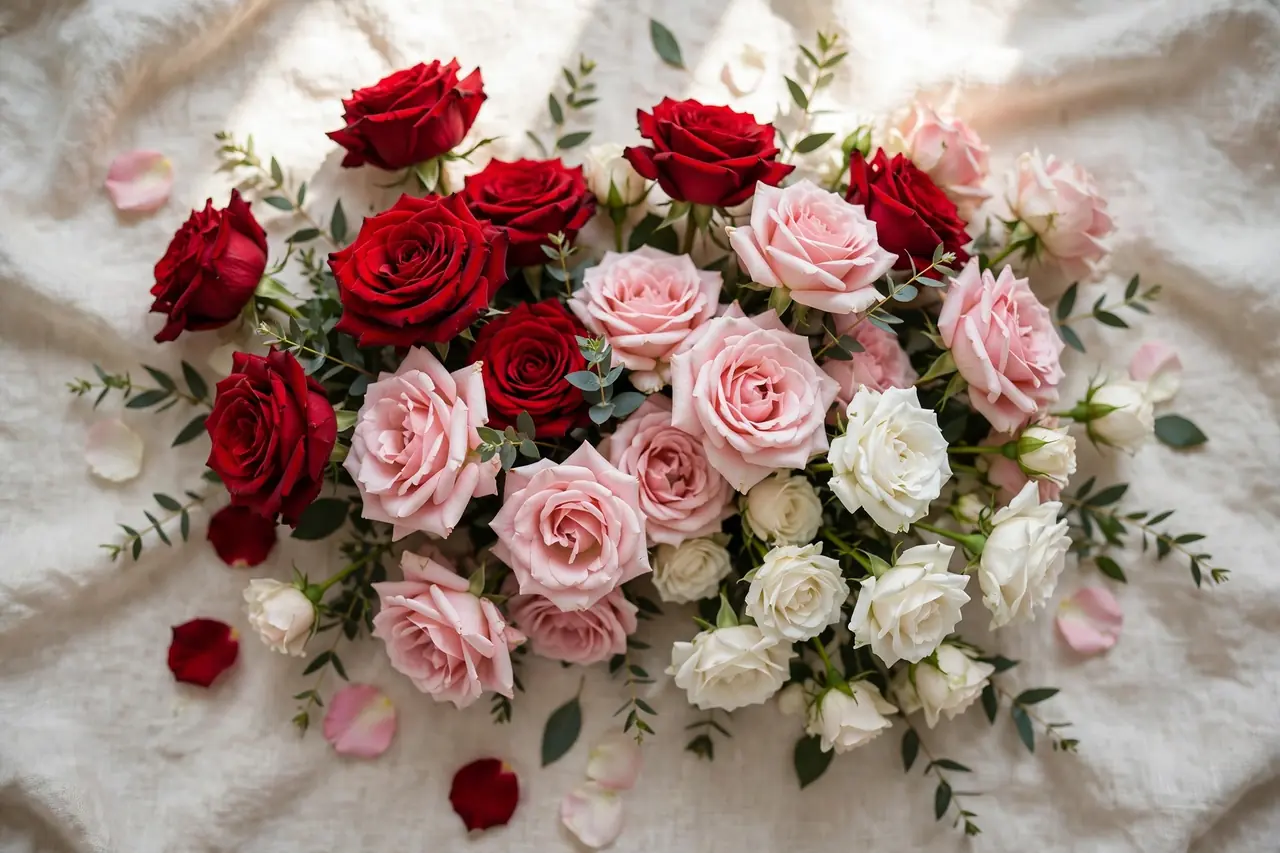
Not all roses are created equal, and on Rose Day the difference matters. A $15 grocery-store dozen and a $60 florist dozen may both be “red roses,” but they differ in stem length, bloom size, freshness, fragrance, and how many days they will survive — differences your recipient will notice even if they cannot name them. Choosing the best roses to give is not about spending the most money. It is about knowing what quality looks like, which varieties perform best, and how to match the rose to the person and the moment.
This guide covers everything: the five main types of gift roses and how they compare, the best specific varieties for Rose Day (in red and beyond), how to judge quality like a florist, what different budgets actually buy, and how presentation multiplies the perceived value of any bouquet. Whether you are buying a single perfect stem or a showstopping arrangement, you will know exactly what to ask for — and what to avoid. And because the rose is only half the gesture, you will also learn how timing, presentation, and the words on the card turn a good bouquet into an unforgettable one.

What Makes a Rose “the Best” for Gifting
Florists judge gift roses on five criteria, and you can too. Freshness is first and non-negotiable: a rose cut yesterday beats a premium variety cut a week ago, every time. Check the sepals (the green leaf-like parts under the bloom should hug upward), squeeze the bud (firm, not squishy), and look for vibrant, unspotted leaves. Stem length and straightness come next: long, straight stems signal premium grading and display beautifully; crooked or short stems suggest lower grades.
Bloom stage matters enormously for gifting. The ideal gift rose is in tight bud to just-cracking — showing color but not yet open. It will open over the next few days, giving the recipient the pleasure of watching it bloom. Fully open roses look spectacular for about 24 hours and then decline; they are for tonight’s dinner table, not for a gift meant to last the week. Bloom size and form follow: high-centered, symmetrical blooms with many petals (40+ in premium hybrid teas) read as luxurious. And fragrance, while not universal in modern varieties, transforms the gift — a rose that smells like a rose creates a multisensory memory that scentless stems cannot.
The honest hierarchy: freshness beats variety, variety beats stem length, and stem length beats everything else people overpay for. A fresh, well-chosen grocery-store rose outperforms a stale “premium” one every time — which is why the inspection skills in this guide matter more than the brand on the box. Keep this hierarchy in mind at the shop and you will never be upsold into disappointment: check the freshness first, choose the variety second, and let stem length be the tiebreaker, not the headline.
The Main Types of Gift Roses, Compared
| Type | What it is | Best for | Typical vase life |
|---|---|---|---|
| Hybrid tea | The classic long-stem rose; large, high-centered single blooms | The traditional romantic bouquet | 10–14 days |
| Spray roses | Multiple small blooms per stem; delicate and abundant | Mixed arrangements, softer looks | 7–10 days |
| Garden roses | Old-fashioned, cupped, intensely fragrant blooms | Luxury gifting, fragrance lovers | 5–7 days |
| Sweetheart roses | Miniature blooms on short stems | Corsages, small posies, accents | 7–10 days |
| Long-stem (graded) | Hybrid teas graded 24″+; premium presentation | Grand romantic gestures, proposals | 10–14 days |
For Rose Day, hybrid teas are the default for good reason: they are bred specifically for the qualities gift-givers want — large blooms, long straight stems, excellent vase life, and reliable availability in every color. Garden roses are the connoisseur’s choice — their fragrance and romantic cupped form are unmatched, but they cost more and fade faster, so give them when the experience of the next three days matters more than the next ten. Spray roses are the arranger’s secret weapon: a bouquet mixing long-stem reds with red spray roses looks twice as abundant for a fraction of the cost of all long-stems.
Sweetheart roses deserve a special mention for Rose Day gifting: their miniature blooms are perfect for small, intimate gestures — a tiny posy tucked into a lunch bag, a single short stem in a bud vase on a desk, a corsage-style wrist arrangement for a Rose Day dance. Because they are inexpensive, they are also ideal for high-volume giving: a teacher giving a rose to every student, or someone decorating a whole dinner table. Do not overlook them just because they are small; their charm is precisely their scale.
Long-Stem vs. Regular: Is Longer Actually Better?
The “long-stem rose” mystique deserves scrutiny. In the trade, stem length is a grading standard: premium roses are cut at 24 inches and up, standard at 18–24, short under 18. Longer stems correlate with larger blooms and better vase life because they come from the strongest canes of the plant — but the correlation is not perfect, and the price premium for 24-inch stems over 18-inch stems is often 50–100%.
Here is the practical truth: stem length matters most for presentation, not for the flower’s intrinsic quality. A 24-inch rose in a tall vase is dramatic; the same bloom on an 18-inch stem in a lower arrangement is equally beautiful. If you are giving roses to be displayed in a grand vase or carried in a presentation bouquet, long stems earn their premium. If the roses will go into a regular table vase at home, standard stems — fresh and well-chosen — deliver 95% of the experience for far less money. Never pay the long-stem premium for roses that will be cut down to fit a short vase; that is literally paying to throw away stem.
One more grading note: ask for “number one grade” if buying from a wholesaler or serious florist. Grade 1 roses have straight stems, unblemished blooms, and full foliage; Grade 2 may have slight bends or minor petal imperfections. The visual difference is small but the price difference can be significant — Grade 2 roses are the smart buyer’s secret for abundant mixed arrangements where no single stem is under scrutiny.
The Best Red Rose Varieties for Rose Day
Variety names are the insider language of rose quality. These red varieties are florist favorites for gifting — ask for them by name at a good flower shop:
“Red Naomi” / “Naomi.” The industry standard for premium red roses: large, velvety, deep red blooms with excellent vase life and a light fragrance. If a florist’s “premium red” is not Naomi, ask what it is — the answer tells you a lot about the shop.
“Freedom.” The workhorse of the red rose trade: reliably long stems, classic high-centered form, strong vase life, widely available. Less velvety than Naomi but more consistent — the Toyota of red roses, meant as high praise.
“Black Baccara.” The darkest red rose in common trade, appearing nearly black in bud and opening to deep burgundy-red. Dramatic, moody, unforgettable — for the recipient with dramatic taste. Note the shorter vase life than standard reds; buy the freshest available.
“Grand Amore” / “Red Paris.” Large-headed varieties with excellent opening form — the blooms unfurl into spectacular wide cups. Choose these when the bouquet will be photographed (proposals, grand gestures); they are bred for the camera.
Do not stress if your shop does not carry these exact names — variety availability varies by region and season. What matters is asking the question: a florist who can name their varieties is a florist who cares about quality, and that care extends to freshness, handling, and arrangement. The variety name is a proxy for the shop’s standards.
The Best Varieties Beyond Red
Rose Day is red’s holiday, but the best rose is sometimes not red at all. For pink lovers, “Sweet Avalanche” (soft blush pink, excellent vase life) and “Pink Floyd” (vivid pink, strong stems) are florist staples. For white, “Avalanche” (pure white, large blooms) and “Polar Star” are the standards — elegant and reliably fresh. Yellow seekers should ask for “High Yellow Flame” or “Stardust”; for peach and orange, “Free Spirit” (a stunning orange-pink bicolor) and “Peach Avalanche” are showstoppers.
Lavender and purple varieties — “Ocean Song,” “Blue Moon” — are harder to find but unforgettable when you do; call ahead. And for the fragrance-obsessed, garden rose varieties like “Juliet” (peach, David Austin), “Patience” (soft yellow), and “Keira” (blush pink) deliver the old-rose scent that modern hybrid teas sacrificed for vase life. If your recipient is the kind of person who buries their nose in every bouquet, garden roses are worth the shorter vase life and higher price — the scent is the gift. To get the meaning right alongside the variety, our guide to Valentine’s Day symbols and their meanings pairs each color with its message.

Choosing Roses by Recipient
| Recipient | Best choice | Why |
|---|---|---|
| Romantic partner / spouse | Dozen long-stem reds (“Red Naomi” or “Freedom”) | The undisputed classic; says everything |
| New crush / early dating | 3–6 stems, pink or peach garden roses | Warm and fragrant without red’s pressure |
| Close friend | Mixed bouquet with yellow, pink, orange | Celebratory and clearly platonic |
| Parent / grandparent | Pink or mixed pastel spray roses | Gentle, abundant, long-lasting |
| Someone who “has everything” | Rare variety: garden roses or “Black Baccara” | Novelty and connoisseurship impress where luxury does not |
| Apology | 15 red roses, premium grade | The traditional apology count, executed flawlessly |
| Long-distance partner | Farm-direct long-stems in bud stage | Tight buds survive shipping and open on arrival |
How to Judge Quality at the Shop: The 60-Second Inspection
You now know the theory; here is the practice. At the shop, run this inspection in under a minute. Sepals up? The green pointed sepals under each bloom should angle upward, hugging the bud — drooping sepals mean age. Bud firm? Gently squeeze the base of the bud; it should feel solid and springy, never soft or hollow. Stems clean? Cut ends should look fresh, not brown or slimy; foliage should be deep green, not yellowing.
Petals intact? Outer petals may have minor blemishes (florists remove guard petals during arranging), but avoid blooms with browning edges or bruised patches. Smell test: if fragrance matters to you, smell the actual bouquet — variety and freshness determine scent, not color. Ask the question: “When did these come in?” A good florist answers proudly; a evasive answer is itself an answer. And check the water in the display buckets — clean, clear water signals a shop that handles flowers properly; murky water signals one that does not.
For grocery-store roses, apply the same tests with lower expectations and sharper eyes — good stems exist in supermarkets, but so does old stock, and the difference is entirely on you to detect. Buy the bouquets from the newest delivery (ask staff), avoid anything displayed near the entrance heaters, and plan to re-cut and feed immediately at home. A $15 grocery bouquet chosen with a florist’s eye routinely outperforms a $40 florist bouquet chosen blind.
Budget Tiers: What Your Money Actually Buys
| Budget | What to buy | Expected result |
|---|---|---|
| $12–$20 | Single premium stem or small grocery bouquet, carefully selected | One perfect rose beats a mediocre dozen; presentation is everything |
| $25–$45 | Half-dozen to dozen standard roses from a good florist, or farm-direct online | The sweet spot: real quality without the premium markup |
| $50–$80 | Dozen long-stem premium varieties, hand-tied, boxed | The classic grand gesture; impressive and long-lasting |
| $100+ | Two dozen+ premium, garden roses, or rare varieties with luxury wrapping | Spectacle territory; match the gesture to the milestone |
The best value in roses is almost always the tier below what you were going to spend, executed perfectly: a $35 half-dozen of fragrant garden roses, hand-delivered with a real letter, will be remembered longer than a $90 two-dozen ordered in a panic. Money buys stems; thought buys meaning. If you are building a bigger gift around the flowers, our gifts for her guide and gifts for him guide show how to pair roses with presents that complement rather than compete.
Presentation: The Wrapping Is Half the Gift
Florists know that presentation multiplies perceived value: the same dozen roses in a plastic sleeve versus hand-tied in kraft paper with ribbon and greenery can feel like a $20 difference. If your roses come plainly wrapped, upgrade them yourself in five minutes: remove the plastic, re-trim the stems evenly, wrap in kraft paper or a linen tea towel, tie with ribbon or twine, and tuck in a sprig of eucalyptus or ruscus (available at any florist for a dollar or two). Add a handwritten card — not a printed gift tag, a real card with real sentences.
For the grand presentation, consider the “rose box”: roses cut short and arranged tightly in a hatbox or keepsake box, blooms facing up in a dense dome. It is the most photogenic format in modern gifting, it needs no vase, and it reads as pure luxury. Many florists offer it; DIY versions need only a box, floral foam, and patience. Whatever format you choose, deliver the roses in water or have the recipient put them in water within the hour — a spectacular bouquet left to wilt in a hot car undoes everything the variety and wrapping achieved.
Do not forget the card — it is presentation too. A $60 bouquet with a blank card feels transactional; a $20 bouquet with a heartfelt handwritten note feels priceless. Write two or three specific sentences: what you admire, a shared memory, what you are looking forward to. Specificity is the difference between a card that gets kept and a card that gets recycled. If words are hard, borrow them honestly — a favorite quote attributed properly beats a generic “Happy Rose Day” every time, and our romantic quotes collection has lines worth stealing (with credit to the sentiment, if not the author).
Beyond Fresh-Cut: Preserved Roses and Subscriptions
Fresh-cut roses are the classic, but they are not the only way to give roses — and for some recipients, they are not even the best way. Preserved roses (real roses treated with a glycerin-based solution that keeps them supple for a year or more) have become a major gifting category. They arrive in elegant hatboxes, need no water, and sit on a desk or shelf as a permanent reminder. The trade-off: they have no fragrance, they feel slightly different to the touch, and they cost significantly more per stem than fresh roses. Give preserved roses when the recipient travels constantly, dislikes maintenance, or would treasure a lasting object over a fleeting one.
Dried roses are the budget-friendly permanent option: hang fresh roses upside down in a dark, dry place for two weeks and they keep their shape and much of their color indefinitely. A bouquet of dried roses in a beautiful vase is a legitimate décor gift, especially in bohemian or vintage-styled homes. Rose subscriptions — monthly or seasonal deliveries from farm-direct services — are the gift that keeps giving: instead of one bouquet that fades, the recipient gets fresh roses arriving regularly for months. For a partner who loves flowers, a three-month rose subscription often delights more than a single extravagant bouquet, and the per-delivery cost is usually reasonable.
There is also the living option: a potted miniature rose plant, which blooms repeatedly with basic care. It suits gardeners, the eco-conscious, and anyone who finds cut flowers wasteful. Pair it with a nice pot and care instructions, and it becomes a gift that grows — literally. For plant-loving recipients generally, our gifts for plant lovers guide has more living-gift ideas that pair beautifully with Rose Day.
Watch: 12 Great Rose Varieties for Bouquets
See top-performing rose varieties — including their vase life, fragrance, and form — compared side by side by a rose grower, so you know exactly what to ask for.
The Ethics of Rose Buying: What Conscious Givers Should Know
Roses are a global commodity, and conscious buyers should know where theirs come from. The majority of roses sold in the US are grown in Colombia and Ecuador, where the high-altitude equatorial climate produces excellent blooms year-round; roses sold in Europe come largely from Kenya and the Netherlands. This global supply chain is what makes fresh roses affordable in February — but it also means your bouquet has a carbon footprint and a labor story.
If these matter to you, look for certifications: Fair Trade Certified and Rainforest Alliance labels on roses indicate audited labor and environmental standards on the farms. Many farm-direct online sellers publish their sourcing transparently. Alternatively, buy local and seasonal: in warmer US states, domestic roses are available much of the year, and a local florist who buys from regional growers shortens the supply chain dramatically. The blooms may be less uniform than imported hybrid teas, but many buyers find the character — and the story — worth it.
A final ethical note: waste. Valentine’s week generates enormous floral waste, as unsold stock is discarded. You can push back gently by buying exactly what you need, composting spent blooms, and choosing potted or preserved roses when they suit the recipient. The most sustainable bouquet is the one that gets fully enjoyed — which brings us back to the core principle of this guide: choose well, choose fresh, and choose for the person. Nothing is wasted when the gift is right.
Best Roses to Give on Rose Day: Frequently Asked Questions
What are the best roses to give on Rose Day?
For a romantic partner: a dozen long-stem red hybrid teas (“Red Naomi” or “Freedom”) from a reputable florist, bought in tight bud. For new relationships: 3–6 fragrant pink or peach garden roses. For friends: cheerful mixed bouquets with spray roses. Freshness matters more than variety — inspect before you buy.
Are long-stem roses better than regular roses?
For presentation, yes — long straight stems look dramatic and grade higher. For the flower itself, not necessarily; a fresh standard-stem rose equals a long-stem bloom in beauty and vase life. Do not pay the long-stem premium if the roses will be cut down for a short vase.
What is the best red rose variety?
“Red Naomi” is the industry benchmark for premium red roses — velvety, large-bloomed, long-lasting. “Freedom” is the reliable workhorse: consistent quality and availability. “Black Baccara” is the choice for drama. Any of the three, fresh, will impress.
How many roses should I give on Rose Day?
Match the count to the relationship: 1 for a bold simple statement, 3 for “I love you,” 6 for a crush, 12 for the classic romantic gesture. Our full guide to Valentine’s Day symbols and their meanings decodes every significant count.
Are grocery store roses okay for Rose Day?
Yes, if you choose carefully. Apply the 60-second inspection (sepals, bud firmness, stem ends, foliage), buy from the newest delivery, and re-cut and feed immediately at home. A well-chosen grocery bouquet beats a neglected florist bouquet every time.
What roses last the longest in a vase?
Standard long-stem hybrid teas (“Freedom,” “Red Naomi”) last 10–14 days with proper care. Garden roses, though more fragrant and beautiful, typically last 5–7 days. For maximum longevity, buy tight buds, keep them cool, and change the water every two days.
Is it better to buy roses online or from a local florist?
Both can be excellent. Farm-direct online sellers often deliver exceptional freshness since roses ship right after cutting, and they are convenient for long-distance gifting. Local florists offer expert arrangement, same-day hand delivery, and the ability to inspect before you buy. For Rose Day itself, a local florist’s same-day delivery is hard to beat; for planned-ahead gifts, farm-direct online is often the best value.
Can I give roses to a man?
Absolutely — and the trend is growing. For men, choose deep colors (red, burgundy) and masculine presentation: fewer, larger blooms rather than frilly mixed bouquets, wrapped simply in kraft paper rather than pastel tissue. A single perfect long-stem red rose or a small cluster of burgundy roses lands well. Confidence in the gesture matters more than the flower.
Should I get roses with fragrance?
If your recipient notices scent, absolutely — fragrant garden roses (“Juliet,” “Patience,” “Keira”) create a multisensory memory that scentless hybrid teas cannot. Many modern long-stems are bred for looks and vase life at the expense of fragrance, so ask specifically for scented varieties.
When should I buy roses for Rose Day?
As close to February 7 as practical — ideally the day before or the morning of. Prices rise sharply in the final 48 hours, so buying 2–3 days early and cold-storing (see our rose-care guide’s storage section) is the smart compromise between price and freshness.
The best rose is the freshest rose, chosen with the recipient in mind, presented with care, and given with words that mean something. Get those four things right and the variety name on the stem is just a bonus — though asking for it by name never hurts, and neither does arriving with the flowers yourself.