Every Valentine’s Day symbol and its meaning carries centuries of history, and most of them mean something different than you’d guess. The heart doesn’t look like a heart because of anatomy. Cupid started as a handsome young man, not a chubby baby. Red roses owe their status to a goddess’s tragedy, and the “XOXO” at the bottom of your card may descend from medieval legal documents. This guide unpacks fifteen of the holiday’s most familiar symbols — where each one came from, what it traditionally means, and how it earned its place on February 14th. Whether you’re choosing flowers, designing cards, or just curious about the iconography of love, you’ll never look at a heart-shaped box the same way again.
The Heart: Love’s Most Famous Shape
The heart symbol is so universal that it’s easy to forget how strange it is: the shape we draw looks nothing like an actual human heart. Its origins are debated, which is part of the fun. One popular theory traces it to silphium, a now-extinct North African plant whose seed pods were heart-shaped; silphium was associated with love and fertility in the ancient world, and its image appeared on coins from the city of Cyrene. Another theory holds that early artists simply drew the best approximation they could of an organ they’d never seen. What is documented is the symbol’s paper trail: a French manuscript from around the 1250s, the Roman de la Poire, shows a man offering a heart-shaped object to his beloved, and heart imagery appears frequently in medieval art. During the Renaissance, the heart became associated with the sacred heart in religious art, and by the 18th and 19th centuries, the familiar double-lobed shape had cemented its status as the universal emblem of romantic love.
Cupid: The Archer of Affection
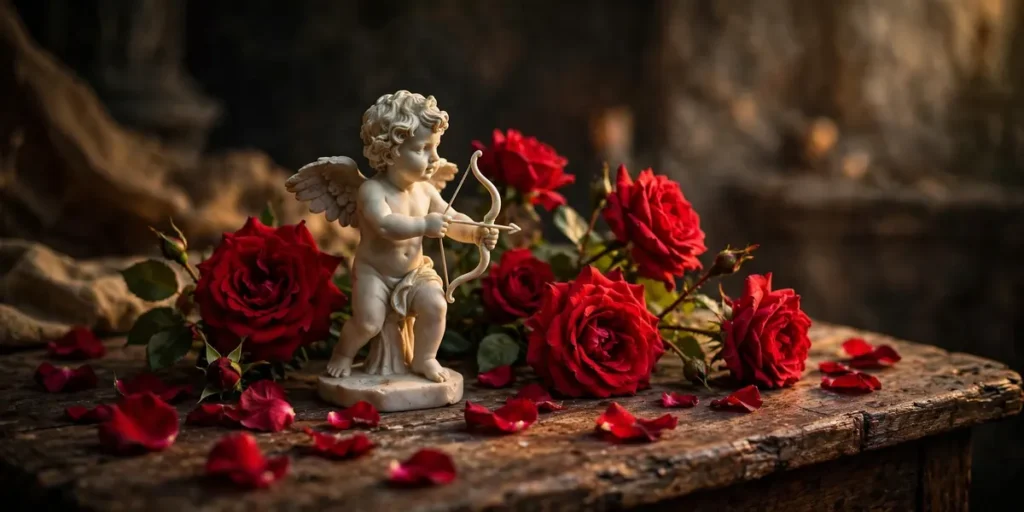
Cupid is Valentine’s Day’s mascot, but he arrived with a résumé. In Greek mythology he was Eros, the handsome god of erotic love, son of Aphrodite. According to the myths, Eros carried two kinds of arrows: golden ones that aroused desire and leaden ones that inspired aversion — an early acknowledgment that love is a gamble. The Romans adopted him as Cupid, and his most famous story is his romance with the mortal Psyche: Venus, jealous of Psyche’s beauty, ordered Cupid to make her fall in love with a monster, but Cupid pricked himself with his own arrow and fell for her instead. For centuries Cupid was depicted as a slender, winged youth. It was Renaissance and especially Victorian artists who transformed him into the chubby, mischievous, cherubic child we recognize on valentines today — a visual shorthand for love as playful, unpredictable, and a little bit blind. (The blindfold sometimes shown on Cupid gave us the cliché “love is blind.”)
Red Roses: Passion in Petals
No flower is more fused to Valentine’s Day than the red rose, and mythology gets the credit. In classical stories, roses were the favorite flower of Venus, the Roman goddess of love. One tale says that when Venus ran to warn her lover Adonis of danger, thorns tore her skin, and roses sprang from the mingling of her blood and tears — forever binding the flower to passionate, sacrificial love. The Romans crowned newlyweds with roses and scattered the petals at celebrations. Much later, the Victorian “language of flowers” gave every bloom a coded message, and the red rose’s meaning — deep romantic love — became the one everyone agreed on. Even the wordplay cooperates: “rose” is an anagram of Eros, the Greek god of love. Different rose colors carry their own traditional messages:
| Rose color | Traditional meaning |
|---|---|
| Red | Deep romantic love and passion |
| Dark pink | Gratitude and admiration |
| Light pink | Gentleness, sympathy, and budding affection |
| White | Purity, innocence, and new beginnings |
| Yellow | Friendship and platonic warmth |
| Orange | Desire and fascination |
| Lavender | Enchantment and love at first sight |
These meanings come from the Victorian language of flowers and remain the standard reference florists use today — handy knowledge when you’re choosing between a dozen red roses and something more nuanced. For help picking the right bouquet, see our Valentine’s Day gifts for her guide.
Doves: The Emblem of Devotion
Doves appear on valentines as the picture of fidelity, and the symbolism has deep roots. Doves are often described as pairing for life, which made them a natural emblem of loyalty and lasting devotion. In classical mythology they were associated with Venus, and in Christian tradition the dove carried connotations of peace and the Holy Spirit — all of which layered onto the bird a reputation for pure, faithful love. Medieval and Renaissance art frequently paired doves with lovers, and the image of two doves became visual shorthand for a devoted couple. Whether or not every dove is truly monogamous (ornithologists note the reality is more complicated), the symbol has endured because it expresses an ideal: love that stays.
Lace: Romance in the Details
Lace seems like mere decoration, but it carries one of the holiday’s most charming origin stories. For centuries, lace trimmed the fine handkerchiefs carried by women of means. According to tradition, if a woman dropped her handkerchief, a nearby gentleman would retrieve it for her — and if she had her eye on him, she might “accidentally” drop it as an invitation. The handkerchief became a flirtation device, and lace became associated with courtship, delicacy, and romantic intrigue. When Esther Howland and the Victorian card-makers began mass-producing valentines, real lace was the premium trim that signaled a card was special. Even today, lace borders on cards and packaging whisper the same message: this was chosen with care.
Love Knots: Eternity Without End
A love knot is a pattern of winding, interlacing loops with no visible beginning or end — and that endlessness is the entire point. As a symbol of everlasting love, the knot appears in Celtic, Norse, and Mediterranean decorative traditions, and it migrated naturally onto Valentine’s imagery. Sailors added their own chapter: during the Victorian era, seafarers on long voyages crafted “sailor’s valentines” — intricate mosaics of seashells arranged into hearts and flowers inside wooden boxes — as tokens for sweethearts back home. Whether tied in ribbon, drawn on paper, or set in shells, the knot’s message is the same: a love that doesn’t unravel.
Ribbons: Tying the Knot
Ribbons have bound lovers symbolically for centuries. In medieval tournaments, knights wore their lady’s colors — often a ribbon or scarf — as a token of devotion into competition. The phrase “tying the knot,” while its exact origins are debated, is popularly linked to wedding customs involving bound hands or cords, and ribbons became the decorative expression of that binding. On valentines, ribbon bows and streamers suggest a gift wrapped with intention: love, presented beautifully. The tradition survives every February in the curling ribbon on chocolate boxes and the satin bow on bouquets.
Arrows: Love at First Sight
The arrow piercing a heart is Cupid’s signature, and it encodes the holiday’s most romantic idea: that love can strike in an instant. In the myths, being struck by Cupid’s golden arrow meant falling helplessly in love with the next person you saw — the ancient explanation for “love at first sight.” The image of the heart pierced by an arrow captures both the thrill and the vulnerability of that moment: love as something that happens to you, sudden and unstoppable. It’s no accident the symbol dominates Valentine’s cards aimed at new lovers; it belongs to the beginning of the story, when everything is possibility and risk.
XOXO: Kisses Sealed With History
Those little X’s and O’s at the end of a message carry more history than you’d expect — though scholars still argue over the details. The leading theory for X-as-kiss traces back to the Middle Ages, when many people couldn’t write their names and signed documents with an X, then kissed the mark as a gesture of sincerity and good faith. Over time, the X itself absorbed the meaning of the kiss. The O-as-hug is generally considered a later, North American addition — possibly from the shape of encircling arms. Neither origin is definitively proven, which makes XOXO a fitting symbol for Valentine’s Day: a tradition everyone understands and no one can fully explain.
Lovebirds: A Feathered Ideal
Chaucer’s claim that birds choose their mates on February 14 gave us more than a poetic image — it gave the holiday a mascot species. Lovebirds, the small African parrots known for their strong pair bonds, became the literal embodiment of the idea, and their name alone made them Valentine’s naturals. In art and card design, pairs of birds — whether lovebirds, doves, or swans — represent the hope that love, like the birds of medieval imagination, finds its mate and stays. The symbol works because it connects the holiday to the natural world: love as something seasonal, instinctive, and renewing.
Keys and Locks: The Key to My Heart
Few phrases are more Valentine’s-coded than “you hold the key to my heart.” The key-and-lock motif symbolizes trust and exclusivity: giving someone the key means granting them access to your innermost self. The image has medieval echoes in chastity symbolism and romantic poetry, and it found modern expression in the “love lock” trend, where couples inscribe padlocks with their names and fasten them to bridges and railings — a ritual that spread from Europe to cities worldwide in the 2000s. As jewelry, the key pendant remains one of the most popular Valentine’s gifts precisely because its meaning needs no explanation.
Rings: The Unbroken Circle
The ring’s symbolism is geometry: a circle has no beginning and no end, making it the perfect emblem of eternal love. Couples have exchanged rings as tokens of commitment since ancient Egypt, and the tradition of Valentine’s ring-giving — whether a promise ring, an engagement ring, or simply a beautiful band — draws on that unbroken lineage. February 14 consistently ranks among the most popular days of the year for proposals, which keeps the ring at the center of the holiday’s iconography. If you’re considering making it official, our Valentine’s Day proposal ideas can help you plan the moment.
Forget-Me-Nots: Love That Lingers
In the Victorian language of flowers, the tiny blue forget-me-not carried exactly the message its name suggests: remember me, and remember our love. The flower’s legend involves a medieval knight who, falling into a river while picking the blooms for his lady, threw them to her with the cry “forget me not!” before drowning — a tragic, romantic origin that the Victorians adored. As a Valentine’s symbol, forget-me-nots represent faithful, enduring affection: the quieter counterpart to the red rose’s passion. They appear on vintage valentines as a promise that love outlasts distance and time.
Chocolates: The Sweetest Symbol
Chocolate’s status as a Valentine’s staple is younger than most symbols here, but no less entrenched. The Aztecs considered cacao a divine gift, and European aristocrats drank chocolate as a luxury long before anyone boxed it. The Valentine’s connection was forged in the Victorian era when Richard Cadbury began selling chocolates in elaborately decorated heart-shaped boxes — inventing both the Valentine’s chocolate box and the idea of the keepsake container. Today, chocolate symbolizes indulgence, sensuality, and the sweet side of romance. Gifting it says: life with you should be delicious.
Valentine Cards: The Original Love Letter
The valentine card itself has become a symbol of the holiday — the exchange of written affection is the ritual everything else orbits. From the Duke of Orléans’ 1415 prison poem to Esther Howland’s lace confections to the classroom shoebox exchanges of today, the card represents love made tangible and deliberate. In Denmark, the tradition took a playful turn with gaekkebrev — anonymous rhyming love notes that turn card-giving into a guessing game (more in our guide to Valentine’s Day in Denmark). However it’s delivered, the card’s message hasn’t changed in six centuries: you were worth the trouble of writing this down.
Valentine’s Symbols at a Glance
| Symbol | Traditional meaning | Origin highlights |
|---|---|---|
| Heart | Romantic love, emotion | Possibly inspired by the silphium seed pod; appears in a French manuscript c. 1250s; cemented in the 18th–19th centuries |
| Cupid | Desire, love’s unpredictability | Evolved from the Greek Eros; Victorian art made him a cherubic child |
| Red roses | Passionate, deep love | Associated with Venus in classical myth; codified by the Victorian language of flowers |
| Doves | Fidelity and devotion | Linked to Venus; famed for lifelong pairing |
| Lace | Courtship, delicate affection | From the tradition of dropped handkerchiefs; premium trim on Victorian valentines |
| Love knots | Everlasting love | Endless interlacing loops; echoed in sailors’ shell valentines |
| Ribbons | Binding commitment | Medieval tokens of favor; decorative expression of “tying the knot” |
| Arrows | Love at first sight | Cupid’s golden arrows; love as sudden and unstoppable |
| XOXO | Kisses and hugs | X possibly from medieval signed-and-kissed documents; O a later addition |
| Lovebirds | Faithful pairing | From the medieval belief that birds choose mates on February 14 |
| Keys and locks | Trust, exclusivity | “Key to my heart” motif; modern love-lock ritual |
| Rings | Eternal commitment | The unbroken circle; exchanged since ancient Egypt |
| Forget-me-nots | Faithful remembrance | Victorian flower language; medieval knight legend |
| Chocolates | Indulgence, sweet romance | Cadbury’s Victorian heart-shaped boxes |
| Valentine cards | Deliberate affection | From the 1415 Orléans poem to Howland’s mass-produced lace cards |
Watch: Roses and their Meanings
A guide to roses and their meanings from Heidi Richards Mooney. This video focuses on flower symbolism, not the complete history of every Valentine’s symbol.
Video by Heidi Richards Mooney. Watch on YouTube.
Frequently Asked Questions
What is the most important Valentine’s Day symbol?
The heart is unquestionably the central symbol — it appears on more cards, boxes, and decorations than all the others combined. Its power comes from centuries of layered meaning: ancient associations with emotion, medieval romantic poetry, religious sacred-heart imagery, and finally the Victorian commercial era that put it on everything.
Why is Cupid a baby on Valentine’s cards?
The original Cupid (and the Greek Eros before him) was depicted as a handsome young man. Renaissance and Victorian artists gradually transformed him into a chubby, winged child — a visual metaphor for love as mischievous, unpredictable, and innocent. The cherubic version photographed better on cards, and it stuck.
What do different colored roses mean?
In the traditional Victorian language of flowers: red means deep romantic love, dark pink means gratitude, light pink means gentleness, white means purity, yellow means friendship, orange means desire, and lavender means enchantment. Red remains the standard for Valentine’s Day, but the other colors let you fine-tune your message.
Where did the heart shape actually come from?
No one knows for certain, which is why several theories coexist. The silphium seed-pod theory is the most romantic, the “artists drew an organ they’d never seen” theory is the most practical, and the documented history starts with heart imagery in medieval manuscripts around the 1250s. Most likely, the truth combines several of these threads.
Why do we sign cards XOXO?
The leading theory traces X to medieval documents that were signed with an X and then kissed as a mark of sincerity; over centuries the X absorbed the meaning of the kiss itself. The O for hugs is generally considered a later North American addition. Like many Valentine’s traditions, its exact origin is debated but its meaning is universal.
Are Valentine’s symbols the same worldwide?
The core symbols — hearts, roses, Cupid — are recognized globally thanks to centuries of cultural exchange, but many countries add their own. Denmark has its gaekkebrev puzzle notes, Wales its carved love spoons, Japan its chocolate-giving customs. For the full world tour, see our Valentine’s Day traditions around the world.
5 More Symbols You Might Not Know
The Color Red
Red deserves its own entry, because it does half the symbolic work of the entire holiday. Across cultures, red signals passion, vitality, and the racing heart — the physiological signature of attraction. It’s the color of roses, hearts, lipstick, and Valentine’s packaging worldwide, and its dominance isn’t accidental: studies in color psychology consistently find red associated with romance and desire across cultures. When in doubt on February 14th, wear red.
Cupid’s Bow
Distinct from the arrow, the bow itself symbolizes potential — love aimed but not yet released. In classical art, a broken or lowered bow could signify love at rest, while a drawn bow meant desire in motion. Jewelry designers love the bow motif for exactly this reason: it suggests romance as an active, ongoing pursuit rather than a finished state.
Posy Rings
Before greeting cards, there were posy rings — gold bands engraved inside with short romantic verses, exchanged by lovers from the 15th through the 17th centuries. They were the text messages of their era: intimate, portable, and meant to be read privately. The tradition reminds us that Valentine’s gift-giving was once about words made permanent, not just objects made expensive.
Ivy
In the Victorian language of flowers and earlier folk traditions, ivy symbolized fidelity and enduring affection — it clings, it lasts through winter, it doesn’t let go. Bridal bouquets and Valentine’s arrangements have included ivy for centuries as a quiet promise of constancy beneath the showier blooms.
Swans
Like doves, swans are famed for forming lasting pair bonds, and they’ve symbolized graceful, devoted love in European art for centuries. A pair of swans with necks curved into a heart shape is one of the most photographed natural “valentines” in the world — nature’s own contribution to the holiday’s iconography.
Using These Symbols in Your Own Valentine’s
Knowing the meanings turns symbol-choosing from guesswork into intention. For cards: pair the symbol with its story — a hand-drawn love knot with a note about “no beginning, no end” says more than a generic heart. For flowers: use the rose-color table above to fine-tune your message, and tuck in ivy or forget-me-nots for the recipient who’ll appreciate the deeper cut. For gifts: a key pendant, a posy-style engraved ring, or a ribbon-tied box all carry built-in meaning — let the symbol do the talking and keep the card simple. For décor: layer symbols with intention rather than scattering them: hearts for love, doves for devotion, knots for permanence. And for proposals: the ring’s unbroken circle is the ultimate Valentine’s symbol — which is why February 14 remains one of the year’s most popular days to ask. If you’re planning that moment, our Valentine’s Day proposal ideas will help you stage it.
The deeper lesson of all fifteen (now twenty) symbols: Valentine’s Day has always been a language, not just a holiday. Every heart, rose, and ribbon is a word in a vocabulary lovers have been refining for centuries. Learn a few words, and your Valentine’s starts saying exactly what you mean.