There is no Thanksgiving morning quite like Thanksgiving morning in New York City. The Thanksgiving parade New York 2026 — better known as the Macy’s Thanksgiving Day Parade — turns Manhattan into a moving theater of giant balloons, marching bands, floats, and Broadway performances, watched in person by millions along the route and on television by tens of millions more. Whether you are planning your first trip to see it live or you are a local looking to do it right this year, this guide covers everything: what to expect, the best viewing spots, how to get there, broadcast options, and insider tips that separate the pros from the shivering crowds.
A quick note on 2026 specifics: parade organizers confirm the final lineup, exact balloon inventory, and broadcast schedule closer to November. What follows describes the parade’s long-standing format and traditions — the route, the viewing strategy, and the atmosphere have held steady for decades — but always confirm 2026 schedules on the official parade listings before you finalize travel plans. The fundamentals below will still make your morning magical.
What the Macy’s Parade Is (and Why It’s Worth the Trip)
The Macy’s Thanksgiving Day Parade has been a New York institution for a century — the 2026 edition marks roughly its 100th year. What began in the 1920s as a holiday celebration for Macy’s immigrant employees has grown into one of the most-watched annual events in the United States. The parade is famous for three things: enormous helium character balloons that tower over the avenues, elaborate floats carrying performers from Broadway shows and recording artists, and a grand finale when Santa Claus arrives to officially open the holiday season.
On parade morning, the procession traditionally steps off on the Upper West Side near Central Park West and marches south through Manhattan, ending at Macy’s flagship store at Herald Square. The whole event takes a few hours from first balloon to Santa’s sleigh. Along the way you will see marching bands from across the country, clown troupes, dance groups, and the iconic giant balloons — some beloved classics, and usually a few brand-new debuts each year that get their own moment of glory.
Watch: The 2025 Parade in 4K
Want to know exactly what parade morning feels like? This full-length 4K recording of the 2025 Macy’s Thanksgiving Day Parade captures the entire route experience — every balloon, every float, and the crowd energy along the way. Watch it to preview what the 2026 edition will bring:
Notice how the crowds thin out near the start of the route and pack in tight around Herald Square — that detail alone will shape your viewing strategy below. Planning a full holiday trip? Pair the parade with our guide to Thanksgiving events in New York 2026, which covers turkey trots, holiday markets, and weekend activities around the city.
The Parade Route, Explained
The traditional route begins on the Upper West Side near West 77th Street and Central Park West, heads south along Central Park West, turns east onto Central Park South, then continues down Sixth Avenue to Macy’s Herald Square at 34th Street. If you can picture a map of Manhattan, that is roughly two miles of parade — and every block of it is lined with spectators.
Here is what the geography means for you as a viewer. The Upper West Side (Central Park West) is the roomiest viewing area because it is residential and the parade is fresh — balloons are at their fullest, performers are at their peppiest, and the crowds are thinner. Midtown along Sixth Avenue is where the television cameras are set up, which means grandstands, restricted areas, and the densest crowds. Herald Square is the finish line and the most electric spot, but also the hardest to access.
Smart viewers pick the Upper West Side every time. Arrive early, bring coffee, and you will see everything with a fraction of the stress. The television broadcast captures the Midtown spectacle beautifully, so there is no need to fight for a spot near the cameras — let millions of viewers do that from their couches.
Best Viewing Spots, Ranked
1. Central Park West (77th to 65th Streets)
The gold standard for live viewing. The sidewalks here are wide, the buildings are residential (so no office crowds), and the parade passes close enough to see balloon handlers in detail. Target the blocks in the 70s for the most space. Get there two to three hours before step-off for a front-row curb spot.
2. Central Park South (59th Street)
The turn from Central Park West onto Central Park South is a photographer’s dream — balloons swing wide around the corner. Spots here fill earlier because it is a short, prime stretch. It is also easy to reach via multiple subway lines.
3. Sixth Avenue (above 42nd Street)
Solid viewing once you are past the restricted TV zone around Herald Square. The 40s and 50s on Sixth Avenue offer decent sightlines with somewhat thinner crowds than the finish-line area. Expect a lively, loud, tourist-heavy atmosphere.
4. Your Hotel Room or a Friend’s Apartment
Never underestimate the luxury option. If you know anyone on the route, a window view beats a curb view — warmth, bathrooms, and coffee included. Some Midtown hotels on Sixth Avenue market parade-view rooms; they book out months in advance and command premium prices, so reserve early if that is your plan.
Getting There: Transit Tips for Parade Morning
Do not drive. Seriously. Street closures ripple across Manhattan on parade morning, parking is effectively nonexistent near the route, and you will spend the holiday in traffic. The subway is the only sane way to reach the parade. Take it to a station near your chosen viewing block and walk the last few avenues.
Key stations for the Upper West Side viewing zone include 72nd Street, 81st Street–Museum of Natural History, and 66th Street–Lincoln Center on the west side lines. Expect crowds, expect bag checks at some entrances, and build in extra time — trains run on a holiday schedule and platforms get packed. Download an offline transit map and screenshot your route; cell service gets spotty when a million people share the same towers.
If you are coming from outside the city, consider staying in Manhattan the night before. Waking up near the route beats a dawn commute from the suburbs, and Thanksgiving morning transit runs less frequently. Many families make it a tradition: check in Wednesday, parade Thursday morning, dinner Thursday afternoon.
Balloon Inflation Day: The Night-Before Spectacle
Ask any parade veteran and they will tell you the best-kept secret of Thanksgiving week: the balloon inflation the day before. On the afternoon and evening before Thanksgiving, the giant balloons are inflated on the streets around the Museum of Natural History on the Upper West Side, and the public is invited to watch. It is free, it is festive, and in some ways it is better than the parade itself.
Here is why inflation day is special. You get to see the balloons up close — really close — as crews unroll them on the pavement and pump them full of helium. Kids can walk right up to a half-inflated character and grasp its true, absurd scale. The atmosphere is relaxed and neighborhoody: food vendors, families, and a general sense of anticipation. There are no barricades of grandstands, no jostling for curb space, just a slow evening stroll among giants-in-progress.
If you can only do one parade-related activity and crowds stress you out, choose inflation day over parade morning. Arrive in the late afternoon to watch the inflation in progress, stay for the fully inflated balloons glowing under the streetlights after dark, and grab dinner on the Upper West Side. Many families make this their tradition and watch the parade itself on television the next morning — warm, comfortable, and with a perfect view of the very balloons they saw being born.
A Century of Parade History in Brief
Understanding the parade’s history makes watching it richer. The first parade marched in the 1920s, organized by Macy’s employees — many of them first-generation immigrants who wanted to celebrate their new American holiday with the kind of festival tradition they knew from Europe. Those early parades featured live animals from the Central Park Zoo (a practice that mercifully ended) and were as much about community pride as commerce.
The giant helium balloons that define the parade today debuted in the late 1920s and early 1930s, and they changed everything. Felix the Cat, Mickey Mouse, and other characters of the era floated above the crowds, and the parade became a showcase for American popular culture as much as a holiday celebration. Through the decades, the balloons have mirrored the times: cartoon stars, superheroes, video game icons, and streaming-era characters have all taken their turn above Manhattan.
The parade has survived a world war (it was suspended during the early 1940s), weathered helium shortages and high-wind controversies, and evolved with television from a local curiosity into a national broadcast ritual. The 2026 edition continues that century-long run. When you stand on Central Park West and watch a brand-new balloon make its debut, you are watching the newest chapter of a story that started a hundred Thanksgivings ago — and that sense of continuity is a big part of why the morning feels so special.
At a Glance: The Parade Route on the Map
Use this map to orient yourself before parade morning. The procession traditionally starts near West 77th Street and Central Park West, travels south, turns onto Central Park South, and finishes down Sixth Avenue at Macy’s Herald Square (34th Street). Mark your planned viewing block in advance and note the nearest subway exits — you will thank yourself at 7 AM on Thanksgiving.
The pin marks the traditional starting area of the route on the Upper West Side — the viewing zone veteran parade-goers recommend most. From here the parade heads south toward Midtown and Herald Square.
What to Bring (and What to Leave at Home)
Parade morning in late November is cold — often near freezing at dawn. Dress in warm layers, wear a hat and gloves, and choose waterproof shoes; you will be standing on pavement for hours. Bring a thermos of something hot, snacks for the kids, a fully charged phone, and a small blanket or stadium cushion if you plan to sit on the curb. Hand warmers are the unsung heroes of parade morning.
What to skip: large bags (security checks slow you down), umbrellas (they block everyone’s view and catch wind near the balloons), and folding chairs on crowded blocks (they take up curb space and annoy neighbors). A compact backpack with the essentials beats a rolling suitcase every time. If you are traveling with small children, a carrier works better than a stroller in dense crowds.
Watching from Home: TV and Streaming
Millions of Americans make the televised parade part of their Thanksgiving ritual, and honestly, it is a fantastic way to see it. The broadcast traditionally airs Thanksgiving morning on a major national network, with coverage from the Midtown reviewing stand — the one stretch of the route where you actually can’t stand in person. Streaming options have expanded in recent years, so check the official parade announcements in November 2026 for the confirmed network and streaming lineup.
Pro tip for home viewers: start the parade on a slight delay so you can fast-forward through commercial breaks, and keep a second screen handy for the social-media conversation. The parade is one of the biggest live-tweeted events of the year, and the running commentary is half the fun.
Hosting a watch party is a lovely low-effort tradition: invite friends over, ask everyone to bring one breakfast dish or pastry, and let the parade be the entertainment. No cooking marathons, no cleanup disasters — just coffee, croissants, and giant balloons on the biggest screen you own.
In Pictures
Nothing conveys the scale of the Macy’s parade like seeing the balloons from a curb-level view. Here is a look at the kind of morning that awaits you — giant characters floating past Manhattan crowds, confetti in the air, and that unmistakable electric feeling:
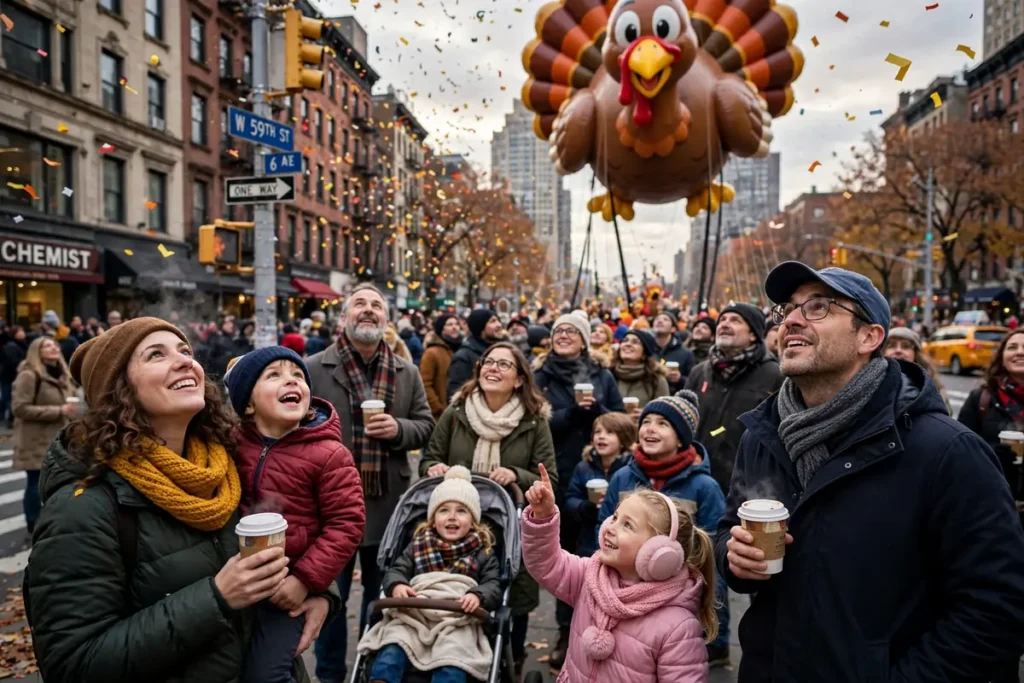
This is the classic parade-morning tableau: families bundled up, kids on shoulders, and balloons towering overhead. If parades are your thing beyond New York, Philadelphia hosts its own beloved Thanksgiving parade — see our Thanksgiving events in Philadelphia 2026 guide for details.
Where to Eat After the Parade
Thanksgiving dinner reservations in New York book out fast, so plan this as early as the parade. Many restaurants across Manhattan serve special Thanksgiving menus — from classic prix-fixe turkey dinners to creative alternatives. Midtown and the Upper West Side are the natural neighborhoods if you watched the parade nearby. Book weeks ahead, confirm whether the restaurant is serving its regular menu or a holiday special, and note the seating times so you can time your exit from the route.
If you are cooking at home or at your rental, remember that grocery stores have reduced holiday hours and the turkey should already be in the oven or brining. Plenty of parade-goers plan a late-afternoon dinner so they can rest (and warm up) between the route and the table.
Parade-Day Survival Tips from Veterans
Eat a real breakfast before you leave — you will not want to lose your curb spot to a food run. Use the restroom before you claim your position; portable facilities near the route have enormous lines. Pick a meeting point with your group in case you get separated, because “by the balloons” is not a location. And give yourself permission to leave when you have had your fill — seeing the first half of the parade up close beats seeing all of it through a phone screen held overhead.
For photographers: the morning light on Central Park West is gorgeous, and the balloons look best against the park’s trees. A mid-range zoom beats a phone’s digital zoom, and burst mode is your friend when balloons bob in the wind. For everyone else: put the phone down for at least part of the morning. The parade is one of the few remaining giant shared experiences in American life — be in it.
Frequently Asked Questions
What time does the Macy’s Thanksgiving Day Parade start in 2026?
The parade traditionally steps off in the morning on Thanksgiving Day — historically around 9 AM Eastern — and runs for about three hours. The exact 2026 start time is confirmed by organizers closer to November, so check the official parade announcements in the fall before planning your morning. If you are viewing in person, plan to arrive at your spot two to three hours before step-off regardless of the official start.
Is the Macy’s Thanksgiving Day Parade free to watch?
Yes — watching from the public sidewalks along the route is completely free, no tickets required. There are some ticketed grandstand areas near the television cameras in Midtown, typically distributed through official channels, but the vast majority of spectators watch for free from the curb. Never pay a stranger for “parade tickets” — sidewalk viewing costs nothing.
Where is the best place to watch the parade in person?
Central Park West between 77th and 65th Streets is the consensus pick: wide sidewalks, thinner crowds than Midtown, and the parade at its freshest. Avoid the blocks immediately around Herald Square unless you have grandstand access — they are the most restricted and crowded. Wherever you choose, arrive early; curb spots fill up fast.
Can I bring kids to the parade?
Absolutely — the parade is one of the most family-friendly events in New York. That said, prepare like a pro: dress kids in bright, warm layers, bring snacks and entertainment for the wait, and consider a child carrier over a stroller for dense crowds. Set a clear meeting point and write your phone number on a tag for younger kids. Many families leave after the first hour or two, once the kids have seen the big balloons.
What happens if it rains on parade day?
The parade goes on rain or shine — it has marched through plenty of wet Thanksgivings. High winds are the real variable: in very strong gusts, balloons may be grounded or flown lower for safety. Dress for the forecast, bring a poncho rather than an umbrella, and check the morning-of weather before heading out. The television broadcast is the cozy backup plan.
How do the giant balloons stay inflated and controlled?
Each giant balloon is handled by a trained team of dozens of volunteers holding tether lines, with a pilot balloon vehicle guiding the way. The balloons are inflated the day before — a process that has become its own beloved public spectacle on the Upper West Side. It is a remarkable piece of choreography, and watching the handlers work is half the fun of the live experience.
Conclusion
The Thanksgiving parade New York 2026 is more than a parade — it is the official opening ceremony of the American holiday season, and seeing it live is one of those experiences that lives up to the hype. Pick your viewing block, dress warm, arrive early, and let the balloons do the rest. Whether it is your first time or your fiftieth, there is always a new balloon, a new float, or a new memory waiting on the route.
One more piece of veteran advice: build slack into your day. Parade mornings reward the unhurried — a slow walk to your spot, an unplanned detour for hot chocolate, a long pause to watch the handlers wrestle a balloon around a corner. The parade will march whether you stress or not, so choose not to. And if the crowds ever feel like too much, remember that the television broadcast from the Midtown cameras shows you angles no curb ever could. Live or on screen, you are part of a century-old Thanksgiving morning.
Make it a full weekend: explore more holiday plans in our Thanksgiving guides collection, from city event roundups to dinner planning, and turn one parade morning into an unforgettable Thanksgiving trip.