Vienna at Christmas is Europe’s most elegant holiday postcard come to life. This Vienna Christmas markets guide walks you through the Austrian capital’s finest festive markets — from the grand Christkindlmarkt glowing in front of the neo-Gothic Rathaus to the baroque splendor of Schönbrunn Palace’s courtyard market — plus the food, the concerts, and the practical know-how to plan a flawless Viennese Advent trip.
No city does Christmas with quite Vienna’s polish. Where German markets lean rustic and French markets lean festive, Vienna leans imperial: classical concerts in candlelit churches, horse-drawn carriages on the Ringstrasse, coffee houses serving hot chocolate the way it has been served for 200 years, and markets set against palaces that once hosted emperors. The Viennese treat Advent as a season, not an event — locals meet friends for punsch after work from late November onward, and the whole city seems to slow down and glow.
Vienna’s Christmas Markets at a Glance
Vienna hosts more than a dozen Christmas markets, but these are the essential ones. Each has a distinct personality, and part of the joy is market-hopping between them on the city’s superb tram and U-Bahn network.
| Market | Setting | Best For | Vibe |
|---|---|---|---|
| Christkindlmarkt, Rathausplatz | City Hall park | First-timers, families, ice skating | Grand & festive |
| Schönbrunn Palace | Imperial palace courtyard | Romance, photography, concerts | Baroque elegance |
| Belvedere Palace | Baroque palace gardens | Art lovers, quieter browsing | Refined |
| Spittelberg | Biedermeier lanes | Unique crafts, local designers | Artsy & intimate |
| Karlsplatz / Art Advent | Before Karlskirche | Certified Austrian handicrafts | Authentic |
| Freyung (Old Viennese Market) | Historic square | Traditional crafts since 1772 | Old-world |
Christkindlmarkt at Rathausplatz: Vienna’s Flagship Market
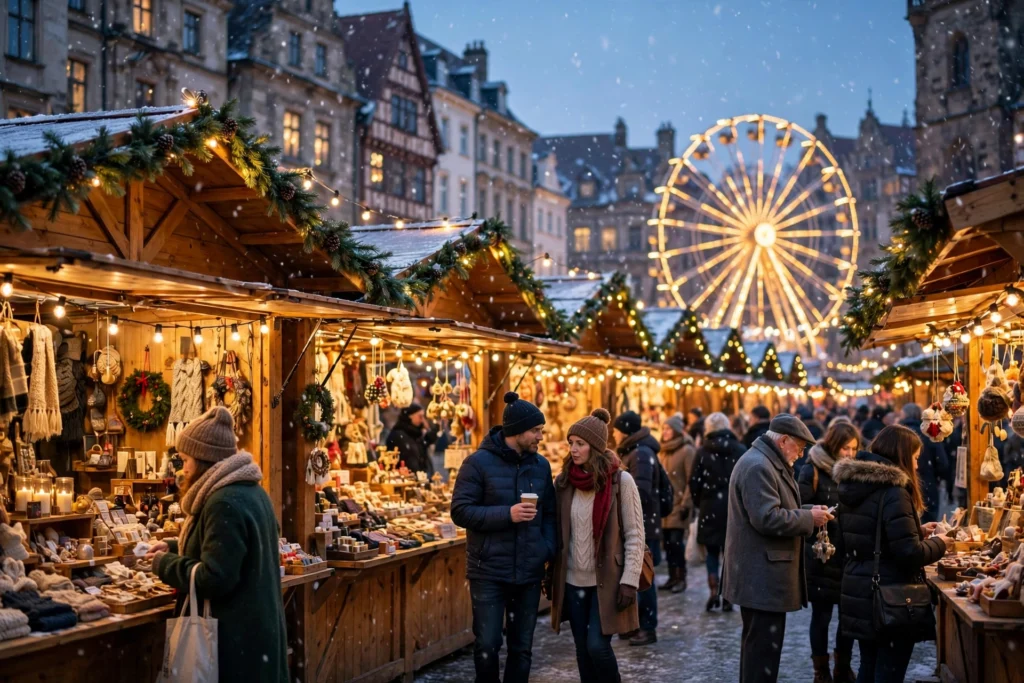
The Wiener Christkindlmarkt in front of the Rathaus (City Hall) is the market most visitors picture when they think of Vienna at Christmas — and it delivers. Around 150 stalls fill the floodlit Rathauspark, with the neo-Gothic city hall glowing behind them like a fairytale castle. A towering Christmas tree, donated annually by an Austrian province, anchors the square, and the surrounding park trees are draped in lights.
What sets Rathausplatz apart is how much there is to do beyond shopping. The ice-skating trail winds through the park’s trees — a romantic, floodlit loop that’s magical after dark (skate rental available on site). Children’s workshops, a nativity scene trail, and choir performances fill the program, and the food stalls run the full Viennese gamut from Bratwurst to roasted chestnuts. This is the biggest, busiest, and most festive of Vienna’s markets — come on a weekday evening for the best balance of atmosphere and elbow room.
Getting there: U2 to Rathaus station, or trams D, 1, 71 to the Ring. The market typically runs from mid-November through December 26.
Schönbrunn Palace Christmas Market: Baroque Romance
If Rathausplatz is Vienna’s grandest market, Schönbrunn is its most beautiful. Set in the vast courtyard of the Habsburgs’ summer palace, with the baroque facade glowing golden behind rows of wooden stalls, this market feels like stepping into an 18th-century Christmas card. After dark, when the palace is floodlit and the courtyard tree sparkles, it is arguably the most romantic Christmas market setting in Europe.
The Schönbrunn market leans toward quality over quantity: traditional handicrafts, blown-glass ornaments, beeswax candles, and regional foods, plus workshops where children can make their own gifts. The palace itself offers Christmas concerts in the Orangery — Mozart and Strauss by candlelight — which pair perfectly with a market visit. Combine it with a daytime palace tour (book ahead; December slots sell out) and you have Vienna’s single best holiday day out.
Getting there: U4 to Schönbrunn station. Allow a half day minimum; the palace, gardens, and market deserve unhurried time.
Belvedere, Spittelberg, and Karlsplatz: Vienna’s Connoisseur Markets
Belvedere Palace Christmas Village
Set against the baroque Belvedere Palace — home to Klimt’s The Kiss — this smaller market trades Rathausplatz’s bustle for elegance. The stalls focus on high-quality Austrian design, jewelry, and culinary specialties, and the palace’s Christmas lighting is sublime. It’s the market to visit when you want beautiful things without the crowds, and it pairs naturally with a visit to the Belvedere’s art collections.
Spittelberg: the artists’ quarter market
Tucked into the narrow Biedermeier lanes of the Spittelberg district, this market feels like a neighborhood secret — even though it’s beloved by locals. The stalls emphasize contemporary Austrian crafts and design: ceramics, textiles, jewelry, and art from independent makers, quite different from the traditional fare elsewhere. The lane setting, strung with lights, is intimate and photogenic. Come hungry — the food stalls here are excellent.
Art Advent at Karlsplatz
In front of the baroque Karlskirche, the Art Advent market is Vienna’s authenticity champion: every product sold must be certified Austrian handicraft, and the food stalls emphasize organic and regional produce. It’s smaller and calmer than the big markets, with a lovely program of children’s activities and a charming petting-zoo-adjacent farm area. If you want to buy gifts with genuine provenance, start here.
Freyung: Vienna’s oldest market
The Old Viennese Christmas Market on the Freyung dates to 1772, making it one of the city’s oldest. Set on a historic square in the old town, it specializes in traditional crafts — nativity scenes, glass, ceramics, and basketry — with a distinctly old-world, unhurried feel. It’s a short walk from the Graben shopping street, making it an easy addition to a city-center day.
What to Eat and Drink at Vienna’s Christmas Markets
Viennese market culture revolves around the Punschstand — the punch stand — where friends gather after work through Advent. Here’s your essential tasting list:
- Punsch: Austria’s answer to mulled wine, often made with rum, amaretto, or fruit juices. Try the Orangenpunsch (orange punch) and the classic Glühwein side by side.
- Maroni: roasted chestnuts, sold from every other stall, eaten hot from a paper cone — the definitive Viennese winter snack.
- Vanillekipferl: delicate vanilla crescent cookies dusted with powdered sugar; buy a tin from a bakery stall.
- Bratwurst & Käsekrainer: the cheese-filled Käsekrainer sausage is a Viennese institution — order it “scharf” (with spicy mustard) like a local.
- Baumkuchen & Lebkuchen: spit-roasted layer cake and gingerbread hearts for the sweet tooth.
- Kartoffelpuffer & Langos: potato pancakes and Hungarian-style fried dough for something hearty.
- Heisse Schokolade: Viennese hot chocolate is famously thick — nearly a pudding. The coffee houses do it best, but market stalls offer a fine approximation.
For sit-down meals between markets, Vienna’s coffee house culture is essential: order a Melange and a slice of Sachertorte at a traditional Kaffeehaus, or warm up with Tafelspitz (boiled beef) or Wiener Schnitzel at a classic Beisl. If you’re building a holiday menu at home later, our Christmas dinner ideas include Austrian-inspired festive dishes.
Viennese Christmas Culture Beyond the Markets
Vienna’s Advent season extends well beyond the stalls, and the city’s cultural calendar is half the reason to visit:
- Classical concerts: Advent and Christmas concerts fill the city’s churches and palaces — the Karlskirche, St. Stephen’s Cathedral, and Schönbrunn Orangery all host seasonal programs. Book ahead.
- St. Stephen’s Cathedral: the city’s Gothic heart hosts Advent services and concerts; the south tower offers panoramic winter views.
- Coffee house season: Vienna’s historic coffee houses (a UNESCO-recognized institution) are at their coziest in December — linger over newspapers, hot chocolate, and cake.
- The Ringstrasse at night: the grand boulevard’s imperial buildings are floodlit year-round, but with market lights added, an evening tram ride on lines 1 or 2 is pure magic.
- New Year’s Eve Trail (Silvesterpfad): if your trip extends, Vienna’s famous New Year’s Eve street party fills the old town with stages, waltzes, and fireworks.
Traveling with little ones? Vienna is wonderfully family-friendly in December — the Rathausplatz workshops, the Schönbrunn children’s museum, and the Prater’s winter attractions all shine. See our Christmas activities for families, kids, and couples for more ideas.
The Perfect 2-Day Vienna Christmas Market Itinerary
Day 1: Imperial Vienna — Rathausplatz, old town, and Freyung
Morning: Start at St. Stephen’s Cathedral and the Graben, then browse the Freyung’s Old Viennese Market (open since 1772) for traditional crafts. Warm up with a Melange and Sachertorte at a historic coffee house.
Afternoon: Walk the Ringstrasse to the Belvedere for art and the palace Christmas village, or visit the MuseumsQuartier. As dusk falls, head to Rathausplatz — arrive around 4 PM to browse the stalls in the blue hour, then stay as the lights take over.
Evening: Ice skate the floodlit trail through the Rathauspark, then dinner of Tafelspitz or Schnitzel nearby. End with punsch at a Punschstand under the city hall’s glow.
Day 2: Palaces and artists — Schönbrunn, Spittelberg, Karlsplatz
Morning: Take the U4 to Schönbrunn. Tour the palace (book ahead), stroll the gardens, then browse the courtyard Christmas market — go before lunch for the calmest craft shopping.
Afternoon: Return to the center for the Art Advent market at Karlsplatz (certified Austrian handicrafts make the best gifts) and the Karlskirche.
Evening: Wander the lamplit lanes of Spittelberg for contemporary crafts and dinner, then finish with an Advent concert — the Karlskirche and St. Stephen’s both host seasonal programs.
What to Buy: A Vienna Souvenir Guide
- Ornaments: hand-blown glass baubles and straw stars from the Karlsplatz and Freyung craft stalls.
- Sweets: Vanillekipferl tins, Mozartkugeln (the pistachio-marzipan chocolate balls), and Lebkuchen hearts.
- Design: contemporary ceramics and jewelry from Spittelberg’s independent makers.
- Music: CDs or vinyl of Strauss and Mozart from market stalls — gloriously on-the-nose and genuinely well performed.
- For the home: beeswax candles, Advent wreaths, and nativity figures from the Freyung’s traditional workshops. Our Christmas decoration ideas will help you display them.
Practical Planning Guide
When to visit
Vienna’s markets typically open in mid-November — earlier than most German markets — and run through Christmas, with Rathausplatz traditionally continuing to December 26. The first two weeks of December offer the best balance of full Advent atmosphere and manageable crowds. Exact 2026 dates are usually confirmed in autumn; check the official Vienna tourism site before booking.
Getting around
Vienna’s public transport is superb: the U-Bahn, trams, and buses run frequently and the 24/48/72-hour Vienna Cards cover unlimited travel plus museum discounts. All the major markets are transit-accessible, and the old town is compact enough to walk between the Freyung, Karlsplatz, and Spittelberg. Fly into Vienna International Airport; the City Airport Train (CAT) or S-Bahn reaches the center in under 30 minutes.
Budget guide
Vienna is a premium destination — budget roughly €150–220 per night for a comfortable December hotel near the center (book 2–3 months ahead). Market grazing runs €30–50 per person per day; a coffee house stop €10–15; a concert €30–80 depending on venue. Market entry is free everywhere. The Vienna Card and Vienna Pass can cut sightseeing costs if you’re doing museums.
Day trips
Bratislava, Slovakia’s capital, is under an hour by train or boat and hosts its own charming Christmas markets — an easy international two-for-one. The Wachau Valley’s abbeys and wine towns are lovely in winter light, and Salzburg’s markets (about 2.5 hours by rail) are among Austria’s finest if you have an extra day.
Tips for Visiting Vienna’s Christmas Markets
- Pace the punsch: Austrian punsch is stronger than it tastes. Alternate with hot chocolate or tea.
- Go on weekday evenings: weekends at Rathausplatz are packed; Tuesday–Thursday evenings are magical and calm.
- Book concerts and palace tours ahead: December’s best seats sell out weeks in advance.
- Dress for standing: you’ll be outdoors for hours — thermal layers and waterproof boots are essential.
- Bring cash: many craft stalls are cash-only, though food stalls increasingly take cards.
- Learn a little German: “Ein Glühwein, bitte” and “Danke” go a long way; Viennese vendors are famously charming when you try.
Vienna Christmas Market Prices: What Things Actually Cost
Vienna is a premium destination, so here’s an honest price breakdown to help you budget. These are typical ranges based on recent seasons — prices creep upward each year, but the structure stays consistent:
- Punsch / Glühwein: €5–7 per cup, plus a €4–5 mug deposit (Pfand) on your first cup. Return the mug for the deposit, or keep it — the annual designs are collectible.
- Maroni (roasted chestnuts): €5–7 for a paper cone.
- Bratwurst / Käsekrainer: €6–9 from market stalls.
- Langos / Kartoffelpuffer: €6–10.
- Sachertorte in a coffee house: €7–9 per slice, plus €5–6 for a Melange.
- Hand-blown glass ornaments: €8–25 depending on size and intricacy.
- Ice skating at Rathausplatz: around €10–12 entry plus €8–10 skate rental.
- Advent concerts: €30–80 depending on venue and seats; church concerts are cheaper than palace galas.
A couple grazing enthusiastically through the markets should budget €60–100 per day for food and drink, plus shopping. The markets themselves are free, so your spending is entirely discretionary — it’s very possible to have a wonderful evening on €30 (two punsch, chestnuts, a sausage) or a lavish one on €150.
Day Trips from Vienna: Bratislava & Salzburg at Christmas
Bratislava, Slovakia (under 1 hour)
Slovakia’s capital is Vienna’s best Christmas day trip: direct trains and Twin City Liner boats connect the two in under an hour. Bratislava’s Christmas markets fill the Main Square (Hlavné námestie) and Hviezdoslav Square with Slovak crafts, lokše (potato flatbreads), cigánska pečienka, and medovina. The old town is compact, the castle glows above the Danube, and prices are noticeably lower than Vienna’s. It’s the easiest international two-for-one in European Christmas travel.
Salzburg, Austria (2.5 hours by rail)
Mozart’s birthplace hosts one of Austria’s most atmospheric Christmas markets on the Domplatz and Residenzplatz, beneath the fortress-topped cliffs. The Christkindlmarkt here dates to the 15th century, and the setting — baroque squares, the cathedral, carolers in the arcades — is pure Sound of Music. Salzburg pairs naturally with a 3-day Vienna trip if you have the time; the rail journey through the Austrian countryside is scenic even in winter.
The Wachau Valley
For something quieter, the Danube’s Wachau Valley — Dürnstein, Melk Abbey — offers storybook villages with small Advent markets and vineyard landscapes in winter light. It’s a peaceful counterpoint to Vienna’s grandeur.
Christmas Shopping in Vienna: Beyond the Markets
Vienna’s markets are wonderful for crafts, but the city’s shopping streets handle the rest of your list. The Graben and Kohlmarkt offer luxury flagships in a pedestrianized imperial setting — window-shopping here is free entertainment. Mariahilfer Strasse, Vienna’s longest shopping street, covers mid-range fashion and department stores. For something more distinctive, the Spittelberg and Neubau districts brim with independent boutiques, design shops, and vintage stores — ideal for one-of-a-kind gifts.
Don’t miss the Naschmarkt — Vienna’s great food market — for edible gifts: Styrian pumpkin-seed oil, Austrian wines, mountain cheeses, and spice blends. And the Freyung’s traditional shops (including the historic Meinl delicatessen) are institutions. December opening hours extend into the evenings, and the streets themselves are decorated beautifully — shopping in Vienna at Christmas is sightseeing with bags.
Vienna in Winter: Weather & What to Expect
Vienna in December averages highs of 3–4°C (37–39°F) and lows around freezing, with short days — sunset is before 4 PM in mid-December, which is actually perfect for market-hopping since the lights matter most after dark. Snow is possible but not guaranteed; the city looks magical either way. The dry cold is manageable with proper layers, and Vienna’s abundance of warm refuges — coffee houses, museums, churches, the station market halls — means you’re never more than a few minutes from warmth. Pack lip balm and moisturizer; the heated indoor air is famously drying. And build a coffee-house stop into every market day — the Viennese consider a mid-afternoon Melange break a constitutional right, and in December it’s the difference between a good day and a great one. The famous Viennese Christkindl markets run in all weather, and a light snowfall on the Rathausplatz is the experience you’ll tell stories about for years.
Frequently Asked Questions
Which Vienna Christmas market is the best?
For first-timers, the Christkindlmarkt at Rathausplatz — it’s the biggest, most festive, and has the ice-skating trail. For romance, Schönbrunn Palace at dusk is unbeatable. For authentic Austrian crafts, head to Art Advent at Karlsplatz. For contemporary design, Spittelberg. Most visitors should see at least Rathausplatz and Schönbrunn.
When do Vienna’s Christmas markets open in 2026?
Vienna’s markets traditionally open in mid-November and run through Christmas Eve or December 26 (Rathausplatz usually runs longest). Exact 2026 dates are typically announced in autumn — confirm on Vienna’s official tourism website before booking travel.
Are Vienna’s Christmas markets free?
Yes — entry to all of Vienna’s Christmas markets is free. You’ll spend on food, punsch, and shopping. Ice skating at Rathausplatz has a small fee plus skate rental.
What is punsch?
Punsch is Austria’s signature Christmas market drink — a warm punch typically made with wine or fruit juice, rum or amaretto, and spices. It’s generally sweeter and often stronger than German glühwein. Popular varieties include Orangenpunsch (orange) and Eierpunsch (with egg liqueur).
How many days do I need in Vienna at Christmas?
Two full days covers the essential markets (Rathausplatz, Schönbrunn, plus one or two smaller ones) with time for a concert and coffee house culture. Three days allows a relaxed pace plus a day trip to Bratislava or Salzburg.
Is Vienna expensive at Christmas?
Vienna is a premium destination, and December is high season — hotels and concerts cost more than in shoulder months. But market entry is free, street food is reasonable, and the city’s public transport is excellent value. Budget travelers can manage by staying slightly outside the center and focusing on markets, which are the main event anyway.
Vienna Awaits: Your Imperial Christmas
This Vienna Christmas markets guide only scratches the surface of what the Austrian capital offers in December — but it covers the essentials: the grandeur of Rathausplatz, the romance of Schönbrunn, the artistry of Spittelberg and Karlsplatz, and the punsch-fueled gemütlichkeit that makes Viennese Advent unique. Come for the markets, stay for the concerts, the coffee houses, and the feeling that Christmas was invented for cities exactly like this. If you’re comparing Austrian and German traditions, our Germany Christmas markets guide covers Nuremberg, Dresden, and Cologne — and our best Christmas markets in Europe ranking puts Vienna in continental context. Frohe Weihnachten!