The Mid Autumn Festival China celebrates each year is one of the world’s most poetic holidays — a night when over a billion people look up at the same full moon, share round mooncakes, and remember that no distance can break the circle of family. Known as Zhōngqiū Jié (中秋节), the “Mid-Autumn Festival,” it’s China’s second-grandest traditional holiday after Lunar New Year, with 3,000 years of history behind it. From the legend of Chang’e flying to the moon to the lantern-lit nights of Hong Kong’s fire dragon dance, this is the definitive guide to its dates, legends, foods, and celebrations.
Mid-Autumn Festival at a Glance
| Detail | Answer |
|---|---|
| Chinese name | 中秋节 (Zhōngqiū Jié); also called the Moon Festival or Mooncake Festival |
| Date | 15th day of the 8th lunar month — the full moon of mid-autumn |
| Mid-Autumn 2026 | Friday, September 25, 2026 (public holiday September 25–27 in mainland China) |
| Mid-Autumn 2027 | Wednesday, September 15, 2027 |
| Status | Statutory public holiday in mainland China, Hong Kong, Macau, Taiwan, and Singapore |
| Core meaning | Family reunion (tuányuán, 团圆) under the full moon; gratitude for the harvest |
| Signature food | Mooncakes (yuèbǐng, 月饼) |
| Signature sights | Lanterns, the full moon, fire dragon dances |
The festival’s emotional center is a single idea: tuányuán (团圆), reunion — the wholeness of the family mirrored in the wholeness of the moon. The full moon’s perfect circle symbolizes completeness, and the Mid-Autumn moon is traditionally considered the year’s roundest and brightest. As the Song dynasty poet Su Shi wrote in lines recited every festival for a thousand years: “May we live long, and share this moon though a thousand miles apart.” If you can’t be home, at least you’re under the same moon. Korea celebrates on this same full moon — see our Chuseok guide for its fascinating parallel traditions.
When Is the Mid-Autumn Festival? The Lunar Calendar
The date is fixed on the Chinese lunisolar calendar — the 15th day of the eighth month — and drifts on the Gregorian calendar, always falling in September or early October:
| Year | Festival Date | Day of Week | Mainland Holiday |
|---|---|---|---|
| 2025 | October 6 | Monday | October 6 |
| 2026 | September 25 | Friday | September 25–27 |
| 2027 | September 15 | Wednesday | September 15 |
| 2028 | October 3 | Tuesday | October 1–3 |
In mainland China, the festival is a one-day statutory holiday, usually bridged with the weekend into a three-day break (in 2026, September 25–27). Hong Kong observes the day after the festival as the public holiday — so in 2026, Hong Kong’s holiday falls on September 26. Taiwan takes the festival day itself. When the festival falls adjacent to China’s National Day (October 1), the two merge into an eight-day “Golden Week” — one of the year’s biggest travel periods.
Origins: Three Thousand Years of Moon Worship
The Mid-Autumn Festival’s roots reach back over 3,000 years to the Shang and Zhou dynasties, when Chinese emperors worshipped the moon in autumn, offering sacrifices to the lunar deity for a bountiful harvest. The moon — yin to the sun’s yang, the celestial body governing tides, calendars, and the feminine principle — held profound spiritual significance.
The festival as a popular celebration took shape in the Tang dynasty (618–907 CE), when moon-viewing parties became fashionable among scholars and poets. Legend credits Emperor Xuanzong with formalizing moon-gazing festivities after a dreamlike visit to the moon palace. By the Song dynasty (960–1279), the 15th day of the eighth month was firmly established as the Mid-Autumn Festival, with mooncakes, lanterns, and family reunions all in place. The Ming and Qing dynasties added layers of folklore and commercial festivity — lantern fairs, opera performances, and the exchange of elaborate mooncake gifts.
The 20th century nearly dimmed the moon: the festival was suppressed during the Cultural Revolution as “feudal superstition.” Its revival since the 1990s — and its designation as a national public holiday in 2008 — reflects modern China’s reclamation of traditional culture. Today it’s celebrated with more enthusiasm than at any point in living memory.
The Legends: Chang’e, Hou Yi, and the Jade Rabbit
Every Mid-Autumn Festival is haunted — beautifully — by its myths. These are the stories Chinese children grow up hearing, told under the festival moon:
Chang’e and Hou Yi: The Goddess of the Moon
The central legend: long ago, ten suns rose at once and scorched the earth. The heroic archer Hou Yi shot down nine, saving humanity, and was rewarded by the Queen Mother of the West with an elixir of immortality. Unwilling to leave his beloved wife Chang’e behind, he entrusted the elixir to her for safekeeping. But his treacherous apprentice tried to steal it — and to protect it, Chang’e drank it herself. She floated up to the moon, where she lives still, the lonely goddess of the lunar palace, accompanied only by a jade rabbit.
On Mid-Autumn night, the grieving Hou Yi set out cakes and fruit as offerings to his wife in the moon — and the custom of moon-viewing and mooncake-eating was born. The festival moon is Chang’e’s moon; when Chinese families gaze up, they’re looking for her silhouette.
The Jade Rabbit
Chang’e’s companion, the Yùtù (玉兔), pounds the elixir of immortality with a mortar and pestle beneath a cassia tree — the dark markings on the moon’s face are said to be the rabbit and the tree. The rabbit appears across East Asian folklore (it’s also in Korean and Japanese moon lore) and has become the festival’s mascot, adorning lanterns and mooncake boxes.
Wu Gang and the Cassia Tree
A lesser legend tells of Wu Gang, condemned to endlessly chop a self-healing cassia tree on the moon — a Sisyphean punishment for offending the gods. The sweet scent of osmanthus (cassia) blossoms in autumn is said to drift down from his tree, which is why osmanthus wine and osmanthus-scented mooncakes are festival staples.
The Mooncakes That Toppled a Dynasty
The most historically flavored legend: during the Yuan dynasty, when China was ruled by the Mongols, rebels allegedly hid messages inside mooncakes coordinating an uprising on the night of the Mid-Autumn Festival. Whether true or not — historians are skeptical — the story captures the mooncake’s role as a vessel of secret meaning, and it’s retold every year with relish.
Mooncakes: The Complete Guide
The mooncake (yuèbǐng) is the festival’s edible soul: a round pastry symbolizing the full moon and family reunion, traditionally given as gifts and shared in wedges (never eaten whole alone — the round cake is meant to be divided, like the family’s love).
Classic Styles
- Cantonese mooncakes — The most famous: rich, glossy pastries with lotus seed paste and salted egg yolks (the yolk represents the moon). Dense, sweet, and built to be shared with tea.
- Beijing-style — Crispier, with sweetened bean paste or jujube fillings, often stamped with decorative patterns.
- Suzhou-style — Flaky, layered pastry (like a croissant’s Chinese cousin) with pork or sweet fillings.
- Yunnan-style — Made with local ham and honey — savory-sweet and utterly distinctive.
- Snow-skin mooncakes (冰皮月饼) — The modern favorite: unbaked, chilled, with a soft mochi-like skin and fillings like custard, fruit, or chocolate. Invented in Hong Kong, now ubiquitous.
- Ice cream mooncakes — Häagen-Dazs started this trend; now every premium brand offers frozen versions.
The Gift Economy
Mooncakes are China’s great autumn gift — and a serious business. Companies order elaborate mooncake gift boxes for clients and employees; families exchange premium sets; luxury hotels sell designer boxes costing hundreds of dollars. The gifting peaks in the two weeks before the festival, and the post-festival discount bins are a beloved tradition for the thrifty. Health-conscious trends have brought low-sugar, mini, and fruit-filled versions, but the classic lotus-and-double-yolk remains the connoisseur’s benchmark.
How to Eat Them Properly
Cut the round cake into wedges, share them, and pair with Chinese tea — the tannins cut the richness perfectly. The salted yolk center goes to the most honored person at the table (or is fought over by children). And mooncakes are dense: one wedge is plenty. Pace yourself; the festival has many delicious hours.
How China Celebrates: Regional Traditions
Hong Kong: The Fire Dragon Dance
Hong Kong’s Mid-Autumn Festival is legendary, and its centerpiece is the Tai Hang Fire Dragon Dance — a 67-meter dragon covered in 72,000 incense sticks, carried by 300 performers through the streets of Tai Hang on the festival’s three nights. Smoke, sparks, and chanting crowds: it’s one of Asia’s great spectacles, recognized by UNESCO, and it draws thousands. Victoria Park hosts the city’s main lantern carnival — a wonderland of illuminated displays — while families gather for reunion dinners and moon-gazing at beaches and hilltops.
Guangzhou and Southern China
The Cantonese heartland celebrates with lantern fairs of extraordinary artistry — giant illuminated tableaux depicting legends and zodiac animals — plus the tradition of worshipping the moon with elaborate offerings of mooncakes, fruit, and osmanthus. The Pearl River delta’s waterways fill with lantern-lit boats.
Suzhou and the South
In Suzhou, the classical gardens open at night for moon-viewing parties straight out of a Tang poem — scholars’ rocks, moon gates framing the moon, kunqu opera performances. It’s the most romantic version of the festival.
Beijing and the North
Northern celebrations are more family-centered: reunion dinners, courtyard moon-viewing, and the giving of mooncakes. The city’s parks host lantern displays, and the miaohui (temple fair) atmosphere takes over commercial streets.
Taiwan
Taiwan has added its own beloved twist: the Mid-Autumn barbecue. Decades ago, a soy-sauce company’s ad campaign (“One family roasts together”) turned the festival into a nationwide BBQ night — now riversides and parks across Taiwan fill with the smoke of thousands of grills. It’s a thoroughly modern tradition, and Taiwanese defend it fiercely.
The Festival Across Asia and the Diaspora
The full moon of the eighth lunar month is celebrated across East and Southeast Asia: Vietnam’s Tết Trung Thu (with its lion dances and children’s lantern parades), Korea’s Chuseok (on the same moon), Japan’s Tsukimi (the quieter moon-viewing tradition with tsukimi dango rice dumplings).
Chinese diaspora communities — in Singapore, Malaysia, Indonesia, Thailand, and Chinatowns from San Francisco to Sydney to London — celebrate with lantern parades, mooncake fairs, and cultural performances. Singapore’s Gardens by the Bay hosts a spectacular lantern festival; Kuala Lumpur’s Thean Hou Temple glows with thousands of lanterns. For overseas Chinese, the festival’s reunion theme carries extra weight: the moon is shared, even when family can’t be.
The Poetry of the Moon: Mid-Autumn in Chinese Literature
No festival in world literature is as thoroughly poeticized as the Mid-Autumn Festival. For a thousand years, China’s greatest poets have written about this moon, and their verses are recited at family gatherings the way carols are sung at Christmas.
The most famous is Su Shi’s “Water Melody” (水调歌头), written in 1076 while the Song dynasty poet-official was separated from his brother: “When will the moon be clear and bright? / With a cup of wine in my hand, I ask the blue sky… / May we live long, and share this moon though a thousand miles apart.” The poem’s closing lines are the festival’s unofficial motto, printed on mooncake boxes and recited by schoolchildren.
Li Bai, the Tang dynasty’s immortal poet, wrote of the moon over a hundred times; his “Quiet Night Thoughts” — “Before my bed, the bright moonlight… / I wonder if it’s frost on the ground. / I lift my head to gaze at the bright moon, / I lower my head and think of home” — is China’s most memorized poem, and inseparable from Mid-Autumn feeling. The moon in Chinese poetry is never just the moon: it’s homesickness made visible, the original long-distance call. When families gather on festival night, someone will inevitably quote a line — and everyone will know exactly what it means.
Lanterns: Light as Celebration
If mooncakes are the festival’s taste, lanterns are its light. The Mid-Autumn lantern tradition turns cities into glowing dreamscapes:
- Palace lanterns (gōngdēng) — the classic red round lanterns, symbols of reunion and prosperity, hung in homes, streets, and temples.
- Rabbit lanterns — children’s favorites: paper or plastic rabbits (for the Jade Rabbit) carried on sticks through neighborhood parades.
- Lantern riddles (cāi dēngmí) — riddles written on lanterns for passersby to solve, a Song-dynasty parlor game still played at fairs.
- Sky lanterns — released in some regions (notably Taiwan’s Pingxi, though that’s more associated with Lunar New Year), carrying wishes into the night sky.
- Grand illuminated tableaux — modern lantern festivals feature enormous LED and silk installations: dragons, palaces, zodiac animals, scenes from the Chang’e legend — outdoor art exhibitions drawing millions.
The lantern’s symbolism runs deep: light against autumn’s growing darkness, the round lantern echoing the round moon, the family gathered in its glow. In the age of electric light, the paper lantern’s warm flicker feels deliberately, defiantly traditional — a chosen softness.
Festival Foods Beyond Mooncakes
Mooncakes get the glory, but the Mid-Autumn table is a full harvest feast:
- Osmanthus wine and cakes — Sweet osmanthus (guihua) blooms in the eighth lunar month; its fragrance is the scent of the festival. Osmanthus wine, osmanthus jelly, and osmanthus-scented lotus root are autumn delicacies.
- Taro — In southern China, eating taro at Mid-Autumn symbolizes warding off bad luck (a pun: yù sounds like “encountering” good fortune).
- River snails and hairy crabs — Autumn is crab season; Shanghai’s hairy crabs (dàzháxiè) with ginger tea are the connoisseur’s Mid-Autumn indulgence.
- Pomelo — The round fruit echoes the moon; in southern dialects, “pomelo” (yòuzi) puns with “protection” and “blessing.”
- Duck — In Nanjing, salted duck is the festival meat; in the south, roast goose.
- Water chestnuts and lotus root — Autumn pond harvests, served fresh and sweet.
The reunion dinner itself — the tuányuán fàn — rivals Lunar New Year’s Eve dinner in importance: multiple courses, the whole extended family, toasts to health and togetherness. For families who can’t gather, video calls at mooncake time are now a ritual of their own.
Celebrating Mid-Autumn Festival Outside China
You don’t need to be in China to honor the festival. Here’s how to celebrate anywhere:
- Buy mooncakes. Chinese bakeries and supermarkets stock them from August onward. Try the classic lotus-and-yolk first, then explore snow-skin varieties.
- Host a moon-viewing. On festival night, gather friends somewhere with a clear sky view — a rooftop, a park, a beach. Bring mooncakes, tea, and fruit. Read Su Shi’s poem aloud (translations are widely available).
- Light lanterns. Paper lanterns are inexpensive and transformative. Hang them, carry them, write wishes on them.
- Call family. The festival’s core is reunion across distance. The video call is the ritual for the diaspora — schedule it at moonrise.
- Visit a Chinatown celebration. Major cities’ Chinatowns hold lantern parades, cultural performances, and mooncake fairs — open to all and genuinely welcoming.
- Cook the harvest. Make a reunion dinner with autumn’s best: crab, taro, pomelo, osmanthus-scented desserts. The menu matters less than the gathering.
In Pictures: Mid-Autumn Festival in China
China's Mid-Autumn Festival is the harvest celebration of the full moon — mooncakes, lanterns, and family reunion under the year's brightest moon. Here's the magic.

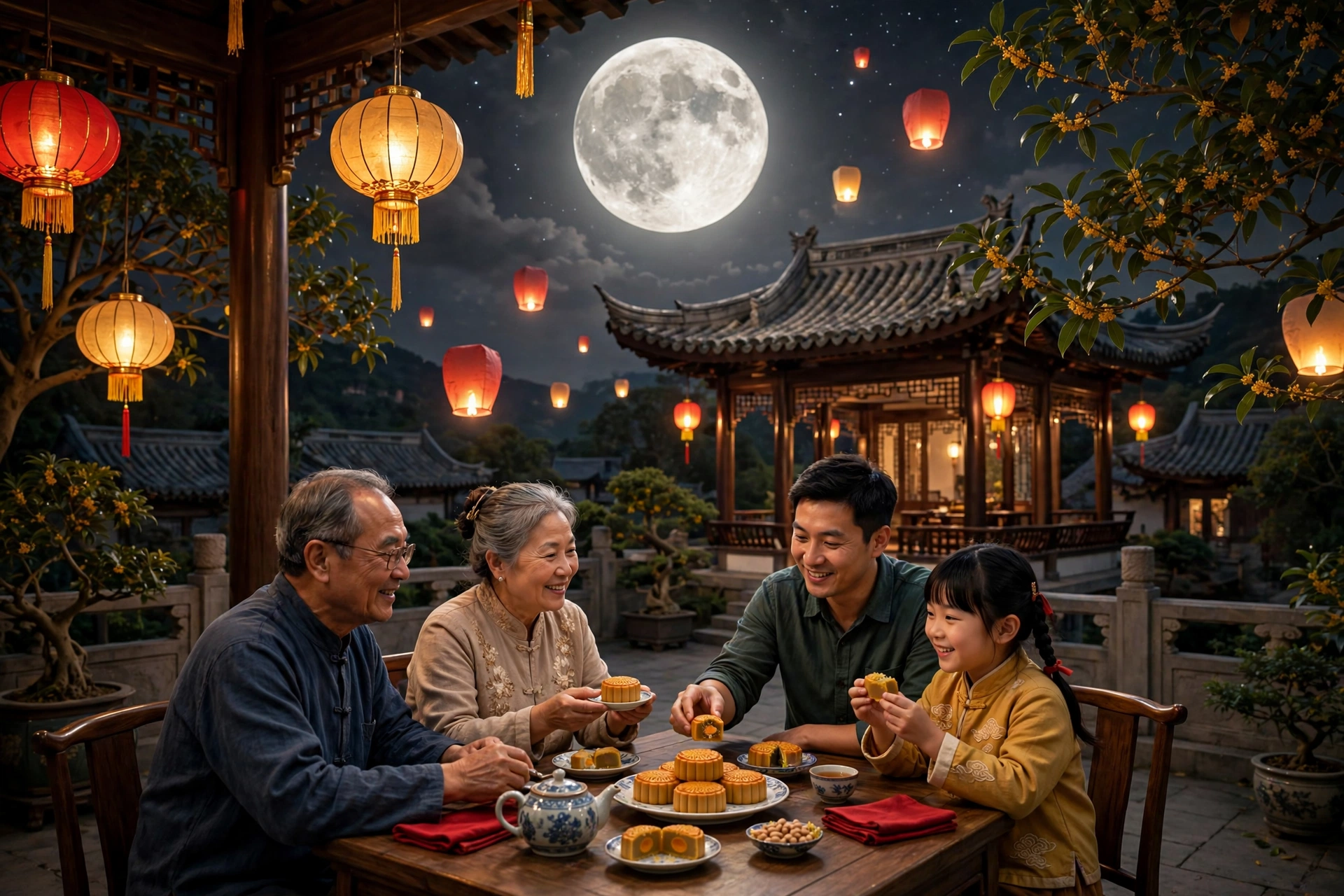
A luminous full moon over Chinese lanterns with a table of mooncakes and tea set for the Mid-Autumn Festival.
Watch: Mid-Autumn Festival in China
From the moon to the heart — the magic of the Mid-Autumn Festival, its legends, and its traditions.
At a Glance: Mid-Autumn Festival in China
The essentials of China's moon festival.
| Fact | Detail |
|---|---|
| 2027 date | Wednesday, 15 September — the 15th day of the 8th lunar month |
| The meaning | Zhōngqiū Jié (中秋节) — a celebration of the harvest and family reunion under the full moon |
| Mooncakes | Round pastries symbolizing the moon and togetherness — lotus seed, red bean, and salted egg yolk are classics |
| The legend | Chang'e, the moon goddess, who flew to the moon — families gaze upward in her honor |
| Lanterns | Lit lanterns symbolize light and good fortune; children parade with star-shaped lanterns |
Frequently Asked Questions
What is the Mid-Autumn Festival in China?
The Mid-Autumn Festival (中秋节, Zhōngqiū Jié) is China’s harvest-moon holiday, held on the 15th day of the eighth lunar month. It’s the second-most important traditional festival after Lunar New Year, centered on family reunion under the full moon, mooncakes, lanterns, and the legends of Chang’e and the Jade Rabbit.
When is Mid-Autumn Festival 2026?
September 25, 2026 (Friday), with a public holiday September 25–27 in mainland China. In 2027 it falls on September 15 (Wednesday).
Why do Chinese eat mooncakes?
Mooncakes’ round shape symbolizes the full moon and family reunion. They’re shared in wedges among family, given as gifts, and tied to legends — including the tale of rebels hiding messages in mooncakes. The act of dividing the round cake embodies the festival’s reunion theme.
What is the story of Chang’e?
Chang’e, wife of the hero archer Hou Yi, drank the elixir of immortality to keep it from a thief and floated to the moon, where she lives as its goddess with the Jade Rabbit. Her husband’s moonlit offerings to her became the custom of moon-viewing and mooncake-eating.
Is Mid-Autumn Festival a public holiday?
Yes — in mainland China, Hong Kong (day after), Macau, Taiwan, and Singapore. It’s a one-day statutory holiday, usually extended into a short break.
How is it different from Chuseok?
Both fall on the same full moon and celebrate harvest and family. Chuseok centers on Confucian ancestor rites (charye) and grave visits; Mid-Autumn centers on moon-viewing, mooncakes, lanterns, and the Chang’e legends. See our Chuseok guide for the full comparison.
Conclusion
The Mid Autumn Festival China celebrates each September is, at its heart, a triumph of tenderness over distance. Three thousand years of moon worship, a goddess’s lonely flight, a rabbit pounding immortality, a dragon of 72,000 incense sticks — all of it in service of a single, simple idea: that family is a circle, like the moon, and no miles can break it. Whether you’re sharing mooncakes in Shanghai, watching the fire dragon in Hong Kong, barbecuing riverside in Taipei, or simply stepping outside to look up from wherever you are in the world, the festival’s invitation is universal: find your people, share something round, and give thanks under the year’s most beautiful moon. For more harvest celebrations worldwide, explore Thanksgiving around the world, learn the festival’s fascinating cousin in our Thanksgiving vs. harvest festival guide, or browse the full Thanksgiving collection.