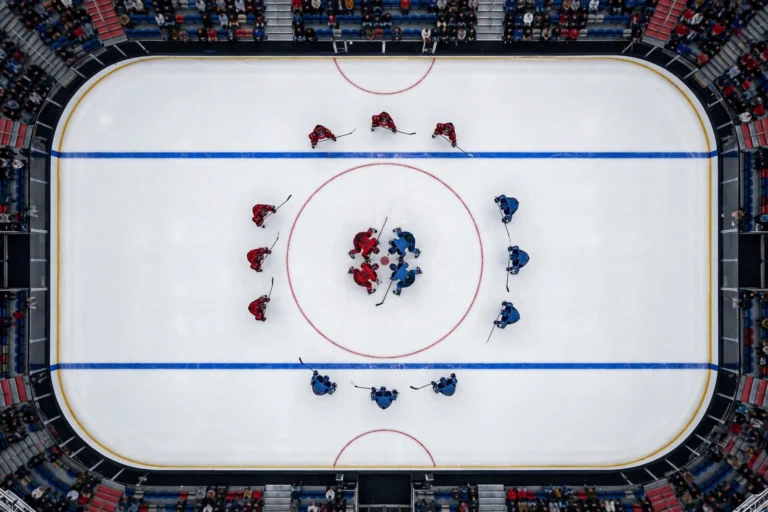
Understanding how hockey works is the fastest way to turn a blur of skates and sticks into one of the most thrilling sports experiences you can have as a fan. At first glance, ice hockey looks like beautiful chaos: players fly across the ice at incredible speed, the puck moves faster than your eyes can track, and whistles seem to stop play every few seconds for reasons nobody explains. But underneath that whirlwind sits a game built on simple ideas. Two teams skate on ice, pass a small rubber puck with sticks, and try to shoot it into the other team’s net more times than the opponent does. Once you grasp the basic structure — three periods, six players per side, goals beat everything — the game opens up layer by layer, and you will start noticing the strategy hidden inside the speed.
This complete beginner’s guide explains everything you need to know: the objective, the rink, the players, how games are structured, how scoring works, the essential rules around penalties and stoppages, and what happens when games go to overtime. By the end, you will be able to follow a full NHL game with confidence, whether you are watching on television or heading to your first live game.
The Objective: Score More Goals Than the Other Team
At its simplest, how hockey works comes down to one objective: put the puck in the opponent’s net more times than they put it in yours. A goal counts as one point, and the team with more goals when the clock hits zero wins. There are no partial points, no field goals worth three, no extra credit for style. Every goal counts exactly the same, whether it is a highlight-reel deke or an ugly bounce off a skate.
Hockey is a continuous-flow sport, which is a big part of its appeal. Unlike football or baseball, where play stops and resets after every down or pitch, hockey keeps moving. The clock runs while the puck is live, players change on the fly without stopping the game, and momentum can swing in seconds. A two-goal lead is never safe, and a team trailing late can pull its goalie for an extra attacker, turning the final minutes into frantic, wide-open drama.
Why Hockey Feels So Fast
Hockey players routinely reach skating speeds that make it the fastest team sport on the planet in terms of pure player movement. The puck itself can travel even faster on a hard shot. Because the playing surface is relatively small and there are only six skaters per side on the ice at once, there is very little empty space. That density creates constant action: hits, passes, shots, and saves happen in rapid succession, and a scoring chance can materialize from nothing in the time it takes to blink.
If you are new to learning sports from scratch, you may enjoy how our guide to how college basketball works breaks down another fast-paced game with the same beginner-friendly approach.
The Rink: Zones, Lines, and Markings
A standard NHL rink is 200 feet long and 85 feet wide, surrounded by boards topped with glass to keep the puck in play. The ice is divided by lines into three zones, and understanding these zones is essential because many of hockey’s most important rules — offside and icing — are defined by them.
| Zone | Location | What Happens There |
|---|---|---|
| Defensive zone | Between your goal line and the nearest blue line | Your team protects its own net and tries to move the puck out |
| Neutral zone | Between the two blue lines, split by the red center line | Teams transition between defense and offense; forechecking battles happen here |
| Offensive (attacking) zone | Between the far blue line and the opponent’s goal line | Your team sets up plays and shoots at the opponent’s net |
The blue lines are the most important markings on the ice. They separate the neutral zone from each end zone, and they define offside: the puck must cross the attacking blue line before any attacking player does, or the play is whistled offside. The red center line divides the rink in half and plays a key role in icing calls. The goal lines run across the ice near each net — a goal is scored only when the entire puck crosses the entire goal line between the posts and under the crossbar.
Faceoff Dots and Circles
You will notice red dots and circles scattered around the ice. These are faceoff spots: nine in total, with one at center ice and four in each end zone. After most stoppages, play restarts with a faceoff at the nearest dot, where two opposing centers battle for the puck as the referee drops it. Faceoffs are small wars that happen dozens of times per game, and winning them cleanly — especially in the offensive or defensive zone — is a genuine skill that can decide close games.
The Players: Six Skaters and a Goalie
Each team dresses up to 20 players for a game — 18 skaters and 2 goaltenders — but only six skaters are on the ice at a time: three forwards, two defensemen, and one goaltender. The forwards are the primary attackers, the defensemen guard against opposing attacks and help move the puck up the ice, and the goalie is the last line of defense in front of the net.
| Position | How Many on Ice | Primary Job |
|---|---|---|
| Center | 1 | Takes faceoffs, plays both ends of the ice, often the playmaker |
| Left wing / Right wing | 2 | Attack along the sides, forecheck, score and create chances |
| Defensemen (left and right) | 2 | Protect the defensive zone, block shots, start the breakout |
| Goaltender | 1 | Stops shots, controls rebounds, anchors the defense |
Lines and Shifts: Hockey’s Rolling Substitutions
Unlike most sports, hockey players do not stay on the ice for long stretches. Forwards skate in groups of three called lines (first line, second line, and so on), and defensemen rotate in pairs. A typical shift lasts only 30 to 60 seconds because skating at full effort is exhausting, and then players hop over the boards to the bench while fresh teammates jump on — all without stopping play. These are called line changes, and coaches manage them like chess moves, trying to match their best players against favorable opponents.
The best players — the stars you hear about on highlight shows — usually skate on the first line and play the most minutes, especially on the power play and in late-game situations. Depth matters too: teams that roll four strong lines can wear opponents down over a long game or a long playoff series.
How a Game Is Structured: Periods and the Clock
An NHL game consists of three periods, each 20 minutes of stop-time play. The clock stops whenever the whistle blows, so a game takes about two and a half hours in real time, including two intermissions of roughly 18 minutes between periods. Teams switch ends after each period so that neither side gets a lasting advantage from rink quirks like the benches or the arena’s sight lines.
| Segment | Duration | Notes |
|---|---|---|
| 1st period | 20 minutes (stop time) | Teams feel each other out; coaches set line matchups |
| 1st intermission | ~18 minutes | Ice resurfacing; analysis and adjustments |
| 2nd period | 20 minutes (stop time) | The “long change” — benches are farther from defensive zones, favoring offense |
| 2nd intermission | ~18 minutes | Ice resurfacing again |
| 3rd period | 20 minutes (stop time) | Protecting leads, pulling goalies, last-minute drama |
One strategic wrinkle worth knowing: in the second period, the team benches are positioned so that defending teams have a longer skate to change players. This “long change” leads to tired defenders getting caught on the ice and often produces more scoring chances — which is why the middle period frequently has the most goals.
Scoring: Goals, Assists, and Points
A goal is scored when the entire puck crosses the goal line into the net. The standard net is 6 feet wide and 4 feet tall, guarded by a goaltender wearing specialized oversized equipment. Goals can be scored with the stick, deflected off bodies, or bounced in off the boards — but a puck deliberately kicked in with a skate or batted in with a high stick does not count.
When a goal is scored, up to two teammates can earn assists for directly contributing to the play. Goals plus assists equal a player’s points, the headline statistic for skaters. A player who scores the goal gets one goal and the passers get assists — so a beautiful tic-tac-toe passing play can put three players on the scoresheet. Goaltenders are judged by save percentage (the share of shots they stop) and goals-against average (goals allowed per 60 minutes).
What Makes a Goal Count — or Not
- Counts: shots off the stick, deflections off any body part, bank shots off the boards or the goalie, and pucks that cross the line before the whistle.
- Does not count: pucks kicked in deliberately, batted in with a stick above the crossbar, scored after the whistle, or pushed in by a dislodged net.
- Reviewed: close calls go to video review, where officials check whether the puck fully crossed the line and whether any infraction occurred.
Penalties: Power Plays and Penalty Kills
Hockey is a physical sport, but there are firm limits. When a player breaks a rule — tripping an opponent, slashing with the stick, holding, high-sticking, and similar infractions — the referee raises an arm and the offender heads to the penalty box. Most penalties are minor penalties lasting two minutes; more serious infractions like fighting or dangerous hits draw major penalties of five minutes.
While a player sits in the box, his team plays shorthanded. The team with the extra skater is on the power play, and the shorthanded team is on the penalty kill. Power plays are prime scoring time: with a 5-on-4 advantage, the attacking team can pass the puck around the zone and pick apart the defense. If the shorthanded team scores, it is called a shorthanded goal — one of the most electrifying plays in the sport. A minor penalty ends early if the power-play team scores; a major penalty is served in full no matter what.
| Common Penalty | What It Is | Typical Length |
|---|---|---|
| Tripping | Using stick, leg, or arm to make an opponent fall | 2 minutes |
| Hooking | Using the stick to hold back or slow an opponent | 2 minutes |
| Slashing | Striking an opponent with the stick | 2 minutes |
| High-sticking | Hitting an opponent with the stick above shoulder height | 2 or 4 minutes |
| Interference | Impeding a player who does not have the puck | 2 minutes |
| Roughing | Unnecessary roughness, usually after the whistle | 2 minutes |
| Fighting | Dropping the gloves and trading punches | 5 minutes |
| Delay of game | Shooting the puck over the glass from the defensive zone | 2 minutes |
Offside and Icing: The Two Rules That Stop Play Most
Two rules cause more whistles than any others, and new fans often find them confusing at first. Both exist to keep the game fair and flowing.
Offside
A team is offside when an attacking player crosses the offensive blue line before the puck does. Think of it like a head start that is not allowed: you cannot cherry-pick behind the defense and wait for a long pass. The linesman raises an arm, the whistle blows, and the faceoff moves back to the neutral zone. Players entering the zone must time their rush so the puck crosses the line first — or at least at the same moment.
Icing
Icing is called when a player shoots the puck from behind the center red line all the way past the opponent’s goal line without it being touched. It is essentially a rule against just firing the puck down the ice to kill time. When icing is whistled, the faceoff comes all the way back to the offending team’s defensive zone, and that team is not allowed to change players — a real punishment late in a close game. There is one major exception: a shorthanded team killing a penalty is allowed to ice the puck freely, which is why you see penalty killers flipping the puck the length of the ice without consequence.
Overtime and Shootouts: Settling Ties
If the score is tied after three periods, the game goes to overtime. In the NHL regular season, overtime is a five-minute sudden-death period played 3-on-3 — three skaters per side plus goalies. The open ice makes 3-on-3 overtime some of the most wide-open, heart-pounding hockey you will ever see, with breakaways and odd-man rushes happening constantly. The first goal wins.
If nobody scores in overtime, the game is decided by a shootout: three rounds (then sudden-death rounds if needed) of one shooter against one goalie, alternating teams. It is pure theater — a single skater with the puck, one goalie, and thousands of people holding their breath.
Playoff hockey handles ties differently and more dramatically: there are no shootouts in the postseason. Instead, teams play full 20-minute sudden-death overtime periods, 5-on-5, until somebody scores. Playoff overtime games can stretch deep into multiple extra periods and become instant legends — the kind of games fans talk about for decades.
The Flow of a Typical Shift: Putting It All Together
To see how hockey works in real time, follow one shift. The puck drops at a faceoff. The winning center passes back to a defenseman, who starts the breakout — moving the puck out of the defensive zone. Forwards streak up the ice through the neutral zone while the defense gaps up to meet them. The puck carrier crosses the blue line (avoiding offside), dumps the puck into the corner or carries it in, and the forwards forecheck — pressuring the opposing defensemen to force a turnover.
If the attack sustains pressure, the team sets up in the offensive zone: defensemen hold the blue line (the point), forwards cycle the puck low around the net, and everyone looks for a shooting lane or a cross-ice pass. Shots come from the point, rebounds bounce around the crease, and the goalie battles through screens. When the defense finally gains control, they clear the zone, and the whole dance reverses. Forty-five seconds later, the forwards glide to the bench and fresh legs hop over the boards. Repeat for 60 minutes.
Hockey Terms Every New Fan Should Know
| Term | What It Means |
|---|---|
| Hat trick | One player scoring three goals in a single game; fans throw hats onto the ice |
| Power play | A team playing with a man advantage due to an opponent’s penalty |
| Penalty kill | Defending while shorthanded |
| Empty net | A goalie pulled for an extra attacker, leaving the net vacant |
| Breakaway | A skater alone against the goalie with no defenders back |
| One-timer | Shooting the puck directly off a pass without stopping it first |
| Slap shot | A full-windup powerful shot |
| Wrist shot | A quick, accurate shot using a snap of the wrists |
| Save | A goalie stopping a shot on goal |
| Shutout | A goalie allowing zero goals in a complete game |
| Forecheck / Backcheck | Pressuring the puck carrier in the offensive zone / hustling back defensively |
| Crease | The blue-painted area in front of the net where the goalie works |
How to Enjoy Your First Live Game
Nothing teaches how hockey works faster than seeing it in person. A few tips for your first trip to the rink:
- Arrive early for warmups. Watching players stretch, shoot, and joke around 30 minutes before puck drop is a relaxed way to get oriented.
- Follow the puck, then widen your gaze. Beginners stare at the puck; experienced fans watch the play develop away from it. Start with the puck and gradually take in positioning.
- Learn the goal horn. The red light behind the net and the horn mean a goal — you will feel it before you see it.
- Stay for the whole third period. Hockey’s best drama lives in the final ten minutes, especially in a one-goal game with an empty net.
- Soak in the atmosphere. From the organ to the between-period entertainment, the arena experience is half the fun — our college football tailgating guide captures a similar game-day ritual spirit, and finding local events near you is the easiest way to catch minor-league or college hockey in your area.
Winter sports fans who catch the hockey bug often branch out — skiing for beginners is a natural next adventure once the cold-weather sports itch kicks in.
Frequently Asked Questions
How long is a hockey game?
An NHL game has three 20-minute periods of stop-time play, plus two intermissions. In real time, expect about two and a half hours, longer if the game goes to overtime or a shootout.
How many players are on the ice in hockey?
Six skaters per team: three forwards (a center and two wingers), two defensemen, and one goaltender. Teams dress 18 skaters and 2 goalies total and rotate them in short shifts.
What is offside in hockey?
Offside occurs when an attacking player crosses the offensive blue line before the puck. The play is whistled dead and the faceoff moves to the neutral zone.
What is icing in hockey?
Icing is whistled when a player shoots the puck from behind center ice past the opponent’s goal line untouched. The faceoff returns to the offender’s defensive zone, and they cannot change players.
How does overtime work in the NHL?
Regular-season overtime is five minutes of sudden-death 3-on-3 play, followed by a shootout if needed. Playoff games use full 20-minute sudden-death 5-on-5 overtimes until someone scores — no shootouts.
What is a power play?
When a player takes a penalty, his team plays shorthanded while the opponent enjoys a man advantage — the power play. Minor penalties end early if the power-play team scores; major penalties run their full five minutes.
Why do hockey players change so often?
Shifts last 30 to 60 seconds because all-out skating is exhausting. Short, intense shifts keep every player fresh, which is why you see constant line changes without play stopping.