Not every home has sun-drenched windows, but that should not stop you from having greenery. The best indoor plants for low light are the tough, adaptable species that evolved on dim forest floors — plants that tolerate north-facing windows, rooms with small windows, and corners that never see direct sun. This guide covers 12 proven low-light houseplants, what “low light” actually means, how to keep them alive, and which popular plants to avoid if your space is dim. Whether you are a total beginner or a serial plant killer looking for redemption, there is a plant here that will thrive in your home.
First, an honest definition: “low light” means bright indirect light is absent — think a north-facing window, a spot several feet from any window, or a room lit mostly by ambient daylight. It does not mean no light. No plant survives in a truly dark room; even the toughest low-light plants need enough light to read a book comfortably during the day. If your space is darker than that, a simple grow light (an LED bulb in a desk lamp works) changes everything.
How to Read Light Levels in Your Home
Before buying, assess your light honestly. Hold your hand about a foot above a white piece of paper in the spot where the plant will live, around midday. A sharp, defined shadow means bright light. A soft, fuzzy shadow means medium or indirect light. Barely any shadow at all means low light. North-facing windows provide gentle, consistent indirect light — ideal for most of the plants on this list. East-facing windows give soft morning sun that low-light plants tolerate well. South and west windows are brightest; place low-light plants several feet back from these, or behind a sheer curtain, since direct hot sun scorches their leaves.
Distance from the window matters as much as direction. Light intensity drops fast — a plant three feet from a north window gets far less light than one sitting on the sill. The plants below are ranked by how dim a spot they tolerate, so match the plant to your actual conditions rather than hoping for the best.
The 12 Best Indoor Plants for Low Light
1. Snake Plant (Sansevieria trifasciata)
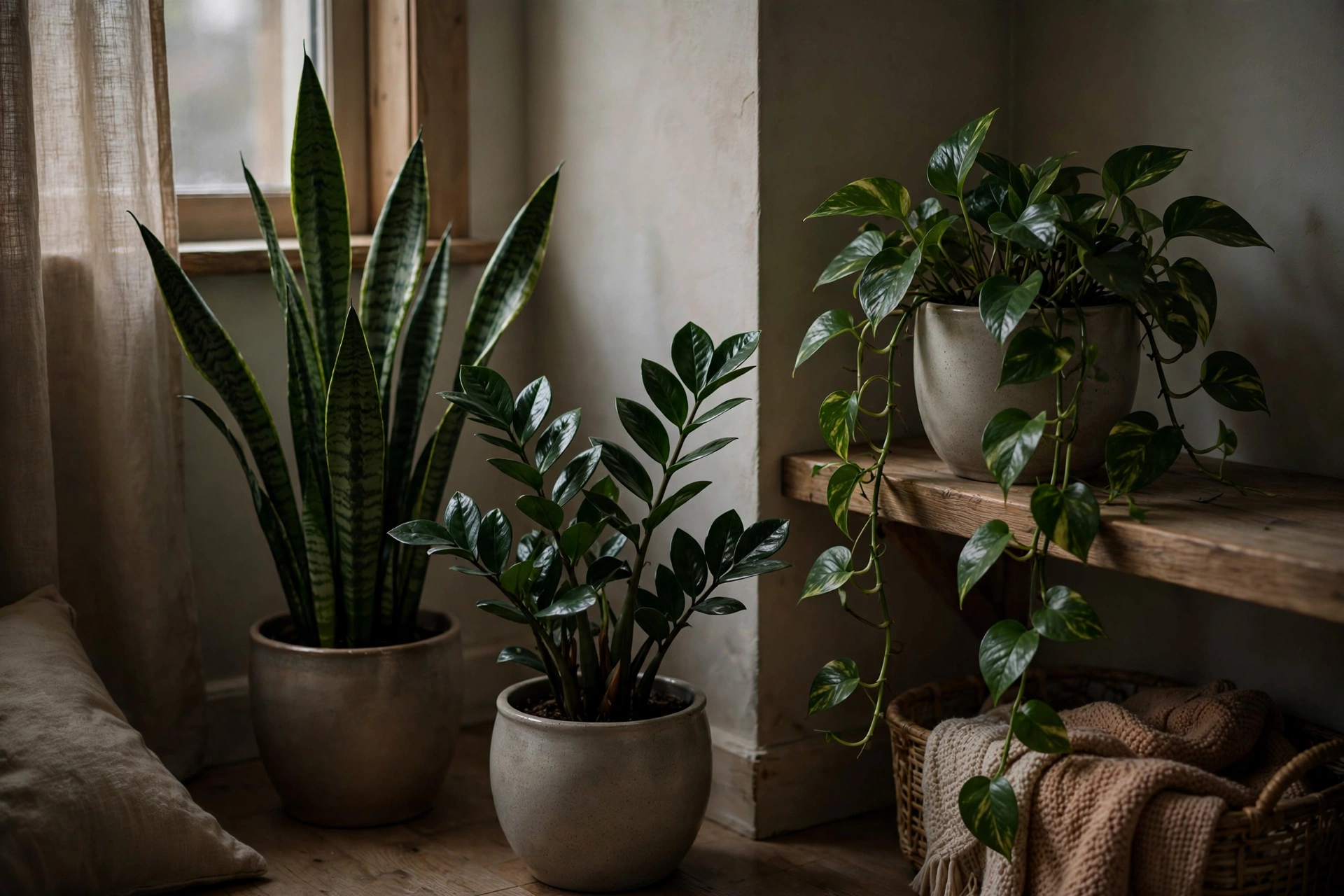
The undisputed champion of neglect. Snake plants tolerate low light, irregular watering, and dry air — the trifecta of difficult indoor conditions. Their stiff, upright sword-like leaves add architectural height to a corner and come in varieties with yellow edges or silvery tones. Water only when the soil is completely dry, roughly every two to three weeks, and less in winter. The main way people kill snake plants is overwatering, which rots the roots. They are also slow growers, so buy the size you want rather than waiting for a small one to fill out.
2. ZZ Plant (Zamioculcas zamiifolia)
Glossy, dark green leaflets on arching stems make the ZZ plant look far more expensive than it is. It stores water in thick rhizomes underground, so it forgives forgotten waterings for weeks — genuinely one of the most drought-tolerant houseplants sold. It grows slowly in low light and a bit faster with more, but it stays handsome either way. Like the snake plant, its enemy is soggy soil; let it dry out fully between waterings. Wipe the leaves occasionally to keep their shine.
3. Pothos (Epipremnum aureum)
The classic trailing beginner plant, available in golden, marble queen, neon, and jade varieties. Pothos tolerates low light better than almost any trailing plant, though variegated types may revert to solid green in very dim spots (less light means less energy for fancy patterns). Let the top inch or two of soil dry between waterings, and trim leggy vines to encourage bushier growth — the cuttings root effortlessly in water, giving you free plants. Hang it, let it trail from a shelf, or train it up a moss pole.
4. Cast Iron Plant (Aspidistra elatior)
The name says it all: this Victorian-era parlor plant earned its reputation surviving dark, drafty, coal-heated rooms. Broad, deep-green leaves rise directly from the soil on stiff stems, forming an elegant clump. It is slow-growing and nearly indestructible — tolerant of low light, temperature swings, and inconsistent care. Water when the top couple of inches dry out. It dislikes being repotted frequently, so give it a roomy pot and leave it alone for years.
5. Peace Lily (Spathiphyllum)
One of the few low-light plants that flowers indoors, producing elegant white spathes in dim conditions where most bloomers refuse. Peace lilies are dramatic communicators — they droop visibly when thirsty and perk up within hours of watering, which makes them excellent teachers for beginners. They prefer consistently moist (not soggy) soil and appreciate humidity. Brown leaf tips usually mean inconsistent watering or fluoride-heavy tap water; switching to filtered water or letting tap water sit overnight often fixes it.
6. Chinese Evergreen (Aglaonema)
With patterned leaves in silver, pink, and red tones, Chinese evergreens bring color to dark corners without needing sun to hold their variegation — a rare trait. They are slow, steady growers that tolerate low light, dry air, and occasional missed waterings. Keep them away from cold drafts, which they dislike more than dimness. Water when the top inch of soil dries. Newer colorful cultivars are just as easy as the classic green types.
7. Spider Plant (Chlorophytum comosum)
Arching striped leaves and dangling baby plantlets make spider plants cheerful and endlessly propagatable — one plant becomes many within a year. They adapt to low light (variegation fades a bit, but the plant stays healthy) and bounce back from underwatering. Brown tips are the classic complaint, usually from fluoride in tap water or fertilizer salt buildup; flushing the soil occasionally and using room-temperature water helps. Hang them where the plantlets can dangle, and snip the babies to root in water or soil.
8. Philodendron (Heartleaf and Similar Types)
Heartleaf philodendron trails like pothos but with softer, heart-shaped leaves, and it is equally forgiving of dim rooms. It tolerates low light, irregular watering, and low humidity, growing steadily where fussier plants stall. Pinch back long vines to keep it full, and propagate the cuttings in water. Like pothos, it is toxic to pets if chewed, so keep trailing vines out of reach of curious cats and dogs.
9. Parlor Palm (Chamaedorea elegans)
A small, feathery palm that has decorated dim Victorian parlors for over a century. Parlor palms grow slowly to two or three feet indoors and tolerate low light far better than most palms — though they do appreciate a bit of humidity and dislike completely drying out. They are one of the few palms considered non-toxic to pets, a real advantage in animal households. Brown frond tips usually signal dry air or underwatering; grouping plants together or adding a pebble tray raises local humidity.
10. Dracaena (Dracaena fragrans and D. marginata)
Upright, tree-like dracaenas add height and structure to dark corners. Janet Craig (broad dark leaves) tolerates the lowest light of the group; the dragon tree (D. marginata, with narrow red-edged leaves) wants a touch more but still qualifies. They are sensitive to fluoride — brown leaf margins are the tell — so filtered or distilled water keeps them happiest. Let the soil dry between waterings and avoid cold drafts.
11. Lucky Bamboo (Dracaena sanderiana)
Not true bamboo but a dracaena grown in water, lucky bamboo thrives in low light on a desk or shelf with almost no care: change the water every week or two, keep the roots submerged, and it carries on for years. It is the lowest-maintenance option on this list and a good choice for offices and bathrooms with small windows. Use filtered water if your tap water is heavily treated, and add a drop of liquid fertilizer monthly in the growing season.
12. Ferns for Low Light: Bird’s Nest Fern
Most ferns demand humidity and consistent moisture, but the bird’s nest fern (Asplenium nidus) is the forgiving exception. Its broad, wavy fronds unfurl from a central rosette and tolerate lower light and drier air than its lacy cousins. Keep the soil lightly moist and water the soil, not the central rosette, to avoid rot. It is a striking, sculptural plant that looks far more exotic than its care requirements suggest.
Comparison: Light Needs, Water Needs, and Pet Safety
| Plant | Lowest Light Tolerated | Water Frequency | Pet Safe? | Beginner Score |
|---|---|---|---|---|
| Snake plant | Very low | Every 2–3 weeks | No — toxic if eaten | 10/10 |
| ZZ plant | Very low | Every 2–3 weeks | No — toxic if eaten | 10/10 |
| Cast iron plant | Very low | Weekly | Yes | 9/10 |
| Chinese evergreen | Low | Weekly | No — toxic if eaten | 9/10 |
| Pothos | Low | Weekly | No — toxic if eaten | 9/10 |
| Peace lily | Low | Weekly (keeps moist) | No — toxic if eaten | 8/10 |
| Spider plant | Low | Weekly | Yes | 8/10 |
| Heartleaf philodendron | Low | Weekly | No — toxic if eaten | 8/10 |
| Parlor palm | Low | Weekly | Yes | 8/10 |
| Dracaena | Low–medium | Every 1–2 weeks | No — toxic to cats/dogs | 7/10 |
| Lucky bamboo | Low | Change water biweekly | No — toxic if eaten | 9/10 |
| Bird’s nest fern | Low–medium | Weekly (keep moist) | Yes | 7/10 |
A note on pet safety: “toxic if eaten” covers a wide range — pothos and philodendron cause mouth irritation that usually deters repeat chewing, while lilies (true lilies, not peace lilies) are genuinely dangerous to cats. If you have pets that chew plants, stick with the pet-safe options above (cast iron plant, spider plant, parlor palm, bird’s nest fern) and keep others out of reach. The ASPCA’s plant database is the authoritative reference when in doubt.
Care Tips That Matter Most in Low Light
Water less than you think
In dim conditions plants grow slowly and use far less water, so the number-one killer of low-light houseplants is overwatering, not darkness. Always check the soil before watering — stick a finger an inch or two down, and water only when it feels dry at that depth. Pots must have drainage holes; a plant sitting in a saucer of water will rot regardless of species. When in doubt, wait a day: underwatering is recoverable, root rot usually is not.
Do not fertilize much
Slow growth means low nutrient demand. Feed low-light plants at half strength, only in spring and summer, and skip fertilizer entirely in fall and winter. Excess fertilizer causes salt buildup that burns leaf tips — the brown edges people blame on everything else. Flushing the pot with plain water occasionally washes accumulated salts out.
Keep leaves clean
Dust blocks what little light reaches the leaves. Wipe broad leaves with a damp cloth every month or two, and rinse smaller plants in the shower. Clean leaves photosynthesize more efficiently, which matters most exactly when light is scarce.
Rotate regularly
Plants lean toward their light source. A quarter-turn every week or two keeps growth even and symmetrical instead of lopsided.
Know when to add a grow light
If a plant stretches with long gaps between leaves (etiolation), leans hard toward the window, or drops leaves despite good watering, it needs more light than the spot provides. A full-spectrum LED grow bulb in an ordinary lamp, run 10 to 12 hours a day on a timer, solves the problem for a few dollars of electricity per year. This is not cheating — it is how you keep a “low light” plant healthy in a genuinely dark corner.
Popular Plants to Avoid in Low Light
- Succulents and cacti — they stretch, pale, and rot in dim rooms; they need bright direct sun.
- Fiddle-leaf fig — famously fussy; drops leaves in low light and drafts.
- Most flowering houseplants (hibiscus, gardenia, jasmine) — blooms require far more light than foliage.
- Variegated showpieces (variegated monstera, calathea varieties) — lose pattern and vigor without bright indirect light.
- Herbs — basil, rosemary, and thyme need strong sun; they go leggy and flavorless on a dim sill.
If you love one of these anyway, pair it with a grow light rather than fighting its nature.
Frequently Asked Questions
What is the absolute easiest low-light plant?
The snake plant and ZZ plant tie for first: both survive weeks of neglect, tolerate very dim corners, and ask only for well-draining soil and infrequent watering. If you have killed every plant you have owned, start with one of these two.
Can low-light plants live in a room with no windows?
Not without help. Even the toughest plants need some light to photosynthesize. A windowless bathroom or office works fine with a grow light on a timer (10–12 hours daily), which effectively gives the plant the light it needs.
Why are my low-light plant’s leaves turning yellow?
Yellow leaves most often mean overwatering — the classic low-light mistake, since dim plants drink slowly. Check that the pot drains, let the soil dry between waterings, and remove yellow leaves so the plant stops wasting energy on them. If watering is correct, consider whether the plant is rootbound or needs a light feeding in spring.
Do low-light plants clean the air?
The famous NASA clean-air study is often overstated — you would need dozens of plants per room to match its results. That said, plants do modestly improve humidity and, more importantly, they make rooms feel calmer and more pleasant, which is reason enough to keep them.
How do I know if my plant needs more light?
Watch for stretching (long stems with sparse leaves), leaning strongly toward the window, new leaves emerging smaller than old ones, or variegated plants reverting to green. Any of these means the spot is dimmer than the plant prefers — move it closer to the window or add a grow light.
The best indoor plants for low light prove that a dim room is a design opportunity, not a limitation. Match the plant to your real light levels, water less than your instincts suggest, and keep the leaves clean — do that, and even the darkest corner of your home can hold something green and thriving. For more ways to make your space feel alive, see our budget-friendly self-care ideas for turning your home into a genuine retreat.
Buying Low-Light Plants: What to Look For
Buy from a reputable nursery or garden center rather than a clearance rack — stressed plants recover slowly in dim conditions, so start with healthy stock. Look for firm, evenly colored leaves with no yellowing, no brown crispy edges, and no signs of pests (check leaf undersides and the soil surface for tiny insects or webbing). The plant should feel firmly rooted, not wobbly in its pot. Avoid plants that are already stretching toward the store lights with long, sparse stems — that legginess is hard to reverse.
Repot thoughtfully: most nursery plants arrive rootbound or in dense peat-heavy mix. Move up only one pot size (about 2 inches wider), use a well-draining potting mix appropriate to the species (add perlite for snake plants and ZZ plants, which demand sharp drainage), and make sure the new pot has drainage holes. Do not fertilize a newly repotted plant for a month — let the roots settle first. Quarantine new plants away from your existing collection for two weeks to make sure no pests hitchhiked home.
Styling Low-Light Plants in Your Home
- Go big in dark corners — one large snake plant or dracaena in a handsome pot anchors a dim corner better than a cluster of small plants that reads as clutter.
- Trail from high shelves — pothos and philodendron cascading from a bookshelf or cabinet top add greenery at eye level without using floor space.
- Group for humidity — clustering plants together raises the local humidity slightly, which peace lilies and ferns appreciate.
- Match pot to decor — in low light, the pot is half the visual impact; a ceramic or woven basket planter elevates even a humble pothos.
- Use plant stands — raising plants 12 to 24 inches on a stand brings them closer to window light and adds height variation to the room.
- Rotate the collection — if you have one bright window, rotate plants through it for a “light vacation” every few weeks to boost vigor.
Troubleshooting Common Low-Light Problems
| Symptom | Likely Cause | Fix |
|---|---|---|
| Yellow, mushy lower leaves | Overwatering / root rot | Let soil dry fully; repot into dry mix, trimming black roots |
| Long, sparse, stretched stems | Not enough light | Move closer to window or add a grow light; prune leggy growth |
| Brown, crispy leaf tips | Fluoride/salts or underwatering | Switch to filtered water; flush soil; water more consistently |
| Variegation fading to green | Too little light for pattern | Move to brighter indirect spot; accept some reversion in dim rooms |
| Drooping despite wet soil | Root rot from chronic overwatering | Unpot, inspect roots, repot in fresh dry mix |
| Tiny webs or speckled leaves | Spider mites (love dry indoor air) | Rinse plant thoroughly; increase humidity; treat with insecticidal soap |