Staring at a blank anniversary card, pen in hand, mind suddenly empty — it happens to the most devoted partners. You have a decade of love in your heart and no idea how to fit it into a five-by-seven card. The problem is rarely a lack of feeling; it is a lack of structure. This guide answers what to write in a first meeting anniversary card with a simple five-part framework that turns overwhelming emotion into a clear, beautiful message — plus dozens of examples for each part, tone guidance, and the mistakes that make cards fall flat.
A first meeting anniversary card is a distinct literary genre. It is not a wedding card (formal, witnessed, about commitment) and not quite a love letter (long, private, unstructured). It is a short, deliberate celebration of a beginning — part memory, part gratitude, part promise. Once you understand its shape, writing one becomes not just easy but genuinely enjoyable.
The Five-Part Card Framework
Every great anniversary card contains five elements, in roughly this order. You do not need all five in equal measure — a short card might give each one a sentence, while a long card might expand two or three — but touching each one creates a message that feels complete.
Part 1: The Opening — Name the Day
Begin by naming what you are celebrating. This orients the reader and gives the card its occasion. It can be simple or lyrical, but it should be explicit: this card is about the day you met.
Example openings:
- “On this day, [X] years ago, my life changed in a crowded [bar/cafe/park]…”
- “Happy anniversary of the best accident of my life.”
- “I have been thinking all week about the day we met, and I needed to tell you…”
- “[Date] — the day everything started. I remember it like this…”
- “Some people celebrate the wedding. I want to celebrate the hello.”
The opening works best when it includes a concrete detail — the place, the date, the weather. Specificity signals that this is a real memory, not a generic sentiment. “In that noisy little Italian place on 5th” beats “at a restaurant” every time.
Part 2: The Memory — Show You Remember
This is the heart of a first meeting anniversary card. Describe something specific from the day you met or the early days after: what she wore, what you talked about, what went wrong, what you thought on the way home. The memory proves attention — it says “I was paying attention then, and I have been paying attention ever since.”
Example memory passages:
- “You wore a green sweater and talked about your grandmother’s garden for twenty minutes, and I remember thinking I had never met anyone who could make gardening sound like an adventure.”
- “I was so nervous I knocked over my water glass, and you laughed — not at me, but with me — and I knew I was in trouble.”
- “We closed the place down. The waiter was stacking chairs around us and neither of us noticed, because we were too busy discovering that we had the same favorite book.”
- “On the walk to our cars, it started raining, and instead of running, we just stood there getting wet and talking. I think about that rain every time it rains.”
- “You told me your most embarrassing story within the first hour. I told you mine within the second. I have never felt so quickly known by anyone.”
Choose a memory she will recognize but may have forgotten — the delight of “I can’t believe you remember that” is one of the card’s greatest pleasures. If your memories differ on details, say so with humor; the two versions are both true.
Part 3: The Appreciation — Say What She Means
Move from the past to the present: what does she mean to you now, after all these years? Appreciation works best when it is specific rather than general. “You are amazing” is nice; “You are the person who remembers everyone’s coffee order, who sings in the car, who held my hand through the hardest year of my life” is unforgettable.
Example appreciation passages:
- “You are the bravest person I know — not in grand gestures, but in the daily courage of showing up, caring deeply, and loving completely.”
- “Thank you for the thousand small kindnesses I never properly thanked you for: the 6 a.m. airport drives, the soup when I was sick, the way you always save me the last bite.”
- “You make our house a home, our routines an adventure, and our hardest days bearable. You do it without fanfare, which is exactly why it deserves fanfare today.”
- “I admire you more every year — your integrity, your humor, your infuriating and wonderful stubbornness. Loving you is easy; deserving you is the work of my life.”
- “You believed in me before I believed in myself, and you have never stopped. Everything I have built, I built on the foundation of your faith.”
Part 4: The Present Love — Say It Now
Do not assume she knows. Say it explicitly, in present tense: I love you now, today, as you are. Anniversary cards sometimes get so focused on memory and gratitude that they forget the simplest sentence. Include it plainly.
Example present-love lines:
- “I love you today more deeply than the day I met you — not instead of that love, but built on top of it, layer after layer.”
- “Loving you is still my favorite thing. It has been my favorite thing since that first evening, and it will be my favorite thing tomorrow.”
- “If I met you again today, knowing everything I know, I would still choose you — faster, surer, and with even more joy.”
- “You are my person. Not just my partner or my spouse — my person, the one I want beside me for all of it.”
- “After all these years, you still make my heart do the ridiculous fluttery thing. I have stopped being embarrassed about it.”
Part 5: The Future Promise — Look Forward
End by facing forward. A promise about the future — even a small, playful one — gives the card momentum rather than just nostalgia. It says: our story is not a memory; it is a project we are still building.
Example closings:
- “Here is to the next chapter — I cannot wait to see what we do with it.”
- “I promise to keep choosing you, in the big moments and the boring ones, for all the years we get.”
- “The best is yet to come. I know, because the best keeps arriving, every year, with you.”
- “Let us make the next [X] years even better than the first [X]. I have some ideas…”
- “Forever started on the day we met. I am still all in.”
Putting It Together: Complete Example Cards
Here is how the framework looks when assembled into complete messages of different lengths and tones.
The Short and Sweet Card
“Happy anniversary of the day we met! I still think about that rainy walk after dinner, and I still choose you every single morning. Here is to us — then, now, always.”
The Romantic Card
“On this day, years ago, the universe put you in my path, and I have been walking toward you ever since. I remember your laugh halfway through dinner and thinking I wanted to hear it every day. I got my wish — and a thousand more I never thought to wish for. You are the love of my life, the mother of my joy, the home I carry everywhere. I love you today with a depth the boy who met you could not have imagined. Forever started that night. I am still all in.”
The Funny Card
“Happy meet-aversary! I cannot believe you said yes to a second date after I knocked over my drink, talked about my fantasy football team for an hour, and got us lost on the way to the car. Your judgment was questionable then and remains questionable now, and I am the luckiest beneficiary of it. I love you more than ever — which is convenient, because you are stuck with me. Here is to many more years of your excellent poor decisions.”
The Deeply Personal Card
“I have been trying to remember exactly when I knew, and I think it was the moment you told me about your grandmother’s garden — the way your whole face changed, the way something ordinary became luminous because you loved it. I wanted to spend my life watching you love things. That is still what I want, every day. Thank you for the years, the laughter, the hard seasons we survived, and the ordinary Tuesdays that feel like gifts. You are my favorite person in the history of people. Happy anniversary of our beginning — let us make the next chapter the best one yet.”
Tone Matching: Write for Your Partner, Not the Occasion
| If Your Partner Is… | Lead With | Include | Avoid |
|---|---|---|---|
| Deeply romantic | Grand declarations | Poetic language, future promises | Irony or understatement |
| Warm but understated | Sincere simplicity | Specific memories, quiet gratitude | Overblown metaphors |
| Playful and funny | Humor and teasing | Inside jokes, self-deprecation | Excessive solemnity |
| Practical and grounded | Concrete appreciation | Specific things you admire and thank her for | Abstract poetry |
| Sentimental keeper | Detailed memories | Dates, places, sensory details | Vagueness — she wants specifics |
| Private and reserved | Intimate directness | Quiet, honest sentences | Anything she would not want read aloud |
Seven Card-Writing Mistakes to Avoid
Mistake 1: Only signing your name under the printed verse. The pre-printed message is the card company’s words, not yours. Even two original sentences transform it. Never leave a card with only a signature.
Mistake 2: Writing only about the past. Nostalgia without present-tense love feels like a eulogy. Always include “I love you now” explicitly — the card should pulse with current feeling, not just memory.
Mistake 3: Being vague. “You are wonderful” could be written to anyone. “You are wonderful because you remembered my presentation was today and texted me luck at exactly 9 a.m.” could only be written to her. Specificity is the entire game.
Mistake 4: Apologizing in the card. An anniversary card is not the place to rehash conflicts or issue blanket apologies. Keep the tone celebratory. If there are things to discuss, discuss them separately, in conversation.
Mistake 5: Writing too much to fit. Plan your message length before you start writing. A cramped, tiny-handed overflow onto the back flap looks rushed. Draft on scrap paper first, count your lines, and choose a card with enough space.
Mistake 6: Forgetting to date it. Always write both dates: today’s date and the original meeting date. Years from now, when she re-reads it, the dates will anchor the memory. Undated cards lose half their power as keepsakes.
Mistake 7: Letting someone else write it. Having a friend “help” is fine; having them write it is not. She will know. The slightly clumsy but genuine sentence beats the polished borrowed paragraph every time — though borrowing a line and adding your own, as our funny wedding day card messages and short wedding day quotes for cards collections encourage, is a perfect middle ground.
When Words Fail: Emergency Card Strategies
It is the morning of the anniversary, the card is blank, and your mind is blank. Three rescue strategies. First, the list card: write “10 things I loved about you then, 10 things I love about you now” — twenty short lines, no eloquence required, devastatingly effective. Second, the quote card: choose one perfect line from our romantic wedding day quotes for her collection, write it beautifully, and add one sentence: “This is exactly how I feel.” Third, the timeline card: draw a simple timeline from the date you met to today, marking five key moments with a few words each. Visual, personal, and impossible to get wrong. Any of these beats a late store-bought card with only a signature — and all of them take less than twenty minutes.
Watch: A Gift of Memories That Says It All
Sometimes the most powerful message is not written but shown. This video captures a partner receiving a lifetime of memories as a gift — a beautiful reminder that what you put into a card, or a gift, is really your attention made visible.
Real Card Examples: Three Complete Cards, Annotated
Theory is useful; examples are better. Here are three complete anniversary cards — different tones, different lengths — with notes on why each choice works.
Card 1: The Romantic Classic. “My dearest [name] — Eleven years ago today, you walked into [place] wearing [detail], and I have never quite recovered. I remember [specific memory], and I remember thinking [honest thought]. You have been my [what she is] ever since. I love you more deeply today than I could have imagined then — not a different love, but a deeper one, built layer by layer out of ordinary days made extraordinary by you. Here is to the next chapter. I am still, completely, yours. — [your name], [today’s date].” Why it works: every framework element is present, the specifics prove memory, and the closing faces forward. The bracketed details make it unmistakably personal.
Card 2: The Playful Heart. “Happy meet-aversary! Fun facts from the day we met: I was [embarrassing truth], you were [charming detail], and we both [shared awkward moment]. Against all odds, it worked. Against all odds, it keeps working — because you are [genuine compliment] and I am [self-deprecating truth]. I love our life, I love our story, and I love you. Now stop reading this card and come [plan for the evening]. — [your name].” Why it works: humor disarms, then sincerity lands harder by contrast. The call to action at the end turns the card into the opening of the evening’s celebration.
Card 3: The Quiet Profound. “The day we met: [date]. The place: [place]. What I remember most: [one vivid sensory detail]. What I know now: you are the best thing that ever happened to me. Thank you for [one specific thing]. I love you. — [your name].” Why it works: radical simplicity. Short sentences, white space, one perfect detail. This card suits reserved partners and small, elegant cards. Its restraint is its power — every word earned its place.
Notice what all three share: specific details, present-tense love stated plainly, and a forward glance. The tone differs; the architecture does not. Use these as templates, replacing every bracket with your truth, and you will have a card worth keeping.
Handwriting and Presentation: Making the Words Beautiful
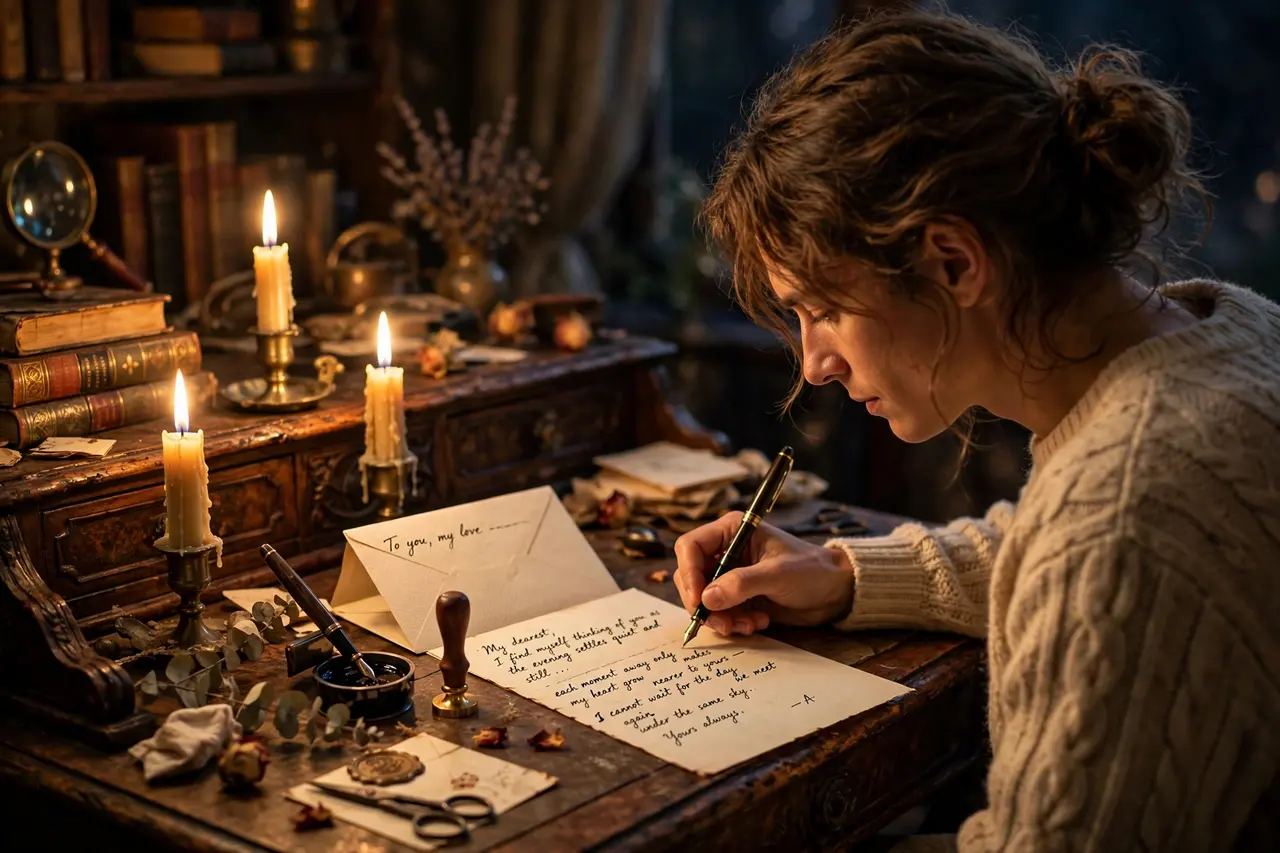
Great words deserve beautiful presentation. The physical craft of the card — the pen, the paper, the handwriting — communicates care before a single word is read.
Choose your tools deliberately. A smooth gel pen or fountain pen on quality card stock transforms the writing experience — for you and for her. Cheap ballpoints skip and scratch; good pens glide, and the difference is visible in every letter. If your handwriting is shaky, slow down dramatically: beautiful handwriting is slow handwriting. Consider practicing the message on scrap paper first, not for perfection but for confidence.
Layout matters. Before writing in the card, lightly pencil in margins so your text block sits centered and balanced. Leave generous white space — cramped writing feels rushed even when it is not. For longer messages, consider writing on separate stationery and tucking it inside the card; the card carries the short message, the letter carries the depth. Date both with today’s date and the original meeting date.
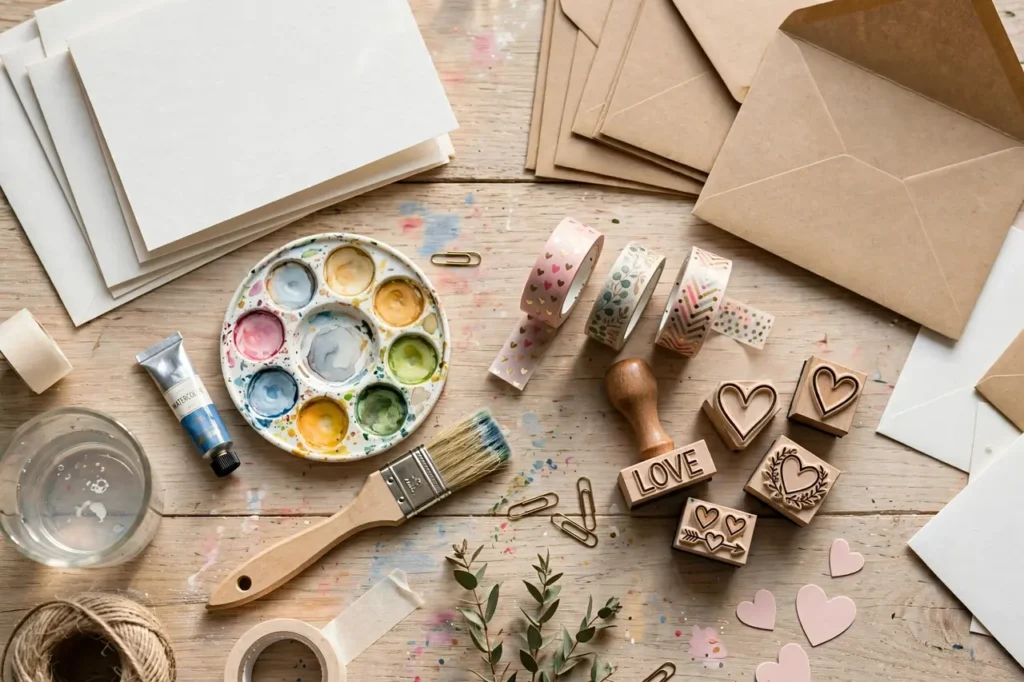
Elevate with small touches. A wax seal on the envelope, a dried flower tucked inside, a favorite stamp, or a spritz of her preferred scent on the paper — these sensory details make the card an experience, not just a message. Write her name on the envelope in your best script. If you are artistically inclined, a small sketch — the place where you met, a heart, your initials in the date — adds a handmade dimension no store-bought card can match.
Present it with intention. Never hand over the card casually. Place it on her pillow, prop it against her coffee mug, seal it in an envelope marked “open at dinner,” or read it aloud yourself — voice shaking slightly, eyes meeting hers. The presentation is the final sentence of the card, the one you deliver in person. Make it worthy of the words inside.
Sentence Starters for When the Words Will Not Come
Sometimes the hardest part is the first sentence. These thirty starters break the blank-page paralysis — complete any of them honestly and you are writing.
Memory starters: “I remember the day we met like…” / “The first thing I noticed about you was…” / “What I did not know that day was…” / “On the way home that night, I thought…” / “The detail I have never told you about that day is…” / “If I could relive one minute of the day we met, it would be…”
Gratitude starters: “Thank you for…” / “I am grateful every day that you…” / “The thing I admire most about you is…” / “You make my life better by…” / “I never properly thanked you for…” / “Because of you, I…”
Love starters: “I love you because…” / “Loving you feels like…” / “What I love most about us is…” / “You are my…” / “Every day with you, I…” / “My favorite thing about being married to you is…”
Future starters: “I cannot wait to…” / “In the years ahead, I hope we…” / “I promise to…” / “Here is to…” / “The next chapter I want us to write is…” / “Someday, I want us to…”
Playful starters: “Fun fact about the day we met:…” / “I knew I was in trouble when…” / “The most ridiculous thing about our beginning was…” / “If our first date were a movie, it would be called…” / “Statistically speaking, we…” / “I would like to formally thank you for…”
Pick three starters — one from memory, one from love, one from future — complete each with a single honest sentence, and you have the skeleton of a beautiful card. The starters do the heavy lifting of beginning; your truth does the rest.
Frequently Asked Questions
What is the difference between a first meeting anniversary card and a wedding anniversary card?
A wedding anniversary card celebrates the commitment you made publicly; a first meeting anniversary card celebrates the private beginning — the luck, timing, or courage that brought you together. The tone can be more playful and wonder-filled, focused on memory and origin story rather than vows and milestones. Many couples keep both traditions, with the first-meeting card being the more personal of the two.
How do I start the card if I do not know what to say?
Start with a concrete detail, not a feeling. Write “I remember…” and complete the sentence with the most vivid detail you can recall from the day you met. Details unlock feelings; starting with feelings often locks you up. Once the first specific sentence is down, the rest follows naturally.
Is it okay to be funny in an anniversary card?
Absolutely — if humor is part of your relationship. The best anniversary cards sound like the person who wrote them, and if that person is funny, the card should be funny. Many couples find a blend works best: humor in the opening, sincerity in the middle, romance in the close. Match the card to your actual dynamic, not to a generic idea of romance.
How personal should the card be?
As personal as you can make it. Include details no one else would know: the song, the spilled drink, the weird thing she said, the thought you had on the drive home. These specifics are what make her re-read the card years later. A card that could have been written to anyone will be treasured by no one.
Should I handwrite or type the message?
Handwrite it. Always. Typed messages feel formal and distant; handwriting — even imperfect handwriting — carries your physical presence. If your handwriting is truly illegible, write slowly and carefully, or write a draft and copy it neatly. The effort visible in careful handwriting is itself part of the message.
What if we met online — what do I write about?
Write about the digital artifacts: the first message, the profile detail that caught your eye, the moment you moved from texting to talking, the first video call. Screenshot your earliest exchanges and reference them. Online beginnings have their own romance — the anticipation, the imagination, the thrill of the first in-person meeting — and it deserves its own card tradition.
Can I write the card as a list instead of paragraphs?
Yes — lists are wonderful card formats. “Ten things I knew about you by the end of our first date,” “Five moments I am most grateful for,” “Three promises for our future” — lists are easy to write, easy to read, and naturally specific. They also look beautiful on the page, with breathing room between items.
How do I end the card?
End facing forward: a promise, a hope, or an invitation to the future. “Here is to us” is classic because it works — it turns the card from a backward-looking memorial into a forward-looking toast. Sign it with warmth, date it with both dates, and seal it with confidence. You have written something she will keep.