You bought the card. It is sitting on the counter, beautiful and blank, and suddenly your mind is empty. What do you actually say? If you have ever stared at a greeting card wondering what to write in a family day card, you are in excellent company — most people find the message harder than the gift. This guide fixes that with simple frameworks, 100+ ready-to-adapt examples for every family member, and the psychology of why certain words land harder than others.
Here is the liberating truth: a great card message is not about being a writer. It is about being specific. “Happy Family Day! Love you!” is fine, but “Happy Family Day to the woman who taught me to parallel park and to apologize — both badly needed” is unforgettable. Specificity is the entire game, and this guide will show you how to play it even if words do not come easily to you. By the end, you will have a message worth keeping — and the confidence to write the next one even faster.
The Anatomy of a Great Card Message
Every memorable card message contains three ingredients, in roughly this order:
1. A specific memory or observation. This proves the message belongs to this person and no one else. “I still laugh thinking about our disastrous camping trip” beats “You are so fun” because only your family has that camping trip.
2. Genuine appreciation. Name what they do or who they are, concretely. “Thank you for always answering the phone, even at midnight” lands harder than “Thanks for everything.”
3. A forward-looking wish or promise. End with warmth pointed at the future: “Here is to more Sunday dinners,” or “I promise more visits this year — starting next month.”
Memory, appreciation, future. Three sentences built on that frame will outperform a page of generic sentiment every time. The rest of this guide gives you the raw material: memories to mine, appreciation angles for each family member, and wishes worth making.
7 Fill-in-the-Blank Formulas (Steal These)
When your mind goes blank, start with a formula. Fill in the brackets with your specifics, and you will have a genuine message in minutes.
- The memory lane: “Happy Family Day! I will never forget [specific memory]. Thank you for [what it taught you or how it felt].”
- The gratitude list: “Three things I love about you: [1], [2], [3]. Happy Family Day to my [role]!”
- The then-and-now: “When I was little, you [something they did]. Now I realize [what you understand now]. Thank you.”
- The superlative: “Nobody [does X] like you. Our family would not be our family without [specific thing].”
- The promise: “This Family Day, I want you to know [appreciation]. And I promise [small, keepable promise].”
- The funny-sweet combo: “Thanks for [funny flaw or habit] and for [genuine quality]. You are the best [role] a [kid/sibling] could ask for.”
- The short-and-mighty: “You make our family feel like home. Happy Family Day.”
Each formula works because it forces specificity. The brackets are where the magic lives — fill them honestly and the message writes itself.
What to Write for Parents: 15 Examples
Parents want to know their work mattered. Tell them what stuck.
- “Happy Family Day, Mom. I finally understand how much you carried so quietly. Thank you for making hard things look easy.”
- “Dad, you taught me to change a tire, to keep my word, and to laugh at myself. That is a complete education. Happy Family Day.”
- “To the two people who made our house a home: every good thing I am started at your kitchen table.”
- “Mom, your 6 a.m. breakfasts before big tests were not just food — they were courage. I still feel it. Happy Family Day.”
- “Dad, thanks for the terrible jokes and the excellent advice. I use the advice daily and the jokes almost as often.”
- “You two built a family out of love, patience, and an unreasonable amount of laundry. It worked. Happy Family Day.”
- “Mom, I catch myself saying your phrases now, and I am proud of it. Thank you for the words I will carry forever.”
- “Dad, watching you with the grandkids taught me more about love than anything else ever has.”
- “Thank you for the curfews I hated and the freedom I needed. You somehow knew the difference every time.”
- “Happy Family Day to my first home and my forever home — you two.”
- “Mom, you believed in me before I believed in myself. I am still spending that belief.”
- “Dad, your garage was my first classroom and your stories were my first books. Best teacher I ever had.”
- “To my parents: the older I get, the smarter you become. Funny how that works. Happy Family Day.”
- “Thank you for showing me what partnership looks like — the laughing, the compromising, the showing up. I am taking notes.”
- “Home was never the house. It was you two. Happy Family Day.”
What to Write for Kids: 12 Examples
Kids need to hear they are delighted in, not just managed. Write to the child they are, not the chores they forgot.
- “Happy Family Day to my favorite human under four feet tall. You make ordinary days feel like adventures.”
- “Watching you grow is my favorite thing in the world. Thank you for letting me be part of your story.”
- “You asked a hundred questions today and I loved every one. Never stop being curious.”
- “To my brave kid: I am proud of how you handled [specific hard thing]. You are stronger than you know.”
- “Happy Family Day! You are kind, funny, and weird in the best way. Do not ever change.”
- “Being your parent is the best plot twist of my life.”
- “Thank you for your laugh — it fixes bad days faster than anything else I know.”
- “You do not have to be perfect. You just have to be you, and you are wonderful at that.”
- “Happy Family Day to the kid who makes me a better person just by existing near me.”
- “I love the way your mind works. Keep building, drawing, dreaming, and asking why.”
- “No matter how big you get, you will always be my baby. That is non-negotiable.”
- “Thank you for choosing me to be your [mom/dad]. It is the greatest honor of my life.”
What to Write for Grandparents: 12 Examples
Grandparents treasure words more than any object. Tell them their legacy is visible.
- “Happy Family Day, Grandma. Your kitchen taught me that love has a flavor, and I am still trying to recreate it.”
- “Grandpa, your stories are the family’s greatest treasure. Thank you for telling them one more time, every time.”
- “Everything good in this family started with you two. We are your masterpiece.”
- “Thank you for the spoiling, the wisdom, and the perfectly timed five-dollar bills of my childhood.”
- “Happy Family Day to the keepers of our family’s best recipes and even better stories.”
- “Grandma, I use your advice weekly and your pie crust recipe monthly. Both are perfect.”
- “Grandpa, you showed me that a person’s word is everything. I am still trying to live up to your example.”
- “The grandkids adore you, and now I understand exactly why. Thank you for loving us across the generations.”
- “Happy Family Day! Your love built the foundation our whole family stands on.”
- “Thank you for proving that spoiling grandchildren is a sacred duty, performed flawlessly.”
- “Every family needs its historians, its bakers, its huggers. You are all three.”
- “We are who we are because of who you were. Thank you for everything, always.”
Pair these words with a keepsake and the impact doubles. Our gifts for grandparents guide has ideas that complement a heartfelt card beautifully.
What to Write for Siblings: 12 Examples
Sibling cards can be funnier and more honest than any other. Lean into the shared history.
- “Happy Family Day to my first best friend and longest-running argument. Would not trade you.”
- “Thanks for not telling Mom about [redacted]. Your silence has been the foundation of our bond.”
- “We survived childhood together, which means we can survive anything. Love you, [name].”
- “To my sibling: thanks for the hand-me-downs, the life lessons, and the alibis.”
- “Happy Family Day! I am glad we are related, because I would have chosen you anyway.”
- “Remember when we [shared memory]? Still the funniest thing that ever happened. Thanks for being my partner in chaos.”
- “You are the only person who remembers our childhood exactly as I do. That makes you irreplaceable.”
- “Thanks for always answering my 2 a.m. calls, even the ones that were just to complain.”
- “Happy Family Day to the person who knows all my stories and loves me anyway.”
- “We may fight like enemies and love like family — because we are family. The best kind.”
- “To my brother/sister: distance means so little when someone means so much.”
- “Growing up with you was the best accident of my life. Happy Family Day.”
What to Write for In-Laws and Blended Family: 10 Examples
Chosen and blended family deserve cards too. Warmth without over-familiarity is the tone.
- “Happy Family Day! Thank you for welcoming me so completely — I hit the in-law jackpot.”
- “To my wonderful mother/father-in-law: thank you for raising the person I love, and for loving me too.”
- “Family is not just blood — it is showing up, and you always show up. Grateful for you.”
- “Happy Family Day to my bonus mom/dad. Bonus is the wrong word — you are essential.”
- “Thank you for making our blended family feel simply like family. That is a gift.”
- “To my stepdad/stepmom: thank you for choosing us, every day. It never went unnoticed.”
- “Happy Family Day! Our family tree has extra branches, and every one of them is beautiful.”
- “Thank you for the holidays, the advice, and for loving my kids like your own.”
- “In-laws like you are why people say marrying in was the best decision. Happy Family Day.”
- “Family grew the day you joined it. We are better with you here.”
| Recipient | Best tone | Lead with | Avoid |
|---|---|---|---|
| Parents | Warm, grateful | A specific lesson or sacrifice | Generic “thanks for everything” |
| Kids | Playful, affirming | Delight in who they are | Criticism or chore reminders |
| Grandparents | Tender, reverent | Their legacy and stories | Anything about aging or health |
| Siblings | Funny, honest | Shared memories | Old grudges (unless joking, mutually) |
| In-laws | Warm, respectful | Gratitude for welcome | Over-familiarity or family politics |
| Partner | Romantic, appreciative | The family you are building | Score-keeping or complaints |
What to Write for Your Partner: 10 Examples
Family Day is also for the person building the family beside you. Do not forget them in the flurry of cards for others.
- “Happy Family Day to my partner in everything. Look what we built — it is beautiful.”
- “Thank you for the 3 a.m. feedings, the school runs, and the a thousand invisible things. I see them all.”
- “I would choose this chaotic, wonderful life with you again every time.”
- “You are my favorite teammate, roommate, and soulmate. Happy Family Day.”
- “Watching you be a parent is my favorite thing about you — and there is a lot to choose from.”
- “Our family is my greatest adventure, and you are my favorite adventurer.”
- “Thank you for laughing with me when the plan falls apart, which is always.”
- “Happy Family Day! Home is wherever you are, preferably with coffee.”
- “I love our life — the mess, the noise, the love. Mostly the love.”
- “Years from now, I want to look back at today and remember how lucky we were. We are.”
For more romantic message inspiration, see our anniversary wishes for wife — many sentiments adapt beautifully to a Family Day card.
What NOT to Write: 8 Card Mistakes to Avoid
Good intentions can still misfire. Steer clear of these common card traps.
1. The generic blast. “Happy Family Day! Hope you have a great day! Love, me.” If the message could be for anyone, it is for no one. Add one specific detail and it transforms.
2. The backhanded compliment. “Thanks for finally calling more often” or “You are a great mom when you try.” If it stings, it does not belong in a card.
3. The guilt trip. “Wish we saw you more” or “It has been too long since you visited.” Family Day cards are for appreciation, not accounting.
4. The scorecard. Avoid listing what you did for them (“After all I have done…”). Gifts and cards are not invoices.
5. The overshare. A card is not the place for family politics, health anxieties, or passive-aggressive commentary about other relatives. Keep it between you and the recipient.
6. The copied poem with no personal line. Pre-written verses are fine as a starting point, but add at least one sentence of your own. The personal line is what gets remembered — and kept.
7. The joke that only you find funny. Teasing works between siblings with mutual understanding. For parents, grandparents, and in-laws, make sure the humor is warm, not edged.
8. Nothing at all. Signing just your name is the biggest missed opportunity. Even two sincere sentences — “You mean the world to me. Happy Family Day.” — outperform a blank card with a $50 gift.
Messages for Special Situations
Not every Family Day is simple. These situations call for extra care — and the right words matter even more.
For a family with a new baby: “Happy first Family Day as a family of [three/four]! [Baby’s name] hit the jackpot with you two. Enjoy every sleepless, wonderful minute.” Acknowledge the exhaustion and the joy together — new parents need to hear that both are normal.
For a grieving family: “Thinking of you this Family Day. [Name] would have loved seeing everyone together today. Holding you in my heart.” Keep it brief, name the person missed, and do not try to fix the grief. Presence on paper is enough.
For military or far-away family: “Miles do not change a thing — you are with us in every story told and every laugh shared today. Counting down to the next hug.” Include a photo from the celebration so they feel included, not just remembered.
For a family going through a hard year: “This year tested us, and we are still here, still us. That is worth celebrating. Proud to be your family, today and always.” Acknowledge the difficulty without dwelling — the card is a toast to resilience.
For a new marriage or new partner joining: “Our family got better the day you joined it. Happy first Family Day — here is to a hundred more.” Explicit welcome matters enormously to someone finding their place.
For an empty-nest Family Day: “The house is quieter but the love is louder than ever. Thank you for raising us well enough to leave — and for always leaving the porch light on.” Honor both the pride and the ache.
For a single parent: “Happy Family Day to the person who does the job of two with the heart of ten. We see everything you do, and we are so grateful.” Single parents rarely hear this directly. Say it plainly.
The 10-Minute Card Writing Ritual
If blank cards paralyze you, try this ritual. It turns card-writing from a dreaded task into ten pleasant minutes.
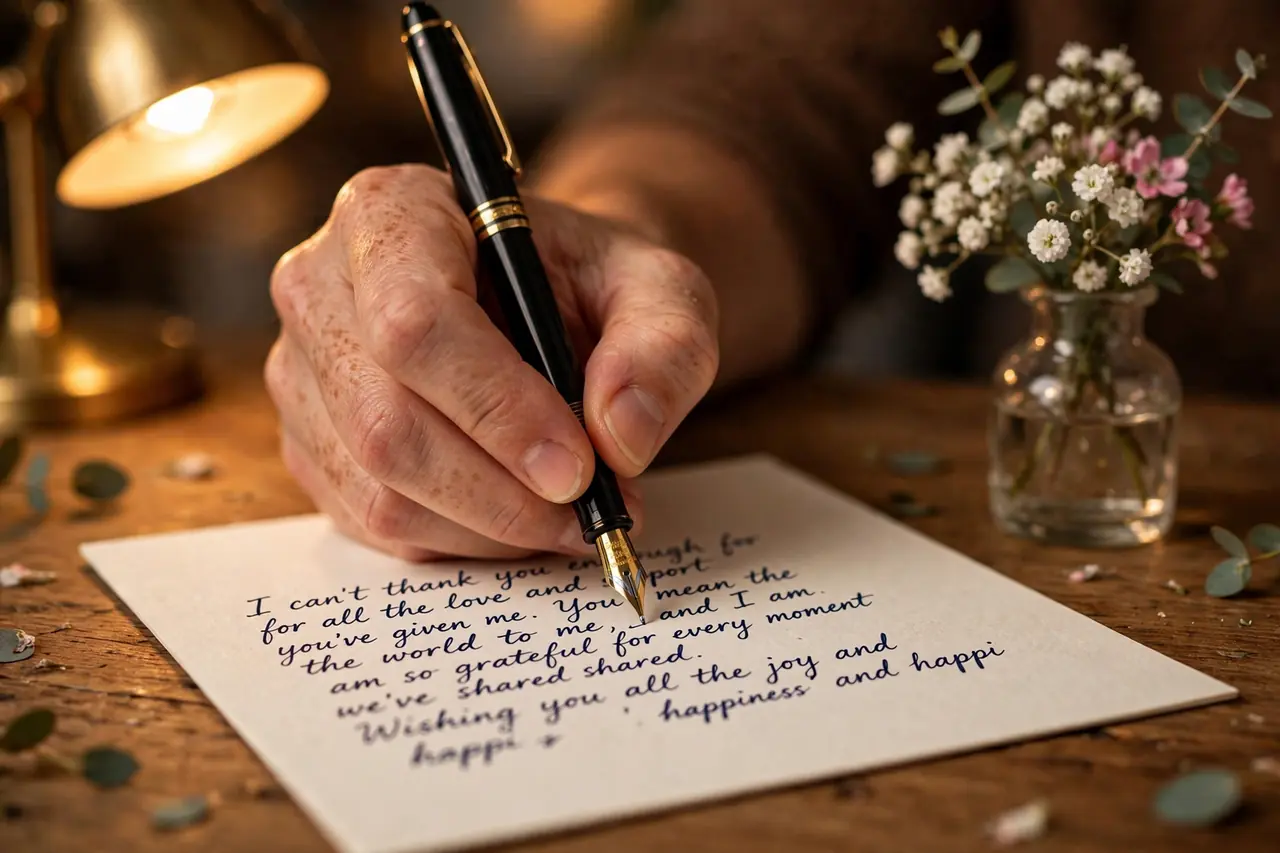
Minutes 1–2: Remember. Close your eyes and picture the person. What is the first specific memory that surfaces? A trip, a meal, a habit, a phrase they always say. Write down three words about it. That is your material.
Minutes 3–5: Draft ugly. On scrap paper, write the memory, one thing you appreciate, and one wish — in whatever messy words come out. No one will see this draft. Ugly drafts produce beautiful cards because they bypass the inner critic.
Minutes 6–8: Copy clean. Transfer the best version into the card in your normal handwriting. Do not aim for calligraphy; aim for legible and unhurried. If you make a small mistake, leave it — a crossed-out word proves a human wrote this.
Minutes 9–10: Sign and date. Choose a sign-off from the list above, add the date, and seal the envelope. Done. Ten minutes, one kept-forever card.
Do this for each family member in one sitting with good music playing, and card-writing becomes a pleasure rather than a chore. Many families make it a tradition: the night before Family Day, everyone writes cards at the kitchen table together. The ritual itself becomes part of the celebration.
Watch: Beautiful Handwriting for Your Card
The words matter most, but beautiful presentation does not hurt. This video teaches brush-pen calligraphy basics for greeting cards — simple techniques that make any message look extraordinary.
Signing Off: How to End Your Message
The closing line is the last taste, so make it sweet. Match the sign-off to the relationship:
For parents and grandparents: “With all my love,” “Forever grateful,” “Your loving [son/daughter/grandchild].” For kids: “Love you to the moon and back,” “Your biggest fan,” “Hugs and high-fives.” For siblings: “Your partner in crime,” “Love you, mean it,” “Still your favorite sibling (do not tell the others).” For in-laws: “With love and gratitude,” “So thankful for you.” For your partner: “All my love, always,” “Yours completely.”
Then — and this matters — date the card. Write “Family Day 2026” somewhere. Years from now, when the card resurfaces in a drawer or a memory box, the date turns it from a nice note into a time capsule. The cards people keep for decades are the dated, specific, honest ones. Yours can be next.
Keeping the Cards: Start a Family Card Archive
Here is a tradition worth starting: keep every Family Day card in one box, year after year. Label the box with the family name and store it somewhere safe. Each year, before writing new cards, pull out a few old ones and read them aloud. Kids who groan at the ritual at twelve will treasure it at thirty. The box becomes a written history of your family’s love — in everyone’s real handwriting, with all the crossed-out words and coffee stains intact. In a world of disappearing messages, a box of kept cards is a radical act of remembering. Start this year; future generations will thank you. And when you sit down to write next year, you will have last year’s words to build on — the archive makes every future card easier and richer.
Frequently Asked Questions
How long should a Family Day card message be?
Three to five sentences is the sweet spot for most cards — long enough to be specific, short enough to be read fully. A single powerful sentence can outperform a paragraph of generic sentiment. For milestone years or after a hard season, a full page is welcome.
Is it okay to use a funny message in a Family Day card?
Absolutely, if it fits the relationship. Funny cards that also land one genuine moment of love are often the ones people keep longest. Open with the joke, close with the heart. Our funny card messages show how to balance humor and sincerity.
What if I am not good with words?
Use the fill-in-the-blank formulas in this guide — they exist precisely for this. Specificity matters more than eloquence: “Thank you for driving me to every practice” beats a flowery paragraph every time. Short, true, and specific is a complete strategy.
Should kids write their own cards?
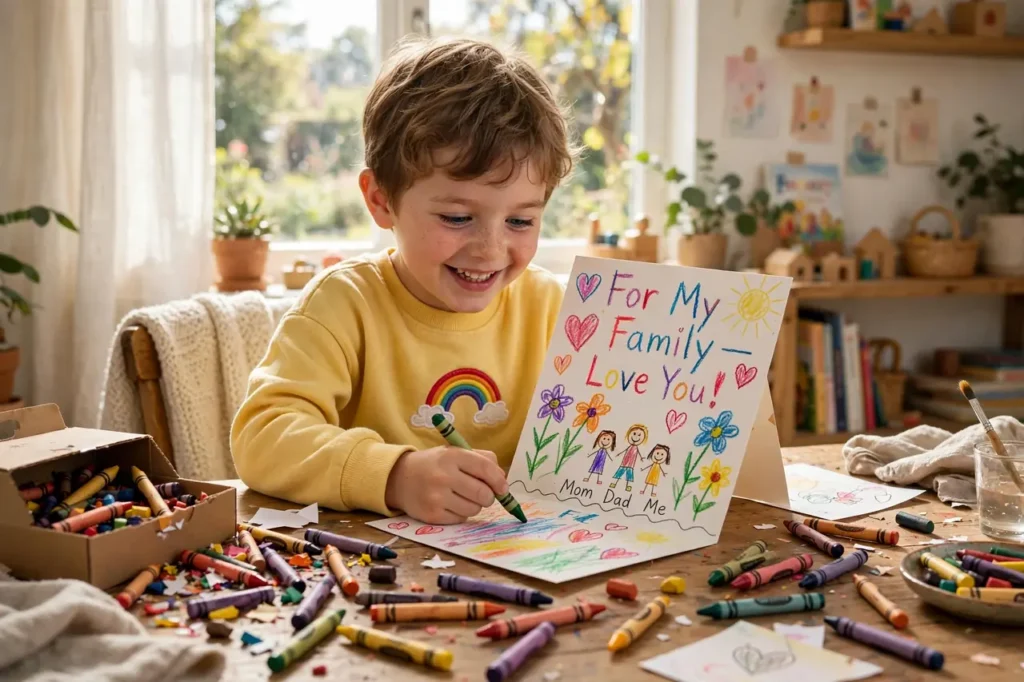
Yes — even toddlers. A scribble with their name (written by you) is precious. Older kids can use the formulas too, and their unfiltered honesty (“You make the best pancakes and you are not too old”) is often the highlight of a parent’s day.
Can I write the same message in multiple family members’ cards?
Try not to. Family members compare cards, and identical messages feel mass-produced. Use the same formula if you like, but change the specific memory and detail for each person. Ten extra minutes of tailoring makes each card feel one-of-a-kind.
What do I write if our relationship is complicated?
Stay honest but kind. Focus on one true positive thing: “I am grateful for the good memories we share,” or “Wishing you happiness today.” You do not have to rewrite history — a brief, sincere note respects both the relationship and the truth. Avoid anything that could read as sarcastic.
Is a store-bought card with a pre-written verse enough?
It is a fine starting point, but always add your own lines. Circle or underline the pre-written part that resonates, then add two to three sentences of your own below it. The personal addition is what transforms a nice card into a kept card.
When should I give the card?
Timing adds meaning. Tuck it under a pillow for a morning surprise, place it at their breakfast seat, hand it over before a family meal with a few spoken words, or mail it early if they live far away. A card discovered unexpectedly feels like a gift in itself. For more on pairing cards with presents, see our messages for parents.