You have the ring. You have the plan — the restaurant, the hike, the living room with the candles. There is just one problem, and it is keeping you up at night: what to say when you propose. Not the vague idea of it. The actual words, in the actual order, coming out of your actual mouth while your heart tries to escape through your ribs.
You are not alone in this panic. Ask any recently engaged couple what the proposer stressed about most, and “the words” beats “the ring,” “the location,” and “the photographer” combined. The ring is a solved problem — jewelers solve it daily. The words feel unsolved because they have to come from you, and “you” is currently running on adrenaline and three hours of sleep.
So here is the complete field guide: the 60-second framework that works for any proposal, dozens of ready-to-use lines organized by the moment they belong to (the opener, the middle, the question itself, the after), what to say in every common proposal setting, the phrases to avoid, and how to recover when your brain blanks mid-knee. By the end, you will have a script — your script — and the confidence to deliver it.
The 60-Second Framework: Your Proposal in Four Parts
Forget “writing a speech.” Think in four parts, fifteen seconds each. Four parts is memorizable under pressure; fifteen seconds each keeps you from rambling. Here is the framework:
Part 1: The landing (15 seconds) — arrive in the moment
Start by naming where you are and what is happening. This sounds strange, but it is the most important fifteen seconds: it slows you down, it gives your partner’s brain time to catch up, and it roots the memory in place. Examples: “Okay. We are here. This is the spot where we had our first picnic.” / “I have been planning this for weeks, and now that we are here, I am more nervous than I expected.” / “Before anything else — look at this sunset. I wanted you to see this.” The landing is not about being eloquent. It is about being present. A specific, honest arrival beats a polished opening every time.
Part 2: The story (15 seconds) — one memory, told briefly
Pick ONE memory. Not your whole relationship history — one scene, vividly told. The night you met. The trip. The ordinary moment you knew. “Do you remember the night the power went out and we ate cereal on the floor? I think about that night all the time, because that was the night I realized I never wanted to stop laughing with you.” One memory does the emotional heavy lifting of ten minutes of generalities. Choose the memory that makes you feel something when you recall it — if it moves you, it will move them.
Part 3: The meaning (15 seconds) — what they are to you
Bridge from the memory to a truth about your partner. This is two or three sentences, maximum, and they should be specific: “You are the kindest person I know — the way you take care of everyone, the way you never let anyone feel alone. I have spent [X] years trying to deserve that kindness, and I want to spend the rest of my life trying.” Character over appearance. Specifics over adjectives. This is the part they will quote back to you for years, so make it true rather than grand.
Part 4: The question (15 seconds) — ask it cleanly
Their name. Eye contact. The question. “Emma, will you marry me?” Fifteen seconds is generous — the question itself takes five. Use the remaining ten for a breath, a smile, and letting the moment land before you present the ring. Do not rush this part. Do not trail off. Do not add seventeen qualifiers. Ask the question like you mean it, because you do.
That is the whole framework: land, remember, mean, ask. Sixty seconds. If you take nothing else from this article, take this — it is enough.
What to Say: The Opener Lines
The first sentence is the hardest because it breaks the seal. Here are openers for every energy level — pick the one that sounds like you on a good day.
Warm and direct openers
- “I have something I have been wanting to say to you, and I finally figured out how to say it.”
- “Before we do anything else tonight, I need you to hear this.”
- “You know how I get when I am nervous? I am nervous right now, and it is for the best reason.”
- “I planned this whole thing, and now that you are here, all the planning feels beside the point. It is just you and me, which is all it ever needed to be.”
Memory-led openers
- “Do you remember [the place/the night/the trip]? I have been thinking about it all week.”
- “[X] years ago, [we met / you said yes to a date / we moved in], and I had no idea what was starting.”
- “I keep coming back to one moment — [the memory] — because everything I feel right now started there.”
Light and funny openers (if that is your dynamic)
- “Okay, don’t freak out, but I have been carrying something in my pocket for three weeks and it is driving me insane.”
- “I have a question, and I need you to know I practiced it in the mirror, so no laughing at my delivery.”
- “Remember when I said I had a surprise? This is bigger than the [previous surprise]. Much bigger.”
What to Say: The Middle (The Heart of It)
The middle is where you say what they mean to you. Below are plug-and-play middle sections — each two to four sentences. Choose one, then personalize it with a specific detail.
The gratitude middle
“Thank you — for the way you love me on the days I am hard to love, for believing in me when I didn’t believe in myself, for making our life feel like an adventure instead of a routine. I don’t say it enough, so I am saying it now, properly: thank you for choosing me, every day.”
The admiration middle
“I have watched you [specific achievement or quality — build your career, care for your family, handle the hardest year of your life] and I have never admired anyone more. You are the strongest, kindest, funniest person I know, and I am the luckiest person I know because I get to love you.”
The “us” middle
“We have built something I never want to lose — the inside jokes, the traditions, the way we can say everything with a look. We are a team, and we are a good one. I don’t want to just keep what we have. I want to make it official, make it forever, and keep building.”
The future middle
“When I picture my future, it is not a place — it is you. Morning coffee with you. Growing old with you. All the ordinary days, made extraordinary because you are in them. I want that future, and I want to start it right now, here, with this question.”
The short-and-powerful middle (for when words are failing)
“You are my best friend. You are the love of my life. You are home. That’s it. That’s everything.”
What to Say: The Question Itself
After all the buildup, the question should be simple, clear, and unmistakable. Use their name. Here are wordings that work — pick one and commit to it.
- “[Name], will you marry me?” — The classic. Unbeatable. Use it with confidence.
- “[Name], will you spend the rest of your life with me?” — Slightly softer, same weight.
- “[Name], I want to marry you. Will you marry me?” — A declaration plus a question; good if you want to lead with certainty.
- “[Name], will you be my [wife/husband/partner]?” — Direct and tender.
- “[Name], let’s do this forever. Will you marry me?” — Casual-romantic; suits playful couples.
- “[Name], I choose you — today, tomorrow, always. Will you marry me?” — Adds the “choice” framing many partners love.
What matters is not which wording you pick but that you finish it. Do not trail off into “…so, yeah?” Do not mumble the last three words. Say the full question, look at them, and then — this is critical — stop talking. Silence after the question is not awkward; it is reverent. Let them answer.
What to Say: After They Say Yes
Nobody plans for the thirty seconds after “yes,” and everyone blanks. Have one of these ready:
- “I love you so much.” (Simple, true, always right.)
- “This is the best day of my life.”
- “I was so nervous. I love you.”
- “We did it. We’re doing this.”
- [Just kiss them. Words optional.]
Then: put the ring on the correct finger (left hand, ring finger — the one next to the pinky), admire it together, and let the moment breathe before reaching for the phone. You will want to call everyone. Give yourselves five private minutes first. You earned them.
What to Say in Every Proposal Setting
At a restaurant (public, intimate table)
Keep it quieter and shorter than you would in private — they may feel the eyes of nearby tables. Lean in, keep your voice low, and let the intimacy of the setting do the work. Good opener: “I wanted to do this here because some of our best nights have started at a table just like this.” Pro tip: coordinate with the restaurant in advance — many will help with timing, champagne, and a discreet photographer. Propose between courses, not during dessert chaos.
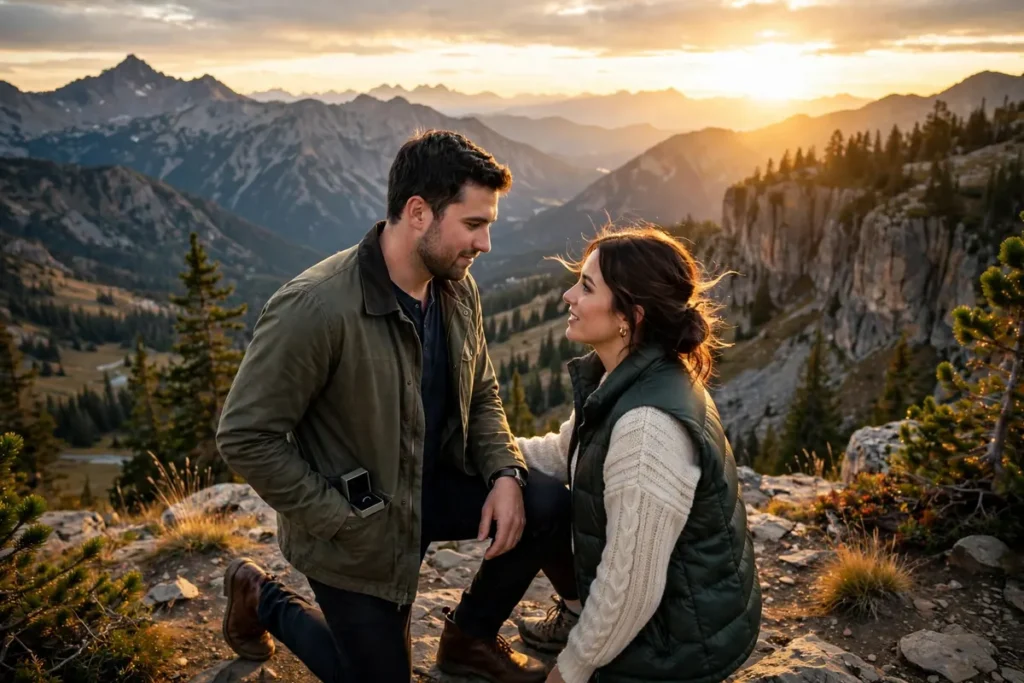
Outdoors (hike, beach, park, mountaintop)
Let the setting speak first. “Look at this. I wanted us to be here for this.” Outdoor proposals pair beautifully with the memory-led framework — the place itself becomes part of the story. Practical notes: check the wind (it eats words and ring boxes alike), have a backup plan for weather, and keep the ring box in a zipped pocket — not a loose jacket pocket on a clifftop. Tell the story of why this place matters to you two specifically.
At home (private, cozy)
Home proposals are underrated and deeply romantic — this is where your real life happens. “This is our place — where we [cook badly / binge shows / do the Sunday crossword]. There is nowhere I would rather ask you this.” Light candles, cook or order their favorite meal, and make the ordinary feel ceremonial. The speech can be longer here; privacy means no audience pressure. Many couples say home proposals felt the most “them.”
In front of family or friends
Shorter is better with an audience — save the long version for private. “I wanted all of you here because you are the people who made us who we are.” Then address your partner directly and tune everyone else out. One caution: only propose publicly if you are certain your partner enjoys being the center of attention. When in doubt, propose privately and announce publicly. A surprise audience is a gamble; a surprise proposal is already enough surprise.
On a trip or vacation
“I have been carrying this ring through [three airports / two countries] and I could not wait another day.” Travel proposals get a natural opener from the journey itself. Pick a moment with a buffer — not the morning of a 6 a.m. flight, not when everyone is hangry. The first full day, after settling in, is usually the sweet spot. And photograph the ring before the trip in case of loss — you will want the specs for insurance.
During the holidays
Holiday proposals are classic for a reason — family is gathered, the mood is warm. “This season is about what matters most, and what matters most is standing right here.” If proposing at a family gathering, consider asking privately first (even an hour before) and using the gathering for the announcement — it honors both the intimacy and the celebration.
What NOT to Say: Phrases to Avoid
Just as important as the right words are the wrong ones. Strike these from any draft:
- Anything about the ring’s cost. “It cost me three months’ salary” turns a romantic symbol into a receipt. The ring’s value is what it means, not what it cost. Never mention price — before, during, or after.
- Apologies disguised as romance. “I know I’m not perfect, but…” / “I know I don’t deserve you, but…” Self-deprecation in a proposal reads as insecurity, not humility. You are not begging; you are inviting.
- Ultimatums or pressure. “We’ve been together long enough” / “Everyone keeps asking when” — the proposal should feel like a beginning, not a deadline met.
- Overly elaborate metaphors. If you would not say it in normal conversation, do not say it on one knee. “You are the sonnet to my stanza” will make you both cringe by the anniversary.
- Inside jokes that need explaining. In an emotional moment, even a beloved inside joke can misfire. Save them for the toast.
- Anything you do not mean. Do not promise a lifestyle you cannot deliver (“I’ll take you to Paris every year”) or a personality transplant (“I’ll never leave dishes in the sink again”). Promise what is true: your love, your effort, your partnership.
When Your Brain Goes Blank: The Recovery Playbook
It happens to most proposers: mid-speech, the words evaporate. Here is your emergency plan, in order of preference:
1. Fall back to the framework. Land, remember, mean, ask. If you forget your exact sentences, just say the next part: “What I mean is…” and say one true thing. The framework is your skeleton; the sentences were just clothes.
2. Say the simplest true thing. “I love you. I want to marry you.” That is a complete proposal. Everything else was decoration. If your brain offers you nothing else, take the simplest true thing and say it with eye contact. It will be enough — it has been enough for millions of couples.
3. Use the card. This is why you brought the small card with key phrases. Pulling it out is not failure; it is preparation. Smile, say “I wrote this down because I knew I would need it,” and read. Your partner will find it endearing, not weak.
4. Laugh about it. “And this is the part where I forgot everything I planned to say, which tells you how much this means to me.” Honesty about nerves is charming. Pretending you are not nervous when you obviously are is not.
What not to do: do not apologize repeatedly, do not start over from the beginning (it doubles the pressure), and do not fill the silence with rambling. A pause, a breath, and one true sentence will always beat five minutes of nervous filler.
What to Say in Special Situations
Proposing long-distance (over video or on a visit)
If you are proposing during a long-awaited visit, name the distance: “Every mile between us taught me that home is not a place — it is you. I am done with the miles.” If circumstances force a video proposal, own it rather than apologizing for it: “I wanted to be on one knee in front of you, and I will be — but I could not wait one more day to ask.” Then plan the in-person redo; the story gets better, not worse.
Proposing with kids present (yours or theirs)
Include them in the words: “I love you, and I love our family — all of it, exactly as it is. I want to make it official.” Kids remember being part of the moment far more than they remember the speech’s eloquence. Keep it short, keep it warm, and have a small role for them afterward (holding the flowers, taking the photo).
A second proposal (rekindled love or vow-renewal style)
Acknowledge the history honestly: “We have been here before, and life took us on a detour. But every road led back to you, and this time I am asking with everything I have learned.” Second proposals carry a weight first ones do not — the weight of knowing exactly what you are choosing. Name that. It is the most romantic thing about them.
When you are both nervous wrecks
Say so out loud: “We are both shaking, and that is perfect, because it means this matters as much to you as it does to me.” Shared nerves are bonding, not embarrassing. Some of the most beloved proposal stories are the messy ones — the dropped ring box, the wrong knee, the laughter through tears. Perfection is forgettable; authenticity is not.
Quick-Reference Table: Lines for Every Moment
| The moment | What to say | Tone |
|---|---|---|
| Breaking the seal | “I have something I have been wanting to say to you.” | Warm, direct |
| Setting the scene | “I wanted us to be here for this.” | Present, grounded |
| The memory | “Do you remember [the moment]? I think about it all the time.” | Nostalgic |
| The tribute | “You are the kindest person I know, and I want to spend my life trying to deserve that.” | Sincere |
| The future | “When I picture my future, it is not a place — it is you.” | Romantic |
| The question | “[Name], will you marry me?” | Clear, steady |
| After “yes” | “This is the best day of my life.” | Joyful |
| If you blank | “I love you. I want to marry you. That’s everything.” | Honest |
Watch: Proposal Speech Ideas and Delivery Tips
Hearing how others pace and phrase their proposal words can unlock your own. This video walks through marriage proposal speech ideas with real examples — pay attention to how the best ones stay simple.
FAQs About What to Say When You Propose
How do I start my proposal speech without sounding awkward?
Start with something true and present-tense: where you are, how you feel, what you see. “Okay, we are here, and I am nervous” is a perfect opener because it is honest and it buys your brain time to settle. Awkwardness comes from trying to sound like someone you are not — so do not. Sound like yourself, slightly braver.
Is it okay to read my proposal from my phone or a card?
Yes — with a caveat. A small card you glance at is endearing and shows preparation. Reading verbatim from your phone for three minutes while avoiding eye contact is not. Best practice: internalize the framework, bring the card as a safety net, and only look at it if you need it. Most proposers never touch the card; just knowing it is there calms them down.
What if I cry and can’t get the words out?
Pause, breathe, smile, and say the shortest true version: “[Name], I love you. Will you marry me?” Tears do not ruin proposals — they are among the most treasured parts of the memory. Your partner is not waiting for a flawless performance; they are waiting for the question. Get to the question, even through tears, and everything else is gravy.
Should I say “will you marry me” or something more creative?
Say “will you marry me” — or a close variant that includes the actual words “marry me.” Creativity in the buildup, clarity in the question. The question is not the place for wordplay; it is the place for unmistakable meaning. Some proposers get so creative (“will you be my forever adventure buddy?”) that their partner genuinely is not sure they have been proposed to. Do not risk it.
How long should I talk before asking the question?
Sixty to ninety seconds of buildup is the sweet spot. Shorter can feel abrupt (unless that is your style); longer risks losing the emotional thread — and your nerve. Time yourself during practice: if your draft runs past two minutes, cut it. The question is the main event; everything before it is the opening act.
What do I do with the ring while I’m talking?
Keep it in its box in a secure pocket (zipped or buttoned) until the question. Presenting the ring too early steals the thunder of the words; fumbling for it after the question kills the momentum. The sequence is: speech → knee → question → open the box and present. Practice the box-opening motion at home — one-handed, smoothly. It is a small detail that makes the moment feel polished.
Should I ask permission from their parents first?
This depends entirely on your partner’s values, not on tradition. If they are close to their family and would be touched, a quiet conversation beforehand is a lovely gesture. If they are independent and would find it patronizing, skip it. When in doubt, ask their best friend what they would want — friends usually know. Never let the permission question delay a proposal your partner is ready for.
You Already Know What to Say
Here is the final truth: you have been writing this speech for your entire relationship. Every “I love you,” every late-night conversation, every time you chose them — that was the draft. What to say when you propose is not a performance to perfect; it is a truth to deliver. Land in the moment, share one memory, say what they mean to you, and ask the question with their name in it.
Sixty seconds. Four parts. One question. You have got this. And when the ring is on and the happy tears are flowing, the words do not stop — they just change shape. Our happy wedding day messages for your fiancée, romantic wedding day quotes for her, and sweet wedding day messages for couples will help you keep saying it, all the way to “I do” and beyond.