Events / Outdoor Events
A useful event bag matches the venue and conditions. Check what you are allowed to bring, choose a few adaptable items and know where to go if the weather interrupts the day.
Check the forecast and bag rules, pack permitted essentials and identify a shelter or exit plan.
Read the venue rules before choosing a bag
Look for the event’s current permitted-items page. Bag dimensions, bottles, umbrellas, chairs and food can be restricted, and one venue’s rules do not establish another’s. Choose the bag after reading those limits so you do not have to abandon useful items at the entrance.
Separate essentials from conveniences. Tickets, identification when required, a charged phone and necessary personal items come first. If an item is essential for access or comfort but its status is unclear, ask the venue about it before arrival.
Use layers that adapt to the actual forecast
Check conditions for the full time you will be outside, including the return trip. A comfortable afternoon can lead into a cooler evening. Choose permitted clothing you can add or remove without carrying a bulky second outfit.
Review rain and wind as well as temperature. A compact rain layer can be easier to carry than an umbrella, but check the event rules either way. Choose shoes for the walking surface and distance; a grassy field and a paved amphitheater call for different practical decisions.
Plan water, food and sun protection
Read the event’s bottle and refill rules before deciding what to carry. Identify available drinking water and food options instead of assuming they will be close to your seat. If outside food is permitted, bring an amount that fits your plan and bag limits.
For exposed daytime events, consider permitted shade or sun-protection items and plan breaks out of direct sun. Do not rely on one piece of equipment to make every weather condition comfortable. Adjust the length of your visit when the conditions do not suit your group.
Treat shelter as a plan, not a packing item
National Weather Service guidance for outdoor sports emphasizes having a lightning plan. Before an event, identify how organizers communicate weather instructions and where you are directed to go. A rain layer helps with ordinary rain; it is not a substitute for following severe-weather guidance.
The National Park Service likewise advises planning for severe weather during outdoor activities. Apply that principle by knowing the exit and a suitable destination before a storm arrives. Follow official instructions rather than waiting for your group to agree in the middle of a disruption.
Keep the bag easy to use
Put tickets and frequently used items where you can reach them without unpacking everything. Protect items that could be damaged by moisture using a permitted pouch or bag. Share a meeting point with companions in case phones become unreliable.
Before leaving home, do a final check against the organizer’s updates. Remove items you are unlikely to use, confirm the return plan and keep enough flexibility to leave early. The best packing list supports the outing without becoming an extra burden.
Explore more
Browse Events and Outdoor Events for related planning guides.
Sources
Pack by scenario: four kits, one method
Forget the universal packing list. Build your kit around the forecast you actually face, using the same four-slot method each time: base layer, outer layer, feet, weather defense. Pick one row from the table below, adjust for the venue’s bag rules, and you are packed.
| Scenario | Base + mid layer | Outer layer | Feet | Weather defense |
|---|---|---|---|---|
| Blazing sun, still air — afternoon amphitheater, fairground | Lightweight synthetic or merino tee; skip the mid layer | UPF long-sleeve shirt you can throw on (doubles as sun cover) | Broken-in sneakers or sandals with a heel strap | Wide-brim hat, SPF 50, sunglasses, refillable water bottle |
| Cold rain — open-air concert, festival | Merino or synthetic long sleeve; fleece mid layer | Waterproof shell (5,000mm+ rating), packable | Waterproof boots or shoes; merino socks + dry spare pair in a ziplock | Shell beats umbrella — check the venue’s umbrella policy first |
| Wind and dust — fairgrounds, desert venues | Long sleeves regardless of temperature; bandana or buff | Windproof softshell or windbreaker | Closed shoes, no sandals; gaiters if it is truly dusty | Sealed sunglasses or goggles, lip balm, extra water (wind dehydrates fast) |
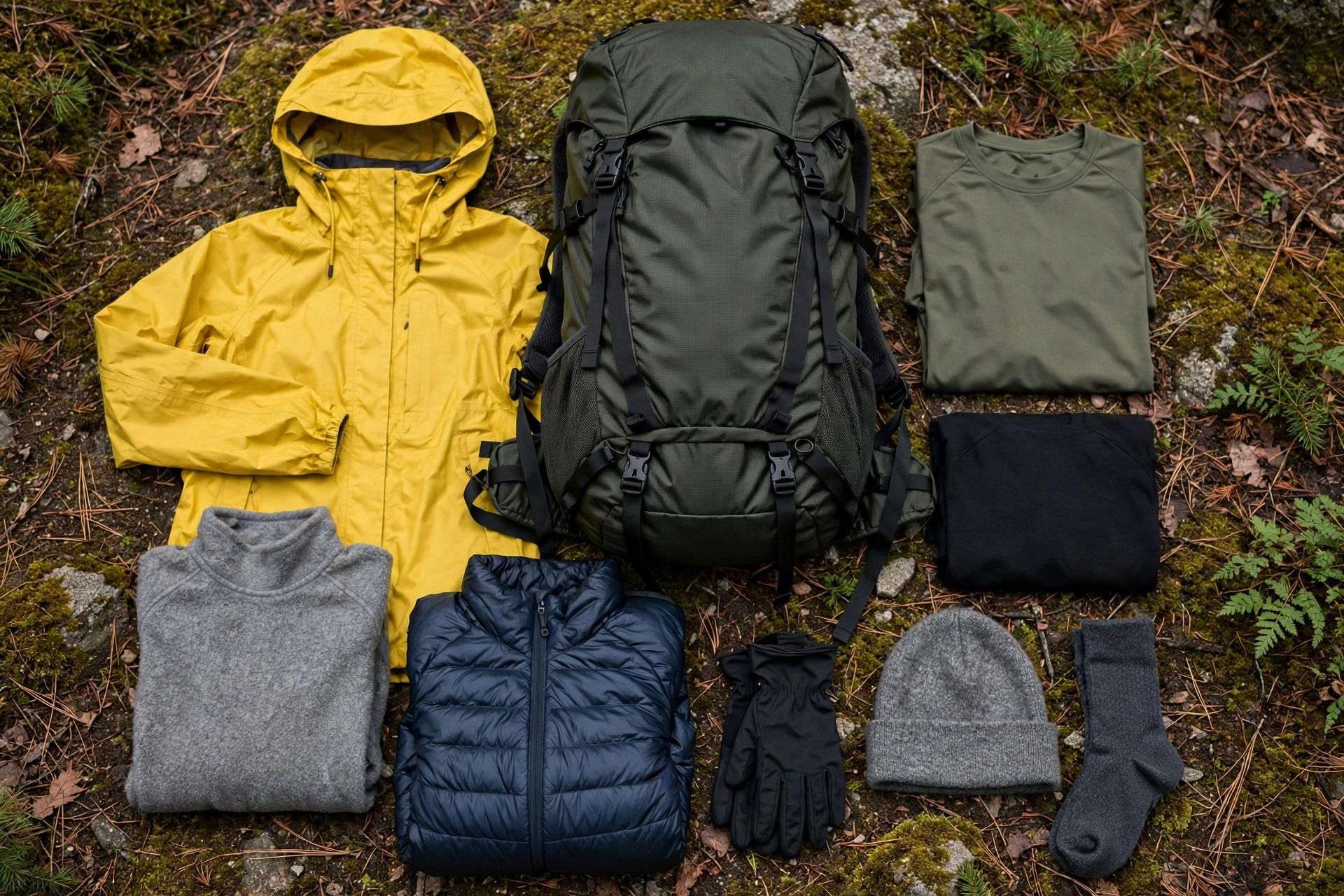
| Warm day, cold night — evening cooldown after sunset | Day outfit plus a packable down or heavy fleece in the bag | Light rain shell as a wind layer for the evening drop | Whatever suits the surface — but pack warm socks | Beanie and light gloves take almost no bag space and save the night |
Fabrics and layering rules that hold up in real weather
Cotton is the enemy in rain and cold — it absorbs water, loses insulation and takes hours to dry. Against the skin, choose merino wool (warm when damp, resists odor) or synthetic athletic fabric (dries fastest). For the mid layer, fleece insulates even when damp; packable down is warmer per ounce but useless once soaked, so pair it with a real shell.
Shell waterproof ratings are measured in millimeters: 5,000mm handles light rain, 10,000–20,000mm handles downpours. A 10,000mm packable shell is the sweet spot — light enough to carry “just in case.” Check for sealed seams and a DWR coating; without sealed seams, water enters through the stitching regardless of rating.
- Umbrella vs. poncho vs. shell: umbrellas block views and are banned at many venues; ponchos cover you and your bag but turn into sails in wind; a shell is the best all-rounder if you own one. When buying for one event, get the poncho.
- Socks: merino-blend hiking socks prevent blisters far better than cotton athletic socks. Pack a dry spare pair in a sealed ziplock — changing into dry socks at hour five feels like a new pair of feet.
- Sun fabrics: a UPF 50 long-sleeve shirt weighs almost nothing and replaces a full reapplication cycle of sunscreen on your arms. Darker, tighter-weave fabrics block more UV than white cotton.
The ready-to-go event bag: build it once, reuse it all season
Keep a packed event bag by the door from spring through fall and you will never scramble again. Start with the venue’s bag rules — many now require clear bags no larger than 12″ × 6″ × 12″ or ban backpacks entirely — then load in this order:
- Access: tickets (screenshot, not just the app), ID, cash in small bills, fully charged phone plus a small portable charger.
- Weather core: your scenario’s outer layer, the warm layer for evening, spare socks in a ziplock.
- Sun and water: sunscreen stick (faster than lotion in a crowd), hat, refillable bottle if permitted, a salty snack.
- Comfort: small first-aid kit (bandages, blister pads, pain reliever), tissues, a large ziplock for your phone if rain threatens.
- Group extras: if you go with others, split the load — one person carries sunscreen, one carries the first-aid kit, one carries the blanket. Nobody needs three full kits.
Check the organizer’s updates the morning of the event — weather shifts and gate policies change. Remove anything you will not use: every extra item is weight you carry for eight hours.
Five packing mistakes that ruin the day
- New shoes. Eight hours of standing in unworn shoes guarantees blisters. Wear the pair you have already walked five miles in, or bring blister pads and accept your fate.
- One heavy jacket instead of layers. A bulky coat is either on or off, with nothing in between. Three thin layers give you seven combinations and pack smaller.
- An umbrella at a no-umbrella venue. Security will make you throw it away or trek back to the car. Check the prohibited-items list before you leave home, not at the gate.
- Counting on the merch tent for rain gear. Venue ponchos cost two to three times drugstore prices and sell out in the first twenty minutes of rain. Bring your own.
- A glass bottle or full-size anything. Glass is banned nearly everywhere, and oversized items get confiscated at bag check. Travel sizes and plastic only.
Poncho or umbrella — which should I actually bring?
Bring the poncho. Umbrellas are prohibited at a large share of outdoor venues because they block sightlines, and they are useless in sideways rain or wind. A poncho covers you and your bag, packs to the size of a fist and costs a few dollars. If you already own a proper rain shell, that beats both — but do not buy a shell for one event.
How much water should I carry for an all-day outdoor event?
Plan on roughly 16–24 ounces per two hours in heat, less in cool weather. A 24-ounce refillable bottle is the practical standard. If the venue bans outside bottles, locate the water stations on the event map at arrival and plan refill breaks.
Are clear-bag rules really enforced?
Yes, and increasingly strictly. Many venues require clear bags within specific dimensions (commonly 12″ × 6″ × 12″), with small clutches the only exception. Bag-check lines for non-compliant bags can cost 20–40 minutes — a $10 approved clear bag pays for itself the first time you skip one.
Is it worth bringing a full change of clothes?
For most events, no — a full change is bulk you will not use. The high-value swap is dry socks and a dry base-layer top in a sealed bag, which handle the two things that actually make you miserable: wet feet and a soaked shirt. Save the full change for multi-day festivals or events where you are camping on-site.