What Is Memorial Day? It is a United States federal holiday observed on the last Monday of May each year, set aside to honor and mourn the American military personnel who died while serving in the country’s armed forces. Unlike holidays that celebrate service or mark the start of summer, Memorial Day has a solemn purpose at its core: remembrance of the fallen. Every year, Americans visit cemeteries and memorials, fly the flag at half-staff until noon, and pause at 3:00 p.m. local time for the National Moment of Remembrance. This guide explains the full story behind the holiday — its Civil War origins as Decoration Day, how it became a federal holiday, the traditions that define it, and respectful ways to observe it. For a broader look at American celebrations, see our Holidays hub.
The True Meaning of Memorial Day
Memorial Day honors those who died in military service to the United States. That distinction matters. It is not a day to thank living veterans for their service — that is Veterans Day, observed every November 11 — and it is not simply the unofficial start of summer, though it does coincide with the season’s beginning. At its heart, Memorial Day is a day of mourning, gratitude, and reflection for the more than one million American service members who have given their lives in the nation’s wars, from the Revolutionary War through present-day conflicts.
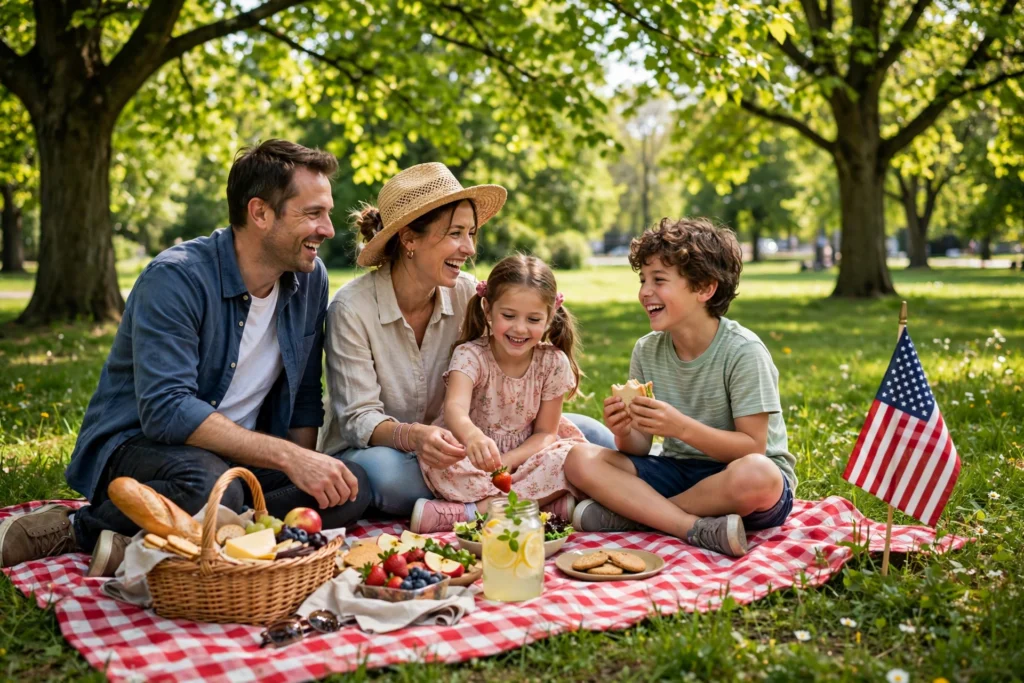
The holiday’s somber purpose coexists with backyard barbecues, parades, and weekend getaways, and that is by design. Americans have long combined remembrance with community gatherings — the earliest observances mixed prayer and speeches with picnics. The key is balance: enjoy the long weekend, but make room for the reason it exists. Even a brief pause — a moment of silence, a flag placed on a veteran’s grave, a donation to a Gold Star family organization — keeps the meaning alive.
The History of Memorial Day: From Decoration Day to National Holiday
The roots of Memorial Day reach back to the aftermath of the Civil War, the deadliest conflict in American history, which claimed an estimated 620,000 lives and left the nation searching for ways to grieve collectively. In the war’s wake, communities across both the North and South began holding springtime tributes to the fallen, decorating soldiers’ graves with flowers and reciting prayers. These observances were widely known as Decoration Day.
Dozens of towns claim to be the birthplace of Memorial Day, and the claims reflect how genuinely grassroots the tradition was. Among the most documented early observances:
- Charleston, South Carolina (1865): Freed Black residents and Union soldiers held one of the earliest known commemorations at a former racetrack turned mass grave, decorating the graves of Union soldiers who had died in a Confederate prison camp.
- Waterloo, New York (1866): The town held a community-wide observance with businesses closed and graves decorated. In 1966, President Lyndon B. Johnson officially proclaimed Waterloo the birthplace of Memorial Day.
- Columbus, Mississippi (1866): Women decorated the graves of both Confederate and Union soldiers, an act of reconciliation widely reported at the time.
- Arlington, Virginia (1868): General John A. Logan, leader of the Grand Army of the Republic (a Union veterans’ organization), issued General Order No. 11 designating May 30, 1868 as a day to decorate the graves of comrades who died in defense of the country. The first large observance was held at Arlington National Cemetery, where 5,000 participants decorated the graves of 20,000 Union and Confederate soldiers.
For decades, Decoration Day was observed on May 30 regardless of the weekday, a date chosen partly because flowers would be in bloom across the country. After World War I, the day’s scope expanded from honoring Civil War dead to honoring Americans who died in all wars. The name “Memorial Day” gradually replaced “Decoration Day” in common use.
How Memorial Day Became a Federal Holiday
The transformation from scattered local observances to a uniform national holiday took a century. The key milestones:
| Year | Milestone | Significance |
|---|---|---|
| 1865–1868 | Early Decoration Day observances | Grassroots tributes in Charleston, Waterloo, Columbus, and Arlington |
| 1868 | General Order No. 11 | First nationally coordinated Decoration Day, May 30, at Arlington National Cemetery |
| 1966 | Waterloo proclamation | President Johnson officially names Waterloo, NY the birthplace of Memorial Day |
| 1968 | Uniform Monday Holiday Act | Congress moves Memorial Day to the last Monday in May, creating a three-day weekend |
| 1971 | Federal holiday status | Memorial Day becomes an official federal holiday, observed nationwide |
| 2000 | National Moment of Remembrance | Congress establishes the 3:00 p.m. moment of silence, signed into law in December 2000 |
The Uniform Monday Holiday Act of 1968 is worth understanding because it explains why Memorial Day no longer falls on May 30. Congress deliberately shifted several holidays to Mondays to create three-day weekends, hoping to encourage travel and leisure. The change took effect in 1971. Some traditionalists still observe the holiday on May 30, and the Veterans of Foreign Wars and other organizations have periodically advocated returning to the fixed date to restore the day’s solemn focus.
Memorial Day Traditions and Customs
More than 150 years of observance have produced a rich set of traditions. Many are simple, quiet acts — which suits a day of remembrance.
Flying the Flag at Half-Staff
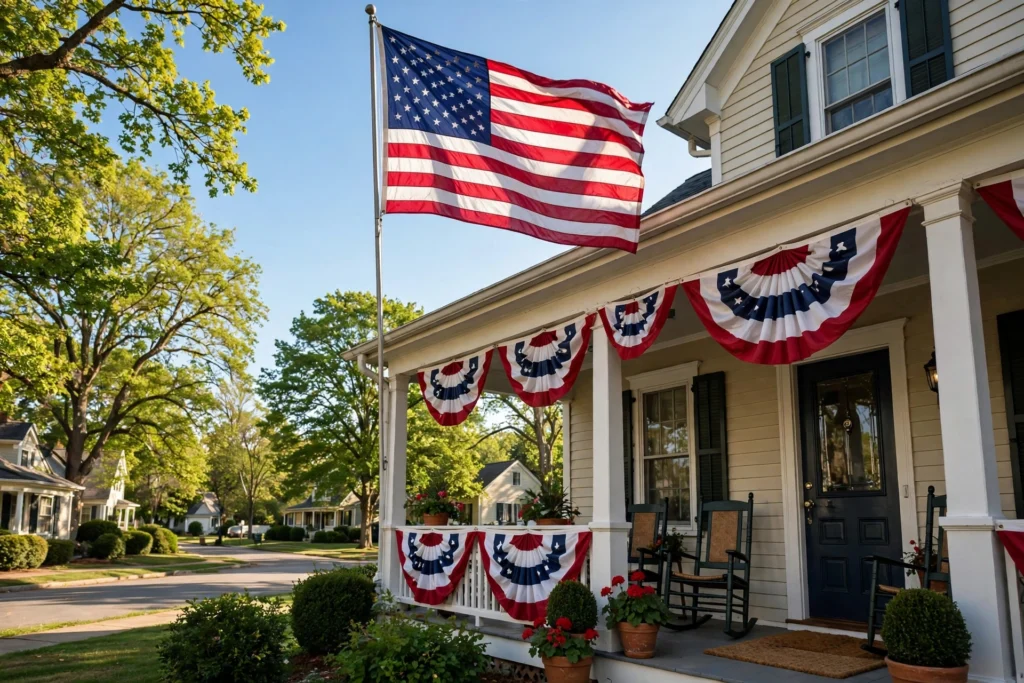
On Memorial Day, the American flag flies at half-staff from sunrise until noon, then is raised to full staff for the remainder of the day. The symbolism is deliberate: the morning honors the fallen, while the afternoon’s full-staff raising signifies the nation’s resolve to continue the fight for liberty in their memory. If you fly a flag at home, this is the single most visible way to observe the day correctly.
The National Moment of Remembrance
Established by Congress in 2000, the National Moment of Remembrance asks all Americans to pause at 3:00 p.m. local time on Memorial Day for one minute of silence to honor the fallen. Major League Baseball games pause, Amtrak trains blow their whistles, and radio stations go silent. Wherever you are — at a barbecue, on the beach, in the car — stopping for that minute connects you to millions of others doing the same.
Visiting Cemeteries and Memorials
Millions of Americans visit cemeteries on Memorial Day weekend to place flags and flowers on the graves of service members. Volunteer groups, Scouts, and veterans’ organizations place small American flags on veterans’ graves in the days before the holiday — a tradition you can join in most communities.
Arlington National Cemetery Ceremonies
The nation’s most solemn Memorial Day ceremony takes place at Arlington National Cemetery. In a tradition dating back decades, soldiers from the 3rd U.S. Infantry Regiment (the “Old Guard”) place a small American flag at every one of the cemetery’s more than 260,000 gravesites in the days before Memorial Day. On the holiday itself, the President or Vice President lays a wreath at the Tomb of the Unknown Soldier. The ceremony is open to the public and draws thousands each year.
Parades
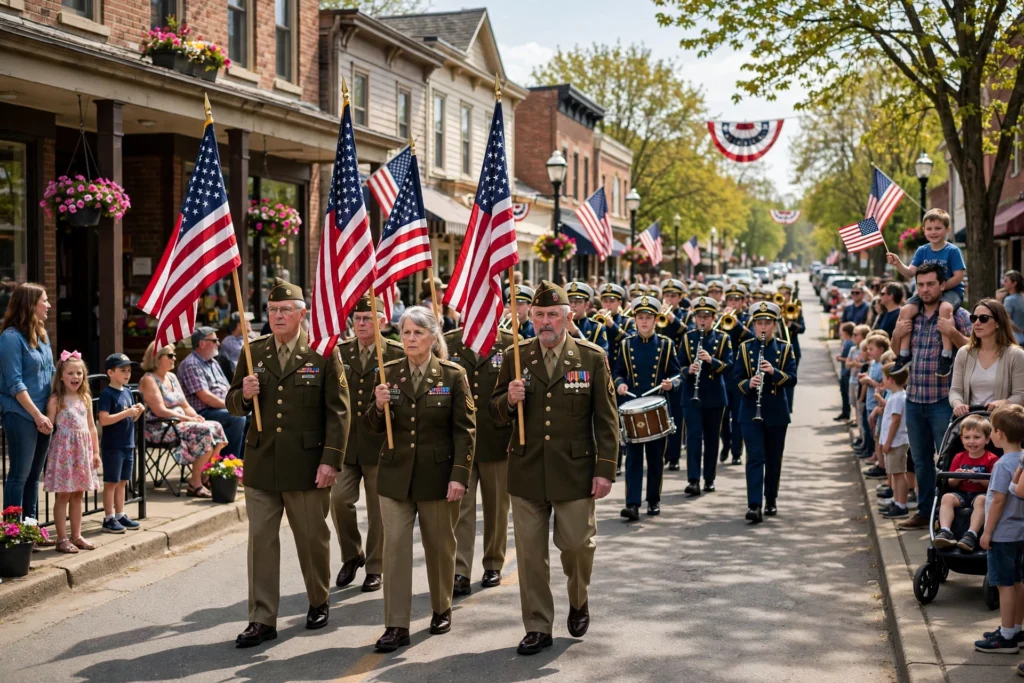
Memorial Day parades are among America’s oldest civic traditions, with some towns holding them continuously for over 150 years. Unlike celebratory holiday parades, Memorial Day parades typically include veterans’ groups, Gold Star families, marching bands playing somber pieces, and moments of silence. Many cities hold theirs on the Saturday or Sunday of the weekend rather than Monday. Our July 4th Parade Guide covers the summer’s other great parade tradition.
The Red Poppy: Memorial Day’s Flower of Remembrance
The red poppy became the international symbol of remembrance after Canadian physician Lieutenant Colonel John McCrae wrote the poem “In Flanders Fields” in 1915, describing poppies growing between the graves of fallen soldiers in Belgium. Inspired by the poem, American professor Moina Michael began wearing and distributing red poppies in 1918, and the flower was soon adopted by veterans’ organizations.
In the United States, the American Legion’s poppy program distributes millions of crepe-paper poppies each Memorial Day, handmade by disabled veterans. Wearing one is a quiet, visible sign of remembrance — and the donations support veterans in need. If a volunteer offers you a poppy in the days before Memorial Day, take it.
What Memorial Day Is Not
Because the holiday arrives with warm weather and a three-day weekend, its meaning sometimes gets blurred. A few clarifications, offered respectfully:
- It is not Veterans Day. Veterans Day (November 11) honors all who served, living and dead. Memorial Day honors only those who died in service. “Happy Memorial Day” can ring hollow to Gold Star families; “have a meaningful Memorial Day” or simply acknowledging the day’s purpose lands better.
- It is not a generic summer kickoff. Nothing is wrong with barbecues and beach trips — they are part of how Americans spend the weekend. But the day’s core is remembrance, and keeping even a small space for that matters.
- It is not about thanking active-duty troops for their service — though gratitude toward all who serve is always welcome, the day specifically remembers those who never came home.
Getting this right is one of the simplest ways to show respect. Our comparison guide Best Family Events in the USA can help you find a local remembrance ceremony to attend with your family.
How to Observe Memorial Day Respectfully
You do not need to attend a formal ceremony to honor the day. Meaningful observance can be simple:
- Pause at 3:00 p.m. Join the National Moment of Remembrance wherever you are.
- Fly the flag correctly. Half-staff until noon, full staff after — and make sure it is illuminated if flown at night.
- Visit a local veterans’ cemetery. Walk the rows, read the names, leave a flag or flower.
- Attend a local parade or ceremony. Small-town observances are often the most moving.
- Wear a red poppy. Support the American Legion’s program when you see volunteers.
- Donate. Organizations supporting Gold Star families, disabled veterans, and veterans’ cemeteries all welcome Memorial Day contributions.
- Learn one story. Read about a fallen service member from your town or state. Remembrance is personal when it has a name.
- Teach the meaning to kids. Explain, in age-appropriate terms, why the long weekend exists.
Memorial Day Dates: 2026, 2027, and Beyond
Memorial Day always falls on the last Monday of May. Here are the dates to know — note that Memorial Day 2026 has already passed, so plan ahead for 2027:
| Year | Memorial Day Date | Status |
|---|---|---|
| 2026 | Monday, May 25, 2026 | Passed |
| 2027 | Monday, May 31, 2027 | Upcoming — next observance |
| 2028 | Monday, May 29, 2028 | Future |
| 2029 | Monday, May 28, 2029 | Future |
| 2030 | Monday, May 27, 2030 | Future |
The 2027 Memorial Day weekend runs Saturday, May 29 through Monday, May 31, 2027. Federal offices, banks, the post office, and most schools are closed on the Monday holiday. Our When Is July 4th 2027 guide covers the summer’s next federal holiday.
Frequently Asked Questions
What is the true meaning of Memorial Day?
Memorial Day is a U.S. federal holiday honoring American military personnel who died while serving in the armed forces. Its purpose is remembrance of the fallen — distinct from Veterans Day, which honors all who served.
Why was Memorial Day originally called Decoration Day?
The name came from the practice of decorating soldiers’ graves with flowers, which began in communities across the country after the Civil War. General John A. Logan’s 1868 order called for decorating graves on May 30, and “Decoration Day” was the common name for decades before “Memorial Day” took over.
Is Memorial Day always on the last Monday of May?
Yes, since 1971, when the Uniform Monday Holiday Act took effect. Before that, it was observed on May 30 regardless of the weekday.
What time is the National Moment of Remembrance?
3:00 p.m. local time on Memorial Day. Congress established the one-minute pause in 2000 so Americans nationwide could honor the fallen together.
Why do flags fly at half-staff on Memorial Day morning?
The flag flies at half-staff from sunrise until noon to honor the fallen, then is raised to full staff for the rest of the day, symbolizing the living nation’s resolve to carry on.
Is it appropriate to say “Happy Memorial Day”?
Many Gold Star families and veterans find the phrase jarring, since the day mourns the dead. Consider “Have a meaningful Memorial Day” or simply acknowledging the day’s purpose instead.
What is the difference between Memorial Day and Veterans Day?
Memorial Day (last Monday of May) honors those who died in military service. Veterans Day (November 11) honors all who served in the armed forces, living and dead.
Are stores and restaurants open on Memorial Day?
Most retail stores, restaurants, and grocery stores stay open, often running major sales. Federal offices, banks, post offices, and schools are closed.
Balancing Remembrance With the Long Weekend
One of the most common questions about Memorial Day is whether it is disrespectful to enjoy the three-day weekend — the beach trip, the barbecue, the mattress sale. The honest answer embraced by most veterans’ organizations is that enjoying the freedoms the fallen defended is itself a form of honor, as long as the day’s purpose is not forgotten. The freedoms to gather, travel, and celebrate are exactly what generations of service members sacrificed to protect.
What veterans and Gold Star families generally ask is not that Americans spend the weekend in mourning, but that remembrance gets a genuine place in it. That can be as simple as starting the weekend’s cookout with a toast to the fallen, spending Monday morning at a local ceremony before the afternoon barbecue, or taking kids to place flags at a veterans’ cemetery on Saturday and then heading to the lake on Sunday. The weekend’s pleasures and its purpose are not opposites — they are two halves of the same American tradition.
If you are planning travel for the weekend, build the remembrance in deliberately. Many destinations pair naturally with observance: Washington, D.C. offers the National Memorial Day Parade and the Rolling to Remember motorcycle demonstration; small towns across New England and the Midwest hold some of the country’s oldest continuous parades; and nearly every state has a veterans’ memorial or battlefield site within a day’s drive. Arriving a day early to attend a local ceremony costs nothing and often becomes the most memorable part of the trip.
For families, the weekend is also a natural teaching moment. Children notice flags, parades, and moments of silence and will ask what they mean. Simple, honest answers — “today we remember the soldiers who died protecting our country” — plant the understanding that the long weekend has a reason. Over the years, those small explanations accumulate into genuine civic understanding.
Finally, remember that Memorial Day’s meaning extends beyond a single Monday. The organizations that place flags on graves, support Gold Star families, and maintain veterans’ memorials operate year-round, and the remembrance they steward continues whether or not it makes the news. The holiday is the nation’s annual appointment with that remembrance — three days set aside, one Monday at the center, to say together what too often goes unsaid: we remember, and we are grateful.
Key Takeaways
- What Is Memorial Day: a U.S. federal holiday on the last Monday of May honoring American military personnel who died in service.
- Origins: post–Civil War Decoration Day traditions; formalized 1868; federal holiday since 1971.
- Next observance: Monday, May 31, 2027 (Memorial Day 2026 has passed).
- Core traditions: flag at half-staff until noon, National Moment of Remembrance at 3:00 p.m., cemetery visits, parades, red poppies.
- Not Veterans Day: Memorial Day honors the fallen; Veterans Day (November 11) honors all who served.
- How to observe: attend a ceremony, pause at 3:00 p.m., fly the flag correctly, wear a poppy, teach kids the meaning.
Memorial Day and Labor Day: The Summer Bookends
Memorial Day and Labor Day frame the American summer — one opens the season with remembrance of the fallen, the other closes it honoring workers. They are often confused because both bring three-day weekends, sales, and barbecues, but their purposes could not be more different. Our Labor Day vs Memorial Day comparison walks through the history, meaning, and traditions of each so you can keep them straight — and observe both with the respect each deserves.