Ask a dozen people what brunch is and you will get a dozen variations on the same answer: it is the meal between breakfast and lunch, eaten late in the morning, usually on weekends, ideally with coffee and something involving eggs. But what is brunch, really? Is it just a late breakfast? A portmanteau with good PR? Or is there something genuinely distinct about it — a set of traditions, foods, and rituals that make brunch its own thing?
The answer is more interesting than you might expect. Brunch has a documented origin story, a specific cultural moment that launched it, and a surprisingly precise definition hiding underneath its casual reputation. It traveled from Victorian England to American hotels to Instagram feeds, picking up eggs Benedict, mimosas, and bottomless deals along the way. Understanding what brunch is — where it came from, what counts, and how it differs from the meals on either side of it — makes you appreciate the meal more, whether you are ordering at a restaurant or hosting at home.
In this guide, we will trace the full history of brunch from its 19th-century origins to its current status as a cultural phenomenon. We will define exactly what counts as brunch (the time window, the menu mix, the spirit), compare brunch vs breakfast vs lunch side by side, break down the classic brunch foods and how they earned their place, explore brunch traditions around the world, and look at where brunch is heading next.
The Origin Story: How Brunch Was Invented
Guy Beringer and the 1895 Essay
Brunch has a birth certificate, and it is dated 1895. That year, a young English writer named Guy Beringer published an essay in Hunter’s Weekly titled “Brunch: A Plea.” In it, he proposed a new Sunday meal that would combine breakfast and lunch — served late in the morning — as a cheerful alternative to the heavy, early Sunday dinners of the era.
Beringer’s argument was partly practical and partly mischievous. He wrote that brunch would be “cheerful, sociable and inciting,” a meal that allowed Saturday-night revelers to sleep in and still eat well. He even suggested it would be good for the soul — a lighter, happier start to Sunday than the traditional roast. The essay is widely credited as the first printed use of the word “brunch,” and Beringer’s framing — brunch as a social, slightly indulgent, weekend meal — is essentially the definition we still use today.
Tragically, Beringer died young, at just 27, and never saw his invention conquer the world. But his essay planted the seed.
From England to America: The Hotel Years
Brunch crossed the Atlantic in the early 20th century and found its first American home in hotels. In the 1920s and 1930s, grand hotels in Chicago and New York began offering Sunday brunch service — elaborate mid-morning spreads aimed at travelers and city dwellers who wanted something between the hotel breakfast and lunch service. The timing was perfect: Prohibition-era Americans were looking for respectable daytime socializing, and brunch fit the bill.
The real accelerant came after World War II. As American suburbs grew and church attendance patterns shifted, Sunday brunch became a secular weekend ritual. Restaurants discovered that brunch was enormously profitable — egg dishes have some of the highest margins in the food business — and the meal spread from hotels to mainstream restaurants through the 1950s and 60s.
Hollywood, the 1980s, and Brunch Goes Mainstream
Brunch got its pop-culture coronation in the 1980s. The 1987 film “Wall Street” and the broader yuppie culture of the decade made power brunches a symbol of urban success. Newspaper Sunday styles sections began covering “the brunch scene” the way they covered nightlife. By the 1990s, brunch was no longer a hotel novelty — it was a standard weekend institution in every American city.
Then came the 2000s and 2010s, which turned brunch into a full-blown cultural phenomenon. Food blogs, then Instagram, made brunch the most photographed meal of the week. Avocado toast became a generational punchline. Bottomless mimosas became a business model. Brunch stopped being just a meal and became an identity — “brunch person” entered the lexicon as a recognizable type.
What Is Brunch, Technically? The Definition
Strip away the cultural baggage and brunch has a fairly precise definition built on three pillars: timing, menu, and spirit.
Timing: Brunch is served late morning to early afternoon, typically between 10 a.m. and 2 p.m. Earlier than that and it is just breakfast; later and it drifts into lunch. The classic window exists for a reason — it lets people sleep in on weekends while still eating with enough of the day left to enjoy. Restaurants generally run brunch service from around 10 or 11 a.m. to 2 or 3 p.m.
Menu: A true brunch menu mixes breakfast and lunch foods. You will find eggs in various forms alongside salads, sandwiches, and sometimes heartier lunch dishes. Sweet and savory sit side by side — pancakes next to a burger is a perfectly normal brunch menu. The defining feature is the combination: a meal that is only breakfast foods eaten at 11 a.m. is a late breakfast, not brunch. The lunch element is what makes it brunch.
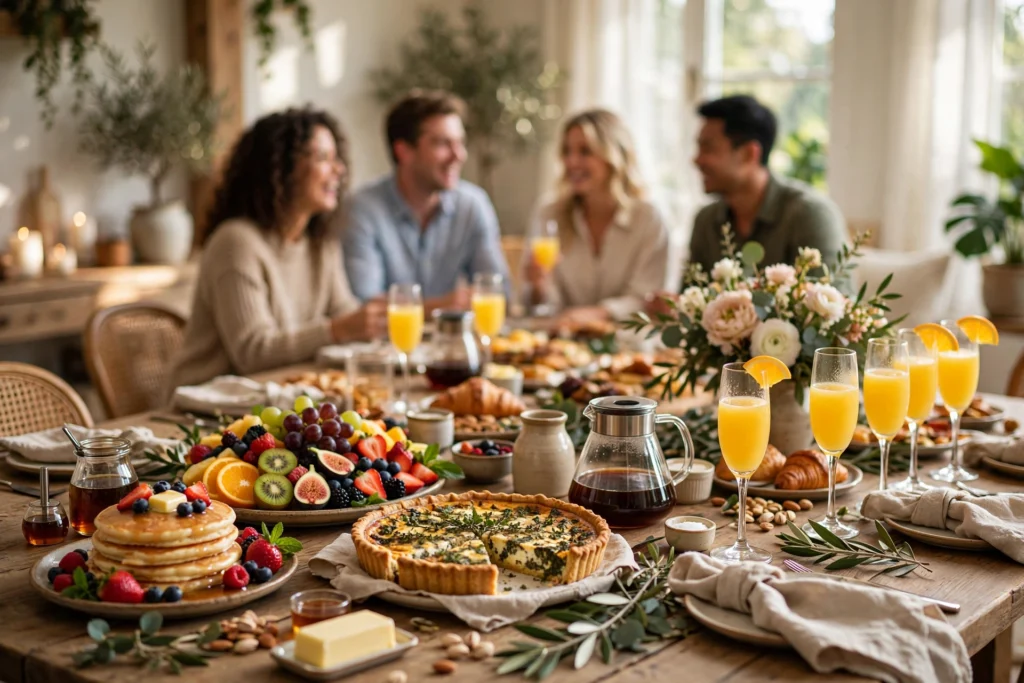
Spirit: Brunch is leisurely and social. It is a meal you linger over, usually on a weekend or holiday, often with drinks. Nobody brunches alone on a Tuesday morning before work — well, almost nobody. The unhurried, celebratory quality is as definitional as the timing. Beringer had it right in 1895: brunch is “cheerful, sociable and inciting.”
Put it together: brunch is a late-morning to early-afternoon weekend meal combining breakfast and lunch dishes, eaten socially and at a leisurely pace. That is what brunch is.
Brunch vs Breakfast vs Lunch: The Comparison
The boundaries between these three meals confuse people, so here is the head-to-head breakdown:
| Feature | Breakfast | Brunch | Lunch |
|---|---|---|---|
| Typical time | 6–10 a.m. | 10 a.m.–2 p.m. | 12–2 p.m. |
| Days | Every day | Weekends & holidays | Every day |
| Menu | Breakfast foods only | Breakfast + lunch mixed | Lunch foods |
| Sweet + savory mix | Rarely | Always | Sometimes |
| Drinks | Coffee, juice | Coffee, mimosas, mocktails, cocktails | Water, soda, sometimes wine |
| Pace | Quick, functional | Leisurely, social | Moderate |
| Setting | Home, café, on the go | Restaurant, home gathering | Office, restaurant, home |
| Eggs | Yes | Yes — the star | Rarely |
| Salads/sandwiches | No | Yes | Yes |
| Social occasion | Not really | Yes — the point | Sometimes |
The key insight: breakfast is fuel, lunch is a break, and brunch is an event. That is the real difference. You can eat the exact same eggs Benedict at 8 a.m. (breakfast), noon on Saturday with friends and a mimosa (brunch), or 1 p.m. on a Wednesday (a weird lunch). The food overlaps; the context defines the meal.
Classic Brunch Foods and How They Earned Their Place
Certain dishes are so associated with brunch that they practically define it. Here is how the canon formed.
Eggs Benedict
The undisputed king of brunch. Poached eggs and ham (or smoked salmon, or spinach) on an English muffin, draped in hollandaise sauce. Its origin is disputed — two New Yorkers both claimed to have invented it in the 1890s — but its brunch credentials are unquestioned. It is rich, it is impressive, it is impossible to eat quickly, and hollandaise is a sauce that demands to be eaten immediately, which makes it a restaurant dish par excellence. Eggs Benedict is brunch in food form: indulgent, a little fussy, and worth lingering over.
The Mimosa
Champagne and orange juice, in roughly a 2:1 ratio. The mimosa was reportedly invented at the Ritz Hotel in Paris in the 1920s and popularized in America by Alfred Hitchcock in the 1940s (he supposedly introduced it to San Francisco). It became brunch’s signature drink because it solved a problem: how do you drink alcohol at 11 a.m. without feeling like you have a problem? The answer: dilute it with orange juice, put it in a champagne flute, and call it brunch. The mimosa’s genius is that it makes daytime drinking feel festive rather than concerning.
Pancakes, Waffles, and French Toast
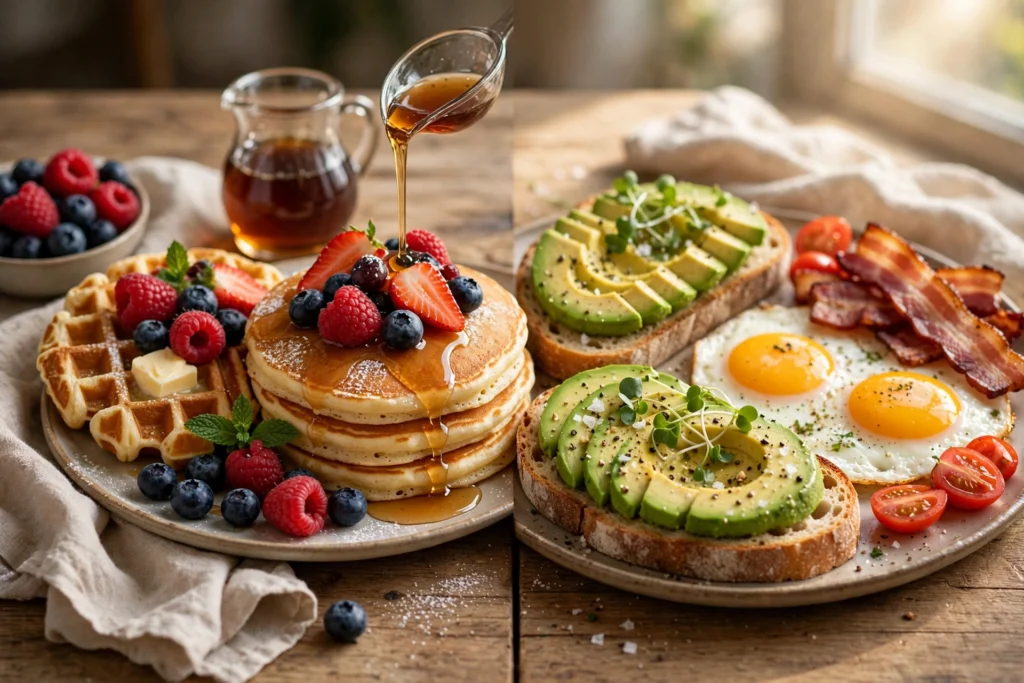
The sweet trinity of brunch. These dishes earned their place because they are the opposite of weekday breakfast — nobody makes waffles on a Tuesday before work. They are project foods: they take time, they involve syrup and toppings, they invite customization. At brunch, they represent permission to eat dessert for a meal, which is a big part of the appeal.
Avocado Toast
The millennial mascot. Avocado toast existed in various forms for decades (Australians claim prior art), but it exploded in the 2010s as the defining brunch order of a generation. It represents brunch’s health-conscious counterweight to the eggs Benedict — the virtuous option that still photographs beautifully. Love it or mock it, avocado toast proved that brunch menus could evolve with the times.
The Full English / Breakfast Burrito / Huevos Rancheros
Brunch is gloriously international in practice. The full English breakfast (eggs, bacon, sausage, beans, toast, mushrooms, tomato) slides naturally into brunch service. In the American Southwest, huevos rancheros and breakfast burritos are brunch staples. Dim sum brunch — the Cantonese tradition of yum cha, with carts of dumplings and tea — is arguably the world’s greatest brunch and predates the Western version by centuries.
Chicken and Waffles
A dish with deep roots in African American culinary tradition (tracing back to Harlem’s jazz clubs in the 1930s, where musicians finishing late-night sets wanted dinner and breakfast at once), chicken and waffles became a brunch menu star in the 2000s. It is the ultimate sweet-savory collision — exactly what brunch is about.
Brunch Traditions Around the World
Brunch may have an English name, but the concept — a leisurely late-morning weekend meal — exists almost everywhere:
- Yum cha / dim sum (China): The original brunch. Families gather late morning for tea and an endless parade of dumplings, buns, and rice rolls. It is social, leisurely, and weekend-based — brunch in everything but name, and centuries older.
- Full English breakfast (UK): On weekends, the full English stretches late into the morning and functions exactly like brunch — a big, social, lingering meal.
- Chilaquiles and café de olla (Mexico): Weekend mornings in Mexico mean chilaquiles (fried tortilla chips in salsa with eggs), tamales, and spiced coffee — a brunch tradition with deep roots.
- Smörgåsbord (Sweden): The Swedish buffet tradition easily stretches into a brunch format, with pickled herring, cheeses, breads, and aquavit.
- Long Sunday lunches (France, Italy, Spain): The Mediterranean Sunday meal starts late morning and runs for hours — functionally brunch with better wine.
- Boozy brunch (USA): America’s distinctive contribution — the bottomless mimosa or Bloody Mary brunch, which turned brunch into a daytime party format all its own.
What unites them all is the pattern: weekends, late mornings, good company, and food that takes its time. Brunch is a human universal wearing an English word.
Why Brunch Became a Cultural Phenomenon
Brunch did not become the defining meal of modern weekends by accident. Several forces converged:
The weekend itself. As the five-day workweek standardized in the 20th century, the weekend became sacred leisure time — and brunch became its flagship meal. It is the culinary expression of having nowhere to be.
Urbanization and restaurant culture. Brunch is primarily a restaurant meal, and it rose alongside the restaurant boom. Cities full of young professionals with disposable income and no children created the perfect brunch market.
Social media. Brunch is the most photogenic meal — colorful, artfully plated, served in good daylight. Instagram did not invent brunch, but it supercharged it, turning specific dishes (avocado toast, açaí bowls, rainbow lattes) into viral phenomena.
The experience economy. Modern consumers, especially younger ones, spend on experiences over things. Brunch is an experience: a two-hour social event with food, drinks, and atmosphere. It sells exactly what the experience economy demands.
Day drinking, destigmatized. Brunch created a socially acceptable framework for daytime alcohol consumption. The mimosa and the Bloody Mary are brunch’s permission slips, and the “boozy brunch” industry is worth billions.
Modern Brunch Trends
Brunch continues to evolve. Current trends shaping the meal in 2026:
- Sober-curious brunch: High-quality non-alcoholic options — craft mocktails, zero-proof spirits, specialty coffees — are becoming standard, not an afterthought. The best brunch spots now treat their mocktail menu with the same seriousness as their cocktail list.
- Global flavors: Menus are moving beyond the standard American canon to include shakshuka, congee, Japanese soufflé pancakes, and Mexican brunch dishes as mainstream offerings.
- Wellness brunch: Protein-forward menus, adaptogenic lattes, and genuinely nutritious options alongside the indulgent classics. The modern brunch menu lets you choose your own adventure.
- Brunch at home: The pandemic permanently expanded home brunch culture — elaborate home spreads, brunch boxes, and virtual brunches proved the ritual does not require a restaurant.
- All-day brunch: Many restaurants have extended brunch hours or gone all-day, acknowledging that the demand is not really about the time slot — it is about the food and the feeling.
The Anatomy of a Perfect Brunch Order
If you want to brunch like a pro, there is a loose formula that experienced brunch-goers follow. Start with coffee ordered immediately — brunch service is slow and caffeine should not wait. Then order in two waves: something light to arrive quickly (fruit, a pastry, yogurt) to take the edge off, followed by your main plate.
For the main, pick one anchor from each side of the menu’s personality: if you go rich and savory (eggs Benedict, a breakfast burrito), balance it with something fresh on the side (fruit, a simple salad). If you go sweet (French toast, pancakes), add a savory side (bacon, sausage) for contrast. The sweet-savory balance is the whole philosophy of brunch on a single plate.
For drinks, the classic move is coffee plus one festive drink — a mimosa, a Bloody Mary, or a craft mocktail. Pace the festive drink; brunch is a marathon, not a sprint. And always, always order the thing the restaurant is known for. Every good brunch spot has a signature dish, and it is signature for a reason.
Frequently Asked Questions
What is brunch a combination of?
Brunch is a combination of breakfast and lunch — the word itself is a portmanteau of the two. It is traditionally eaten late in the morning (10 a.m. to 2 p.m.), usually on weekends, and the menu mixes breakfast dishes (eggs, pancakes) with lunch dishes (salads, sandwiches).
Who invented brunch?
The word “brunch” was coined by English writer Guy Beringer in an 1895 essay titled “Brunch: A Plea,” where he proposed a late-morning Sunday meal combining breakfast and lunch. The concept of a leisurely late-morning meal existed before him in various cultures, but Beringer gave it its name and its modern framing.
What time is brunch?
Brunch is typically served between 10 a.m. and 2 p.m., with the sweet spot around 11 a.m. to 1 p.m. Restaurant brunch service usually runs from about 10 or 11 a.m. to 2 or 3 p.m. on weekends. Earlier than 10 a.m. is breakfast; much later than 2 p.m. drifts into lunch.
What is the difference between brunch and breakfast?
The main differences are timing, menu, and occasion. Breakfast is an everyday early-morning meal of breakfast foods, eaten functionally. Brunch is a weekend late-morning event mixing breakfast and lunch foods, eaten socially and leisurely. You can eat the same eggs at both — the context is what changes the meal.
What foods are traditionally served at brunch?
Classic brunch foods include eggs Benedict, omelets and frittatas, pancakes, waffles, French toast, bacon and sausage, bagels with lox, avocado toast, fresh fruit, pastries, and breakfast potatoes. Drinks include coffee, mimosas, Bloody Marys, and fresh juice. Modern brunch menus add global dishes like shakshuka, dim sum, and chilaquiles.
Is brunch only on weekends?
Traditionally yes — brunch is a weekend and holiday meal, which is part of what makes it special. However, many restaurants now serve brunch on weekdays or offer all-day brunch menus. At home, of course, you can brunch whenever you like. The weekend association remains strong, though.
Why is brunch so popular?
Brunch combines the best of several worlds: sleeping in, indulgent food, socializing, and (optionally) daytime drinks. It fits the modern weekend lifestyle perfectly, it is highly photogenic for social media, and restaurants love it because egg-based dishes are profitable. It has become a cultural ritual, not just a meal.
What should I wear to brunch?
Smart casual is the standard: nice jeans or trousers, a clean top, and real shoes. Brunch is more dressed up than a weekday breakfast but less formal than dinner. When in doubt, check the venue — upscale restaurants expect more polish, casual spots are relaxed.
Conclusion
So what is brunch? It is a word coined in an 1895 essay, a meal that traveled from English country houses to American hotels to Instagram feeds, and a ritual that turns an ordinary weekend morning into a small celebration. It is defined by its timing (late morning), its menu (breakfast meets lunch), and above all its spirit — leisurely, social, and just indulgent enough to feel special.
Whether you are ordering eggs Benedict at a white-tablecloth restaurant, grabbing breakfast tacos from a truck, or hosting a spread at home, you are participating in a tradition that is more than a century old and still evolving. Brunch endures because it answers a simple human desire: to slow down, eat well, and enjoy good company while the day is still young. That is a combination that never goes out of style.