Long before the greeting-card industry, before the dozen red roses, before the diamond ring as the default proposal, a young Welshman who wanted to marry a girl did something far more demanding: he sat down with a block of wood, a knife, and the long dark evenings of a Welsh winter — and carved her a spoon.
The Welsh love spoon — llwy garu, the “spoon of love” — is one of the world’s oldest romantic traditions still in living practice. Carved from a single piece of wood, dense with secret symbols, presented as a proposal and judged by the recipient’s father, it turned courtship into craftsmanship. This is the story of the spoon: what the symbols mean, how the ritual worked, and why, four centuries later, Welsh couples still give spoons on St Dwynwen’s Day.
What Is a Welsh Love Spoon?
A love spoon is a wooden spoon carved from a single piece of wood — never assembled, never glued — whose handle has been transformed into an intricate openwork design of symbols. The earliest were probably simple variations on the cawl spoon (the spoon used to eat cawl, the traditional Welsh stew), perhaps with a heart carved into the neck. Over generations, the carving grew more and more elaborate: the handle widened to carry complex designs, the bowl sometimes shrank to a token, and the whole object crossed the line from utensil to artwork.
Nobody knows exactly when the tradition began — it seems to have been around forever — but the physical evidence starts in the 17th century. The oldest dated love spoon in existence is held at St Fagans National Museum of History near Cardiff: inscribed 1667, it has survived more than 350 years as proof that a young man’s whittled declaration of love could outlast the love affair, the carver, and very nearly the language he spoke. The museum’s collection spans the centuries, each spoon as unique as its maker, each designed with one particular girl in mind.
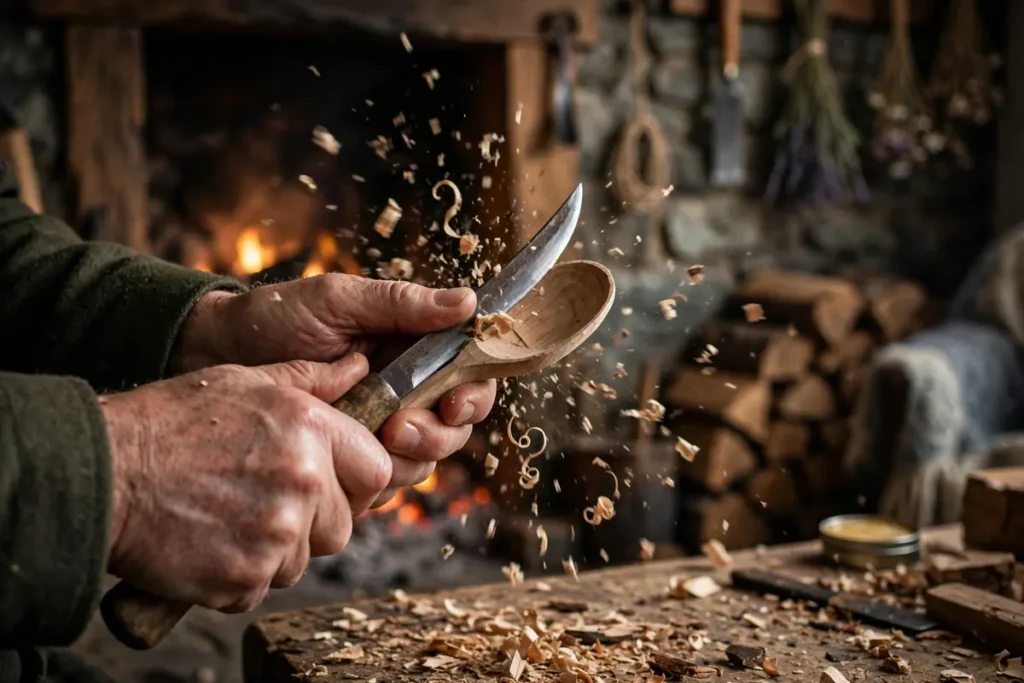
The woods matter. Traditional carvers favored sycamore above all — fine-grained, pale, and forgiving — along with lime, yew, and fruitwoods. The carving was done with simple hand tools, including a special curved knife Welsh craftsmen called the twca cam (the curved dagger), designed for hollowing the bowl and cutting the delicate openwork. A complex spoon could absorb an entire winter’s worth of evenings — and that was the point. The hours were the message.
The Courtship Ritual: How a Spoon Became a Proposal
In 16th- and 17th-century Wales, the love spoon did the work that the engagement ring does today. The ritual ran like this:
A young man, usually over the long winter evenings when farm work paused, would carve a spoon for the girl he hoped to marry. Into the handle he worked a language of symbols — hearts, bells, chains, knots — each carrying a message about his intentions: love, marriage, fidelity, prosperity. The more intricate the carving, the more impressive the statement, because intricacy meant hours, and hours meant devotion. A suitor who presented a clumsy, rushed spoon was telling the girl exactly what he thought she was worth.
The presentation itself was formal. Tradition holds that the finished spoon was first given to the girl’s father for inspection — he would judge both the spoon and, by extension, the carver. Was the young man skilled? Patient? Capable of providing? The spoon was a résumé in wood. If the father — and the girl — approved, the couple were allowed to court. If she accepted the spoon, she accepted him: the spoon was the proposal.
There’s a linguistic footnote worth savoring. It’s widely said — including by Welsh heritage sources — that the 19th-century English word “spooning,” meaning romantic cuddling or canoodling, derives from this tradition of courtship-by-spoon. Etymologists hedge on the exact path, but the story is told with such affection in Wales that it hardly matters whether it’s strictly true. A culture that names cuddling after its love spoons is a culture that has its priorities right.
Welsh sailors added their own chapter. Spending long, lonely months at sea, sailors carved spoons for the girls they’d left at home, and their work reflected shipboard life: Celtic knots borrowed from rigging ropes came to mean everlasting love; anchors declared the sailor’s heart “anchored at home”; a ship’s wheel promised he would work hard for her and the family she would give him. The maritime spoons are among the most distinctive in the tradition — love letters in timber, written between watches.
A Dictionary of Love Spoon Symbols
The symbols are the spoon’s secret language — a vocabulary of intentions that let shy young carvers say what they couldn’t say aloud. Here are the classic meanings, as recorded by Welsh craftsmen and museums:
| Symbol | Meaning |
|---|---|
| Heart | “I love you” — Dwi’n dy garu di |
| Double heart | Mutual, requited love |
| Bell | Marriage — “we chime together in harmony” |
| Ball in cage | Love safely held; the number of balls may signify hoped-for children |
| Celtic knot | Everlasting, eternal love — no beginning, no end |
| Chain / linked chain | “We will be together forever”; links may represent children |
| Cross | “Let God bless our union” — faith over the marriage |
| Diamond | Wealth and good fortune |
| Dragon (Y Ddraig Goch) | Wales itself — protection, and the community’s support |
| Horseshoe | Luck for the couple’s future |
| Key / keyhole | “I will protect you” — security, home, safekeeping |
| Padlock | Security; the lover will keep his partner safe |
| Anchor | “My heart is anchored at home” (especially on sailors’ spoons) |
| Ship’s wheel | “I will work hard for you and our family” |
| Birds | “Let’s fly away together” — elopement, escape |
| Comma shapes | The soul — an old, mystical motif |
| Twisted stem | “We will grow together from this moment” |
| Heart-shaped bowl | A full and bountiful life together |
Read a spoon like a sentence: a heart locked with a key, hung on a chain of three links, says I love you, I will protect you, and I see our three children in our future — all without a single word. For a deeper look at the day these spoons are most often given, see our guide to St Dwynwen’s Day: Wales’ own Valentine’s Day on January 25.
Watch: What Is a Welsh Love Spoon?
The Lovespoon Workshop — a family business hand-carving spoons since 1969 — explains the tradition and how it has evolved into the modern day.
Timeline: Four Centuries of the Love Spoon
1600s: The tradition takes shape
Welsh suitors carve increasingly elaborate spoons as courtship gifts. The oldest surviving dated example — inscribed 1667 — enters what will become the St Fagans collection.
1700s–1800s: The golden age of carving
The tradition flourishes across rural Wales. Sailors develop the maritime symbolic vocabulary. Antique spoons from this era now fetch thousands at auction — Christie’s sold an 18th-century Welsh love spoon for £3,600 in 2006, and a 19th-century beechwood example for £5,400 in the same era.
1800s: “Spooning” enters the language
Tradition holds that the English word “spooning” (romantic cuddling) derives from the Welsh courtship custom — a folk etymology Wales embraces regardless of the philologists’ verdict.
1900s: From courtship to craft
As the original courtship function fades, love spoons survive as a Welsh craft tradition and national symbol. Carvers like the founders of the Lovespoon Workshop (est. 1969) keep the hand-carving alive as a profession.
Today: The living tradition
Spoons are given for weddings, anniversaries, births, housewarmings, and above all St Dwynwen’s Day. Tourist shops across Wales sell them; master carvers still make them by hand; and somewhere every winter, a young person is still carving one for someone specific.
Love Spoons Today: Weddings, Anniversaries, and Everything Worth Marking
The love spoon survived the death of its original function by becoming something larger: a universal Welsh token of affection. Where once a spoon meant marry me, now it can mean almost any serious sentiment — and the occasions have multiplied accordingly.
Weddings remain the spoon’s natural habitat. A love spoon given at a Welsh wedding — often incorporating the couple’s names, the wedding date, or twin hearts — is both gift and heirloom, destined for a wall rather than a drawer. Some couples commission spoons as wedding favors; others receive a grand “wedding spoon” as the centerpiece gift. The symbolism that once proposed marriage now blesses it.
St Dwynwen’s Day is the spoon’s annual high season. Card shops and craft shops across Wales report the January rush, and giving a spoon on January 25 connects the giver to both traditions at once — the saint and the craft, the legend and the labor. It’s the most culturally loaded gift in the Welsh romantic calendar.
And then everything else: anniversaries (a spoon a year is a collection with a narrative), births (a tiny spoon for a new baby, sometimes with a ball-in-cage for the child), housewarmings, graduations, retirements. The tradition has proven endlessly adaptable because its core message — I spent time thinking about you — fits any occasion where time is the real gift.
The commercial side deserves an honest note. Travel anywhere in Wales today and you’ll find love spoons as souvenirs — some hand-carved by Welsh craftsmen, some mass-produced far away. Purists lament the dilution; pragmatists note that a tradition visible in every gift shop is a tradition that survives. The advice is simple: if the symbolism matters to you, buy from a Welsh carver, ask about the wood and the symbols, and pay for the hand work. A real hand-carved spoon — like the ones from workshops that have been carving since 1969 — carries something no factory copy can: the hours.
How to Choose (or Give) a Love Spoon
1. Read the symbols first
Use the dictionary above. A spoon is a sentence — make sure it’s saying what you mean. Giving a bell (marriage) on a third date sends a different message than a heart (love). Choose symbols that match the relationship’s truth.
2. Buy Welsh, buy handmade
Look for spoons carved in Wales from traditional woods — sycamore, lime, yew, fruitwood. Hand-carved spoons show tool marks and slight asymmetries; those are features, not flaws. Ask the seller about the carver. If no one can name the carver, keep shopping.
3. Consider commissioning
Many Welsh carvers take commissions: your names, your date, symbols chosen for your story. A commissioned spoon takes weeks — which is exactly why it’s the ultimate romantic gift. Plan ahead for St Dwynwen’s Day or an anniversary. If time is short, our last-minute Valentine’s Day gifts guide has faster options — but nothing beats the commissioned spoon for meaning.
4. Present it with the story
A love spoon given without explanation is just a pretty object. Tell the recipient what the symbols mean, why you chose them, and the 350-year history they’re holding. The story is half the gift — which is why our Valentine’s Day gifts for her guide keeps coming back to meaning over money.
5. Hang it where you’ll see it
Traditionally, spoons were displayed proudly on the wall — a public declaration. Don’t bury yours in a drawer. Hang it where the light catches the carving, and let it do what it was made to do: remind you, daily, that someone once spent a winter carving their intentions into wood for you.
Myth vs. Fact: The Love Spoon
Myth: Love spoons were always decorative art objects.
Fact: They began as working spoons — variations on the cawl spoon people actually ate with. The decoration grew over generations until the art overtook the utensil. The earliest spoons were tools that became tokens.
Myth: Every symbol has one fixed, ancient meaning.
Fact: Symbol meanings have been debated, elaborated, and sometimes invented over the centuries. The core vocabulary (heart = love, bell = marriage) is well established, but some attributions are modern systematizations of what was once a looser folk language. Treat the dictionary as tradition, not scripture.
Myth: “Spooning” definitely comes from love spoons.
Fact: It’s the beloved folk etymology, repeated by Welsh heritage sources — but etymologists note the word’s history is murkier, with “spooning” for cuddling possibly arising independently from the image of spoons nesting together. Wales tells the love-spoon version with pride, and honestly, it’s the better story.
Myth: The father’s inspection was universal and formal.
Fact: The “spoon presented to the father” is the traditional telling, and it reflects real patriarchal courtship customs — but like all folk history, the formality varied by place, period, and family. The core truth stands: the spoon was judged as a measure of the man.
Myth: Machine-made souvenir spoons are “just as good.”
Fact: They’re fine as souvenirs, but they miss the point. The tradition’s entire meaning was time spent by a specific person for a specific person. A hand-carved spoon from a named Welsh carver honors that; a factory copy is a picture of a tradition, not the tradition.
Anatomy of a Masterpiece: Reading a Great Spoon
To appreciate the love spoon fully, it helps to “read” one great example the way its maker intended — symbol by symbol, from bowl to tip. Imagine a masterwork spoon of the kind that wins competitions at Welsh craft eisteddfodau today:
The bowl is small and heart-shaped — a token bowl, not a working one, signaling that this spoon was never meant for soup. Its heart shape announces the theme before the handle says a word: this is about love, and the maker wants you to know it immediately.
The neck rises from the bowl into the first openwork panel: a pair of hearts locked together, carved so delicately that light passes between them. Double hearts mean requited love — not just I love you but we love each other. It’s a bold claim for a suitor to carve, and that’s precisely why it impresses.
The mid-handle carries the spoon’s most technically demanding feature: a cage containing three wooden balls, each carved in place from the same single piece of wood, free to rattle but impossible to remove. The cage says love safely held; the three balls whisper of hoped-for children. Carvers will tell you the ball-in-cage is the ultimate proof of skill — one slip of the knife and months of work are ruined.
Above the cage, a length of chain — five interlocking links, each carved from the solid — declares eternal togetherness, the links sometimes standing for the couple’s children or for the years they’ve been together. The chain flows into a Celtic knot with no beginning and no end: everlasting love, the carver’s promise made geometry.
The crown of the spoon — its topmost element — is often the most personal: a bell for marriage, a dragon for Welsh pride and protection, or the carver’s own invention, a flower the girl loved or a motif from her village. The crown is where the generic language of symbols becomes a personal sentence.
Read end to end, such a spoon says: I love you and you love me; our love is safe; I see our children; we are bound forever without end; marry me, under the dragon’s protection. No ring, no card, no text message has ever said more in less space. And every hour of the winter that went into cutting those links free from the solid wood is still there in the grain, four centuries after the first such spoon was carved — a love letter you can hold.
Frequently Asked Questions
What is a Welsh love spoon?
A llwy garu (“spoon of love”) is a wooden spoon carved from a single piece of wood, with an intricately carved handle full of romantic symbols. Originating as a courtship gift in Wales — the oldest dated example is from 1667 — it was traditionally carved by a suitor and presented as a proposal of marriage.
What do the symbols on a love spoon mean?
Each symbol carries a message: hearts for love, bells for marriage, balls in cages for children, Celtic knots for eternal love, chains for togetherness, crosses for faith, diamonds for prosperity, dragons for Welsh protection, keys for security, anchors for steadfastness. See the full dictionary table above.
How old is the love spoon tradition?
At least 350 years in documented form — the oldest dated spoon, inscribed 1667, is at St Fagans National Museum of History near Cardiff. The tradition itself is likely older; as one Welsh source puts it, it seems to have been around forever.
Are love spoons still given today?
Yes — for weddings, anniversaries, births, housewarmings, and especially St Dwynwen’s Day (January 25). They’ve evolved from courtship proposals into all-occasion tokens of affection, and Welsh carvers still make them by hand.
What wood are love spoons carved from?
Traditionally sycamore above all, plus lime, yew, and fruitwoods. Sycamore’s fine, pale grain made it the carver’s favorite. Each spoon is carved from a single piece — never assembled or glued.
Where can I see historic love spoons?
St Fagans National Museum of History near Cardiff holds a major collection spanning the centuries, including the 1667 example. It’s the essential pilgrimage for anyone serious about the tradition.
Four Centuries of Carved Devotion
The love spoon shouldn’t have survived. It was a peasant courtship custom from a corner of Britain, made obsolete by the engagement ring, the greeting card, and the text message. It survived because it answers a need none of those things touch: the need to prove, in a way that can’t be faked, that someone spent time — hours of it, in the dark of winter, with a knife and a block of sycamore — thinking about you.
That is what you’re really giving when you give a love spoon: not wood, but hours. Not a symbol, but the patience to carve one. Four centuries of Welsh suitors understood that. On St Dwynwen’s Day, or any day that needs marking, the spoon still says it best — without a single word.