Long before the ceremony music starts, the wedding day is already telling its story — in the quiet of the bridal suite, the steam of a morning shower, the nervous laughter of the wedding party, the way your mother’s hands shake as she fastens your necklace. Wedding morning photos capture the anticipation, the intimacy, and the beautiful chaos that the rest of the day moves too fast to notice.
This guide delivers 42 wedding day morning photo ideas — every essential getting-ready shot, organized by the morning’s natural timeline, with lighting and framing guidance for each. Whether you are the bride, the groom, or the photographer, you will know exactly which moments to protect, which details to stage, and how to make the season’s most flattering light work for you. Think of it as insurance for your memories: the day itself will fly by in a beautiful blur, but these photographs will hold every precious morning moment perfectly still, ready to revisit whenever you wish.
The Wedding Morning Photo Timeline
Mornings move fast. This timeline shows when each category of shots happens and what the light is doing — share it with your photographer and your glam team so nobody is competing for the same minutes.
| Time Block | Photo Focus | Light Notes |
|---|---|---|
| T–3 hours (setup) | Details flat lay, dress/suit, venue/room | Soft early light — ideal for details |
| T–2.5 hours | Hair & makeup in progress, candid prep | Window light builds — keep subjects near windows |
| T–2 hours | Wedding party candids, robes, toasts | Bright and flattering — peak getting-ready light |
| T–1 hour | Getting dressed, parent moments, final details | Still excellent — the “golden prep hour” |
| T–30 min | Full look portraits, quiet moments, departure | Transition light — move outdoors if possible |
| T–0 | Leaving for ceremony / first look | Midday or afternoon — plan shade |
T = ceremony start time. The golden rule: details and dressing happen in the best window light; save outdoor portraits for the last 30 minutes when everyone is ready.
The Details: Still Life of the Morning (1–8)
These are photographed first, before the room fills with people. Gather everything into one bag the night before and hand it to your photographer on arrival.
1. The Invitation Suite Flat Lay
Your full invitation suite styled with flowers, ribbon, and your rings. Lighting/framing: shoot near a window on a neutral surface (a white bedsheet works); overhead angle, soft side light for texture. This image sets the tone for the entire album — give it 15 unhurried minutes.
2. The Dress Portrait
The gown alone, hanging in beautiful light. Lighting/framing: hang at window height on a pretty hanger; shoot slightly upward with the window behind for a glowing effect. Include the veil draped nearby for a second composition.
3. The Suit & Details
The groom’s suit, tie, shoes, watch, and cufflinks arranged or hanging. Lighting/framing: darker backgrounds suit menswear — a wooden door or dark wall adds contrast. Steam the suit the night before; wrinkles photograph as neglect.
4. The Rings Macro
Both rings photographed in an interesting way — on the bouquet, in a ring box, on the invitation. Lighting/framing: macro lens, shallow depth of field, window light from the side. Clean the rings the night before; every speck shows in macro.
5. The Shoes
Wedding shoes styled with flowers or on a pretty surface. Lighting/framing: low angle to give them presence; pair with the bouquet for scale and romance. Photograph before they are worn — pristine shoes tell the “beginning” story.
6. The Jewelry & Accessories
Necklace, earrings, bracelet, hairpiece — arranged artfully. Lighting/framing: dark velvet or white linen background depending on metal tone; side light makes gems sparkle. These are often gifts — the photo preserves the giver’s thoughtfulness.
7. The Bouquet Portrait
The bouquet alone, in perfect condition, before it is carried. Lighting/framing: hold against a plain wall or window light; shoot from slightly above. Mist it lightly with water for freshness — a hydrated bouquet photographs dramatically better.
8. The Perfume & Personal Items
Your wedding-day scent, a family heirloom, the “something borrowed.” Lighting/framing: group 3–5 small items; odd numbers compose best. These tiny personal artifacts are what you will point to in fifty years and say “remember this?”
The Bride’s Story (9–18)
The bridal morning is a transformation narrative — capture the arc from robes to radiance.
9. The Morning Coffee Moment
Bride in robe, coffee in hand, gazing out the window — calm before the beautiful storm. Lighting/framing: backlit silhouette or soft side light; keep it candid. This is the “real life” frame that balances the polished portraits.
10. Hair in Progress
The stylist at work — brushes, pins, concentration. Lighting/framing: shoot over the stylist’s shoulder or through the mirror. Tidy the vanity first; stray bobby pins and coffee cups distract.
11. Makeup Application Close-Up
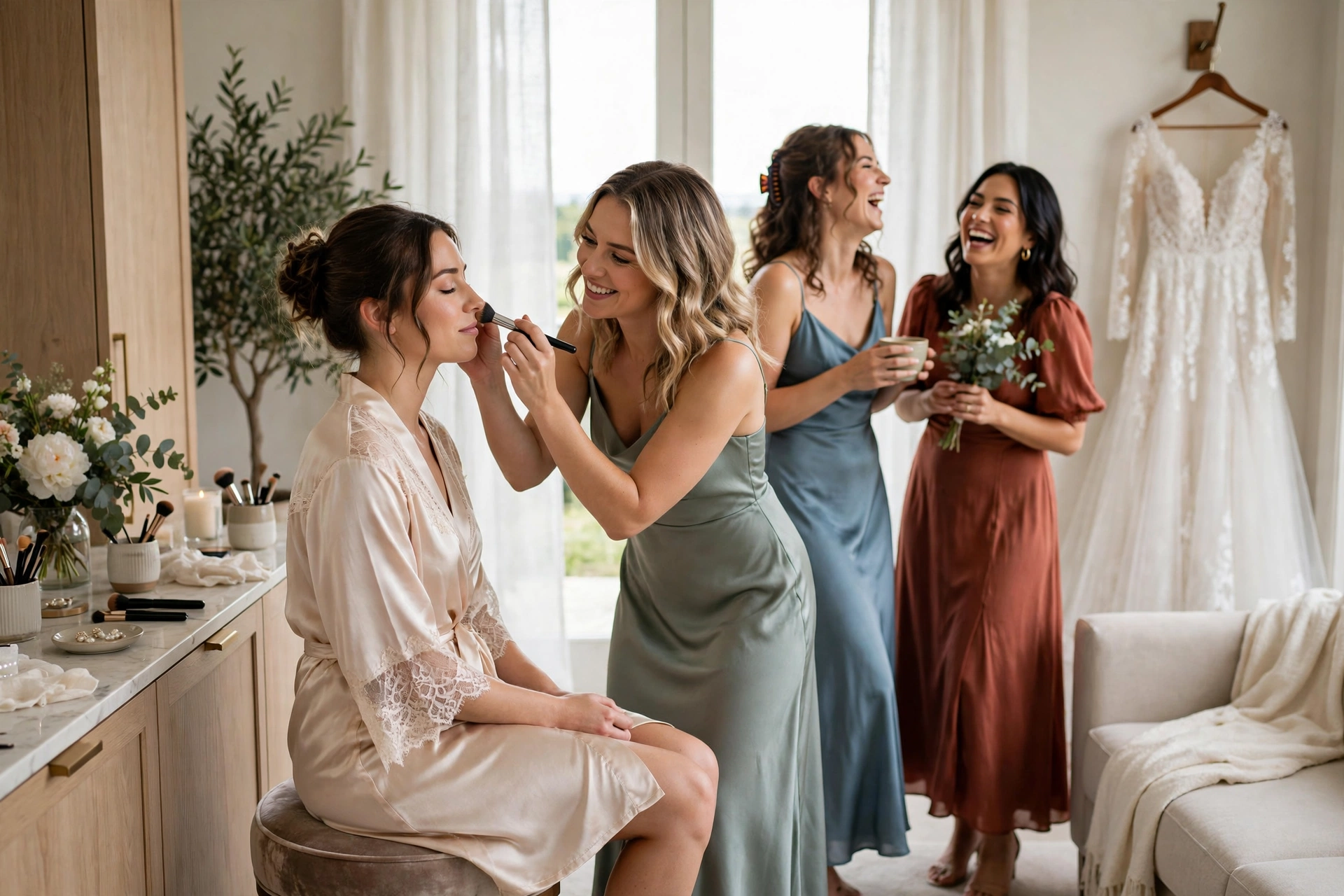
The makeup artist’s brush mid-stroke, the bride’s serene expression. Lighting/framing: close crop on the face; the makeup mirror’s ring light actually helps here. Ask the artist to pause for 30 seconds for a clean frame.
12. The Robe Group Shot
Bridesmaids in matching robes, champagne in hand, laughing. Lighting/framing: arrange loosely, not in a line; shoot when laughter is genuine. Take this early — robes come off and the moment passes.
13. Stepping Into the Dress
The bride stepping into her gown, helpers holding it. Lighting/framing: photographer shoots from a respectful distance with a longer lens; the moment is intimate. Clear the room to essentials-only for these frames.
14. The Zipper/Button Moment
A mother’s or maid of honor’s hands fastening the dress — the ceremonial “you’re ready” beat. Lighting/framing: close on the hands; faces soft in background. This is consistently one of the most emotional images of the morning.
15. The First Full-Length Mirror Look
The bride seeing herself complete for the first time. Lighting/framing: capture both her face and the reflection; clear everyone else from the mirror’s view. Give her 60 private seconds — the emotion needs privacy to surface.
16. The Bouquet Pickup
Picking up the bouquet — the final piece. Lighting/framing: hands and flowers in close-up, then a full portrait holding it. The bouquet completes the bridal portrait; photograph the transition.
17. The Veil Placement
The veil being placed or adjusted — a helper’s hands, the fabric floating down. Lighting/framing: backlit for translucency; shoot in burst as the veil settles. Veils catch light like nothing else — position near the window.
18. The Bridal Portrait
The complete bridal portrait — the definitive “she was a bride” image. Lighting/framing: full length, clean background, soft window light from 45 degrees. Take this now, while hair, makeup, and dress are pristine — touch-ups never fully restore the just-finished glow.

The Groom’s Story (19–26)
Groom prep is faster, funnier, and often overlooked — protect these minutes.
19. The Suiting Up
The groom putting on his jacket — the male equivalent of the dress moment. Lighting/framing: a groomsman helps with the jacket; photographer captures the motion. A full-length mirror doubles the composition.
20. The Tie & Cufflinks
Close-ups of the tie knot, cufflinks being fastened — the details of masculine elegance. Lighting/framing: macro or close focus; hands tell the story. If the bride gifted the cufflinks, this frame carries her presence into his morning.
21. The Watch Check
The groom checking his watch — anticipation in a gesture. Lighting/framing: candid; do not stage it. Photographers watch for this authentic beat — it says “it’s almost time” without words.
22. The Groomsmen Toast
The crew raising glasses before heading out. Lighting/framing: low angle, glasses mid-clink, genuine grins. Take it 30 minutes before departure — later, and ties loosen and boutonnieres wilt.
23. The Best Man Moment
A quiet beat between groom and best man — adjusting a boutonniere, a handshake, a laugh. Lighting/framing: documentary style, no direction. These friendship frames are the ones grooms actually print.
24. The Father-Son Beat
Dad helping with the tie or sharing a private word. Lighting/framing: stay back, long lens, no interference. Fathers are often the most emotional and least photographed — prioritize this.
25. The Full Groom Portrait
The definitive groom portrait — confident, complete, calm. Lighting/framing: full length against a clean background; hands in pockets or adjusting cuffs (never dangling). Five minutes, three poses, done.
26. The Departure
The groom and groomsmen heading out — walking, laughing, car doors closing. Lighting/framing: shoot from behind as they walk away; the “heading into it” energy is cinematic. This is the groom story’s closing frame.
The People Who Love You (27–34)
The morning belongs to your inner circle — capture the village that raised this wedding.
27. The Bridesmaids Candid Cluster
Unposed laughter among the bridesmaids — the friendship energy that no formal shot captures. Lighting/framing: photographer blends into the room and shoots continuously; the best frames come between poses. These are the images the bridesmaids themselves will treasure.
28. The Groomsmen Chaos
Groomsmen being groomsmen — the jokes, the wrestling over the tie, the group bravado. Lighting/framing: embrace the mess; documentary style. Do not over-direct — authenticity is the entire point.
29. Mom & Daughter Quiet
A still moment between mother and bride — hands held, foreheads touching, no words needed. Lighting/framing: tight crop, soft light; ask others to give them 2 minutes alone. Mothers consistently name this their favorite photo of the day.
30. Dad’s First Look
Father seeing his daughter as a bride for the first time. Lighting/framing: photographer positions for the father’s face — his reaction is the shot. Coordinate it deliberately; it will not happen well by accident.
31. The Grandparent Portrait
Bride or groom with grandparents — fully dressed, unhurried. Lighting/framing: seat grandparents (comfort first); soft window light. Take this in the morning when everyone is fresh — by the reception, grandparents are tired and the moment is rushed. These portraits become family heirlooms; treat them accordingly.
32. The Flower Girl & Ring Bearer
Little ones in their outfits — usually hilarious, always adorable. Lighting/framing: get low to their eye level; let them play. Have a bridesmaid on standby with snacks — a fed toddler is a photogenic toddler.
33. The Wedding Party Generations
One frame with the couple, parents, and grandparents together — three or four generations. Lighting/framing: arrange by height, grandparents seated center; even, flattering light on every face. This is the photo that hangs in hallways for decades.
34. The “Village” Group
Everyone who helped that morning — glam squad, planner, wedding party — one joyful group shot. Lighting/framing: wide, celebratory, mid-cheer. The people behind the scenes deserve to be in front of the camera once.
Candid Gold: The Unplannable Moments (35–42)
You cannot schedule these — but you can create the conditions for them.
35. The Happy Tears
The first tear — during a letter reading, a parent’s hug, a quiet moment. Lighting/framing: photographer stays alert and silent; long lens, no flash. Waterproof mascara is not vanity — it is photo insurance.
36. The Belly Laugh
The uncontrolled, head-back, tears-streaming laugh. Lighting/framing: burst mode; the peak laugh frame is gold. Someone in the room should be designated fun-bringer — every great morning has one.
37. The Toast to the Bride
Bridesmaids toasting the bride — glasses raised, love declared. Lighting/framing: shoot through the raised glasses for a creative frame; then a clean group shot. Keep it to one toast — mornings run on tight timelines.
38. The Letter Reading
Reading the partner’s letter — the morning’s emotional peak. Lighting/framing: complete privacy plus the photographer; no audience. The vulnerability needs safety to surface. This frame, done right, is the one you will show your children.
39. The Last Look Back
Leaving the getting-ready room — a final glance at the space where the transformation happened. Lighting/framing: shoot from inside as they exit; the doorway frames the shot naturally. A small moment with big nostalgia.
40. The Shoe Switch
Swapping slippers for wedding shoes — the literal step into the day. Lighting/framing: low angle on the feet; it is a charming detail frame. Comfortable backup shoes nearby are not weakness — they are wisdom.
41. The Final Touch-Up
The last lipstick, the final hairpin — readiness as ritual. Lighting/framing: mirror composition; the “almost” state is beautiful. This is the exhale before the entrance.
42. The Deep Breath
Eyes closed, one deep breath, before leaving for the ceremony. Lighting/framing: quiet, close, reverent. Ask the photographer for this explicitly — it is the period at the end of the morning’s sentence, and it centers you for everything that follows.

Morning Light Mastery: A Mini Guide
Wedding morning light is the day’s most forgiving — soft, directional, and free. Here is how to maximize it:
- Claim the brightest room. The getting-ready room should be the one with the most and largest windows — not the biggest room. Light beats square footage for photos.
- Face the window. Hair and makeup chairs should face the window; the artist needs the light, and so does the camera. Backlit subjects (window behind them) create silhouettes — beautiful intentionally, muddy accidentally.
- Sheers are magic. Sheer curtains diffuse harsh direct sun into the soft glow photographers dream about. If the room has heavy drapes, open them and let sheers do the work.
- Turn off overhead lights. Mixed lighting (warm overheads + cool window light) creates unflattering color casts. Windows only, wherever possible.
- White walls bounce light. Position subjects near white or light walls — they act as giant reflectors, filling shadows softly. Dark wood-paneled rooms need the subject closer to the window.
- Watch the clock. Light changes fast in the morning. The dreamy 8 AM glow is harsh by 11 AM. Schedule the most important portraits (bridal portrait, parent moments) in the softer early window.
The Print-and-Go Morning Photo Checklist
Tape this to the getting-ready room door. Check items off as they are captured — it keeps the morning on track without anyone memorizing the full guide.
Details (photographer does first, 30–45 min)
- Invitation suite flat lay
- Dress / suit portrait
- Rings macro (clean them the night before)
- Shoes, jewelry, bouquet, perfume, personal items
Getting Ready (candid + directed, 60–90 min)
- Hair and makeup in progress
- Robe / pajama group shot
- Stepping into the dress / suiting up
- Parent help moments (zipper, tie, boutonniere)
- Letter reading (private — photographer only)
- First full mirror look
People (15–30 min)
- Wedding party candids
- Mom, dad, and grandparent portraits
- Flower girl / ring bearer
- Generations group photo
Finale (15 min)
- The quiet bridal / groom portrait in best light
- Veil placement / final touch-ups
- The deep breath before departure
- Walking out — the morning’s closing frame
Pro move: assign one bridesmaid or groomsman as the checklist keeper. The photographer shoots; the keeper tracks. Nothing gets missed, nobody gets nagged, and the morning keeps its joyful momentum. Couples who use a checklist report feeling significantly calmer — the small thoughtful preparations, like this one, are what separate frantic mornings from magical ones.
Pro Tips for a Perfect Photo Morning
- Prep the room the night before. Clutter is the enemy of morning photos. Box up everything non-essential — chargers, bags, food wrappers — before bed. A 10-minute tidy saves hours of Photoshop.
- Steam everything. Dress, suit, veil, robes — wrinkles photograph as clearly as faces. A handheld steamer ($25) is the best photo investment of the morning.
- Build buffer time. Hair and makeup runs late more often than not. A 30-minute buffer protects photo time — without it, portraits are the first casualty.
- Designate a detail bag. Rings, invitations, jewelry, perfume, shoes — one bag, handed to the photographer on arrival. Hunting for the ring box at 9 AM is a time thief.
- Keep the room calm. Cap the getting-ready room at the wedding party plus one or two extras. Crowds create chaos, and chaos photographs as stress.
- Eat and hydrate. Faint brides and shaky hands ruin more photos than bad light. A real breakfast and water within reach — non-negotiable.
- Think about what lasts. The sentiments that endure in a marriage — gratitude, tenderness, joy — are exactly what morning photos should capture. Tell your photographer which emotions matter most to you.
Mistakes to Avoid
- Choosing the getting-ready room for size, not light. A big dark room photographs worse than a small bright one. Always prioritize windows.
- Letting the timeline slip. Every 15 minutes lost in the morning comes out of portraits or ceremony calm. Assign a timeline guardian with authority to hurry people kindly.
- Forgetting the groom’s coverage. Many photographers default to the bridal suite. Confirm in writing how much groom-prep time is covered — his morning deserves equal care.
- Over-staging candids. “Pretend to laugh” produces the worst photos in the album. Create genuinely fun conditions (good music, good people, champagne) and let candids happen.
- Skipping the details. Without the flat lay, the album has no establishing shots — it starts mid-action. Details are the “once upon a time” of your visual story.
- Not planning for tears. Waterproof everything, tissues within reach, and a bridesmaid assigned to touch-ups. Tears are beautiful; mascara rivers are not.
Frequently Asked Questions
What time should the photographer arrive on the wedding morning?
Typically 2–3 hours before the ceremony — enough for details (30–45 min), getting-ready candids, and dressing moments. Discuss the exact arrival against your hair/makeup schedule; the photographer should arrive as styling nears completion, not at the start when everyone is in pajamas. If in doubt, earlier is always better than later — idle photographer time costs far less than missed moments.
Should we do a first look to get more morning photos?
A first look does not add morning photos — it moves couple portraits earlier, freeing cocktail hour. The real morning-photo advantage of a first look is calm: portraits happen privately, without the post-ceremony rush. If morning light and privacy appeal to you, it is worth considering.
How do we handle photos if we are getting ready in the same space?
Many modern couples prep together — it is intimate and efficient. The photographer captures the shared morning: helping each other dress, joint toasts, combined wedding-party energy. You lose the “first look” surprise but gain authenticity. Just ensure the room is big enough and well-lit for double the people.
What should the wedding party wear for getting-ready photos?
Matching robes, pajama sets, or button-down shirts (which do not mess up hair when removed). Avoid random t-shirts and towels — they date the photos and clash. This is a small investment with outsized visual return; even simple matching shirts transform the gallery.
How do we get good photos in a dark hotel room?
Request the brightest available room when booking — corner rooms and high floors get more light. Open every curtain, turn off yellow overheads, and position key moments (dressing, portraits) directly by the window. A skilled photographer brings supplemental lighting, but window light remains king — even a small window beats a big dark room.
Should we hire a videographer for the morning too?
If budget allows, yes — morning audio (letters being read, toasts, laughter) is irreplaceable, and video captures motion and voice that photos cannot. If you must choose, prioritize photography for the morning and add videography from the ceremony onward. The words spoken that morning deserve to be heard again.
What is the one morning photo we absolutely cannot miss?
The quiet portrait — you, fully ready, in beautiful light, in a moment of stillness. It is the image that anchors the album, the one most likely to be printed large, and the one you will look at when you want to remember how it felt to be on the edge of everything. Protect five minutes for it, no matter how chaotic the morning gets.
How do we include loved ones who cannot be there in morning photos?
Photograph their photo — a framed picture of a late grandparent on the vanity, their jewelry worn that day, or a FaceTime call captured candidly. Many couples also save an empty chair with a flower in the getting-ready room. These quiet tributes photograph with deep dignity. Pairing the image later with meaningful family traditions in your album captions turns a simple photo into a legacy piece.
The Morning Is the Story Before the Story
Every epic has a quiet beginning. Before the vows, before the dance, before the confetti — there is a morning of coffee and nerves, of mothers’ hands and best friends’ laughter, of a dress on a hanger and a deep breath before the door opens. These 42 ideas exist to make sure that beginning is remembered as beautifully as the celebration it launches — every glance, every giggle, every golden sliver of morning light.
Share the timeline with your photographer, prep the room the night before, chase the window light, and then be present for it all. The morning only happens once — photograph it like it matters, because it does. When the day speeds up and the hours blur together, these quiet morning frames will be the ones that slow time back down and let you live it all over again.