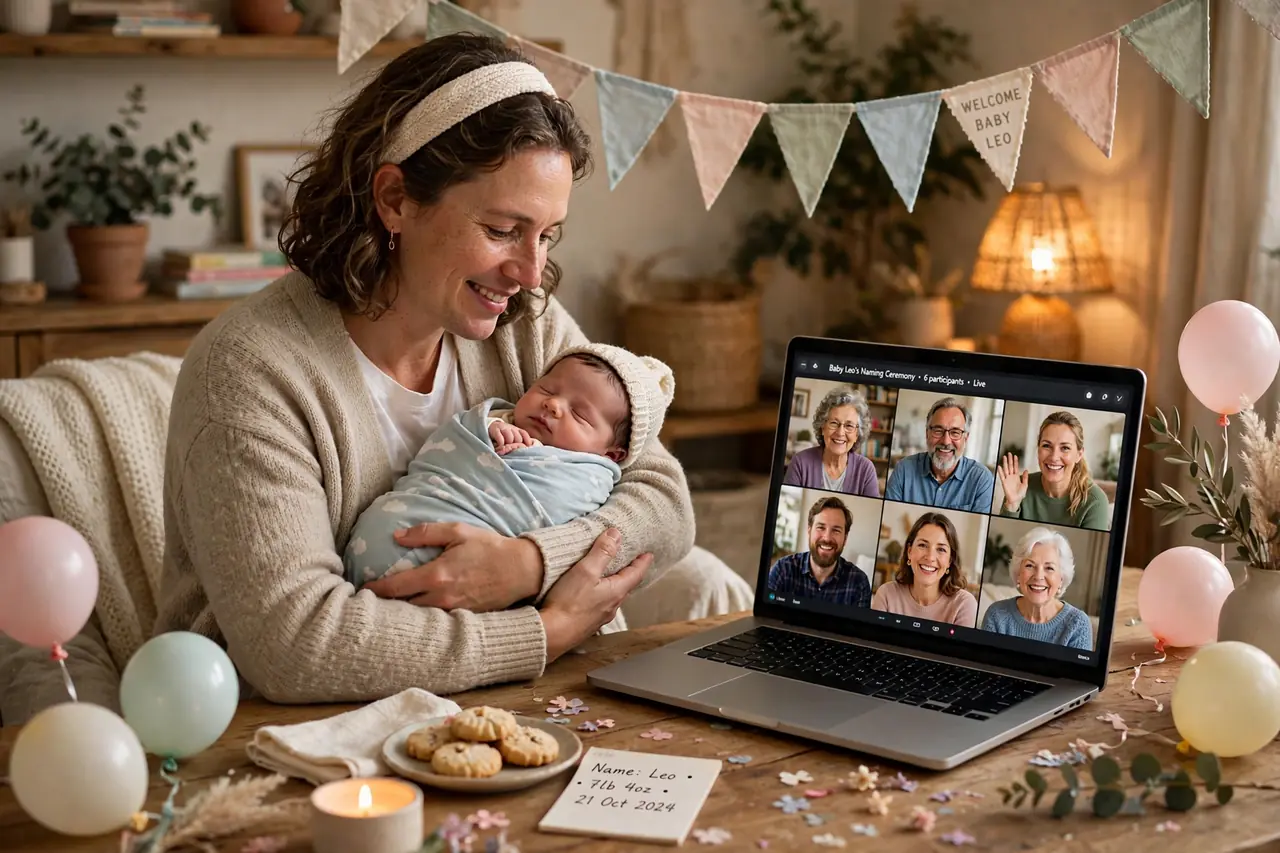
When the people who love your baby live in twelve different time zones, when travel is impossible, when the world has other plans — the naming ceremony doesn’t get cancelled. It goes online. And here’s what thousands of families have discovered since virtual celebrations became mainstream: a well-planned online naming ceremony isn’t a lesser version of the real thing. For far-flung families, it’s often the better version — the only format where everyone who matters can actually be present.
This guide is your complete playbook for a virtual naming ceremony that feels warm, personal, and genuinely moving through a screen: why online ceremonies work better than you’d expect, how to choose the right platform, 20 ideas for setup, engagement, and ritual-by-mail, a host’s run-of-show playbook, troubleshooting for every common tech disaster, and answers to the questions families ask before going virtual. Done right, your baby’s naming day will prove something lovely — that love doesn’t need a venue. It just needs a link.
Why Virtual Can Be Genuinely Wonderful
Let’s address the quiet fear first: that a virtual ceremony will feel flat, awkward, or like a sad substitute. It can — if you treat it as a webcam pointed at a living room. But families who plan virtual ceremonies as virtual ceremonies, designing for the medium rather than apologizing for it, consistently report something surprising: the intimacy of seeing every loved one’s face, close up, reacting in real time.
Think about what a screen does well. It puts grandmother’s tearful smile six inches from your face instead of six rows away. It lets the cousin in Sydney and the aunt in Toronto attend the same event without anyone buying a plane ticket. It gives shy family members — the ones who’d never take a microphone in a hall — a chat box and a mute button, and they participate more, not less. And it creates, automatically, a recording of the entire ceremony that becomes a priceless artifact.
Virtual ceremonies also solve the newborn problem elegantly. The baby can nap until two minutes before showtime, feed during a lull with the camera politely angled away, and melt down without derailing anything — you just mute for a moment. No venue, no catering, no seating chart, no weather. The budget for a beautiful virtual ceremony is essentially the cost of decorations for one room and postage for ritual kits — often under $150 total.
The key mindset shift: you’re not broadcasting an event at remote viewers. You’re hosting a gathering where the room happens to be digital. Every idea below is built on that principle — design for togetherness, and the technology becomes invisible.
Choosing Your Platform
The platform shapes the experience more than any other decision. Here’s how the main options compare for a naming ceremony:
| Platform | Best for | Guest limit (free) | Watch out for |
|---|---|---|---|
| Zoom | Interactive ceremonies with 10–100 guests | 100 guests, 40 min | 40-minute limit on free plan — the paid month is worth it |
| Google Meet | Simple, no-download events | 100 guests, 60 min | Fewer hosting controls; runs in browser |
| YouTube Live (private) | Large audiences, mostly watching | Unlimited viewers | One-way — guests can’t easily participate |
| FaceTime | Tiny gatherings of Apple-only family | 32 participants | Apple devices only; no recording built in |
| WhatsApp video | International family already on WhatsApp | 32 participants | Small screens; best for intimate groups |
For most families, Zoom is the right answer: gallery view lets everyone see each other (which is the whole point), breakout rooms enable small-group mingling after the ceremony, and the host controls — spotlight, mute-all, waiting room — prevent the chaos that sinks virtual events. Buy one month of the paid plan to remove the time limit; it’s the best $15 you’ll spend on the entire celebration. Whatever you choose, send the link twice (invitation + day-before reminder), include a one-tap phone dial-in for the technologically hesitant, and open the “room” 20 minutes early with music playing so early arrivals land somewhere warm.
20 Virtual Naming Ceremony Ideas
Setting the virtual stage
1. Design one beautiful camera corner. You don’t need to decorate a house — just the 6-foot square behind you. A clean wall or curtain, the baby’s name displayed (wooden letters, a banner, a framed print), soft lighting from the front (a window or a ring light), and a plant or flowers for depth. Everything outside the frame can be chaos; nobody will know. Test the shot the day before at the same hour to check the light.
2. Light yourself like you mean it. The single biggest upgrade to any virtual event is lighting: face a window, or place an inexpensive ring light or desk lamp behind the camera, aimed at your faces. Overhead ceiling lights cast ghoulish shadows; front light makes everyone look radiant. This $25 fix does more for the “feel” of your ceremony than any decoration.
3. Dress the frame, not yourselves (much). Wear what you’d wear to a real ceremony from the waist up — the camera rarely sees more — but prioritize the background: it should read “celebration” in one glance. A “welcome to [name]’s naming day” sign, balloons in the ceremony colors, the blessing book on a side table — these visual cues tell remote guests they’ve arrived somewhere special.
4. Appoint a tech host (not you). The single most important role: a tech-savvy friend or relative who admits guests from the waiting room, mutes background noise, spotlights speakers, watches the chat for questions, and troubleshoots — all while you stay fully present with the baby. Brief them on the run-of-show, give them co-host powers, and thank them lavishly. This person makes or breaks the event.

Keeping remote guests engaged
5. The gallery-view welcome. Open with the host spotlighting themselves for the welcome, then switch to gallery view and have every household wave and say hello — going “around the room” the way you would in person. It takes five minutes, and it transforms 40 black rectangles into 40 familiar faces. Ask everyone to rename themselves (“Grandma Rosa — Lisbon”) so the family geography is visible.
6. Chat-box blessings. During the naming moment, invite guests to type blessings in the chat simultaneously — then have the host read a selection aloud. The scrolling cascade of love is viscerally moving, and the chat log becomes a keepsake you can print and bind. For larger groups, this beats going around verbally (which takes forever and loses energy).
7. Breakout room mingling. After the formal ceremony, send guests into randomized breakout rooms of 4–5 for 15 minutes of unstructured catching-up — the virtual equivalent of milling around with drinks. People consistently name this the highlight: it’s where the real conversations happen, the ones a big group call never allows. Reconvene for a final toast, then let people drift off naturally.
8. Pre-recorded video blessings. Ask far-flung loved ones (and anyone nervous about speaking live) to record 30–60 second videos in advance. The tech host plays two or three during the ceremony at planned moments. Pre-recorded pieces never suffer from lag, frozen screens, or mic failures — they’re the reliable emotional heavy artillery of virtual events.
9. The simultaneous toast. Everyone raises whatever they’re drinking — champagne in Chicago, tea in Tokyo — and on the count of three, the whole grid says the baby’s name aloud and drinks. It’s silly, it’s loud, it’s slightly chaotic with audio delays, and it is wonderful. Screenshot the grid mid-toast; it’s the group photo of the virtual age.
10. Live polls and name trivia. Between ceremony segments, run a quick poll: “What does [name] mean?” with multiple-choice answers, or “Guess the baby’s birth weight” for laughs. It takes 90 seconds, wakes up the back rows, and gives the tech host something to do besides muting. Keep it to one or two — this is seasoning, not the meal.
Rituals across the distance
11. The mailed ritual kit. Two weeks before, mail every household a small kit: a candle, a card for writing a blessing, a printed program, and maybe a tea bag with a note (“brew during the ceremony”). When the moment comes, everyone lights their candle simultaneously — dozens of small flames across the grid. The physical object in each home bridges the digital gap; guests consistently say the kit made them feel present rather than merely watching. Budget roughly $5–8 per household including postage.
12. Simultaneous candle lighting. The centerpiece ritual for virtual ceremonies: at the naming moment, every household lights their candle at once while the parents light the baby’s. The host counts down, the grid blooms with light, and someone always cries. Keep lighters or matches in the kit (not everyone owns them), and warn guests to have the candle ready — fumbling kills the moment.
13. The digital blessing book. Share a collaborative document or digital guest-book link where guests write blessings during the ceremony. Project it (screen-share) for a minute so everyone sees the words accumulating in real time. Afterward, export it as a PDF, print it as a booklet, and file it in the baby book — a crowdsourced love letter from across the world.
14. Show-and-tell heirlooms. Invite grandparents and elders to hold up meaningful objects to their cameras and tell their 60-second stories: the christening gown, the grandfather’s pocket watch, the recipe card in a grandmother’s handwriting. The close-up intimacy of video makes this more powerful than it would be across a room — every guest sees the trembling hands and the worn edges.
15. The name reveal countdown. If the name is secret, build the reveal for the medium: a shared screen showing a beautifully designed slide, a 10-second countdown in the chat, then the name appears as everyone gasps at once. The chat explodes — hearts, exclamation marks, all-caps joy — in a way a physical room can’t quite replicate. Screenshot it immediately.
Program flow for the screen
16. Keep the formal ceremony to 20 minutes. Screen attention spans are shorter than in-person ones — plan 20 minutes of formal ceremony maximum, then open the floor. The arc: welcome (3 min), name story (5 min), one reading or video blessing (4 min), the naming ritual (5 min), toast (3 min). Everything else — mingling, extra toasts, performances — happens in the unstructured time after, where it belongs.
17. Rehearse with your speakers. A 15-minute tech rehearsal the day before with anyone speaking or performing prevents 90% of virtual disasters: check their lighting, audio, and framing; confirm they know how to unmute; agree on the handoff order. It also calms nerves — people fear the technology more than the speaking, and familiarity dissolves the fear.
18. Record everything (and say so). Hit record, announce it warmly (“we’re recording so [name] can watch this someday — wave to the future!”), and store the file in two places afterward. The recording becomes one of the family’s most-watched videos — the baby’s first encounter with their own naming day, years later, surrounded by faces some of which may be gone. This alone justifies the virtual format.
19. The after-party link. When the formal event ends, don’t just hang up — drop a second, casual link (“the after-party”) for anyone who wants to linger. The core group that stays — usually 8–12 people — gets the intimate, unhurried conversation that big events never allow. Some families report the after-party, all laughter and baby close-ups, as the truest part of the day.
20. Send a physical memento after. A week later, mail every household a printed photo from the ceremony (the toast screenshot works beautifully), a copy of the program, and a handwritten thank-you. The digital event ends when the call ends; the physical memento extends it into real life and lands on refrigerators across the world — a daily reminder of the day everyone gathered, apart together.
The video above shows a real family celebration held live over video call — watch how the hosts keep energy up, manage the flow between households, and create genuine warmth through the screen. It’s the best possible preview of what your virtual naming ceremony can feel like when it’s hosted with intention.
The Host’s Run-of-Show Playbook
Print this timeline and give it to your tech host. Timings assume a 2:00 p.m. start — adjust to suit the majority of your guests’ time zones (late morning U.S. time often catches both European evening and Asian night owls; there’s no perfect hour, so poll your VIPs).
T-20 min: Tech host opens the room. Music playing (a shared playlist). Early arrivals greeted by name in chat. Parents do final baby prep off-camera.
T-5 min: Host posts the run-of-show in chat. Reminds everyone to mute. Spotlights the ceremony camera. Takes a deep breath.
0:00 — Welcome (3 min): Host welcomes everyone, explains the flow, introduces the parents. Gallery view for the hellos.
0:03 — The name story (5 min): Spotlight on parents. Tell it like you’re telling friends — because you are.
0:08 — Reading or video blessing (4 min): Pre-recorded video plays (reliable) or a live reader (spotlighted, rehearsed).
0:12 — The naming ritual (5 min): Candles ready. Countdown. The name spoken. Chat blessings flow. Screenshot the moment.
0:17 — Toast (3 min): Everyone raises a glass. The baby’s name said aloud by the whole grid. Applause, laughter, happy chaos.
0:20 — Open celebration: Breakout rooms for mingling, or open floor for toasts and stories. Recording can stop here (or keep rolling for the after-party).
0:45 — Graceful close: Host thanks everyone, shares the photo album link and the after-party link. The formal event ends; the lingering begins.

Troubleshooting: Every Common Disaster, Solved
| Problem | Prevention | Live fix |
|---|---|---|
| Guest can’t join / link fails | Send link twice; include phone dial-in | Tech host texts them the dial-in number directly |
| Someone’s audio echoes | Rehearsal; “one device per room” rule | Host mutes them; message: “mute your second device” |
| Speaker freezes mid-reading | Ask speakers to pre-record as backup | Play the backup video seamlessly; nobody minds |
| Background chaos (dogs, kids) | Ask guests to join from a quiet spot | Smile and carry on — it’s charming, not ruined |
| Baby melts down on camera | Schedule around nap; feed beforehand | Angle camera away briefly; the show continues |
| Time-zone confusion | State times in 3 zones on the invite | Record everything; latecomers watch the replay |
| Dead air / awkward pauses | Tight run-of-show; host narrates transitions | Host fills with a question or a pre-recorded piece |
The meta-rule: every problem has a boring, practical solution, and the tech host’s job is to apply it invisibly while the parents stay radiant. Nothing in this table should ever reach the parents’ awareness during the event — that’s what the host is for.
Virtual Ceremony Etiquette: A Note for Guests
If you’re attending a virtual naming ceremony as a guest, a few small courtesies make an enormous difference to the family hosting. First, join on time — the ceremony is short, and slipping in late means missing the naming moment itself. Join 10 minutes early, say hello in the chat, and settle in.
Keep yourself muted unless you’re speaking, and remember that your camera shows more than you think — tidy the visible background, or use a subtle virtual background if your space is chaotic. Keep your video on during the ceremony itself: a grid of faces is the whole emotional point, and black rectangles feel like empty chairs to the parents.
Participate visibly. React with expressions, use the chat for blessings, hold up your candle at the right moment. The family can’t feel your presence the way they would in a room, so your visible engagement is your presence. And afterward, send a message — a text, a card, a photo of you watching — telling them what the ceremony meant to you. Hosts remember who showed up with their whole heart, even through a screen.
Finally, don’t multitask visibly. We all know the temptation, but twenty minutes of undivided attention is a genuine gift to new parents. Close the other tabs, put the phone down, and be there. It’s the smallest thing, and it matters more than you know.
Frequently Asked Questions
How do we choose a time across time zones?
Poll your must-have guests (grandparents, godparents) for their availability windows, then pick the slot that includes the most VIPs — typically late morning or early afternoon U.S. time, which lands as evening in Europe and late night in Asia. Accept that someone will be up late or early; that’s the nature of global family. Record the ceremony so anyone who can’t make it live still experiences it fully.
What if elderly relatives struggle with the technology?
This is the most common worry and the most solvable. A week before, do a 10-minute practice call with each hesitant guest: walk them through joining, muting, and gallery view. Recruit a “tech buddy” — a younger relative in the same household or a phone call away during the event. And always provide a phone dial-in option: joining by ordinary phone call requires zero technical skill and still lets them hear everything and speak.
Should we dress up for a virtual ceremony?
Yes — at least from the waist up, and encourage guests to do the same. Dressing up signals that this is an occasion, not a meeting, and it transforms the screenshots from “video call” to “celebration.” Mention it on the invitation with warmth: “Festive attire encouraged (at least where the camera can see!).” The baby, of course, should be in their full naming-day outfit.
How do we handle gifts for a virtual ceremony?
The cleanest approach: “Your presence is the present — no gifts, please.” If guests insist (grandparents will), suggest a book with an inscription mailed to the baby, or a contribution to an education fund. Never open gifts on camera — it turns the ceremony into a performance and makes non-givers uncomfortable. Thank givers privately afterward.
Can we combine virtual and in-person guests?
Yes — the hybrid ceremony is increasingly popular: a small in-person gathering with a laptop “at the table” for remote family. The keys: a dedicated camera position with a good view (not a phone propped on a stack of books), a separate microphone near the speakers so remote guests can hear, and a tech host managing the online side while someone else manages the room. Test the audio both ways in rehearsal — remote guests hearing the room is the part most often neglected.
How do we make it feel special and not like a work meeting?
Ritual, beauty, and intention are the difference. Open with music (not silence), decorate the camera frame, use the ritual kit so everyone has a physical object, keep the program tight and emotional, and close with a real toast. Ban the phrases “you’re on mute” energy by having the tech host handle all logistics invisibly. When every detail says “celebration,” nobody thinks “meeting.”
What about privacy and recording?
Announce recording at the start and get implicit consent (“we’re recording for the baby book — let us know if you’d rather be off-camera for any part”). Use a private, unlisted link — never a public livestream — and don’t post the recording publicly without checking with guests. Screenshots shared on social media should respect anyone who asked to stay private. A little care here prevents all awkwardness later.
Is a virtual ceremony appropriate for a religious naming?
Many clergy now accommodate remote participation, especially for the celebratory portions — though sacraments themselves (like baptism with water) generally require physical presence. Talk to your officiant early: common arrangements include a small in-person sacramental rite with immediate family, followed by a larger virtual celebration where the naming is announced and blessed. Most traditions have found graceful ways to honor both the sacrament and the scattered family.
Apart Together, Naming as One
A virtual naming ceremony asks you to believe something radical: that presence is not the same as proximity. That a grandmother’s tears in Lisbon, a godfather’s toast in Toronto, and a cousin’s laughter in Sydney can gather around a baby in a living room in Ohio and make a ceremony as real as any held under one roof. Families who’ve done it will tell you it’s true — the grid of faces, the simultaneous candles, the chat full of blessings — it works. It really works.
So send the kits, test the lighting, brief your tech host, and then let go and be present. Years from now, your child will watch the recording and see something remarkable: dozens of people, scattered across the planet, stopping their lives at the same moment to say one small human’s name with love. Distance meant nothing. Love meant everything. And that is a ceremony worth having, in any medium, on any continent. For more ways to celebrate your growing family, explore our Baby & Children celebrations, ideas for new parents, and practical tips for traveling with your baby when you’re ready to gather in person.